Share Your Development Plan Out Loud.

Working out loud can accelerate development. Share your Development plan with your team. They know your weaknesses already and they are in a great position to coach and support your learning.

When I worked in corporate life, I always managed to shock a few of my colleagues, both peers, team members and others, by sharing my development plan openly with them. My thinking was pretty simple. The benefits of sharing the plan were real.

My colleagues work with me every day. They know my strengths and weaknesses, usually better than I do. They are a great source of coaching and feedback. Sharing my plans with them authorised them to say “hey, Simon, you are doing that thing on your plan”

Acknowledging that I am trying to develop and sharing how was a great way to gain their trust and their support in the changes I was seeking to make. People valued the honesty and the effort to improve. People that I mentored valued the insight into how I put together my plan and where my efforts went. People went out of their way to give me suggestions and to work with me when their development needs were aligned. Peers and my teams also held me to account to do what I had openly committed to achieving. Most importantly, I was publicly role modelling what I asked them to do each day.

In addition, being explicit on when I was hoping to move roles and where I was hoping to go next helped the team around me to understand how they needed to develop and what opportunities that they might have ahead. Instead of succession planning being a mystery, it could be an open conversation in the team. 

Take your development plan. Remove anything that is truly confidential or relates to others. Then share it will your colleagues. Get ready for some great conversations to help you and your peers grow.

Reflections on Facebook at Work (& Promises of Universal Adoption)

image

One core reasons collaboration tools have an adoption problem is a lack of benefits to users. That problem is not solved by a new tool. The benefit problem is solved by working out loud purposefully – creating an environment to learn, solve problems and create new solutions together.

The reviews of Facebook at Work are starting to come in. The claims from Facebook are intriguing: no community management required, no need to worry about adoption (after all its Facebook – your users are using it already) and so on. Does a new solution like this solve all the issues with collaboration at work?

Universal Adoption Isn’t Enough

We have had similar promises before of universal adoption before. Many existing IT systems providers were convinced that collaboration was a layer or feature that they could add to their applications. After all, they had adoption and use of their system, so the collaboration would naturally work in their system, particularly if they forced it into the existing processes. These systems have largely failed to deliver on expectations because the basics of value are not met. People don’t expect to connect with others or to share their work while working on processes in ERPs or other IT systems. Usually people collaborate to avoid the restrictions of these process driven systems or to achieve better outcomes than they can get from the system. Forcing in additional messages and conversations brought greater burden and more noise than user benefit.

Facebook begins as a dominant personal social tool so it starts in a much stronger position for adoption. For Facebook users, it is already platform to connect and share with others. Many sophisticated users already work there, marketing themselves and their businesses and engaging communities through Facebook pages and groups. Carrie Basham-Young has reviewed how easy Facebook has made it in Facebook at Work for people to Connect and to Share. We might wonder how the separate Facebook at Work profile will compete with the personal profiles for time and attention. Many users will already be connected and sharing social updates with work colleagues through a personal profile. Even so, Facebook will undoubtedly be able to capture a large share of the corporate graph and its watercooler conversations.

Sharing Isn’t Enough

Velux recently shared some insight into their adoption of social collaboration. A key insight of that case study was that sharing social status updates alone is not enough to create value. They needed to solve problems and create new value together. They need to move beyond what they saw as the pattern of ‘working out loud in Twitter’ to a more purposeful form of work asking questions to solve problems and connecting around key projects and activities. Like all social collaboration tools, Facebook at Work will need to help organisations navigate this transition and its history may be its disadvantage in this regard.

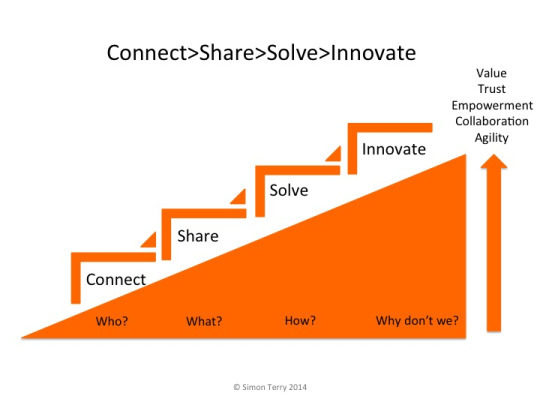
The Solve and Innovate steps of the Value Maturity Model of Collaboration will be where users see novel benefit and what keeps ensuring that they devote time and effort to using the new tool. Facebook at Work has clearly taken this into account with its focus on categorising groups into Teams and Projects, Open Discussions, Announcements and Social. However, if the traditional Facebook patterns of behaviours of social announcements and other forms of social sharing dominate, Facebook at Work will have not advanced the collaboration in the organisation, they will have simply extended Facebook use deeper into office hours. What if the patterns of Facebook use prove harder to change than our work email practices?

 Purposeful Working Out Loud Required

Working out loud requires people to consider the purpose & effect of their sharing. John Stepper’s discussion of the 5 elements of working out loud makes this explicit. Working out loud only makes sense when it makes work better for you and for others through learning, winning or giving help, making a new connection or other ways of solving every day work challenges. 

All forms of social collaboration, no matter how smart the technology, require individual users and the organisations involved to solve the challenge of creating connections based on purposeful working out loud. Slack another adoption success story is now being queried for the value of the conversations it creates. Slack’s solution is often suggested to be in its integrations but these can be complex to navigate and even discover for a new user dealing with a high volume chat channel.

Creating value for users and organisations is what will ensure that we change the long entrenched practices in way we work and we will consistently value new approaches to collaboration. Organisations need to invest in change support and community management to achieve an ongoing uplift in the value of collaboration. Facebook at Work is unlikely to magic this away any time soon because the context of value creation in each organisation and for each employee is different. The organisation needs to use new methods of working and collaborating to create its own approach to success. This is why customer success processes at other collaboration vendors have been notoriously resistant to being reduced to an algorithm. 

Not Quite Digital

You lost customers over your service migration. 

The fax machine is always busy. 

The CEO prints emails. 

Internet access requires a paper form. 

All of the product information on your site is available in easily downloadable pdf. 

Your digital consultant has 39 followers. 

Your digital strategy is 150 pages of PowerPoint in a binder on a shelf in the archive. 

Everyone is too busy preparing for performance reviews to collaborate.

Everyone wants to know the ROI. 

Your office isn’t visible on Google Maps. 

You routinely save documents to USB drives because of the capacity limits on your desktop and server drives.

It takes 90 days to get through the approval process to deploy in a release window.

The Transformation project has produced more video than code. 

Design thinking happens in the creative department. 

Investment committee meetings go for 3 days. 

The head of product always tells a story about the launch of the iPod. 

Only the complaints department sees customer feedback and they are too busy to share it. 

You had an API but shut it down because people were using it. 

Your mobile strategy is to migrate to SMS because WAP adoption has been disappointing. 

The coffee table book in your foyer celebrates your centenary, 25 years ago.

The only scrum occurs when the fruit basket is delivered each week. 

Your app has a manual. 

Your big data strategy begins with some offshoring of data entry. 

You have multiple single sign-ons. 

Everybody in the leadership team has visited Silicon Valley (at least once).

End-to-end processes is a vision. 

Calls to your call centre are directly correlated to communications you send your customers. 

The whiteboard in your head of transformation’s team area says ‘do not erase’ 

It has only a drawing of a cloud on it 

Change is what you get from the vending machine

And you just sent an analyst out to buy sticky notes.

Working out loud on Career Transition

I throw a spear into the darkness. That is intuition. Then I must send an army into the darkness to find the spear. That is intellect. – Ingmar Bergman

Working out loud on your intuitions is critical to success of career transition. So is bringing your network to bear as an army of hunters and collaborators to help make the new role a success.

A bunch of friends, collaborators, and inspirational leaders were made redundant yesterday. At the end of a day of reaching out to offer help, I came across the quote above from Ingmar Bergman and it reminded me of each of my past career transitions. Enforced change is daunting and can be a time of doubts and confusion. We can be deeply unsure of what comes next.

When career change takes us by surprise we usually never quite know what we want next. We are deep in the realm of doubts and hopes. We need to trust our intuition as a signal of personal purpose. We need to throw some experimental spears. Working out loud is a great way to test the waters, refine your hopes and draw opportunities. Throw a few spears and see what happens.

However working out loud is just the beginning. The next challenge is to send out an army to help you find the next role, project or help you start the next business. There’s too much for one individual to do alone. Networks are the most powerful way to search for, find or even create the new role. Combinations of strong and weak ties will make things happen that you could never expect. Working out loud can make the network aware. You will need to work the network ongoing with all your intellect to turn ideas into opportunities to fulfil your purpose.

My friends are well placed for success in this game. They are highly talented and know how to work like a network. They have global networks. They have authority on the difficult challenges in change and adoption in the future of work. They are trusted experts and partners. They are ideally placed to leverage the wirearchy to their next success. The opportunity now is to work out loud and connect, share, solve and innovate with those who admire them.

For all of us who are pondering our next move, how are you leveraging working out loud and calling on the power of your networks? How are you helping others find their next horizon?

Your Purpose in a Network

“All the value that we create is delivered for others and negotiated with others. We cannot escape the networks in our work. We are not an island widget producing output in a process. We are humans tackling increasingly complicated problems in webs of relationships that stretch through our organizations and out to the network where our purposes have their effects.”

We can’t escape networks as individuals and as organisations. We are embedded in a wirearchy that is far more powerful than we are aware. When avoidance is no longer a strategy we must engage. What is the purpose of your work and leadership in the networks around you?

There is no Island

Let’s say you were a traditionalist manager and you saw social communication as a distraction from the perfect order of your process driven life and neatly structured hierarchical silos. You can ban any form of networking in your organisation. You can ensure that employees never get together physically across the boundaries of teams. You can turn your organisation into closed cells in the name of efficiency. You can replace employees with robots to make the more compliant.

Except:

  • You still have customers and they are organised into networks that reach around into your organisation
  • Your competitors are leveraging networks to reach new customers, to learn, to solve challenges and to create new innovations
  • Your suppliers are using networks that involve your employees and customers to understand how best to create value too
  • Your employees still have phones & internet connections, friends (some of whom are customers), connections in the real world that may want to influence your organisation or even their own thoughts on what your organisation should be doing from their external community activity.
  • Even your robots will be networked in an era of the internet of things

Even if you wanted to ignore the network and focus solely on the performance of a hierarchical process driven organisation, you no longer can. The network has subverted the hierarchy.  The networks have always been there disrupting your efforts at perfection. They are just more visible and more capable than ever. Your employees, competitors, suppliers, customers and community have always been networked into groups large and small by human interaction. Now those conversations are global, mobile, persistent, transparent and real time.

Purpose in a Network

Welcome to the wirearchy. It doesn’t replace the hierarchy. It works with it, shaping your actions and the actions of others in your organisation with its ‘dynamic two way flow of information, trust and authority’. 

The wirearchy challenges you to consider your purpose. Your purpose guides how your actions reach out into the networks around you and have an effect on others.  That effect on others is what determines the information you receive, the authority you are given and the trust you earn. Improving these things takes work. It cannot be delivered by management fiat or a great personal or corporate brand campaign in the era of networks.

In a wirearchy, we each have the opportunity to improve our information, authority and trust. We each have the opportunity to lead. Unlike traditional management this is an opportunity, not a requirement. Fail to use it when required and the network will route around you taking away your hard won gains. The network doesn’t require your participation; it simply values it.

The Purpose is in the Work

The purpose is in the work. You won’t find it in a job, a manager’s opinion or in a book. Choose the work that you like to do and go have an impact in your networks doing that. Your role in the wirearchy will be surfaced by action. You will also get a better sense of the value that you create for others, helping you to better appreciate your performance in the network. 

The simplest purposeful actions that each of us can take are those that create value for others in our networks:

  • Connect People: Help others find their path & communities in the network
  • Share our Work and our Passions: work out loud on the activities going on in your life to let others learn and help
  • Solve Challenges with and for others to share your expertise, experience and capabilities
  • Innovate and Experiment to create new value together

Start where you feel comfortable. Start where you feel you can make a difference. Your networks and your purpose will guide your leadership work from there.

Manage Your Performance (in A Network)

“Keep away from people who try to belittle your ambitions. Small people always do that, but the really great make you feel that you, too, can become great.” – Mark Twain

Organisations are moving away from traditional performance management. Expensive managers are being removed from organisations as they explore ways to be flatter and more responsive. More people are working freelance. 

Managing your own performance is more important than ever. However, managing your own performance involves real challenges both in terms of personal and network value.

A Story of Doubt

Late in 2015 I lost my way. 2015 was a good year measured on my set of measures and most objective measures. I was busy on work that mattered to me and my clients. The work was purposeful, rewarding and recognised so by clients and others. However as the year came to an end after a few needed weeks of rest, I found myself doubting my performance and my momentum into 2016. With distance from my work, I wasn’t sure how well I was actually going to do in the new year.

Quite late in December I found out I was being considered for a Microsoft Most Valuable Professional award to be announced on 1 January. Until this occurred, I wasn’t even aware the award existed. In a matter of days, winning an award had become an important external benchmark to how I saw my performance. This need was an emotional, not a rational process. I slept terribly on the night of the 1 of January (due to timezones the award was announced early 2 January in Australia) and awoke to find no email from Microsoft. I was disappointed and resigned to the outcome as confirmation of my doubts. Dejected, I began reading the comments of winners on social media and congratulating those I know who had won. An hour later discovered an email in my junk mail and I realised a great insight into my personal limits of performance management.

Performance is Personal

Performance management is a personal process that happens between our ears, not on paper. We have already made the personal investment of our time and our efforts when the evaluation begins. We pretend it is rational and objective but we know that we are human with doubts, ego & emotions to manage. The SCARF model from David Rock highlights many ways that performance management can go wrong, by violating our sense of status, certainty, autonomy, relatedness or fairness. Anyone who has been through a corporate performance management process knows that an external opaque process of evaluation of feedback can trigger all sorts of reactions. What looks simple on paper rarely works that way in real human conversations.

Moving from performance management once a year by others to continuous self-management makes the process no easier and far more personal. The movement from an external accountability to a personal responsibility improves autonomy and can reduce relationship stress but it still leaves challenges and removes many external benchmarks. It also creates hard new responsibilities to fairly assess ourselves relative to others. We still have the same doubts and challenges but in many cases we can now struggle to accurately and consistently measure the true value of our work.

Valuing Yourself Accurately

In the era of self-management, workers need the capability to accurately value their work and their performance. From pricing your work, to negotiating your responsibilities, to managing the performance and reward process are all founded on the ability to accurately value your work and be able to communicate this value to others. New ways of working give us new processes to manage performance but fundamentally these processes still rely on our ability to accurately assess our own value and to negotiate that with others. 

When I lost confidence in my own measures of success, I found myself outsourcing these to a partial external event of benchmarking. That made little sense as a process of evaluation. There was only some overlap between the award criteria and how I deliver value to my clients and what I value. The most valuable part of the process was it was a partial measure of reputation in one community (see below). The process was more akin to grasping for a lifeline than genuinely seeking to understand how much value I had created.

This demand for accuracy in valuation challenges us all to tackle the reality of our performance in new ways. Traditionally we both under and over estimate different elements of our performance. Many traditional self-assessment process take advantage of this using benchmarks to knock off our over assessments but leaving our undervaluations. Just like my experience, they work as partial measures of the value we create, over reliant on benchmarks and competitive assessment on narrow criteria. 

Managing our responsibility to be accurate demands we test our self-perceptions continuously, focus on creating greater value and shake those crises of self-confidence that hold us back. We need to genuinely learn from failures and not reposition or hide them. We need to overcome our triggers to hold a true growth mindset. We need to become our own performance leaders, helping ourselves to become as great as we can be.

We also need to start to value ourselves far more as players in a complex system rather than a widget in a mechanistic process. 

Your Value in a Network

The most underutilized resource still waiting for discovery may be our ability to cooperate much more deeply than the systems of work have so far envisioned. – Esko Kilpi

All the value that we create is delivered for others and negotiated with others. We cannot escape the networks in our work. We are not an island widget producing output in a process. We are humans tackling increasingly complicated problems in webs of relationships that stretch through our organisations and out to the networks where our purposes have their effects.

Creating this network value is the key challenge and as Esko Kilpi highlights in the article above this depends more on cooperation and collaboration than competitive mindsets. Most performance management is competitive, dividing a scarce pool as an incentive. Network performance management is abundant, encouraging collaboration and cooperation to create new innovative value for individuals and for the stakeholders who benefit from the organisations purpose. Network performance management starts to bring us back to elements very similar to those of the SCARF model directly:

  • How we gain status (in the form of authority, reputation & influence) in our networks
  • How we react to and embrace uncertainty as a source of value creation through learning and experimentation
  • How we manage our autonomy and translate our opportunities for personal agency into value creation and fulfil our purpose
  • The breadth and depth of our relationships through our ability to broker connection, coordinate activity and access necessary information and capabilities
  • The fairness of our network exchanges in terms of reciprocity and mutual value creation.

Leadership in networks is a critical capability for all of us in the future of work. As Harold Jarche has noted, this kind of leadership is less controllable than traditional management, which presents its own issues for the management of collaboration. Leadership matters because it is the critical element to creating and sustaining value creation in networks as Dion Hinchcliffe has eloquently explained.

Managing performance in networks requires us to focus on both the need for new accuracy in our personal assessments and leadership of collective aspects of the abundant opportunities for greater performance through collaboration & cooperation. Individually and collectively we will need new measures, new confidence and to learn as we go on better ways to work.
Sell Aggression. Buy Relationships

image

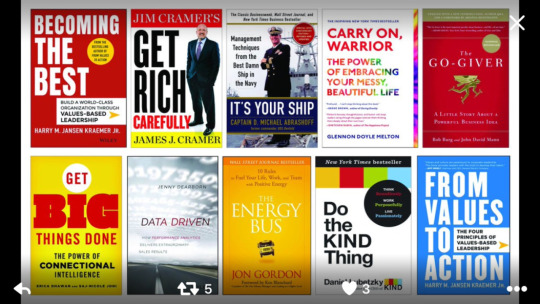
I saw a list shared on twitter of 25 books for CEOs from 2015. The above image was attached to the tweet. I reacted immediately to the macho impression of the attached image of the covers. Then I looked more closely and realised many of the subtitles run contrary to the general image of the cover. These books look like the typical aggressive competitive advice for CEOs to outcompete, outperform and to go big. However, the actual advice within the aggressive red or yellow cover is far more nuanced. Human relationships matter.

Sell Aggression

This is an old game. Strong leadership sells. We sell aggression. Alpha males rule the chimp pack. Wear red and yellow. Stand in a power pose. Be the best. Be simple. Know the right answer. Do one thing better than anyone else on earth and rule the whole damn thing.

Except this is the cheap shot. Aggression primes our primate brain and gets our attention. Aggression makes us pick up the book. Aggression isn’t what makes change happen and isn’t what delivers results. Aggression is the empty wind of a loud shouting exploitative push economy. Aggression is the bait in a leadership bait and switch.

Buy Relationships

Any successful leader knows that relationships is where the real work gets done. Collaboration and cooperation drive progress, not force. Nothing gets done alone. You don’t want anything done by the coerced. You want commitment not compliance.

Humanity triumphs again and again against the forces of power. Force an outcome and passive resistance will undermine its effectiveness. Bureaucracy rules. For every blustery threat, the real deal gets done in a quiet conversation as power is traded for persuasion.

Win commitment and you will see people’s capabilities blossom. The messy beautiful work of leveraging the capabilities of people happens in rich, complex and unpredictable networks of oh so human relationships. That far less saleable work, but it is the work of value. Relationships are where leaders seal the deal when they switch away from the bait of aggression.

Portfolio for the Future of Work

As our economies become more connected, faster and more complicated, these human relationships will only increase in value. Relationships bring information, trust & authority, critical differentiators, cost-lowering capabilities and fundamental elements of effectiveness.

The portfolio strategy for leaders in the future of work is to be long relationships. Those relationships will make your work far richer and more human. Buy now.

Leadership is a gift given and received

You aren’t invited to lead because of what it will do for you. You aren’t invited to lead because of what you have done. You aren’t invited to lead because of your role.

People follow because of the value you create for & with others. Leaders help people build shared purpose, vision and understanding, create new capabilities and find paths to action. The action generated from leadership helps people to create new value together.

Anyone who works to help others create value can lead. Give the gift of your talents at this collaborative work and others will recognise your actions with the gift of leadership.