The Internet of Humanity

An extraordinary technological opportunity confronts your business. Global communication networks have unprecedented reach and mobility. These networks can connect highly capable autonomous intelligent agents called humans. The potential of this technology could change your business, and even human society, in disruptive ways. 

Even more incredible the capabilities of these intelligent agents are not fixed. Equipped with a full range of sensors, motion and agile communication capabilities they are highly adaptive. They have been known to survive all environments on this planet and even near space. They learn from each other and can even collaborate without APIs to decide novel approaches to the challenges & opportunities in their environment. These agents are self-powering, purpose driven, upgrade automatically and operate entirely autonomously. 

Imagine the ability to discover, to explore and to make sense of the entire globe. Imagine the opportunities in global advocacy, creativity and collaboration. Imagine what your business could do if it connected humans. Just think of the novel products, the extraordinary experiences and the economic and social value you could create with the Internet of humans. 

We have the ability to leverage an Internet of humanity. We just need to better understand how they work.

Working Out Loud & Building Antifragility

For the robust, an error is information; for the fragile an error is an error. – Nassim Nicholas Taleb.

Many people struggle with the risks & discomfort of working out loud. Nassim Nicholas Taleb’s concept of Anti-Fragility helps understand when to work our loud.

Taleb distinguishes between three adjectives of in his work:

  • fragile: at best unharmed by a shock 
  • robust: at best and at worst unharmed a shock, i.e. unchanged 
  • anti-fragile: at worst unharmed by a shock and with potential to be improved.

These ideas is a useful way to shape the practice of working out loud.

When to Work Out Loud 

If a situation is likely to be fragile, for example because you can’t handle feedback or the situation requires a single answer, think carefully about working out loud or at least work out loud and mitigate the risks. Working out loud on a performance management conversation or feedback for another is a situation that is likely to be fragile. The relationship and performance could be jeopardised with any shocks or simply from a sense of lack of fairness in the transparency.

In situations where you are robust or anti-fragile, working out loud is essential.  There is no downside and at worst information and at best opportunities to improve your work. Complex or chaotic scenarios in the Cynefin framework are examples of situations likely to demonstrate these characteristics as working out loud can play into an effective strategy of probe-sense-respond or act-sense-respond. 

Becoming Anti-fragile

One of the strong reasons that I recommend people experiment with working out loud, such as in the safe environment of a working out loud circle, is that practice builds towards an anti-fragile state of work. Many of the initial concerns from working out loud come from concerns around emotional states, perceptions and ‘doing it wrong’. So many people complicate the simple act of sharing purposefully and openly.

Many of these concerns are overblown and contribute to our fragility at work. Practice of working out loud in simple experiments of sharing across diverse contexts can help individuals to see that they and their relationships are far more robust than they expect. They and their relationships can be deepened by the better information, shared context and trust created by working out loud.  The many benefits of working out loud can push them to greater practice as they realise the benefits of learning continuously.

The Life-crushing Magic of Hierarchy

Humans are inherently messy creatures. We accumulate history and the entanglements of human relationships and emotions. As a manager this human mess can interfere with the joy of the unrelenting execution of your will. A cluttered organisation shows no respect to a manager’s inherent expertise and power. 

My life as a manager was transformed when I discovered the life-crushing magic of hierarchy. Your life and organisation can be neat and orderly, if you follow these simple organisational principles. 

Touch Everything

Firstly you must understand the principle behind all hierarchical organisation. A manager must constantly touch everything. Dump all your expectations about independent action by your team on the floor. Subject everything to your hands-on micromanagement power. 

You must feel free to touch any activity in the organisation at any time, throw it into a disordered pile and then use your superior management skills to put things back into the places that best suit you. Do this until your organisation shines with respect for your management skill. 

Kill Joy

Look at any activity if it sparks joy in your employees, discard it from your organisation. You have the power to exclude these activities that divert from the joy of experiencing unfettered authority. Crush the activities and discard any employees associated with them. The more meaningless the work the better it will demonstrate your management expertise. If too much meaning arises in work, intervene and make changes or better yet reorganise again.

Process not People

When organising your business it is traditional to be concerned with individual business units, alignment to customer or business outcomes and the people involved. Put aside this nostalgia. 

Focus instead on process. Ask yourself only whether the process brings you joy and crushes the freedom of your people. Make sure your processes are inflexible, opaque, compliance-oriented, end-to-end and untouched by nostalgic human considerations. The more abstract the outcomes that your processes create the better. 

Organise your business one process at a time and follow each process to the end before proceeding on to the next until you have completed your arrangements process by process. This may increase the mess and confusion in the meantime but you will find an organisation that is far easier to control and manage in the end.

If at any time you are not getting joy from this process, reorganise your people to make their arrangement more appealing. Over time your people will begin to appreciate the recognition that they get from being dumped into reorganisation. They will shine around you for the fear that next time you may get them. 

Everything in its place

Everything must be in its place before you go to work. Only you will be best able to determine the sweet spot for an employee. Don’t let them create mess by making career choices. Fold them carefully into their small box alongside their peers in the process. Never let your employees feel that they have a place to which they can go home. 

Arrange your remaining employees in tightly segmented silos and narrow process defined roles. It is essential they are visible and accessible to you at all times. You will need the ability to grab them from their important work at a whim and put them back easily at your pleasure. Measure them continuously to keep them aware of their need to maintain your respect and bring you joy.  

When interacting with your employees discard any that show too much spark. Remember to share your unfettered opinion and discard theirs at every opportunity. Finish every interaction with one of your employees by remarking gently ‘Thanks, I’ll take it from here.’

No Stacking

Stacking can crush employees at the bottom and damage their self-respect. This is an activity which should be reserved to bring joy to you. This is why it is so essential that employees are carefully folded into a place in process. Therefore do away with any unnecessary intermediate managers who may have the time to create fiefdoms to challenge your own. Keep the other managers moving quickly to satisfy your directives so that they have no time for their own thoughts, action or joy. Make everyone subject to your direct instruction and make all the decisions with your unique, shifting and often emotional rationales. 

A category of employee that requires particular attention in removing any other forms of leadership are your change agents. They are an unnecessary source of independence and activity. You will find no spark of joy in your dealings with them. Instead they may even challenge your authority or make unnecessary suggestions. Implement an enterprise social network in your organisation. This will enable you to identify those employees who still hold opinions and may act on their own outside of your chosen process. Gather your change agents. Hug them and thank them for their service. Then bundle them out the door

Follow these principles closely and your hierarchy will be neat, tidy and much smaller. Be sure that it will bring you, and you alone, great joy. Other managers will look on your shiny, svelte & compliant organisation with new respect.

Apologies to Marie Kondo. Thank you to those who gave me encouragement, ideas and suggestions for this post. May it spark some much needed joy in your work. If anyone reading is still in any doubt, don’t do this.
Share Your Development Plan Out Loud.

Working out loud can accelerate development. Share your Development plan with your team. They know your weaknesses already and they are in a great position to coach and support your learning.

When I worked in corporate life, I always managed to shock a few of my colleagues, both peers, team members and others, by sharing my development plan openly with them. My thinking was pretty simple. The benefits of sharing the plan were real.

My colleagues work with me every day. They know my strengths and weaknesses, usually better than I do. They are a great source of coaching and feedback. Sharing my plans with them authorised them to say “hey, Simon, you are doing that thing on your plan”

Acknowledging that I am trying to develop and sharing how was a great way to gain their trust and their support in the changes I was seeking to make. People valued the honesty and the effort to improve. People that I mentored valued the insight into how I put together my plan and where my efforts went. People went out of their way to give me suggestions and to work with me when their development needs were aligned. Peers and my teams also held me to account to do what I had openly committed to achieving. Most importantly, I was publicly role modelling what I asked them to do each day.

In addition, being explicit on when I was hoping to move roles and where I was hoping to go next helped the team around me to understand how they needed to develop and what opportunities that they might have ahead. Instead of succession planning being a mystery, it could be an open conversation in the team. 

Take your development plan. Remove anything that is truly confidential or relates to others. Then share it will your colleagues. Get ready for some great conversations to help you and your peers grow.

Reflections on Facebook at Work (& Promises of Universal Adoption)

image

One core reasons collaboration tools have an adoption problem is a lack of benefits to users. That problem is not solved by a new tool. The benefit problem is solved by working out loud purposefully – creating an environment to learn, solve problems and create new solutions together.

The reviews of Facebook at Work are starting to come in. The claims from Facebook are intriguing: no community management required, no need to worry about adoption (after all its Facebook – your users are using it already) and so on. Does a new solution like this solve all the issues with collaboration at work?

Universal Adoption Isn’t Enough

We have had similar promises before of universal adoption before. Many existing IT systems providers were convinced that collaboration was a layer or feature that they could add to their applications. After all, they had adoption and use of their system, so the collaboration would naturally work in their system, particularly if they forced it into the existing processes. These systems have largely failed to deliver on expectations because the basics of value are not met. People don’t expect to connect with others or to share their work while working on processes in ERPs or other IT systems. Usually people collaborate to avoid the restrictions of these process driven systems or to achieve better outcomes than they can get from the system. Forcing in additional messages and conversations brought greater burden and more noise than user benefit.

Facebook begins as a dominant personal social tool so it starts in a much stronger position for adoption. For Facebook users, it is already platform to connect and share with others. Many sophisticated users already work there, marketing themselves and their businesses and engaging communities through Facebook pages and groups. Carrie Basham-Young has reviewed how easy Facebook has made it in Facebook at Work for people to Connect and to Share. We might wonder how the separate Facebook at Work profile will compete with the personal profiles for time and attention. Many users will already be connected and sharing social updates with work colleagues through a personal profile. Even so, Facebook will undoubtedly be able to capture a large share of the corporate graph and its watercooler conversations.

Sharing Isn’t Enough

Velux recently shared some insight into their adoption of social collaboration. A key insight of that case study was that sharing social status updates alone is not enough to create value. They needed to solve problems and create new value together. They need to move beyond what they saw as the pattern of ‘working out loud in Twitter’ to a more purposeful form of work asking questions to solve problems and connecting around key projects and activities. Like all social collaboration tools, Facebook at Work will need to help organisations navigate this transition and its history may be its disadvantage in this regard.

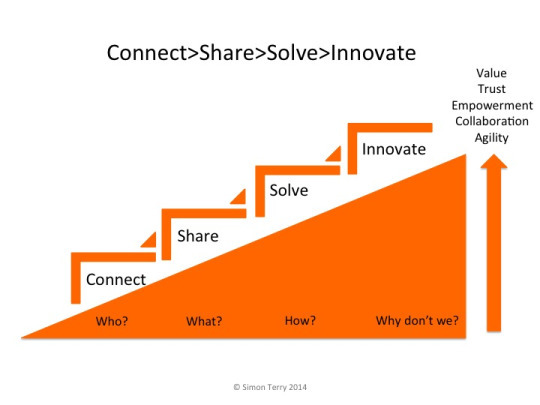
The Solve and Innovate steps of the Value Maturity Model of Collaboration will be where users see novel benefit and what keeps ensuring that they devote time and effort to using the new tool. Facebook at Work has clearly taken this into account with its focus on categorising groups into Teams and Projects, Open Discussions, Announcements and Social. However, if the traditional Facebook patterns of behaviours of social announcements and other forms of social sharing dominate, Facebook at Work will have not advanced the collaboration in the organisation, they will have simply extended Facebook use deeper into office hours. What if the patterns of Facebook use prove harder to change than our work email practices?

 Purposeful Working Out Loud Required

Working out loud requires people to consider the purpose & effect of their sharing. John Stepper’s discussion of the 5 elements of working out loud makes this explicit. Working out loud only makes sense when it makes work better for you and for others through learning, winning or giving help, making a new connection or other ways of solving every day work challenges. 

All forms of social collaboration, no matter how smart the technology, require individual users and the organisations involved to solve the challenge of creating connections based on purposeful working out loud. Slack another adoption success story is now being queried for the value of the conversations it creates. Slack’s solution is often suggested to be in its integrations but these can be complex to navigate and even discover for a new user dealing with a high volume chat channel.

Creating value for users and organisations is what will ensure that we change the long entrenched practices in way we work and we will consistently value new approaches to collaboration. Organisations need to invest in change support and community management to achieve an ongoing uplift in the value of collaboration. Facebook at Work is unlikely to magic this away any time soon because the context of value creation in each organisation and for each employee is different. The organisation needs to use new methods of working and collaborating to create its own approach to success. This is why customer success processes at other collaboration vendors have been notoriously resistant to being reduced to an algorithm. 

Not Quite Digital

You lost customers over your service migration. 

The fax machine is always busy. 

The CEO prints emails. 

Internet access requires a paper form. 

All of the product information on your site is available in easily downloadable pdf. 

Your digital consultant has 39 followers. 

Your digital strategy is 150 pages of PowerPoint in a binder on a shelf in the archive. 

Everyone is too busy preparing for performance reviews to collaborate.

Everyone wants to know the ROI. 

Your office isn’t visible on Google Maps. 

You routinely save documents to USB drives because of the capacity limits on your desktop and server drives.

It takes 90 days to get through the approval process to deploy in a release window.

The Transformation project has produced more video than code. 

Design thinking happens in the creative department. 

Investment committee meetings go for 3 days. 

The head of product always tells a story about the launch of the iPod. 

Only the complaints department sees customer feedback and they are too busy to share it. 

You had an API but shut it down because people were using it. 

Your mobile strategy is to migrate to SMS because WAP adoption has been disappointing. 

The coffee table book in your foyer celebrates your centenary, 25 years ago.

The only scrum occurs when the fruit basket is delivered each week. 

Your app has a manual. 

Your big data strategy begins with some offshoring of data entry. 

You have multiple single sign-ons. 

Everybody in the leadership team has visited Silicon Valley (at least once).

End-to-end processes is a vision. 

Calls to your call centre are directly correlated to communications you send your customers. 

The whiteboard in your head of transformation’s team area says ‘do not erase’ 

It has only a drawing of a cloud on it 

Change is what you get from the vending machine

And you just sent an analyst out to buy sticky notes.

Working out loud on Career Transition

I throw a spear into the darkness. That is intuition. Then I must send an army into the darkness to find the spear. That is intellect. – Ingmar Bergman

Working out loud on your intuitions is critical to success of career transition. So is bringing your network to bear as an army of hunters and collaborators to help make the new role a success.

A bunch of friends, collaborators, and inspirational leaders were made redundant yesterday. At the end of a day of reaching out to offer help, I came across the quote above from Ingmar Bergman and it reminded me of each of my past career transitions. Enforced change is daunting and can be a time of doubts and confusion. We can be deeply unsure of what comes next.

When career change takes us by surprise we usually never quite know what we want next. We are deep in the realm of doubts and hopes. We need to trust our intuition as a signal of personal purpose. We need to throw some experimental spears. Working out loud is a great way to test the waters, refine your hopes and draw opportunities. Throw a few spears and see what happens.

However working out loud is just the beginning. The next challenge is to send out an army to help you find the next role, project or help you start the next business. There’s too much for one individual to do alone. Networks are the most powerful way to search for, find or even create the new role. Combinations of strong and weak ties will make things happen that you could never expect. Working out loud can make the network aware. You will need to work the network ongoing with all your intellect to turn ideas into opportunities to fulfil your purpose.

My friends are well placed for success in this game. They are highly talented and know how to work like a network. They have global networks. They have authority on the difficult challenges in change and adoption in the future of work. They are trusted experts and partners. They are ideally placed to leverage the wirearchy to their next success. The opportunity now is to work out loud and connect, share, solve and innovate with those who admire them.

For all of us who are pondering our next move, how are you leveraging working out loud and calling on the power of your networks? How are you helping others find their next horizon?

Your Purpose in a Network

“All the value that we create is delivered for others and negotiated with others. We cannot escape the networks in our work. We are not an island widget producing output in a process. We are humans tackling increasingly complicated problems in webs of relationships that stretch through our organizations and out to the network where our purposes have their effects.”

We can’t escape networks as individuals and as organisations. We are embedded in a wirearchy that is far more powerful than we are aware. When avoidance is no longer a strategy we must engage. What is the purpose of your work and leadership in the networks around you?

There is no Island

Let’s say you were a traditionalist manager and you saw social communication as a distraction from the perfect order of your process driven life and neatly structured hierarchical silos. You can ban any form of networking in your organisation. You can ensure that employees never get together physically across the boundaries of teams. You can turn your organisation into closed cells in the name of efficiency. You can replace employees with robots to make the more compliant.

Except:

  • You still have customers and they are organised into networks that reach around into your organisation
  • Your competitors are leveraging networks to reach new customers, to learn, to solve challenges and to create new innovations
  • Your suppliers are using networks that involve your employees and customers to understand how best to create value too
  • Your employees still have phones & internet connections, friends (some of whom are customers), connections in the real world that may want to influence your organisation or even their own thoughts on what your organisation should be doing from their external community activity.
  • Even your robots will be networked in an era of the internet of things

Even if you wanted to ignore the network and focus solely on the performance of a hierarchical process driven organisation, you no longer can. The network has subverted the hierarchy.  The networks have always been there disrupting your efforts at perfection. They are just more visible and more capable than ever. Your employees, competitors, suppliers, customers and community have always been networked into groups large and small by human interaction. Now those conversations are global, mobile, persistent, transparent and real time.

Purpose in a Network

Welcome to the wirearchy. It doesn’t replace the hierarchy. It works with it, shaping your actions and the actions of others in your organisation with its ‘dynamic two way flow of information, trust and authority’. 

The wirearchy challenges you to consider your purpose. Your purpose guides how your actions reach out into the networks around you and have an effect on others.  That effect on others is what determines the information you receive, the authority you are given and the trust you earn. Improving these things takes work. It cannot be delivered by management fiat or a great personal or corporate brand campaign in the era of networks.

In a wirearchy, we each have the opportunity to improve our information, authority and trust. We each have the opportunity to lead. Unlike traditional management this is an opportunity, not a requirement. Fail to use it when required and the network will route around you taking away your hard won gains. The network doesn’t require your participation; it simply values it.

The Purpose is in the Work

The purpose is in the work. You won’t find it in a job, a manager’s opinion or in a book. Choose the work that you like to do and go have an impact in your networks doing that. Your role in the wirearchy will be surfaced by action. You will also get a better sense of the value that you create for others, helping you to better appreciate your performance in the network. 

The simplest purposeful actions that each of us can take are those that create value for others in our networks:

  • Connect People: Help others find their path & communities in the network
  • Share our Work and our Passions: work out loud on the activities going on in your life to let others learn and help
  • Solve Challenges with and for others to share your expertise, experience and capabilities
  • Innovate and Experiment to create new value together

Start where you feel comfortable. Start where you feel you can make a difference. Your networks and your purpose will guide your leadership work from there.