From Life-crushing to Life-affirming Work

image

My parody post on the Life-crushing Magic of Hierarchy, rightly prompted the reaction: “Yes, but what do you recommend we do about it?”. This entire blog is an extended essay on what to do to help make work more human. I believe the critical challenge for organisations as we move into the future of work is how to use learning, leadership and collaboration to create more life-affirming workplaces and work. For those who are looking for quick clarity, I thought I would distill a few basic responses to the challenge.

Call The Life-crushing Management & Discuss it

Frighteningly several people have taken the post at face value as a recommendation of management practices. This highlights our need to discuss the excesses and abuses of management practices more widely. Transparency & debate is a first step, because many of the practices will be stopped or adapted when challenged or discussed openly. Importantly, transparency alone is not enough.  We need people to act on change too.

Calling hierarchical leaders to explain their actions is not a step taken lightly. Like it or not, the call will challenge some leaders and not all challenges are welcome. Simple steps can be taken to make it easier to call bad practice and start a discussion:

  • Don’t do it alone: Build a coalition or at least check your perspectives with others before you call a bad practice. Ensure that there is a crowd of supporters for your view point.
  • Seek to understand: Begin by seeking to understand the management perspective. Don’t presume malevolence or incompetence. Most bad decisions come from a lack of shared context.
  • Based your questions in higher purpose, values or strategy: Appealing to and clarifying the higher order can give you more basis for a challenge.
  • Add external perspectives: Closed systems atrophy. Some times lack of diversity can be the problem. Add external ideas, data and perspectives to add weight to your call.
  • Offer help: If you call something, be prepared to work to create a better way. There’s a lot of critics. There are fewer collaborators.

Discuss People, Outcomes & Purpose

The practices “recommended” share a common goal of valuing management power over the effects of work. Creating a vibrant discussion of purpose, the importance of meeting people’s needs and the impacts of work beyond the organisation is critical to moving to more meaningful work. Starting with a strong sense of why work is to be done and the goals it is to achieve for the organisation, the individual and other stakeholders is a key part of a better more engaging work environment.

Importantly, this begins to foster and “outside-in” perspective that pushes hierarchical managers to look to new data and perspectives in their decision making.  Being clearer on goals and purpose is also a fundamental underpinning to allowing new forms of autonomy for employees to react and make change.

Grow Accountability, Autonomy and Change

As we add human accountability to the networks in our organisations, we enable people to begin to grow trust and influence. Think of the definition of wirearchy and focus on increasing ‘the dynamic two-way flow of power and authority, based on knowledge, trust, credibility and a focus on results”. Many simple issues in our organisations can be addressed by allowing people to share more information and begin to exercise autonomy to make decisions that need to be made beyond roles, mere compliance and process constraints. The exercise of that autonomy rises as accountability & trust rises. At the same time, we start to accelerate the pace of change in our organisations enabled by the distributed talents of our people. Increased accountability is one of the goals of traditional management, but common practices tend to disempower. We need instead to increase accountability and empowerment at the same time.

Build Capability

The appeal of traditional management practice is that managers need not be very effective at coordinating people and the employee’s roles are kept rote and simple. Working in more human ways will require organisations to build new capability to lead and to influence and also to make more complex decisions in every role in the organisation. We can’t manage and work in different ways if we have not helped people to develop the required capabilities. Enabling people throughout the organisation to gather information, to learn, to make change and to influence others becomes very important.

Continue the Collaboration & Change

There are no quick fixes, no gurus and no systems to buy to make a more life-affirming workplace. The steps above need to be led by management and by the entire team in the organisation over an extended period of change.  We don’t necessarily need to start by throwing out hierarchy or managers.  In most cases, they come back in another form anyway. What we need to do is to learn to work in new and much more effective ways that value human potential inside and outside the organisation.

Capabilities aren’t learned overnight and new ways of working take time to embed and be secure from the next round of management changes and new hires. The best way to carry this journey forward is to embed it in a collaborative change program that the entire team embraces.  Making life-affirming work part of the cultural fabric of the organisation must be the ultimate goal.  After all, there is no destination, just an endless journey of improvement and change.

The Hustle

Want to do something meaningful? Meaningful is hard. It is going to take hustle.

Meaningful is Hard

There is no truer statement than “if it was easy, someone would have done it by now”. Making change that matters and doing purposeful work takes effort. The obstacles are real. They are the real work.  Do the work.  

The effort begins with understanding what impact you want to have. Then you have to understand how you can fulfil your purpose. Lastly you need to find people to work with and opportunities to tackle. Finally you get to find out whether you can make a living through working on your purpose. Some times purpose is a living but others times purpose turns out to be a hobby or a calling.

To make matters worse, you need to do all that work in the wrong order and in overlapping steps. In many cases the answers are unclear or contradictory. You do the work and you learn a little more about where you are going.  You keep doing the work and you learn even more. The work sustains you and provides momentum & networks that matter. 

The Hustle Required

There is far more hustle required than you expect. Here’s one example of the hustle required to persuade others: 2% of sales are closed in the first meeting. Yes, 98% of the pitches fail when every failed pitch feels like time to call it quits. 80% of sales are closed after more than 5 follow-up calls, when every empty call feels like time to move on. No wonder 44% of sales people give up after only one follow-up. The winners are those who hustle more and hustle longer. Remember these numbers come from enterprise sales, if your change is more unique or more unusual it could require even more hustle to find your market.  The winners in change stay in the game and they hustle.

The hustle is just working intensively on your purpose: making connections, building relationships, identifying problems and offering ways to solve them. You don’t need to use sharp practices. There are no shortcuts. They will only cut you in the end. You need to do more than “build it” and “turn up”. You need to get out into the market and challenge people to listen to your pitch. 

Hustle. Work your purpose hard. Remember to take the odd break to reflect and reset yourself for the next burst of hustle. If you work it continuously, the hustle will become the Grind.

Why Collaboration Value is Understated

image

Applying mechanical process productivity to collaboration provides us with an efficiency benefit case for collaboration. Understanding the true benefits of collaboration requires us to understand the knowledge work systems in place and the broader effectiveness of the organisation at creating value.

Value of Collaboration is Not Easy

We always facing the challenge of valuing the benefits of collaboration.  Collaborative technology is part of the infrastructure of the organisation. It’s use is open to many applications that will be co-created by the employees and shaped by the organisation. Many of the outcomes are not direct; collaboration facilitates a more effective organisation.

The temptation is to play it safe. We can use the same process efficiency mindset that applies to any other system to automate processes.  The question usually asked is “How much more efficient will our people be when they use a collaboration system?’  A number of studies have looked at the impact of collaboration systems on in process efficiency of knowledge workers. One of the most widely quoted statistics is the McKinsey survey that identified 20-25% of the time of knowledge workers could be saved with better ways to search for and interact on information. This mindset often drives an adoption focus to collaboration projects that misses a bigger opportunity to create value.

25% Better Off?

If you are processing iron ore into steel and you find a way to do it 25% better, then you will have 25% more steel or need 25% less inputs. That is a mechanical process saving. Inputs became outputs at a cost. This is how our traditional efficiency mindset has focused us on measuring value.

However, knowledge work isn’t like steel manufacture. At the end of a knowledge work process, we still have the inputs and the outputs. Both the inputs and the outputs can be shared widely at very low cost because they are easily reproducible. Most importantly, neither the inputs nor the outputs are fixed. 

Let’s consider a practical example. As a knowledge worker, you are asked to create a new process to improve the efficiency of steel production. Is the goal to do this 25% faster? No, the goal is to create the most efficient way of producing steel.  There are four elements that measure effectiveness of your work:

  • Reduce waste: If there is no better way currently possible or someone has already done the work, then don’t work on creating a new process. Do something else.
  • Reuse existing knowledge: If someone has developed a process that is more efficient, use that process as a basis. Don’t start with a blank page.
  • Create new knowledge: If you can bring together people who have never been connected, if you can share information that has not been shared you may be able to solve new problems or create an entirely more effective process for steel manufacture. This is likely to impact a much larger value opportunity than knowledge work in your organisation.
  • Create new value with existing or new knowledge: Your new process for steel manufacture will be able to be shared across your organisation and may even become a product in its own right.

The economic value of these four elements aren’t productivity measures of knowledge work.  The economic value is the impact on the production of steel and the greater value created in the organisation by collaboration to improve steel production. In my experience the benefits from simply stopping wasteful projects without any value add, is an order of magnitude larger than the productivity benefit from reduced search by knowledge workers.

Thinking more broadly about the economic impacts of collaboration can create a dramatic step change in the benefits for an organisation.  Rather than looking at efficiency in the cost base of knowledge work, collaboration impacts value creation organisation-wide. This new view has a critical role to play in shaping leaders support for collaboration and the level of investment an organisation should make in fostering collaboration in the organisation.

Simple Visuals of Where Digital Transformation May Go Next

Prediction is very difficult, especially about the future – traditional Danish saying often attributed to Nils Bohr

image

The interest in A Simple Visual History of Digital Transformation prompted some to ask about where do we go next. Make any predictions on digital transformation and you can be sure that someone is currently working to undermine your credibility. The following suggestions for the future of digital transformation are offered on the basis that these are ideas that exist “but are not yet widely distributed” to borrow an idea of William Gibson.

image

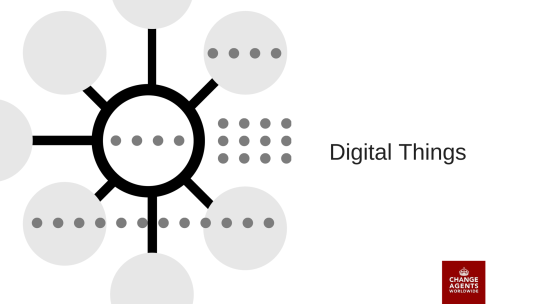
As the costs of digital connectivity and computing power fall, these capabilities are being added to more and more devices. The internet of things has reached our homes and our workplaces. The increased ability to gather and use information in real time will drive new innovations in our businesses and our lives.

image

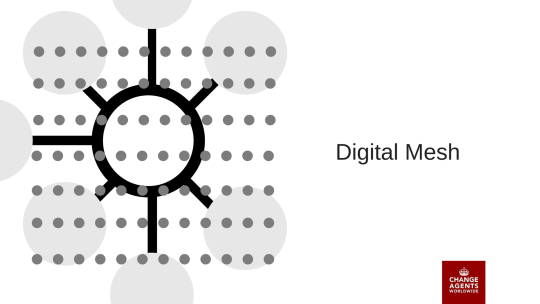
Add enough digital connectivity and computing power and you have created the potential for a mesh of sensors, connectivity and processing power to fill our environments. Now our digital things and our communication devices can be in constant contact and new applications will be developed to take advantage of the rich digital environment.

image

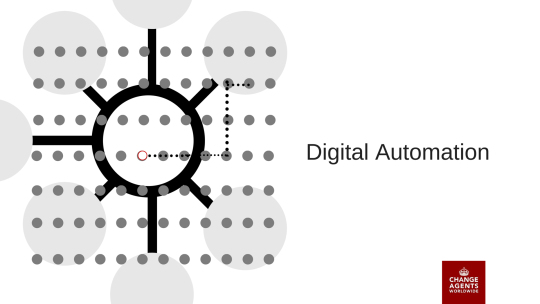
The digital mesh will help accelerate digital automation as many traditional roles of knowledge workers, such as the gathering, digesting and processing of information now flow from an ambient mesh and are managed through algorithms and their managers.

image

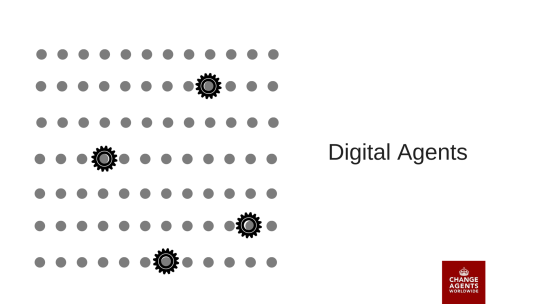
A digital mess also enables the greater leverage of bots, digital agents that can navigate the mesh and achieve outcomes for their owners, clients and masters. These algorithms take on the role of making local decisions or acting as advisers or facilitators across the breadth of the networks. Digital Agents help manage the scale of information and the real time demands of the mesh.

image

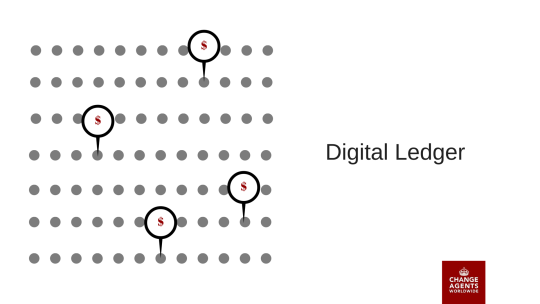
Distributed and connected computing power also enables us to revisit concepts of how we record, store and share information on concepts like ownership, identity and history of transactions.  Instead of a single ledger located in one location, the transaction history can be distributed and validated across the network, as in blockchain. Innovations will build on these capabilities into new domains.

image

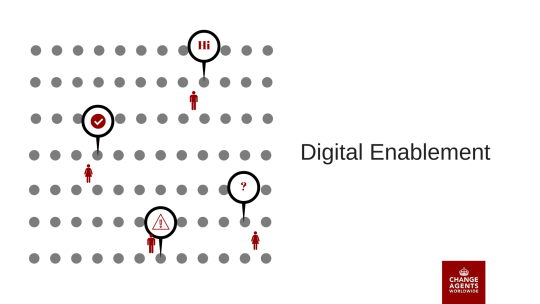
The digital mesh increasing can enable individuals by supplying capabilities need for individuals to have greater awareness, connection or to do work that was previously beyond the capability of a single individual. If an organisation is a solution to transaction costs as Coase suggest, there are new implications for the role and future of our organisations and the growing capabilities of the digital systems will shape the work individuals will do (or don’t do).

image

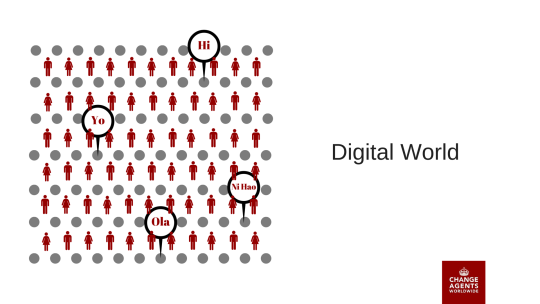
We have not yet begun to explore the potential of extending this digital mesh and its capabilities to the entire world. We can already see new approaches, such using e-commerce villages in China, video in education in India, market pricing data for farmers in the third world or mobile payments in Africa. As the costs of digital technologies fall and reach expands new entrepreneurs will solve new problems for those beyond the reach of this technology today. Perhaps then we will truly experience the power of the Internet of Humanity.

Do the work

We want shortcuts, quick fixes, off the shelf solutions and easy outs. They don’t work. We need to do the work.

In leadership we like big vision & easy answers, but we need to do the work of connecting people to have hard conversations and work on real solutions.

In collaboration we like technology and hot trends, but we need to do the work of connecting people in shared work for strategic value.

In learning, we like innovative delivery and content, but we need to do the work to help people learn every day on the job and in their networks.

In management, we like big decisions and trendy new approaches, but we need to do the hard daily work of helping people realise their potential and better meeting customer needs.

In strategy, we like the glossy PowerPoint and the sexy ideas but we need to do the work of building new capabilities and driving execution.

In health, we want the pill, the plan and the new thing, but we need to do the hard work of living a better life.

In politics, we like confidence, certainty and bold policy, but we need to do the work to connect people to work through complexity and uncertainty on solving real social problems.

Where ever we look we want it easy. Good things come from good work. Do the work.

Step away from the guru with a quick fix. Put down the book, the PowerPoint or the phone. Start with the work.

A Simple Visual History of Digital Transformation

image

Since the Mosaic Browser helped introduce the internet to the world, we have experienced a digital transformation of business. We had digital activities in our organisations before. We had already spend almost 50 years computerising processes. However, the digital connectivity of the internet began more radical change. Here’s an overly simple graphical reminder of elements of that journey.

image

We began by creating digital channels to connect our organisations to their customers.  The website began with simple digital brochures and basic contact information. Very quickly our websites became richer and more valuable.  Innovation began outside the organisation that showed the way for all subsequent phases of digital transformation.

image

We added processes to support the customer interactions. In many cases these processes were new, partial and designed solely to support the new digital channels.

image

We saw potential in these digital processes and started to apply them more widely. These processes worked in the midst of our legacy process and often in unconnected ways.

image

As the breadth of our digital channels expanded and we needed to manage new social and mobile channel needs, we needed a dedicated digital team to manage the expanding offering and to help integrate the core digital processes and infrastructure required to support growing digital ambitions.

image

With a digital team to advocate and lead the way on growing digital opportunities, we saw digital interaction takeover much of the electronic communication in the organisation and new integrated digital processes develop in supply chains, shareholder & community management and other forms of stakeholder engagement. APIs began to standardise digital communication formats in an increasing way for organisations. Organisations could leverage vast amounts of data on interactions and increasingly on activity across the organisation. 

image

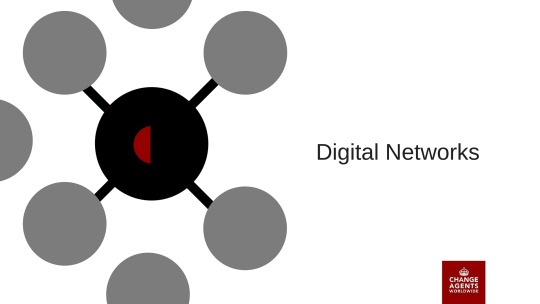
With digital interactions dominating & pressure to focus on core business activities, organisations began to become more aware that they operated in digital networks, connected to customers, suppliers and other stakeholders. Importantly, it became increasingly obvious that these networks connected all stakeholders reducing transaction costs and increasing transparency. Most dangerously these networks & data flows gave competitive advantage to those most able to leverage digital technologies in disruptive ways.

image

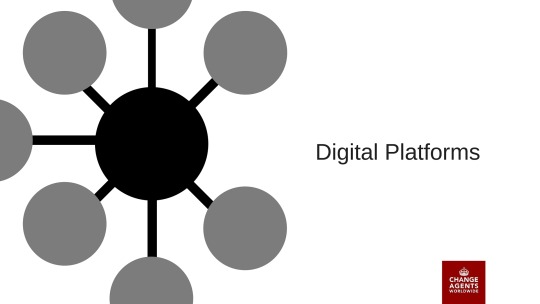
Seeing potential in connectivity, new and existing organisations saw the ability to focus on platforms that connected system players, creating new value and disrupting the traditional business of intermediaries. These platforms were increasingly agnostic of whether they ran on a computer, a phone or another device, giving them greater geographic and temporal reach.  We began to connect all processes & devices into networks to leverage the power of information. Concepts like employee, contractor, supplier and customer had less secure meaning in a networked world as chains of connectivity ran in all directions & right through the organisation.

image

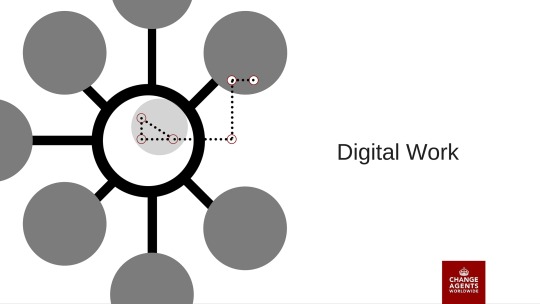
With platforms and networks running through and beyond the organisation, people began to explore the opportunities in new ways of working using digital. The boundaries of organisations no longer constrained the boundaries of work.  Seeking to retain talent, leverage information more effectively and create greater agility, organisations experimented with new digital ways of working and organising work.

This digital transformation has only just begun. There are many more phases ahead. The innovations and experiments of organisations will take us even further into exploring the potential of globally connected digital networks.

The Internet of Humanity

An extraordinary technological opportunity confronts your business. Global communication networks have unprecedented reach and mobility. These networks can connect highly capable autonomous intelligent agents called humans. The potential of this technology could change your business, and even human society, in disruptive ways. 

Even more incredible the capabilities of these intelligent agents are not fixed. Equipped with a full range of sensors, motion and agile communication capabilities they are highly adaptive. They have been known to survive all environments on this planet and even near space. They learn from each other and can even collaborate without APIs to decide novel approaches to the challenges & opportunities in their environment. These agents are self-powering, purpose driven, upgrade automatically and operate entirely autonomously. 

Imagine the ability to discover, to explore and to make sense of the entire globe. Imagine the opportunities in global advocacy, creativity and collaboration. Imagine what your business could do if it connected humans. Just think of the novel products, the extraordinary experiences and the economic and social value you could create with the Internet of humans. 

We have the ability to leverage an Internet of humanity. We just need to better understand how they work.

Working Out Loud & Building Antifragility

For the robust, an error is information; for the fragile an error is an error. – Nassim Nicholas Taleb.

Many people struggle with the risks & discomfort of working out loud. Nassim Nicholas Taleb’s concept of Anti-Fragility helps understand when to work our loud.

Taleb distinguishes between three adjectives of in his work:

  • fragile: at best unharmed by a shock 
  • robust: at best and at worst unharmed a shock, i.e. unchanged 
  • anti-fragile: at worst unharmed by a shock and with potential to be improved.

These ideas is a useful way to shape the practice of working out loud.

When to Work Out Loud 

If a situation is likely to be fragile, for example because you can’t handle feedback or the situation requires a single answer, think carefully about working out loud or at least work out loud and mitigate the risks. Working out loud on a performance management conversation or feedback for another is a situation that is likely to be fragile. The relationship and performance could be jeopardised with any shocks or simply from a sense of lack of fairness in the transparency.

In situations where you are robust or anti-fragile, working out loud is essential.  There is no downside and at worst information and at best opportunities to improve your work. Complex or chaotic scenarios in the Cynefin framework are examples of situations likely to demonstrate these characteristics as working out loud can play into an effective strategy of probe-sense-respond or act-sense-respond. 

Becoming Anti-fragile

One of the strong reasons that I recommend people experiment with working out loud, such as in the safe environment of a working out loud circle, is that practice builds towards an anti-fragile state of work. Many of the initial concerns from working out loud come from concerns around emotional states, perceptions and ‘doing it wrong’. So many people complicate the simple act of sharing purposefully and openly.

Many of these concerns are overblown and contribute to our fragility at work. Practice of working out loud in simple experiments of sharing across diverse contexts can help individuals to see that they and their relationships are far more robust than they expect. They and their relationships can be deepened by the better information, shared context and trust created by working out loud.  The many benefits of working out loud can push them to greater practice as they realise the benefits of learning continuously.

The Life-crushing Magic of Hierarchy

Humans are inherently messy creatures. We accumulate history and the entanglements of human relationships and emotions. As a manager this human mess can interfere with the joy of the unrelenting execution of your will. A cluttered organisation shows no respect to a manager’s inherent expertise and power. 

My life as a manager was transformed when I discovered the life-crushing magic of hierarchy. Your life and organisation can be neat and orderly, if you follow these simple organisational principles. 

Touch Everything

Firstly you must understand the principle behind all hierarchical organisation. A manager must constantly touch everything. Dump all your expectations about independent action by your team on the floor. Subject everything to your hands-on micromanagement power. 

You must feel free to touch any activity in the organisation at any time, throw it into a disordered pile and then use your superior management skills to put things back into the places that best suit you. Do this until your organisation shines with respect for your management skill. 

Kill Joy

Look at any activity if it sparks joy in your employees, discard it from your organisation. You have the power to exclude these activities that divert from the joy of experiencing unfettered authority. Crush the activities and discard any employees associated with them. The more meaningless the work the better it will demonstrate your management expertise. If too much meaning arises in work, intervene and make changes or better yet reorganise again.

Process not People

When organising your business it is traditional to be concerned with individual business units, alignment to customer or business outcomes and the people involved. Put aside this nostalgia. 

Focus instead on process. Ask yourself only whether the process brings you joy and crushes the freedom of your people. Make sure your processes are inflexible, opaque, compliance-oriented, end-to-end and untouched by nostalgic human considerations. The more abstract the outcomes that your processes create the better. 

Organise your business one process at a time and follow each process to the end before proceeding on to the next until you have completed your arrangements process by process. This may increase the mess and confusion in the meantime but you will find an organisation that is far easier to control and manage in the end.

If at any time you are not getting joy from this process, reorganise your people to make their arrangement more appealing. Over time your people will begin to appreciate the recognition that they get from being dumped into reorganisation. They will shine around you for the fear that next time you may get them. 

Everything in its place

Everything must be in its place before you go to work. Only you will be best able to determine the sweet spot for an employee. Don’t let them create mess by making career choices. Fold them carefully into their small box alongside their peers in the process. Never let your employees feel that they have a place to which they can go home. 

Arrange your remaining employees in tightly segmented silos and narrow process defined roles. It is essential they are visible and accessible to you at all times. You will need the ability to grab them from their important work at a whim and put them back easily at your pleasure. Measure them continuously to keep them aware of their need to maintain your respect and bring you joy.  

When interacting with your employees discard any that show too much spark. Remember to share your unfettered opinion and discard theirs at every opportunity. Finish every interaction with one of your employees by remarking gently ‘Thanks, I’ll take it from here.’

No Stacking

Stacking can crush employees at the bottom and damage their self-respect. This is an activity which should be reserved to bring joy to you. This is why it is so essential that employees are carefully folded into a place in process. Therefore do away with any unnecessary intermediate managers who may have the time to create fiefdoms to challenge your own. Keep the other managers moving quickly to satisfy your directives so that they have no time for their own thoughts, action or joy. Make everyone subject to your direct instruction and make all the decisions with your unique, shifting and often emotional rationales. 

A category of employee that requires particular attention in removing any other forms of leadership are your change agents. They are an unnecessary source of independence and activity. You will find no spark of joy in your dealings with them. Instead they may even challenge your authority or make unnecessary suggestions. Implement an enterprise social network in your organisation. This will enable you to identify those employees who still hold opinions and may act on their own outside of your chosen process. Gather your change agents. Hug them and thank them for their service. Then bundle them out the door

Follow these principles closely and your hierarchy will be neat, tidy and much smaller. Be sure that it will bring you, and you alone, great joy. Other managers will look on your shiny, svelte & compliant organisation with new respect.

Apologies to Marie Kondo. Thank you to those who gave me encouragement, ideas and suggestions for this post. May it spark some much needed joy in your work. If anyone reading is still in any doubt, don’t do this.