I recently did a podcast with Tathra Street on making leadership safe for humans. Tathra has an series of interviews on the idea of Human Centred Leadership. In our 30 minute conversation, we discussed my leadership lessons, how work is changing, the demands of digital culture, working out loud and more.
The discussion was great but sadly the audio quality did not hold up to the content of the discussion.
Almost twelve months ago, I discovered the Microsoft Most Valuable Professional (MVP) Program when I found out that I had been nominated for the award. That nomination was a first step for Microsoft to widen the program to encompass people who worked to foster adoption of its products. The MVP Program has been longstanding as a way to connect Microsoft with the traditional IT pros who make up its base of customers, developers and partners. After a year of experience of the MVP program, I wish I had known about it a lot earlier. The benefits to me and to the organisations with which I work from the program have been fantastic. Most importantly of all, the MVP program has strengthened my connections to a community of incredibly smart, committed and professional practitioners who have shown me new and better ways to do what I do.
So let’s look at what a year of being a Microsoft MVP means. The MVP program is a recognition of contribution to the Microsoft community. Microsoft itself says:
“The Microsoft MVP Award gives us the unique opportunity to celebrate, honor and say thank you to top-notch technology experts who make outstanding contributions to their communities. These technology experts have an unstoppable urge to get their hands on new, exciting technologies and love to share their knowledge.”
The award which is for one-year term is a recognition of the quality and amount of work done and the value created by each individual for Microsoft, for its customers and for the individual’s own organisation. It lasts for a year because it is a reward for the work and that level of effort must be sustained and grow.
If we want to examine what it means to be a MVP we are going to have to dive into understanding and exploring the impact of that work. To save you the challenge of listening to me talk about myself, I asked a fellow MVP, Amy Dolzine of EY if I could feature her work and efforts this year. Amy works in knowledge management for EY where she is a Global Awareness Advisor and Enterprise Social Engagement, Research and Awareness Lead where she is responsible for designing, managing and continuously improving global initiatives that increase the firm’s adoption of collaboration and communication tools such as Yammer and SharePoint. By enabling real time collaboration and sharing of expertise her work at EY enables client service teams to deliver better client outcomes and create increased revenue opportunities for the firm. Amy’s work at EY and her past experience with other organisations leading Yammer implementations also makes her a global expert in social collaboration and someone that people around the world look to for expertise and insights on how best to develop the maturity of collaboration in their organisations.
Sharing
I first met Amy through her active participation as a leader in the Yammer Customer Network, which is now the Microsoft Tech Community. Amy demonstrates her leadership and passion in this environment, by actively sharing insights, asking questions, identifying bugs to be resolved and providing feedback to other community members and the product teams. I’ve been lucky to be a member of a number of communities this year where I have been able to leverage Amy’s practical insights. Having such a professional expert available to help you unravel challenges or support your ongoing work is invaluable. If she is able to provide this support to others, I can only imagine the value that she is delivering to EY client service teams as they go about the important knowledge work of collaboration that is critical to the client service of EY teams.
The ongoing sharing of her expertise extends beyond the tens of thousands of members of these communities as well. Amy is also active in blogging and sharing her insights in social media. Her blogposts on Linkedin throughout the year have always been insightful reflections of the opportunities of collaboration and experience she has learned working in the EY environment and beyond.
Speaking
An MVP is expected to be out and about sharing their expertise at events in their communities and events that that Microsoft runs. These speaking engagements are always learning opportunities. They refine insights, help make new connections and provide opportunities to listen to and engage other practitioners in the field. Personal and organisation brands grow due to the quality of these presentations and I have watched Amy continue to promote the leadership of EY in the social collaboration space at many events during the year:
YouToo Social Media Conference Kent State University, April 2016: External social media conference in its 9th year. Amy was the first speaker ever on the topic of internal social. As a result of sharing her work, Amy was able to create recognition for EY as a leader in the space. Importantly Amy helped a number of people at existing or future EY clients realize the value of working collaboratively and how it could help them make their companies more productive and engaged.
JBoye: Philadelphia, PA May 2016: EY is a member of the JBoye organisation’s networks. They have 2 conferences a year, one in Philadelphia, one in Arhus Denmark. Because of her status as MVP and reputation, JBoye asked Amy to speak at an event about enterprise social. Events aren’t just about speaking. At this conference Amy developed industry connections by meeting John Stepper, author of Working out Loud and Susan Hanley, the author of many books on Knowledge Management and SharePoint. Amy has gone on to introduce these thought leaders to others in her network. Developing connections in the industry and bringing together people is a key part of the MVP opportunity.
Microsoft Ignite Atlanta, GA September 2016: I facilitated this panel of 5 leading MVPs. The panel was a “from the front lines” kind of presentation about how to roll out enterprise social and received an enthusiastic reception with many questions and excellent feedback. What the audience valued was Amy’s ability, along with the other panellists, to bring practical examples and real world experience to the often daunting and abstract challenges of collaboration. Showcasing the value that a leading organisation like EY can do in this way and highlighting the ability of a professional like Amy to share this expertise reflects well on the firm.
DogFoodCon Columbus, OH October 2016: At DogFood Con Amy presented two presentations on the business value of enterprise social and the value of building knowledge communities. Again these presentations showcased EY as a leader in social collaboration and shared practical techniques to advance other organisations work in these areas. Feedback on these presentations showed the continued development of Amy’s influence and her reputation as a leader in the space.
Microsoft MVP Summit Seattle, WA November 2016: MVP Summit is the highlight of the MVP year with a week long summit with in-depth presentations about Office 365, Yammer and SharePoint. For MVPs this is a chance to get deep into the product roadmaps for key products, to learn about initiatives to come and to connect with each other. Amy also got the opportunity during this week to interact as a subject matter expert with the Yammer Product team as they ran a product hackathon. Taking her frontline expertise and sharing it directly with the product teams to shape their future roadmap is a key opportunity for an MVP and puts them in a great position to assist their organisation to optimise Microsoft’s product implementations.
Learning
Being an MVP gives you unique exposure to the work of other MVPs and also the Microsoft product teams. Throughout the year on a weekly and monthly basis there have been updates from the product teams and others in Microsoft on the roadmaps and other opportunities being considered and tackled. MVPs get privileged access to these conversations under NDA in exchange for their contribution to Microsoft’s thinking. It is a rich and valuable mutual learning experience with early warning and an ability to influence future product development highly valuable to Amy in her work.
The global community of MVPs learn from each other. Everyone in that network is looking to push the implementation of the technology to greater levels of effectiveness for their organisations. Amy gets rich connections and early insight into that work is an incredible learning opportunity and a platform for future collaboration opportunities as well.
I asked a few fellow MVPs what they had learned from working with Amy during the year. Their answers reflected my own perceptions and the respect with which MVPs are held in the Microsoft customer base:
“Amy is by far the most practical, value-focused strategist that I’ve seen in social collaboration. She has a gift for inspiring people with the vision and then moving them to roll up their sleeves and get to work realizing the benefits.” – Melanie Hohertz, Cargill
“Through Amy’s insightful and honest public contributions, I learned that EY is a leader in the emerging science of social collaboration. Not only have I gained a better understanding of Enterprise Social Networking and how it can help organizations through Amy’s efforts, I’ve also gained a great deal of respect towards EY as a company on the leading edge of modern business progress.” – Tom Kretzmer, Lubrizol
“Just a few moments of conversation with Amy showed me the heights my own organization could achieve through Enterprise Social Networking; continuing the conversation through this past year showed me that she is a leader to keep an eye on.” Becky Benishek, Crisis Prevention Institute
Personal Connection
When you spend a year working alongside someone through communities and events, you develop a strong sense of their values, their approach to others and the way that they approach their work. We all know that these values and approaches are the bedrock of excellence in performance and ability to contribute to others. What comes across to me from my year working closely alongside Amy is her passion for making work and technology solutions better for the people in EY, her deep commitment and energy to making a difference and her generosity in creating, building relationships and helping others. This work is not without its frustrations. What I love about Amy is that she keeps these values front and centre as she tackles the challenges and the successes. Most organisations barely recognise that their people are making contributions to others in this way well beyond the narrow descriptions of their jobs and KPIs. I am pleased to know that EY is different and Amy is recognised for her passion, her contributions and her generosity.
I am incredibly lucky to have got the chance to know Amy better through the MVP program. Because of the work of Microsoft to celebrate her work and her ongoing efforts to share and help others, you get the chance to know her better too. If you’d like to become an MVP, the challenge is to think how you can make this kind of a contribution to others through your work.
Mindsets shape our perception. – A large sign that needs to be placed in all workplaces
The changing nature of work is growing greater attention in the business press and in the strategy teams of large and small organisations. New ways of working and new platforms of work are gaining traction and much handwringing is going on about the potential “post-job” future of work.
Many organisations see the changing nature of work as an opportunity to use transactional platforms to lower employment costs and deliver a greater flexibility of resources. They see platforms that offer a highly competitive pool of temporary and flexible labour as solely an efficiency play. Much of the investment and energy behind these platforms have been driven by the idea that they can take advantage of a struggling and transforming post-crisis global economy, digital technology and new work patterns of work to deliver real cost savings to organisations. That focus on the transactional efficiency benefits of Gig Economy reflects the prevailing mindset on the purpose of work and organisations. These organisations often can’t see that there is another way.
I was recently asked why I wanted to work in the Gig Economy. My answer was that I don’t. I work in the Purpose Economy. A traditional organisation might see an opportunity for efficiency and flexibility through a pool of transactional gig workers. I am looking for flexibility, purpose, relationships, collaboration and learning through a diverse portfolio of rewarding work.
I don’t join large scale platforms that atomise participants, commoditise work, create competitive dynamics and are designed for value capture to the platform (for more read Harold Jarche’s excellent description) . The transactional efficiency mindset of business is strong and deeply embedded. For many people, this has become the only way of business. It is all that they can see. However, there are other more purposeful, more valuable and more human ways of working. Breaking this mindset and setting out in a different pattern can be richly rewarding.
What impressed me as an adviser to Sidekicker was the team’s focus on relationships with both their workforce and their clients. They are looking for skills, talents and a better way of working with benefits to both workers and clients in areas of the market like event management staff where that is a rare mindset. The mindset of doing repeatable high quality business in a relationship for mutual gain is a valuable proposition in a world of atomised marketplaces.
I recently blogged about becoming an adviser to Peer Academy. This platform focuses on helping participants to collaborate, work and learn as peers. The learning and collaboration focus of this platform makes it a far more valuable and purposeful solution for organisations and participants.
I am a participant in Change Agents Worldwide because first and foremost it is a network about relationships, collaboration and learning. Change Agents Worldwide seeks to create value through scaling the efforts of individual Change Agents, but it recognises that it must first deliver value to the individual, cannot compete with them and must allow them to shape their participation and their work. A true network needs remarkably few rules to help individuals pursue their purpose, learn from others and to deepen relationships.
Ultimately, my work is driven by my purpose of making work more human. I write, speak, consult and coach towards this end. The portfolio nature of my work enables me a diversity of projects that contribute to this goal. My future success depends on what work I do, what relationships I build and what I learn. I have an entrepreneurial drive to improve my proposition to better fulfil my purpose. I get to build relationships that shape what I work on, what I learn and with whom I work.
A purposeful portfolio also helps diversify my risk and ensures a more consistent flow of rewards. I’ve been subject to far greater income risk and far more atomisation as an employee than I have ever experienced as an independent worker. Critically the nature and amount of those rewards remain in my control and are agreed through relationship conversations, not market place bidding, bell-curve performance processes or restructures. Not all the rewards are cash, I shape the value that I share in my work.
Before your organisation considers a new model of work for its efficiency gains, consider whether there is a wider benefit in exploring the potential of deeper relationships, richer purpose and more responsive work. Leveraging these opportunities will require you to consider many new areas of organisational work in 2017, but particularly:
What do you offer the purposeful worker? Is your organisational purpose clear enough to shape your work?
Is your employee & worker experience good enough to attract, to retain and to leverage the contributions of those working in the purpose economy? Are you treating temporary labour as an equal member of your teams or as second class citizens?
How does your organisation onboard, collaborate and learn at scale, especially with those who may not care for your processes or be seeking a career in your organisation?
Are your team structures and work processes agile enough to incorporate and benefit from the inputs of your new workforce?
Can your management capabilities, models, policies and systems handle the networked organisation and a purposeful workforce?
PS: An example of the limiting power of mindsets is that we now need to clarify the meaning of ‘gig economy’. Language that came out of the creative professions to reflect their flexibility in pursuit of purpose becomes redefined in a corporate mindset to transactional efficiency.
This morning I was reading about a high profile group of business leaders who are supporting a change I want to see in business and advocate through my work. For a moment, I felt a wave of relief. I thought to myself ‘The cavalry have arrived to save us’. Then I reflected again on what the arrival of the cavalry means to Change Agents working to bring about change.
As someone who has been an organisational Change Agent and a consultant to Change Agents, I have seen the cavalry arrive many times in fights for change. Like the cavalry in old films they arrive late, but bringing the power to drive organisational change. In some cases, just like the films, the cavalry can be a saviour of a beleaguered team of Change Agents on the losing end of a battle. Unfortunately, even when they succeed in forcing change, the organisational heavy hitters arriving can have downsides. Here’s why:
Everyone stops when the cavalry arrives: when the official forces arrive, everything stops. Your supporters stop work expecting a quick resolution. Opponents hide out waiting for this to blow over. Nobody wants to discuss the change anymore because the cavalry will sort it.
The cavalry take charge of the battle: the cavalry are used to being powerful. They are used to winning their way. Usually they will tell the change agents to stop while they make the change happen. They don’t like distraction or initiative.
The cavalry fights a different battle: The cavalry have power. They arrive with a thunder of hooves and lots of weapons. They fight hard and fast and take no prisoners. A quick transactional solution suits their temperament. They aren’t interested in sustainability or buy-in. With power, it isn’t needed. They will definitely tell you everything you are doing is wrong.
The cavalry eat your supplies: all those men and horses are hungry. The goodwill, the momentum and resources of your change efforts will be commandeered by the cavalry. These precious resources will be put to work on the cavalry’s charge. They will also follow the cavalry to its next battle.
The cavalry win their battle but not the peace: the big surprise is to discover that the battle is soon over. You learn that the cavalry is not fighting for the same goal. They just look aligned and when their goal is achieved they declare peace. Sometimes they declare a new goal just to win and declare peace.
The cavalry charge elsewhere: Cavalry are always on the move. Trench warfare or a long resistance is not their style. They sweep people from the field and move on. When you need help to consolidate the fragile peace that they declared they will mount up and ride away.
So if you are a change agent, take care when the cavalry arrives. Use the opportunity wisely to advance your cause. Retain the power to make change and keep your relationships.
If you are a leader, ask yourself whether your efforts to help change agents feel like the interventions above. How are you building the capability to make change?
Simon Terry provides consulting, advice, speaking and thought leadership to global clients through his own consulting practice, and as a Charter Member of Change Agents Worldwide, a network of progressive and passionate professionals, specializing in Future of Work technologies and practices. The focus of Simon’s practice is assisting organizations to transform innovation, collaboration, learning and leadership.
As the end of November approaches, that time has come again when we must consider whether we have the right initiatives in place for ourselves and our organisations as we get ready for 2017. How are you transforming the capabilities and work practices in your organisation to make sure that your teams are more effective in their work?
Why is Work Changing?
The way we work is fundamentally changing under the influence of five main drivers:
Pervasive Global connection: As internet connectivity has gone mobile, we now have the ability to connect with, to converse with and to see the whole system of our stakeholders any time anywhere.
Automation: Digital technology has enabled us to automate simple tasks and string together increasingly complex processes and systems.
Data and Analytics: As digital connection and digital automation expands so does our ability to gather data and analyse that data to provide insight and run complex algorithmic processes.
Changing Consumer Expectations: As consumers are exposed to the potential of digital through consumer technology and consumer services, the businesses must meet disruptive and exacting standards for convenience, service, value and speed.
Accelerating Pace of Change: Disruption, greater responsiveness to change and ever-shortening cycles of feedback are the new norm for business and our work practices must adapt to enable our businesses to keep up.
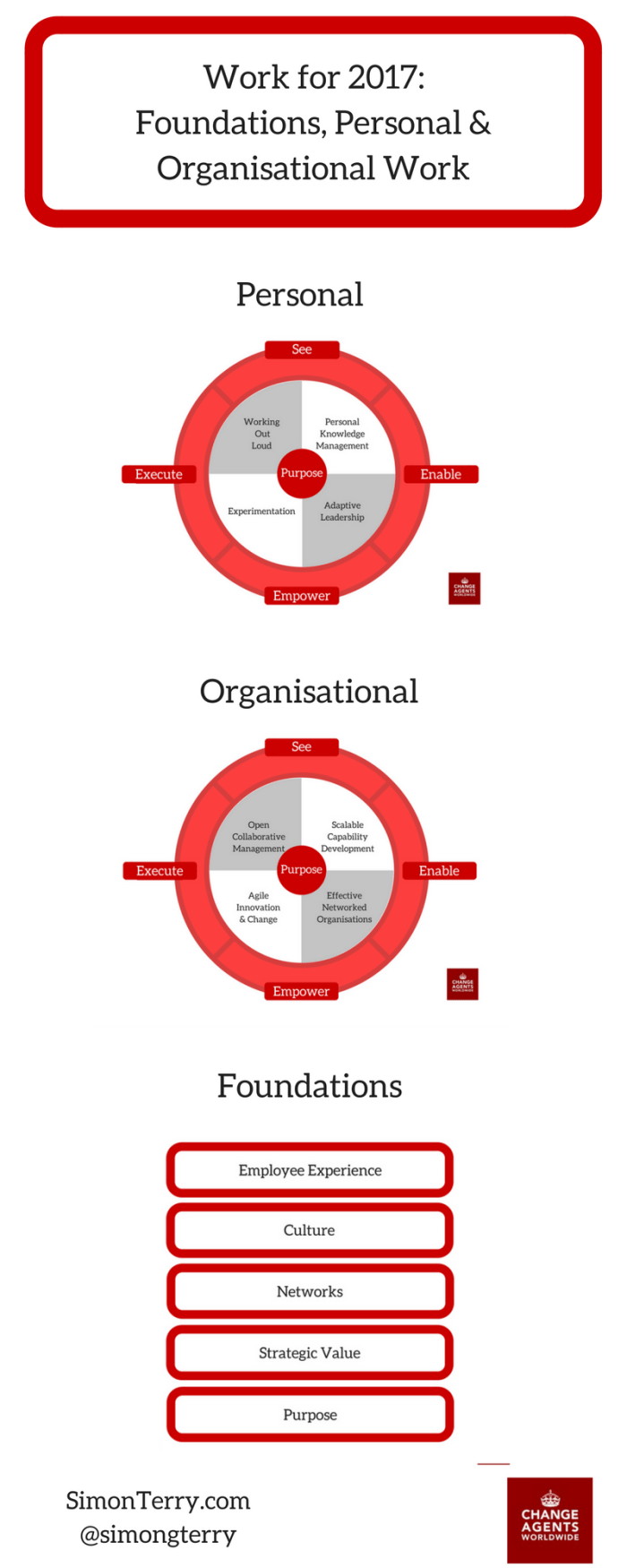
With these pressures on the way we work, every business should have a focus on how it is changing the way its people work and the practices that will support ongoing transformation of work. Here are my recommendations on what work you should have on your backlog for the new year:
Foundations:
These five are in place in your organisation today. However, they may not be well understood, managed or serving your purpose. As you look to 2017 it is always worthwhile to ensure that the foundations are sound and well aligned.
Purpose: Be clear on your personal purpose. Look for that purpose in the work you do. Clarify the shared purpose in your organisation. Don’t impose a purpose designed around the leadership table. Discover the purpose through the stories and the work that bring your organisation together.
Strategic Value: What value are you trying to create to fulfil your purpose? What kinds of value matter most to your stakeholders? When do they know you are creating value? What measures tell you that you are achieving your goals?
Networks: To compete in the network era, your organisation must be networked. How are you bringing people together to connect, to share, to solve problems and to respond to the networks around your organisation? The technology matters less than the connection, the behaviours and the shared purpose. Are you clear on the strategic value of your communities, are they well supported with sponsorship, investment and community management so as to accelerate their value creation?
Culture: Move beyond words on a poster. Move beyond generic platitudes. Move beyond an agglomeration of individual team cultures. What specific values are shared across your organisation? Why do these help fulfil your purpose? How do those values translate to expectations about behaviours in and across your teams? Is the culture in your organisation effective for your purpose and the value you are seeking to create? How do you personal role model the behaviours you expect from others?
Employee Experience: Are you working somewhere that values the employee experience and is adapting it to changing work and changing roles in the organisation? How have you aligned your employee experience to your desired customer experience? Does your workplace create rich value for employees and enable them to express their potential in fulfilment of purpose? Does your employee experience work as well for the one-hour temporary contract worker as the long term employee? Does it work equally well for all levels of the hierarchy and all corners of your network?
Personal Effectiveness: Four Key Future of Work Practices
These four personal practices are enablers of the future of work. They enable an individual employee to deliver greater value in their work by responding to the opportunities and information in their environment. Agile and adaptive they empower employees to continuously improve and innovate.
Working Out Loud: Sharing work in progress in a purposeful way with relevant communities will accelerate learning, sharing and feedback cycles. Start working out loud now.
Personal Knowledge Management: Learn how to turn the personal information flood into effective sense making, learning and sharing. A critical skill to make sense of complexity and to leverage networks for learning.
Adaptive Leadership: Enabling the rebel and the change agent to lead more effectively in any system. Improving understanding, influence and the increasing the breadth of leadership techniques to create collective change in any system.
Experimentation: Move beyond the limits of your expertise. Learn by doing. Resolve uncertainty through action. Shorten cycles of decision making and feedback to increase personal effectiveness.
Organisations are made up individuals. These four practices of organisational effectiveness scale and accelerate the personal practices through a focus on design of systems for connection, learning and adaptation.
Open Collaborative Management: Middle managers are often those who find a change to digital ways of working most threatening and disrupting. Open up the work of management. Move management from planning, allocation and control to facilitation, alignment and coaching. Shorten cycles and improve the performance value of feedback. Foster the role of managers as network navigators and brokers. Management can be a critical point of leverage in achieving more open, more collaborative and more effective work.
Scalable Capability Development: Turn each employee’s learning into a contribution to scalable system for delivering strategic value. Create Big Learning systems that scale learning around strategic capabilities for the organisation’s success. Coordinate your learning agenda as an agile change program. Curate the capability building of your teams, leveraging learning from peer communities and leverage social learning to bring 70:20:10 and a performance-oriented approach to learning to life at scale and in the workplace.
Effective Networked Organisations: Take advantage of the networks in and around your organisation to rethink your business model and organisational design choices. Break the centralised/decentralised binary and move beyond hierarchy. Enable autonomy, foster alignment and improve effectiveness for purpose. Skill your teams to achieve effectiveness in the wirearchy. You don’t need to purchase a new management system. You need to adapt your approach to managing knowledge, trust, credibility and results to your purpose, culture and community.
Agile Innovation & Change: Adapt to the changing needs of the environment and stakeholders to deliver new value. Accelerate innovation and change through new approaches and by putting in place the systemic support for employee-led innovation, change and transformation to a more responsive organisation.
Simon Terry provides consulting, advice, speaking and thought leadership to global clients through his own consulting practice, and as a Charter Member of Change Agents Worldwide, a network of progressive and passionate professionals, specializing in Future of Work technologies and practices. The focus of Simon’s practice is assisting organizations to transform innovation, collaboration, learning and leadership.
Our connected world is great at supplying solutions. However everyone needs to know what problems you want to solve. Ask for what you want. Don’t stop asking until you get it.
I was raised to be grateful for whatever life brings. My life has been overwhelmingly positive. I have received so many blessings it is hard to be thankful enough. However the flip side of a pattern of success and an attitude of acceptance is that it can cause me to forget to ask explicitly for what I want. Waiting quietly can replace a public hustle.
Let’s be blunt. The universe respects hustle. The return doesn’t come to the five minute version of hustle. The universe rewards persistent and public effort. Success is driven by continuing to build relationships, sticking at a plan, learning from experience and working hard at clear goals. Overnight success is usually a seven year effort.
How does our connected world deliver its help? When you are clear what you want and go after it, you are more likely to succeed. Focus helps you and helps others to help you. Just publicly putting your Purpose into the world can start to attract people, resources and efforts of help. The support of others, their help and opportunities will help you stay focused and persist. Persistence will attract more people and more opportunities to solve your challenges and meet your needs.
If you don’t ever express what you want, then you are missing out. Give yourself the time and the opportunity to get what you want. Keep publicly pushing for your goal. Our connected world will reward your intent & persistence in time.
Yesterday for HISA’s series on Innovating Health, along with Vishaal Kishore, I facilitated a discussion of healthcare leaders on how to create a culture of systemic innovation. In the conversation we discussed the insight that participants in the healthcare system are great at innovation in a crisis. When the urgency and need are high, resources are made available, change leadership arises, collaboration comes forth and novel solutions are pushed through to solve challenges. We need to reflect on why the innovation and change that arises in a crisis is not more critical to our organisations.
Learning from Crisis Innovation
Many organisations and systems are capable of extraordinary things in a crisis. Inspired by crisis level performance, the response of leaders can be to seek to leverage and replicate this capability beyond the crisis. Many leaders try to recreate innovation and change through a manufactured crisis situation, either through a ‘burning platform‘ or simply a high pressure project environment. These strategies result more often in crash than crash through. It is rare that sustainable change flows from a skunkworks or a pressure cooker because people and systems push back on embedding and adoption of change when the crisis subsides and practices return to normal. These interventions are transactional and not generative. In addition, the costs of a rolling crisis to employees and organisation involved can be extreme.
Other leaders take the view that innovation is only possible in special circumstances and therefore look to create space for those unique circumstances of shared purpose, collaboration, leadership and resourcing. With this mindset comes a focus on a special extra space for innovation. This space ranges from extra time, to special teams, to extra funding through to dedicated innovation labs. There is an important role for dedicated space for innovation. Critically these spaces can act as ‘wiggle room‘ to enable change agents to learn and demonstrate their potential and to enable organisations to test approaches and see proof the value of innovation. Extra space for innovation can be a key part of a transition to wider changes in the system to foster and support innovation across the organisation.
The inadvertent consequence of both of these approaches is a view that innovation is over and above work. Innovation happens in a crisis, a project or a lab. It doesn’t happen at my workplace. Innovation is what others do when asked. Sustainable systemic innovation requires organisations to focus on how innovation can become critical to work and not a crisis. The best innovations are driven by the insights, interactions and lessons of the flow of everyday work.
Critical Innovation Leadership is Leadership
When we look at some of the human elements that align in a crisis situation to enable people to push through to realise new ideas, we can see that many of these circumstances are not that special at all. In fact they should be critical to the success of any work. Leaders should foster these in all work. Clarity of purpose supports all work. Focus on value for diverse stakeholders improves effectiveness of work everywhere. Great leadership and collaboration to work across silos and around barriers is essential to all work. Resourcing and risk appetite should be driven by value creation and the needs of work. A learning mindset is critical for all work in an era of continuous change and rising expectations.
We can and should address challenges in crises when they arise. We can all benefit for the extra reflective space, practices and resources for special areas devoted to innovation. However, the challenge for all work and all leaders is how to move innovation and change from crisis to a critical everyday part of every role. We need to focus on the capabilities, behaviours and systems that enable and act as barriers to innovation in everyday work. Aligning and improving these aspects of the system will benefit all work. All work benefits when leaders set about creating the ideal circumstances for innovation and change.
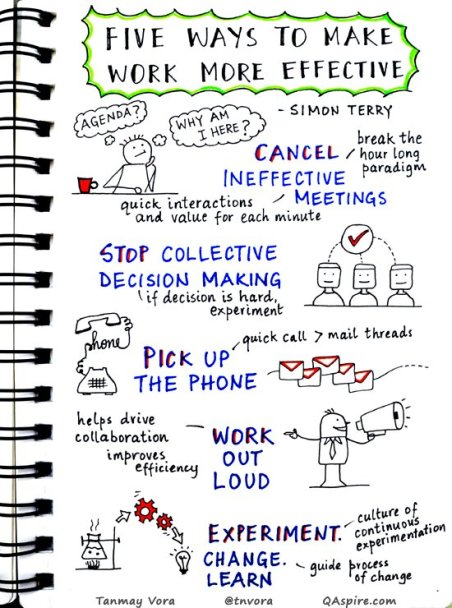
Some time ago I published a post on five small changes that we can each make to make work more effective. Tanmay Vora turned the post into the great sketch above that has been widely shared. On the weekend I wondered whether all this sharing actually helped anyone to change their work. Tanmay and others responded that they were using the sketch as a guide to their work. However, my question remains open. Do we have as much change as we should? Do we act on the small ways to improve work?
Changing Work is Hard
Changing work is hard. We would all like work to be more effective, but we continue to cling to ineffective practices. We know there are better ways but we don’t always use them. Why is there a gap between our future of work intent and action.
Let’s look at some of the reasons why changing work is difficult.
Reactive not Reflective: We are busy. Being busy often deprives us of the time to reflect on how best to do our work or how we could improve our work. While time pressures should present an incentive to plan a better way, we often think it is better to just start. Take the time each day, if only for 5 minutes to reflect on how your work could be improved.
Habit: There is comfort in habit. Habits provide patterns of certainty in an incredibly volatile and uncertain world. Habits can be behaviours or habitual mindsets. Together they create ingrained and unthinking behaviours. Sending an email or organising a meeting is a routine next step and others will share the habit making it harder to break. Find triggers for new habits. Make a choice to think and go another way and lead people away from bad habits.
Social Capital: Dave loves his meeting. Dave has perfected his meeting to suit his needs and his project. How do I tell him that it is a complete waste of everyone else’s time? We aren’t always great at feedback and we hate to put our accumulated social capital in jeopardy, particularly if what we are asking is out of the usual. Explore better ways of working with your work colleagues through collaborative coaching conversations. Encourage them to reflect and to help you find better ways of working too.
Fear: Our workplaces are full of fear. Fear power, fear of ostracism, fear of loss of status or wealth or purpose. Our workplaces put the full neurological gamut of status, certainty, autonomy, relatedness and fairness under threat. Adding change to the mix risks upping the fear quotient. We need to make the benefits of change clear to ourselves first and then to others. We need to use these elements of our uncertainty to help us, not hinder us.
Conscious Incompetence: New skills are hard. They don’t work as well as our habits. We may have been unconsciously incompetent at our old approach, but as soon as we try something new we are conscious of the gap in our skills. Practice and experience is the only way to improve our skills. We need to do the work and get better.
Initiative: Nothing changes unless someone acts to influence change. We can wait for our boss or others to discover the change themselves. However, to bring about change sooner we need to exercise individual leadership and take on the challenge of making change happen. We must be our own role models. We need to find our voice and lead with our actions to change the way we work.
Simon Terry provides consulting, advice, speaking and thought leadership to global clients through his own consulting practice, and as a Charter Member of Change Agents Worldwide, a network of progressive and passionate professionals, specializing in Future of Work technologies and practices. The focus of Simon’s practice is assisting organizations to transform innovation, collaboration, learning and leadership.