Writing

Truth, Persuasion & the Future of Work

image

We often slip into use the language of force to describe transformation of our organisations in the future of work: rebels, revolution, vanguard, etc. In so doing, we inadvertently romanticise the force & power dynamics that are at the heart of traditional organisations. Using the language of persuasion is more aligned to the changes advocated by the future of work.

Managers will transform to a new way of working when they are persuaded it is truly a better way. The future of work needs the employee’s engagement. We are transforming work to make it more human. Let’s use more human means in that transformation.

Satyagraha

Satyagraha is the term used to describe Mahamatma Gandhi’s approach to nonviolence. This approach has inspired non-violent change since. Focused on ‘insistence in truth’ it sought to focus on action that would bring forth persuasion of the opponents of change and strength in those arguing for change:

pursuit of truth did not admit of violence being inflicted on one’s opponent but that he must be weaned from error by patience and compassion. For what appears to be truth to the one may appear to be error to the other.

Gandhi also said:

Satygraha is a weapon of the strong; it admits of no violence under any circumstance whatsoever; and it ever insists upon truth.

Critical to Gandhi’s approach was the recognition that arguing for a new truth is an act of strength and that the means matter. Adopting the means of the oppressor to justify change weakens the cause.

Changing to the Future of Work

The future of work will not arrive in a revolution. As tempting as it may be to declare that there will be a moment of radical transformation, the changes that will come to the way we work will arrive as one by one managers change to new and better practices.  If they fail to change, it will come as their organisations are replaced by those who work in better ways.

The critical challenge for those advocating change is to endure and persuade. Those managers clinging to old ways genuinely believe that they are better. Use of these means is often a ‘self evident truth’ or ‘what management means’. Change agents must continue to advocate, to seek new arguments to demonstrate the truth of better practices and to take their arguments to those who need to hear change. Most of all they must retain compassion.

There will be no storming of corporate barricades. No new flag will be raised to herald a new era. There will be victories one person at a time as persuasion wins managers over from old models of management. 

Change Agents Must Endure, Prove their Truth and Persuade

Advocating for this change will take endurance. Old models of management are not beyond using force, punishment and exile to preserve their turf. The change agent must understand and embrace the setbacks and difficulties of the challenge.

Change agents must be humble enough to put their truth to the test. Managers will not be convinced by speeches and hype. They are convinced by value and results and when they are comfortable against the risks and emotions of change from the very practices that have founded their success and identity. Their minds will change when they accept a better truth.

If we are to make work more human, more driven by human purpose and human relationships, we must accept the means of change matter. Persuasion is the acceptable means. We must demonstrate better ways, prove the value of experiments and argue the case for change until it is accepted. Our new networks run best on integrity, influence and trust. Let’s make these core to our transformation to the future of work.

The Cultural Renaissance

The way people behave matters. We are experiencing a renaissance in focus on culture in our organizations. After emphasising process and systems, we are recognising the value of culture for collaboration, innovation, agility and the ability to realise the potential of an organisation. However culture is a challenging realm for managers more used to tangible systems to change.

Culture is Behaviour

‘Culture is how people behave’ – Mary Barra

Many organisations don’t understand culture. They treat it as an abstraction or a communication issue. The mindset believes that posters, communications and effective change management workshops can drive culture change. If everyone is clear on our values then the culture will change.

Nobody changed a corporate culture with a values statement. Values are subject to conflicts, interpretation and there is a gap to implementation in action.

What Behaviour do you Expect?

‘Culture is what happens when managers are not in the room’

Culture is about behaviours. A culture appears in action, not ideas. That’s why it has a positive or negative impact in a business.

Watching the actions of others is how we determine what actions are required and what is allowed. When a group of people form an expectation that some behaviours will happen and others are prohibited, those expectations shape their actions.

We know words mislead. The surest test of a culture is what behaviours happen when nobody is watching. We know a single action might be a fluke. We want consistency before we change our expectations of how people behave. Leaders need to take particular care to not announce new behaviours that they can’t live consistently.

Changing Culture Takes Actions

‘Culture eats strategy for breakfast’ -Peter Drucker

If your culture change program remains in the realm of ideas and ideals then the culture of the organisation will defeat it. Make sure you consider the following questions:

– what are your actions today before the change?
-are the actions you expect clear practical and realistic for people?
– who will lead the way in consistently & visibly demonstrating the new behaviours?
– which actions will you discourage?
– how will you ensure the changes in action are noticed and shared widely to reinforce the need for change?

Action is the heart of culture. Change the actions to change the behavioural expectation that is culture.

Authorise Yourself

image

The biggest limit on our actions and behaviours is our perception of what we are authorised to do. We deauthorise ourselves constantly. We wait to be given authority to act that we could just take.

Authority is Often Your Perception

Because we are unsure of what authority others will give us we wait for clarity. In this uncertainty, our perceptions of authority can be wildly off the mark.

In most cases, other people are just hoping we or someone would do something. They are willing to give authority to act to people who can get something done.  Their view of your authority is a perception too. The best way to change it is to act.

Our perceptions of authority also cause us to deauthorise ourselves in other ways:

  • we worry whether we can express our opinions
  • we worry what information we can share
  • we worry whether we can help others
  • we worry whether we can solve problems
  • we even worry what clothes are acceptable to wear

All of this worry is wasted. We either have the authority or it can be quickly clarified. It can be embarrassing to be wrong on one’s authority but a little social embarrassment is part of getting things done.

Authorise Yourself

Recognise authority is a perception. Perceptions change quickly. Authorise yourself. Act.

If there is an issue, you will discover quickly. Mostly others will gravitate to support your authoritative acts.

For the cost of a little occasional embarrassment you can avoid a great deal of worry and stress. More importantly you will get much more done.

As the famous adage goes “Ask for forgiveness. Don’t ask for permission”. 

The Responsive Bank. Feature article in Q factor Oct 2014

Responding to a disruption and applying the Responsive Organisation principles to financial services

Note: the reference to an MBA in the bio at the end of the article is an error.

The Responsive Bank. Feature article in Q factor Oct 2014

The OODA Loop of Blogging

Work out loud and accelerate the benefits of blogging.

The OODA loop is one of my favourite strategic tools because it highlights the competitive advantage in speed and learning in a Responsive Organisation. I have also found OODA a useful mindset for my blogging and a way to ship posts consistently.

What is the OODA Loop?

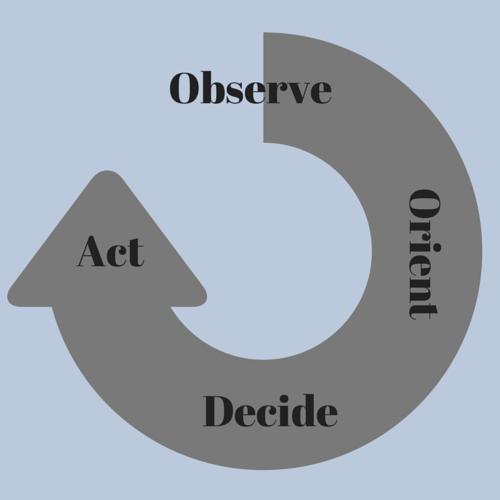
Developed by a U.S. Airforce strategist Col. John Boyd the OODA Loop is the concept that strategic advantage goes to the party who can best navigate the decision loop through observing the situation, orienting themselves, deciding what to do next and translating that decision into action. Through transparency, autonomy and experimentation, a responsive organisation moves decisions to the edge of the organisation accelerating its OODA loop to deliver better business value.

How does OODA accelerate my blogging?

Observe: My blogging is built on a foundation of being constantly on the look out for insights. Every day as we work we are exposed to great ideas, wonderful learning and exciting conversations that challenge our thinking. The more I capture the more I learn and the more I have to share. Are you tuned to observe and capture these opportunities to share through a blog? Managing your attention to observe these moments and building a system to capture notes at the moment helps.

Orient: A blog is an expression of your cumulative knowledge and experience. Finding a way to orient a new observation against your current knowledge matters to building a consistent philosophy. You need to know how a new post fits into your blog. Once I have an insight I try to quickly connect it to other ideas on the blog and elsewhere that extend the thinking. Building this system of links helps reassure you of the value of a new post. Ultimately I would like these links to provide an ever evolving network structure to the ideas on my blog.

Decide: Struggled with a white screen? Found your 500 word post is 2000 words long? These are challenges of deciding what you are writing about. Decide to share one small simple idea. Keep it simple. Stop when it is done. If the idea gets complicated break it into a series. If you have oriented well then the decision on the role and scope of a post is a little easier.

Act: Write. Just start. The best way to solve a problem in a post is to write. You can always throw out and start again later. Only by writing and posting do you generate the interactions that create new insights. Embrace permanently beta. Ship the post and let others help you learn more. This focus on action in blogging is the power of working out loud.

Accelerating the OODA cycle on your blog reduces the risk of a writer’s block or a monster post that can be finished. Work out loud one idea at a time and invite others to share and accelerate your learning.

International Working Out Loud week is from 17-24 November 2014. For more on #wolweek check out wolweek.com. International Working Out Loud week is a great time to put OODA into action in your working out loud.

The Leadership Thought Bubble

One action creates more danger for corporations than any other: asking leaders to give an opinion that they are unqualified to give. Sign-off should not be a time for input.

How many times have you seen this scenario? A team works on research and analysis. Using the insight developed, the team builds detailed recommendations and plans to implement them. However, to put those quality plans into action, they need sign-off from a senior leader.

This is the moment that a carefully developed plan meets the danger that is a leadership thought bubble.

All leaders want to make a difference. Most want to show that they add value. Sometimes leaders deliver a critical insight. However, too many will express a half-formed opinion to challenge a team’s thinking or to show that they are making a contribution. This moment is best described as a leadership thought bubble. An idea that popped into their head as they considered the detailed recommendations.

The thought bubble is a test too many projects fail:

  • Many projects take a thought bubble to be an order, changing their approach, surprising the leader and raising doubts as to the work that has been done. The leader rarely means their idea to replace the work done. Often they expect it will be simply considered.  
  • Other projects engage the thought bubble as a debate, pushing the leader to justify their half formed idea. As we know defending your position strengthens it and the more fragile the idea the more fierce the debate. Bad ideas get built upon and become harder for projects to ignore. Suddenly the leader has a point to prove.

Engagement upfront and ongoing in the development of recommendations can mitigate the danger of a late thought bubble. Clarity of when you are seeking approval and when you are seeking input also helps.

The best response to an unwanted thought bubble is to explain how the issue is addressed another way. If the issue can’t be discounted immediately then take the feedback away to consider in light of work done. In many cases, the leader will forget their thought bubble anyway. If it is an ongoing issue, then a more detailed fact based answer can be prepared at a distance. Even better, design an A/B test to put the leaders perspective to the test against the team.

If you have the confidence in your work, stand your ground using facts against leadership thought bubbles. Better yet structure your conversation so you aren’t inviting a thought bubble. Sign-off is not a time for input.

5 Ghosts of Leadership Past

Halloween is a time to remember those no longer with us and to laugh at those shades who have not left us. In leadership some ghosts of past leadership styles still haunt us.  They are too real and too enduring.

Here are 5 ghosts of past leadership that should be allowed their rest:

1 The General

Military command and control and military hierarchy have inspired much of our thinking in both leadership and management. For some, being a general in command of troops is the model of leadership.

Except the military no longer sees it this way. The military knows good leadership that empowers and enables teams to perform at their peak makes a life or death difference. Their approach has evolved well before business. Military leaders think of empowering agile teams to outpace their opponents in decision making and change to achieve a purpose. Military leaders fight a network with a network. The modern general is far less a commander than our perception of the napoleonic era ghosts of leadership.

2 The Decision Maker

Big leaders making big decisions is the second ghost of leadership past. These ghostly apparitions believe that if the ‘buck stops here’ then it makes you a leader.  

We know hierarchy is usually a terrible way to make a decision.  Decision making by remote hierarchical leaders lacks context, impedes agility and frustrates the engagement necessary to implement decisions. Nobody loves a dictatorship. Organisations need to make decisions in responsive ways and leverage experiments to help them to learn.

3 Egotist

If Carly Simon’s “You’re So Vain” is the sound track to your leadership, you might be living a ghostly legacy of the days when leadership was about charisma, big profile and a way to express your ego. These ghosts live on with leaders who think that the bigger the ego boost the more influence they have.

Leadership is not about you. Leadership is how we realise the potential of others and how we achieve purposes that benefit others. Check your ego and exorcise that ghost.

4 Know it All

It is said of John Stuart Mill that he was the last person to have been taught everything there was to know in his era. Mill was exceptionally bright, but the pressure of knowing everything led to a nervous breakdown and he has been dead for over 140 years. The legacy of the all-knowing leader lives on as a ghost.

Only leadership ghosts think in our increasingly complex and fast moving age that leaders must have all the answers. Leaders must enable their organisation to know more and use it better. They do not need to be the expert. They need to know how to better leverage expertise and to enable their teams to do the same.

5 The Invisible Leader

If there are oak panelled doors between you and your team, you might as well be a ghost. Nobody is led by pronouncements from the boardroom or one-way communications. Leadership takes relationships and engagement.

These ghostly leaders need to get out and engage with their teams. Turn leadership transactions into relationships and create some real influence and accountability.

Let the Ghosts of Leadership Past Rest

Let the ghosts of leadership past rest.  Like other human interactions leadership is constantly evolving and adapting to suit the challenges of our times.  Leaders need to let go of the old models and experiment with newer and more effective ways of engaging teams, particularly in networks.

Leveraging Accountability in Networks

In networks we are less able to leverage power to enforce accountability. Leveraging accountability requires a different focus as we are challenged to consider how we connect to personal purpose, relationships and reputation. Considering these approaches benefit leaders in each domain.

Accountability in Hierarchy is Done to You

In traditional hierarchical management, accountability is the responsibility of those in power. Accountabilities are enforced leveraging the power of leaders to reward, punish and exclude.

As a result accountability can be an imposed experience.  Decisions made remotely have impacts on status, rewards and other benefits. Accountability is a transaction of consequences that may not endure. An individual depends on good leaders to fully understand the process by which they are held to account and the rationale of the consequences.

Accountability in Networks is Personal

Confronted by an absence to enforce consequences with power many traditional leaders assume there is no accountability in networks. Individuals collaborating as peers are coming and going under their own authority. How could anyone hold them to account for their actions or decisions. We are too familiar from discussion of trolls and lurking with the idea that in a network domain there is little accountability.

Accountability in networks has not gone but it must be founded in personal decisions, relationships and reputation. Trust is the fundamental commodity of collaboration in networks and trust is a human process with swift and effective accountability.

For an individual to have any accountability in a network, they must have made a personal decision to engage.  The best of these decisions are founded in and reinforce personal purpose. Individuals rarely walk away from commitments aligned to their personal purpose. One of the reasons, efforts to hold lurkers to account fail is that the individual has usually made no explicit commitment to do anything. 

Communicating the decision to engage to others in a relationship is the the foundation for accountability in that relationship. Once the personal decision is shared it creates expectations in another.  How an individual performs against those expectations has implications for their ongoing relationship, their reputation in the community and the trust that others have in them.  Trolls explicitly avoid this relationship. They leverage anonymity to escape personal consequences and explicitly reject the norms of the communities that they attack. Trolling is a transaction in a community built on relationships. The major enterprise social networks rely on verified identities of employees to draw into the organisations community these relationships and their consequences.

Individuals who fail this relationship based approach to accountability will feel consequences. They may not be excluded or punished but they will find their influence decline as people decline to engage with them. Individuals will lose their authority to act. Having proved themselves untrustworthy the network routes around them like a blockage. The consequences of this for an individual can be harsh, devastating and enduring. Ostracism is a punishment for failing accountability in many ancient communities for this reason.

Leverage Accountability in a Relationship

To leverage accountability in networks, even those woven through our hierarchies, leaders need to follow some key practices:

  • Get personal: The best accountabilities are personal so we need to move from imposing accountability on groups to a focus on the individual and the individual’s actions and decisions.
  • Stand for a purpose: Purpose underpins deep accountability. If you stand for a purpose, you have a better chance of drawing the commitment of others who share that purpose and also of those people holding themselves to account.
  • Discover & share common truths: Shared context strengthens accountability. Focus on discovering and sharing common truths. You will be held to account for spin
  • Ask for explicit public commitments: Public commitments become part of relationships. Be explicit. Encourage people to share theirs and ask others in the community to hold them to account 
  • Lead adaptively: Creating tension that enables individuals and the community to reflect on performance and identify opportunities to improve is a key skill. The network will not always listen to leader’s answers but it is more likely to engage with a great question.
  • Enable in a Responsive Organisation: The focus of a Responsive Organisation on autonomy, transparency and experimentation increases the focus on personal commitment and relationships. A Responsive Organisation reduces the excuses around process and policy and seeks to extend the accountability of relationships to customers and community external to the organisation.

Accountability in hierarchies is based on transactions of power. In networks it demands a much more personal and relationship based approach.

This post is the last in a five part series on managing accountability in the network era. The other posts deal with:

Authenticity and Accountability in Networks

Authenticity is the foundation of accountability in networks. If we engage with pretence nothing is sure. By challenging ourselves and others to be authentic we have something to hold ourselves to account against when we interact in networks.

Accountability demands Authenticity

I recently saw this quote from Marc Mathieu, a senior marketer at Unilever, about marketing and it highlighted for me how much of our communication is changing in a world where we are surrounded by connected networks:

Marketing used to be about creating a myth and telling it. Now it’s about funding a truth and sharing it. – Marc Mathieu

Whether you are a leader, a marketer or an individual, the challenge is to share your authentic story and engage others. The authenticity and the humanity is what engages because it is true. We doubt the perfect and the mythical.

Networks have the capacity to unravel created myths and surface the contrary reality. The social movements that campaign against many organisations are seeking to make more widely known the holes in their myths. This is a process of the community through its networks holding the organisations to account for their lack of authenticity.  The movement will succeed or fail to the extent it can more authentically engage people.

Communication demands Authenticity

Communication and engagement built on pretence has foundations of sand. The same applies if we reiterate the opinions of others without any reflection as to their authenticity. If we don’t care to understand the facts and are happy to settle for spin or opinion, then we are comfortable with make believe and deceit is not far away.

No manager would seriously argue to run an organisation on this basis. Yet many engage in corporate speak, spin and massaging the facts in an effort to influence, market and improve their position. While this may gain short term influence, in the medium term it will have a devastating impact on authority when the wider network unravels the myth.  When leadership and influence in a network relies on your authority, it is wiser to build on surer foundations.

Authenticity is the heart of accountability.

Accountability is best when it is personal and when it is founded in an agreed context.  A connection to an authentic personal position brings accountability back to the individual in the network. There is no arguing later that you were mislead or that the facts have changed if the decision is authentically yours.

You will be held to account for what you say in the network era.  It is far better to make those views reflect the authentic you.  

This post is the third in a five part series on managing accountability in the network era. The other posts deal with: