Writing

Community is Two-Sided

‘Build it and they won’t come’ – Internet maxim

Organisation everywhere are seeking to leverage the benefits of connecting. In embracing community organisations need to recognise that the needs of the community matter too.

Community is always two sided. Participants in a community expect give and take. Community members come together for a common purpose but they also seek to achieve their own.

Community is not a channel for your messages. Community is not a platform that you can make others use in a way that suits you. Behave that way and you may get engagement but you won’t build community. This is why so many enterprise social networks disappoint and why so many social communities have little engagement. They have been built for the needs of one side only.

If you want the depth of connection, richness of contribution and creative potential of community, then you will need to participate as a member of that community, not its owner. Critically that means taking the needs of others into account in your plans.

Information Shapes Responsive Action

Traditional organisations aren’t inactive. The difference with a Responsive Organisation is how information is used. Responsive Organisations create and share information to guide action greater effectiveness of purpose.

Every organisation is busy. Management’s focus on efficiency ensures that activity is everywhere. Many organisations excuse their inability to be more responsive on the grounds they have so much going on. They just don’t have the budget or people to do more.

Responsiveness is not about doing more. ResponsiveOrgs do better. Focusing on effectiveness at delivering purpose changes their decisions.

In a focus on efficient execution traditional organisations choose to exclude information from decisions and limit decision making. They limit the sources of learning and potential. Efficiency can work on an internal logic. Effectiveness demands external orientation.

The challenge for a traditional organisation looking to become more responsive is not how to do more. The challenge is how to use information differently and how to shape different actions. Ultimately an organisation might get more done with less but that comes from greater effectiveness and better decisions.

Responsive Organisations learn. Better use of information helps shape more effective decisions. That is responsiveness in action.

Why Hierarchal Management Survives – Institutional Filter Failure

We like to believe hierarchical management survives because those in power won’t surrender it. More likely it survives because we have not yet developed better management practices for handling excess of information. Our hierarchies make us intentionally dumb to avoid the challenges of networked information flows. We rely on hierarchy to remain unresponsive.

The Power but No Glory

Ask most frustrated change agents about why management is not changing faster to new ways of working and conversation eventually turns to the lack of incentive for managers to surrender their power.  After all when the rewards, power and prestige of senior management is so great, why would any organisational leader jeopardise these benefits by moving to new models of management.  In this view a senior management cartel stands in the path of change.

Ask senior managers about the needed changes in organisations and they will list the same issues as the change agents – too many meetings, too many emails, not agile and responsive enough, bad decision making, not enough innovation, and poor execution. Senior managers recognise that power is not what it once was. Fiat power is declining, engagement is low and threats must give way to influence.

However, when you ask about moving to new network and self-organising ways of working, the first response is usually not about a loss of power. The first response is some form of “I barely manage my emails. How would I cope if everyone could contact me directly?”  This complaint may take the form of social channels as a new method of two way communication, the need to respond to new issues from customer or community networks, new performance measures, managing autonomous experimentation or the being exposed to incomplete work in progress through working out loud.

Institutional Filter Failure

Consider for a minute the shared list of the sins of a hierarchical organisation: meetings, email, narrow internal views, partial data, bad decision making and limited ability to act.  These aspects of the system are not symptoms of the hierarchy.  They are its reason for being.  They are the system.

In an age of an increasing overload of information, management more than ever needs filters. Clay Shirky famously said: 

‘There’s no such thing as information overload – only filter failure’

Our management systems are full of these ways to reduce and control the spread of information to make management life more manageable. They aren’t flaws, filtering is the system. The system is working perfectly as we designed it.  We have these process to make our organisations less responsive. We want to exclude lots of information to make managers’ lives easier.

Managers resist giving up these flaws of the hierarchy because we have not yet offered them alternative filters in which they can have confidence.

Responsive Organisations Use Information

Responsive Organisations don’t exclude information. They work it. Instead of trying to pass it around through series of filters, these organisations seek to enable people to make use of the information they have, to share it on a pull basis and to create new and valuable information to assist their work.

Think for a minute of the key elements of responsive organisations:

  • External orientation: Opening up the organisation to its environment and orienting it this way pushes the traditional hierarchical approach of information management to breaking point. When the ‘facts are outside’ to quote Steve Blank, management must embrace different ways of managing information.
  • Transparent Network structures: Network models of working are pull structures unlike hierarchies traditional push models of communication. In a network people have the ability to find the information that they need.  We don’t need to push it around we just need to make it findable through approaches like working out loud. This transparency contributes to trust and shared context, critical elements to reduce the decision making overhead.
  • Autonomy to employees: If employees have autonomy they don’t need to share their context and rationale with their boss to get a decision.  They just make the one that they think best.
  • Experimentation: Experimentation further shifts the burden of information and decision making. When the right answer is the one that survives a test, we don’t need meetings up the chain to get an OK.
  • Purpose: As most managers know communicating strategic intent down a hierarchy is hard work. Either the strategy doesn’t survive translation or the application in a different frontline context is a challenge, particularly balanced with the rules and regulations that must come with it.  Purpose is easier to get. Purpose comes from within an employee and can be a richer and stronger guide to their action.  Purpose reinforces autonomy.

Responsive Organisations adopt new approaches to filter and use information. Instead of relying on the decision making of a few overwhelmed managers in the hub of the network. Responsive Organisations enable every node to filter and to act on the information. That approach accelerates both learning and action.

Don’t Know, Learn

Hierarchical management is obsessed with what is known. (This is both the appeal and the failure of ‘big data’) Managing what is known is the objective of the system. Instead of knowledge the system becomes an information filtering system and critical insights are lost. However, you don’t need to know as much if you can learn.

Knowledge is not worth much as a stock. It value comes from use in a flow. Insightful analysts like Dion Hinchcliffe and John Hagel are already describing a new information platform view of the next phase of our connected lives

Responsive Organisations will be those that develop the approaches and practices to best use information in new ways to achieve the purposes of the organisation and realise the potential of its people. That’s called learning.
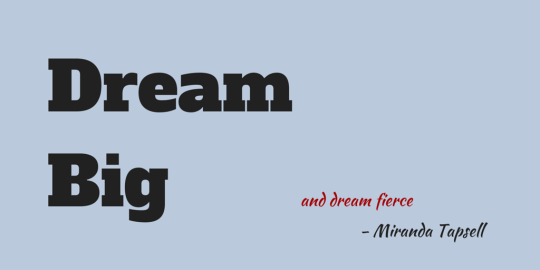
Dream Big and Dream Fierce

image

In life and in work, we need to aim high and we need to work hard to these goals. Even the best disappoint others occasionally. Failures and missteps are part of the process of learning. Others will forgive in time. However on any journey to a big goal, the toughest critic is most likely you. Don’t disappoint yourself. Be fierce in your own interests instead.

Dream Big and Dream Fierce

At the recent Logie awards, actress Miranda Tapsell spoke of her journey from a 17 year old Larrakia woman to winning awards in her chosen profession.  She called for more diversity in television because of its potential to inspire and unite us. Importantly, she also encouraged other young girls to “Dream big and dream fierce”. 

Dreaming big is important.  We have more potential than we know.  However, the latter part of that advice is well considered. Fierce pursuit of your goals is required for any form of success. Too many disappoint themselves by partial effort.

Stop Being Your Own Critic

Fierce pursuit of your dreams also demands that you stop the inner voices holding you back. Don’t let your own high expectations be a source of disappointment. You will be far more aware of your failings than others. Hold this in balance. Too many disappoint themselves by accepting the imposter syndrome that makes achievement feel unworthy.

Be Real

Success comes from being real in the world and improving every day. Big dreams aren’t achieved by dream boats. They are achieved by fierce agents of change.

Being real does not mean embracing others’ views of what are ‘realistic expectations’.  Fierce pursuit of your dreams means you must be real and engaged in the world. That means you need to have a real view of your status, your relationships and your capabilities. The need to understand these clearly is not because these are limits but because you must know what you need to change. Being real is the first step to learning, growing and getting where you want to go.

Being really also extends to accepting that there will be mistakes and challenges on your fierce journey to your goals.  Embrace these mistakes too as part of a real journey. Forgive yourself a lot and learn a little.

Stick to your values

The mistakes you will struggle to forgive are those where you don’t live up to your own expectations on how to behave. We all need a fierce focus on living to our values, especially when it is easy, attractive or convenient to take another path. Our influence comes from our actions and our integrity and we must fight to defend that against paths of convenience. 

Making the right decisions and saying the right things isn’t easy. Most of us aren’t perfect, but we need to have a fierce dedication to the values that make us who we are.  Big dreams are achieved through integrity.

Wherever your success journey is going, Miranda Tapsell’s advice is more succinctly and more elegantly than this explanation so as you go forward remember her words and share them with others:

“Dream big and dream fierce” 

Work takes Community

No employee is an island. Everyone is surrounded by relationships and the need to share goals, context, information and skills. Focus on the community.

Collaboration is Human not Technological

Dion Hinchcliffe made an important point about #wolweek in his list of key events in the evolution of collaboration.  Dion pointed out that #wolweek celebrates collaboration agnostic of the choice of technology. Working out loud can work as well on post-it notes as it does on an enterprise social network. Working out loud works when it enables an individual to find ways to engage a community.

The rise of Slack has fostered a debate as to whether the answer is small scale collaboration or enterprise collaboration. This debate confuses the technology with the community. Vibrant communities require both small and large scale collaboration. There is no such thing as a Slack community. Slack simply connects (The same is true of an enterprise social network or any other tool). People form the community. That community comes from the users and reflects their connections across the whole of their lives. The community may well, and probably should, reach far beyond the walls of the organisation.

If small scale collaboration doesn’t reach enough people or share widely enough, then people will add tools to achieve the necessary community. That may not always be the efficient way to work. However, we can trust a community to find the effective way to work.

Community is also fractal. Any large scale community is made up of smaller groups working around shared challenges. Don’t force the scale or the groupings for your communities. Allow people to find and shape the scale that works for them. Community management and social network analysis tools can assist communities to connect where there are gaps but they cannot make people into communities.

A vibrant community will use the tools that it takes to collaborate. Members of Change Agents Worldwide collaborate across a bewildering range of tools, as expert users. The collaborate from face to face conversations over coffee (often tagged as Change Agents in the Wild!) through an enterprise social network, through messaging applications, in other networks whereever we come together and in various forms of collaborative document tools. I can never predict where the next useful message will appear but I know it will come from my community. We collaborate where we need to go to bring the benefits of the community to the work.  

Build Collaborative Communities

The work I do with clients using the Value Maturity Model approach is about helping clients to identify and understand the communities that are a part of their work.  For many organisations this is the first time they have started to look at the real human interactions, rather than the formal hierarchies and process charts.

When organisations foster and support these communities across all channels, they discover the exponential potential of their people. Instead of managing people for efficiency like machines, they see that connected people, sharing purpose and working out loud can be dramatically more effective. The value creation through revenue, cost and risk benefits are clear.  The added benefit is building an organisation that is more human, learns better, is more trusting and more connected as a community.

There are now so many ways to connect that the issue is not whether you can bring the communities in your organisation together. Most organisations are struggling to keep up with the new ways that their employees have to connect. You can be sure your competitors are currently seeking these benefits by learning the new ways to bring their communities together. 

The key questions are what you are doing that stops your people benefiting from new and effective ways of working and what could you be doing to enable more communities. How are you enabling your people to achieve the benefits of community in their work?

Responsive Retail Experiences Required

Retail stores must be as responsive as their digital competitors. The days of excuses are over.

I needed to buy a specific item today at a retail store in Hong Kong. I looked up the store address online and confirmed its opening hours. I went to the store at opening to be told it was closed for 30 minutes more. When I returned 30 minutes later I was told they wouldn’t open for 10 minutes. The staff were casually cleaning the store and decided to let me in anyway.

When I was finally admitted they were out of stock, their stock ordering system was down for its second day and there was no chance of them getting stock this week. The staff in store were full of excuses and very apologetic.

I ordered what I wanted online walking out of the store on my phone. I bought it from a digital retailer. It will be delivered to my hotel same day.

This experience was in a luxury goods retailer. Their store for out is incredibly expensive. Their rent is high. There were lots of staff waiting around. However all the money invested is wasted when the systems and employees are not responsive to customers.

The store lost any opportunity to add more to my basket. Worse, I’m unlikely to shop that brand of stores again.

If a retail store is not organised to be as responsive as its digital competitors, then it will lose more than business. Unresponsive retail stores inconvenience customers and lose their support.

Choose enthusiasm

I am often told by others that I am so positive and enthusiastic. My concern is that enthusiasm and positivity shouldn’t be remarkable.

My enthusiasm for life and work comes from knowing my circumstances come from the choices I make. I choose to do what brings me the opportunity to be positive. I choose to work with those that I trust, value and with whom I genuinely enjoy the work. If these circumstances change, I change either fix things or choose to change what I’m doing to ensure I can spend my time making a positive contribution. I embrace my choices wholeheartedly, even the bad ones.

I don’t always choose to do the fun stuff. Life doesn’t work that way. Life need to be purposeful and fulfilling purpose takes effort and setbacks. My enthusiasm is because I know these challenges are part of the work. I just need to keep going and get past them.

I take care to balance enthusiasm with reality. I don’t want to be positive about the rose coloured view. I want to be positive about now as it really is. However that realism extends to being realistic about making change. Many fears never eventuate.

Making choices is never free of consequences. There’s money, fun, relationships and opportunities lost at every turn. Some choices disappoint. However living a life is not free of consequences. We have choice so use it and move on without regret.

Embrace your choices with positivity and enthusiasm. If you can’t do that, make a change. There’s nothing more powerful than to approach this moment with positivity and enthusiasm.

Real Conversations Influence

People with a modicum of social adjustment don’t start conversations by describing what they want from others. However many times in influence conversations (like marketing, sales, leadership or collaboration) we do exactly that. Make sure your marketing, leadership and collaboration conversations consider others as humans.

Today I received an email from a connection that was a poor attempt to hide an email marketing piece. I replied pointing out it had no relevance to me, wasn’t interested in my issues and asked to be removed from the list. The opportunity for further influence has been damaged.

Everyday we ask others to listen to us as people seeking to influence our networks. In verbal conversation, we recognise the need to build rapport, to explain context and to understand the other’s situation first. We know influence comes from a relationship.

However put us in a stage or in some form of digital communication and we often forget these critical niceties. We see influence as a transaction. I ask. You do ( even if the response rate is only 1%). We excuse our approach to ourselves on the grounds of urgency, efficiency, need or authority. None of these matter much to the other person dealing with our insistent demands.

More human conversations build relationships in all channels. Understanding and relevance are foundations for influence. There’s no excuse for shouting about your needs if you want influence.

Shouting your needs simply doesn’t work. Have a human conversation instead.

What’s your minimum scale?

What’s your minimum scale of operation? Disruption means businesses often have to survive declines in revenue as they change business model. Are you able to adapt to the future disruptions or will your business model be a barrier to change? Remember that the capabilities of your people will be a key element of any transformation.

Focusing on Minimum Scale of Operations

Clay Shirky wrote a telling account of the challenges facing printed media in the NY Times The insight is that inherent in any business model is a minimum scale of operations.  We are used to thinking of overhead.  However, Shirky points out that falling volumes can turn the infrastructure of operations into overhead. At a given scale, there’s no point continuing. The need to operate above that scale becomes a barrier to responsiveness and even survival in times of disruptive change.

We don’t pay much attention to the minimum scale when we are growing. We look for investments to make to grow the business. Our myopia only becomes an issue when we need to make changes to our business models.

Turning Growth Investments into Overheads

Often the investments in growth we make on the way up are the overheads we struggle with as we change the business model to respond to disruption:

  • Need national sales offices or store network to grow? It will be overhead as you shrink. Ask any bank about the challenges of keeping branches economic as transactions, sales and advice move elsewhere. 
  • Need a custom built IT system? It will be overhead when competitors adopt agile solutions in the cloud. 
  • Need a warehousing, distribution or manufacturing operation to cater to growth? It will determine the minimum number of units your need to sell. 
  • Need a fancy office for your growing workforce? At least you can probably sublet this overhead as your workforce shrinks or works from home.

The business cases for each of these investments would be based on steady business volumes and predictable growth. These assumption mean that the business has ruled out the ability to handle exponential growth or any significant decline in activity. Few investment plans consider the need for agility or the impact of the investment on future changes in business model. Requiring greater consideration of optionality in an organisations approach to growth would change the business model to a more responsive one at the outset.

Investing in the Agility of People 

Many organisations respond to their failure to create a responsive business model by aggressively cutting their personnel costs. Undoubtedly, disruptive change will mean a loss of jobs as business models change. In this process organisations need to take care that they don’t lose the human capital critical to the potential to respond to change.

People can be cut far more quickly than writing off one of the growth investments above. Announcing a personnel cut, often has a far more acceptable hit to the profit and loss statement for the share market. Cutting personnel can become a substitute for a strategy to respond to change in the market.

To avoid this outcome organisations need to consider on the way up that talented people can be redeployed more easily than an investment in infrastructure. Instead of investing to deskill people with infrastructure that become overhead in times of disruption, we can invest in agility and the capability of our people. Organisations also need to chose their activities to maximise the value that their people create. People can learn, adapt and create new ways to work and create value for customers. A responsive business will have at its heart a team of people working both in the business and on the business model, constantly learning new ways to be more effective, to respond to customers and to grow.

Struggling to maintain their growth, businesses facing disruption can face surprising new challenges in their scale of operations. Organisations need to plan for optionality as they develop a more responsive business model. They also need to consider the role of our employees as the engine of responsiveness.