Writing

#MSIgnite Day 4:

I spent Day 4 at Microsoft Ignite hearing stories of how Yammer is being put to use in organisations around the world to realise the potential of people and to provide a platform to connect organisations in their digital transformation.

A Spirit of Generosity

The day was full of many great stories and lots of practical advice which is a mark of the generosity of the Yammer community. It began with an update on a very familiar one as Al Reid of NAB shared stories of NAB’s network. Matt Dodd of Bankwest also shared practical advice using the Value Maturity Model from their experience of creating a thriving network on Yammer. Tom Kretzmer from Westinghouse also ran a session on Yammer for IT, but sadly I wasn’t able to hear it. Melanie Hohertz and Simon Denton also did a great session, including costumes on how to use both Yammer and Teams together, weaving together both the inner and outer circle. The MVP panel saw the audience tap into the expertise and experience of Martina Grom, Chris Slemp, Noah Sparks, Melanie Hohertz and Darrell Webster. Like last year, the discussion in the room saw members of the audience leaping in to share their ideas and contribute answers to questions (especially Lesley Crook of Change Agents Worldwide and Miguel Zlot of Coors)

In the MVP panel, Noah Sparks highlighted that fostering a culture of generosity is one of the key elements in the growing maturity of a Yammer community. The Yammer community at Microsoft Ignite reflected this at the highest level. After each session, audience members hung around to answer questions and solve each other’s problems. Some of the most creative conversations and vigorous exchanges have been over food, coffee or on the long walks across the halls. Consultants shared experiences, IP and approaches with their competitors. The generosity of this sharing was because they all recognise that change is hard and that we are better when the collective practice of Yammer adoption lifts.

Change is Hard

I noted in yesterday’s review that much of the advice on adoption was consistent.  Many of the challenges discussed across the four days are consistent too:

  • The fickle nature of leadership support: keep focused on strategy and value, tell stories to bring the value to life, focus on the executive’s business needs, keep pushing and leverage competition among executives to find a way forward
  • Explaining the benefits of collaboration and accounting for the value: have a strategy, gather the stories of success, follow those stories to the hard value in financial systems, be prepared to leverage champions and employees to advocate the value too.
  • The realities of winning user engagement, effort, time and attention in a busy world with significant business pressures
  • Areas in which Yammer still lacks features or the integration with the Microsoft365 suite to deliver: many of these are on the roadmap, but it is useful to hear the successes, human changes and hacks others have used to move beyond the missing options – I spoke to a financial services client on how their existing employee compliance processes were actually better protections than a technology feature that their risk department was seeking, because informed and accountabilities removes the behaviour at source.
  • The appeal of the shiny new thing: always

Many of the speakers have been successful leaders of Yammer networks for years. Audience members can at times feel that the stories of success feel out of reach. However, there was a lot of humility on display in all the talks to counter this with mistakes, missed opportunities and ongoing challenges openly discussed. There is no moment when a collaboration platform is done. A collaboration platform is never fully deployed. A community of humans keeps growing and changing. With that change will come new opportunities and new challenges.  That’s why there is always more learning, more potential and more work to be done. For all those struggling there is hope and reward for persistence when a community gets it and begins to engage in the journey to maturity.

We are tempted with our process focus to think of adoption like deployment, a series of steps to be done to move to completion. Many of the questions in sessions were appeals for simple steps. The speakers did their best to help, but they had to note that each community is different, improvisation, experimentation, and adaptation are required to fit the purpose, context, capabilities and culture of the  Adoption is not a playbook followed end to end. It is more like a work of street performance art, moving through phases woven from modules that respond to the needs and the circumstances (an idea I have borrow from and explored in more detail in the Experience Economy a book on the delivery of customer experiences)

Leadership

The flowing adaptive nature of adoption sets the context for the need for leadership. Discussion of executive leadership support was everywhere. However, there’s a more important form of leadership that must be fostered to win the prize of the modern workplace. Every speaker today, every audience member is a leader. Anyone tasked with building collaboration or leading a digital transformation has to be a leader. Digital transformation is more than technology or process change. It is a change in culture of organisations, Changing culture in communities with deep history takes leadership, both hierarchical and distributed.

Leadership is not a hierarchical position. Leadership is the work of influencing others to act to make themselves and the world better. That well describes the ambitions of the Yammer community at Microsoft Ignite. Change leadership is not safe and is rarely easier. The leadership dimension of adoption work lies at the heart of the challenges above. Successful modern workplaces don’t just have executives who get it and lead their teams forward with purpose and passion. They have community managers and change champions working to put in place the structures around which vibrant community behaviours can emerge. Most importantly of all, they have users who take the small daily act of bravery of sharing their work, their story, their assistance or their challenge on the platform.  Digital workplaces leverage all the human potential in the organisation.  That leverage is not just to do. It is also the leverage of finding and working with the leadership talents of all people.

To be able to leverage the benefits of this leadership we must remember that we need our digital organizations to support an environment of psychological safety such that people can take the risks of sharing, learning and working together on change. Leadership and role modeling in the community will build the trust and the examples necessary for success.

Gratitude

My visit to Microsoft Ignite ends with this post as client work calls me back to Australia with a day to go in the event. I know all the sessions are shared online so I will have some catching up to do when my plane lands, not just the last day but also the sessions I have missed in other streams. My thanks go to all who have shared their work across these days.  I would also like to thank Microsoft teams who have made the event possible and whose work was so well showcased at Ignite. Thanks especially to the Yammer team for their passion, support. I look forward to seeing them all again soon. I learn so much from them every time we meet.

There are two teams who made Ignite a whole lot of fun and helped push me to learn more and get more out of the event. The first is the Yammer MVP crew (Lonya French, Amy Dolzine, Melanie Hohertz, Becky Benishek, Simon Denton, Chris Slemp, Noah Sparks, Tom Kretzmer, Kevin Crossman, Martina Grom, Lesley Crook, Darrell Webster, Cai Kjaer, Scott Ward and the virtual participant Benjamin Elias). The second was the REgarding365 team, led by Alistair Pugin and Darrell Webster as community reporters, who set a standard of content creation, thought leadership and energy that was unmatched at the event. Thanks to all.

Thanks also to everyone who has followed along, liked or shared these posts or provided feedback on their value. The response each day has been a a wonderful reward.

#MSIgnite Day 3: Loops, Change and Platforms for Digital Transformation

Day 3 at Microsoft Ignite was again focused on the role of collaboration in the Modern Workplace and the changes required to support people to engage and be more effective on these platforms. I had two talks leveraging the Value Maturity Model on the day

Connecting the Inner and Outer Loop

IMG_1284

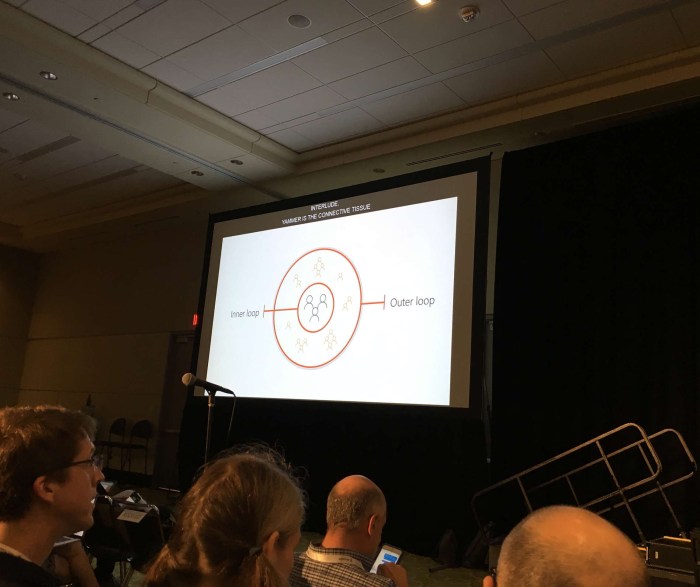
George Box famously said “All models are wrong. Some models are useful.” The more time that I spend with the idea that the Modern Workplace has an inner loop of high velocity focused conversations and outer loop of discovery and diversity the truer Box’s maxim seems. The two-loops model undoubtedly works to explain the position of the products and helps organisations and users understand the connected roles of the two tools in the Microsoft365 ecosystem.

I spent time at the Yammer Booth in the Expo hall talking to people about their questions and views. It was clear from these conversations that the commitments demonstrated to the Yammer roadmap and the new position have reassured many customers. The focus of customer questions was mostly how and why Yammer might coexist with Teams in an organisation. Discussing the two patterns of work and their interactions helped these customers to address their questions.

The intuitiveness and simplicity of the approach also belies some complexities. Firstly, We work in context and our context will come from both loops. A critical question that will need to be addressed in the ongoing evolution of this approach is what are the interactions and patterns of the connections, interactions and exchange of information between the two loops. Over time this behaviour can shape the product features ad change required for business success. These answers will be found in the working behaviour of people in effective digital organisations.

Second, these loops are complex networks compromising multiple overlapping subnetworks and stretching to the edges of the organisation and beyond. As Teams get larger and more active, I can see a teams user overhead issue that other chat products often experience. This could take the form of the forgotten channel or be the challenge of managing growing numbers of channels and messages.  Dynamic group membership, integration and community management tools may help ameliorate this, but the jury is out for some time. Growing maturity of practice in organisations using both Teams and Yammer will surface new challenges and opportunities of this approach.

Changing Work Interactions

Much of the day was listening to customer case studies of the journey of changing interactions in the workplace to support Yammer adoption. I heard case studies from both Diageo and GSK. I also heard Scott Ward’s advice on the tips and tricks of using gamification to build new habits and sustain change, engaging rewards and aligning them to intrinsic motivations.

As the community management and change adoption of collaboration platforms is a strong and mature discipline, it was not surprising to see consistency across the conversations about what it takes to deliver effective change and the business value that leaders expect.

IMG_9732.JPG

IMG_9784.JPG

IMG_9786.JPG

Yammer collaboration involves new ways of working so a key part of each of these stories was communication and sense-making. Creating and sharing stories across the organisation is a key opportunity to reinforce and build on this success.

IMG_9749.JPG

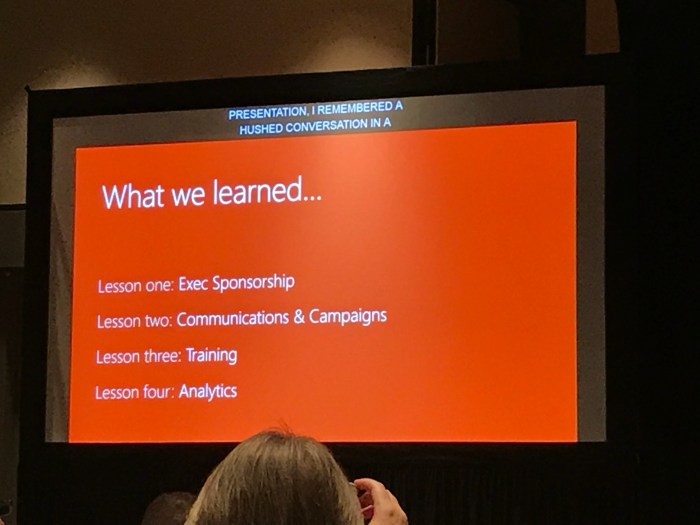
Executive engagement remains a key topic of conversation and as ever varies from the amazingly active to the distracted and busy leader focusing elsewhere. Making a case for the strategic value of collaboration matters to engage these leaders. Executive leadership can accelerate a collaboration and cultural change but it is not the only way. Great leaders make the investment to achieve their target culture for the organisation.  Clearly it is harder without the support of hierarchical power and authority, but good progress can be made by those well aligned even in the absence of investment and  If you cannot win a leader first time, another opportunity comes up on the transition of their successor. Whatever you do, don’t get disheartened by the swings and roundabouts of executive support. Have a strategy, deliver value and they will always come back. The point of my Breaking Down the Value of Yammer Post session was to show executives and users how you can find value and uses in a single post. 

IMG_9733.JPG

Strong executive sponsorship at Diageo

IMG_9754.JPG

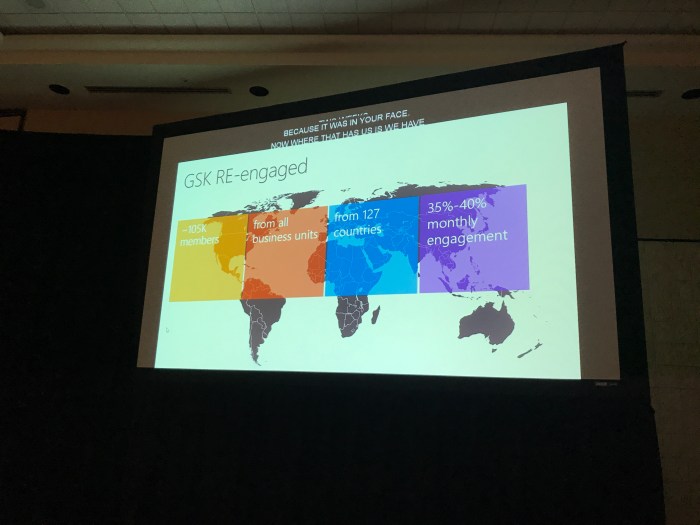
Showing the value of re-engagement at GSK

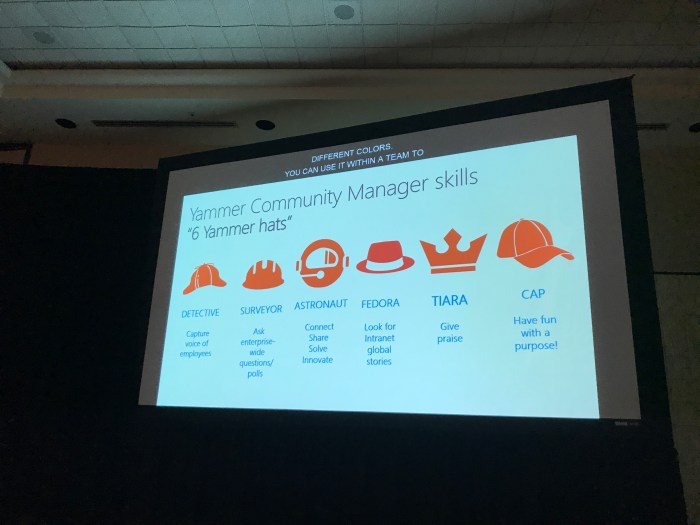
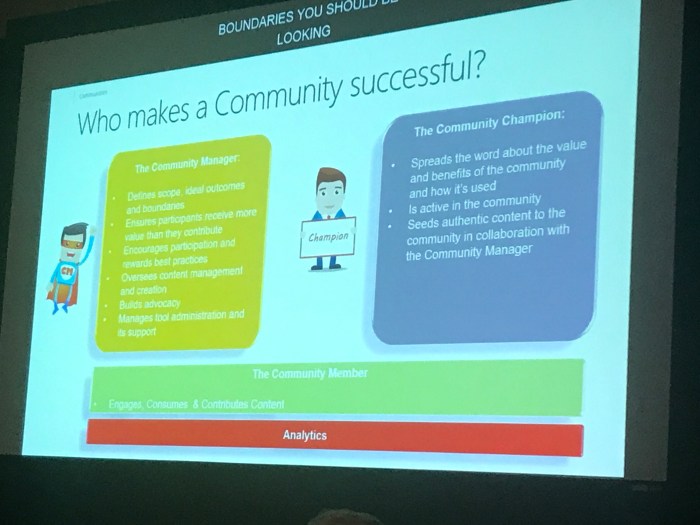
Community Management played a critical role in all these case studies. Lesley Crook outlined some key roles that community managers play as stewards of business value in their networks.

IMG_9756.JPG

Platforms for Digital Transformation

IMG_9789.JPG

Scott Ward, Cai Kjaer and I presented on Yammer as a Platform for Digital Transformation.  There is not an organisation in the world that is not at least considering its digital disruption transformation. The forces of change are irreversible and the evidence that new business models present opportunities and threats is clear. 

The point we wanted to emphasise is that digital transformation is more than replacing your processes with new digital wiring. The opportunity is to transform business models to deliver to customer needs in new ways, reorganising the way they work and creating a digital culture. This culture demands new transparency, new accountabilities, new agility, new leverage of customer insights and new collaboration organisation wide. We need to balance the focus & speed of inner circle agility with a wider awareness, alignment, & diversity of thought in the outer circle. 

If you are going to stand up stakeholder groups for each part of your digital transformation initiative, connect those streams in Yammer to help cross-stream awareness, build collaboration and deliver cultural change. Organisations that share a common context in the outer loop of collaboration are more effective in all their work. 

Digital transformation is not a technology problem. Digital technology and process change is easier with new cloud applications. The part that takes work is the customer insight, business model experiments and culture change. Yammer can help with all of that. 

Most importantly of all Yammer can help you identify the Change Agents and communities that will make all change possible. 

IMG_9743.JPG

Three Closing Questions:

What is your strategy to use collaboration to fulfil your digital transformation journey?

What investments in community are you prepared to make to have better customer insights, better employee autonomy and new levels of change? 

What culture do you want and how do your people connect in new interactions?

Day 2 #MSIgnite: Holding Tensions in Modern Workplace Transformation

Yesterday I outlined some of the high-level themes of Microsoft Ignite’s Modern Workplace stream. Today I will dive into the weeds as the conversations shifted from vision and roadmaps to the breadth of product development and customer case studies to realise that vision.

No Universal Digital Transformation

In sessions across the day, in conversations around the halls, at vendor booths, it was clear that digital transformation is sold in many forms. We had file-sharing as digital transformation, collaboration as digital transformation, giving the tools to work being digital transformation, the new Teams hub as a centre of gravity for digital transformation, and we had deep cultural programs of change to address opportunities for customers and employees and to realise human potential.

IMG_9698.JPG

Mars’ Team Leading its Modern Workplace work

What the better of these approaches explicitly recognised is that:

  • digital transformation is human change
  • the potential of digital transformation is more than digitising process,
  • the goal is meeting human needs and realising human potential

This approach means that from sessions on SharePoint, Teams, Microsoft365 and Yammer came a consistent refrain of listening and exploring to better understanding the employee & customer need in the modern workplace.  This insight better enables us to tailor solutions to the different employee and customer personas. The digital transformation context made clear that these propositions are not set and forget. Each is an experiment and the beginning of an agile process of adaptation.

Highlights of this approach in action were:

  • the breadth of capabilities delivered across SharePoint & OneNote to deliver modern user experiences consistent with or superior to the consumer cloud apps.
  • New Hubsites capability in SharePoint, where individual sites can be easily reconfigured on the fly in hierarchies and adapt automatically to fit style or other criteria set for the Hubsite.
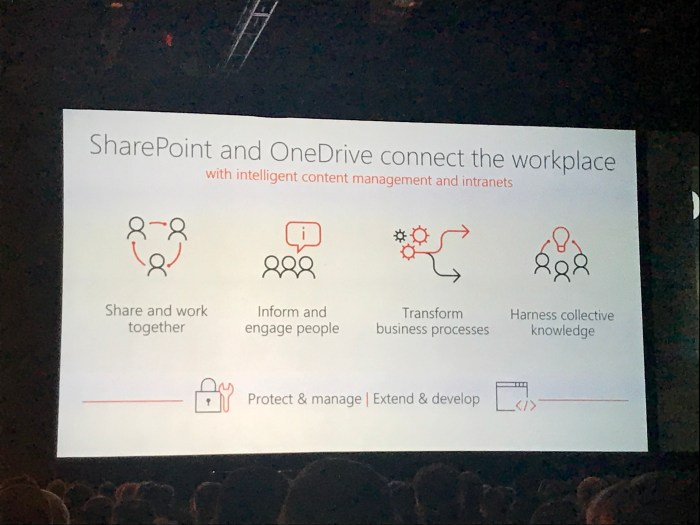
  • The ease of integration of Flow in SharePoint and dynamic business processes & applications built in ease visual steps.
  • Improved SharePoint Search with suggestions, previews and more
  • Teams adoption focusing deeply on listening and experimentation and supported by flexible FastTrack resources.
  • Yammer case studies based on experimentation and adaptation.
  • A light hearted discussion of the etiquette of the Modern Workplace by Loryan Strant and Darrell Webster of Regarding365.
  • Calls for working out loud and openness of work in many sessions.
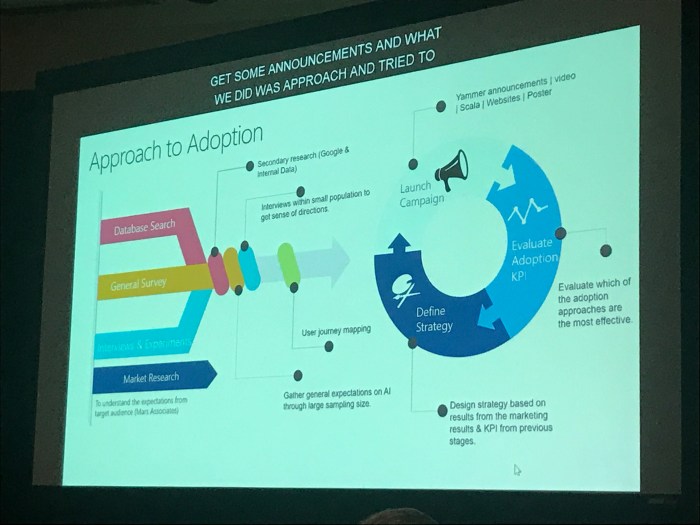
  • Mars’ approach to adoption of workplace tools

IMG_9720.JPG

Digital transformation requires cultural transformation. We need that culture to enable the agility and learning of a digital business. That begins by delivering platforms for connection across the organisation.

Connection

Humans are social learning animals. Every session spoke about connection and the opportunity to learn individually and together. Sharing and collaboration plays a key role in fostering this inherent human social nature. We do well when we begin from how our teams and organisations want to connect and share, rather than from a tools ability to help.

IMG_9700.JPG

Depth of connection at Mars through Yammer

The buzz of connection and sharing played through the corridors as Microsoft employees, customers and partners interacted. These conversations were the richest and most personal of the day. As good as many of the Microsoft presenters and products are, nothing beat the opportunity to engage deeply on issues that matter most to you. I particularly enjoyed the opportunity to meet the little circular faces of my social feeds as entertaining conversation partners. I also enjoyed the vibrant debates as IT Professionals and advocates argued their cases for the best way forward late into the night.

Adoption is Adoption is Adoption

IMG_9687.JPG

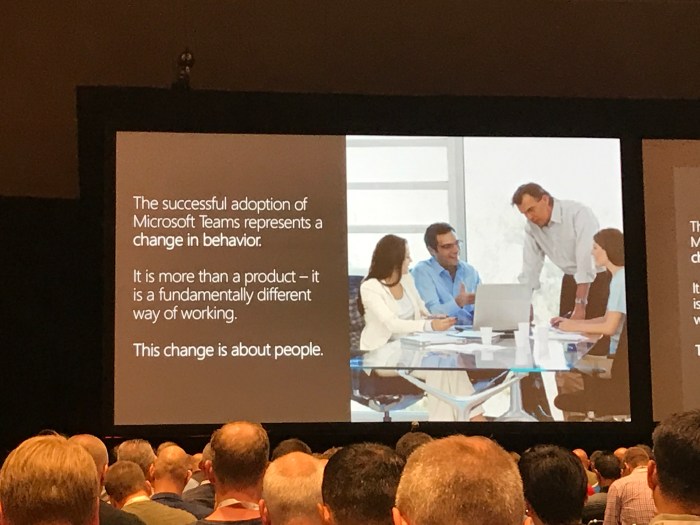
Across the day, we were reminded that adoption is asking humans to change their behaviours in the Modern Workplace. Technology alone will not deliver results without human change. That change is driven by human needs in their work and the process of change. We need to remember this is a human process for human purposes and must deliver benefits to employees and organisations.

IMG_9705.JPG

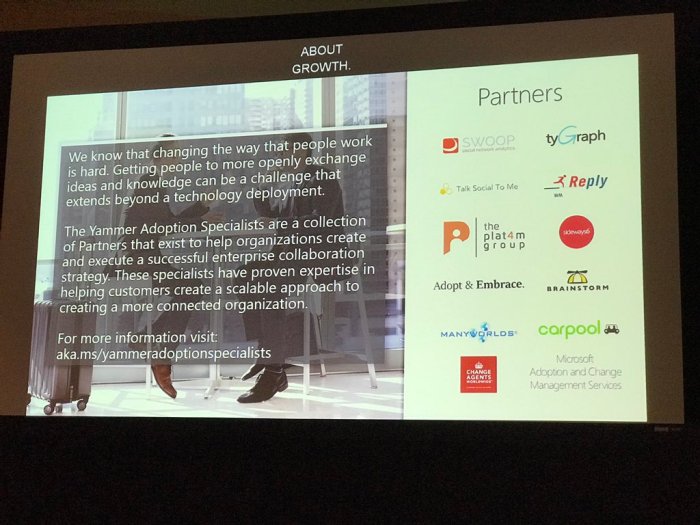
The adoption approach for Teams or SharePoint or Microsoft365 or Yammer when successful are driven by the same fundamental human insights. Adoption can be a frustratingly imprecise discipline to those looking for the directness of running code, but it remains essential to tailor to the manifold complexity of human work and its changes in every organisation.  With its breadth and depth of experience, Microsoft has a strong ecosystem of adoption partners.  Change Agents Worldwide was included in great company in the list of Yammer Adoption Specialists. Product focus is important but we need to be better as a community around Microsoft365 and the Modern Workplace to leverage the shared potential, experience and learning of a common adoption practice, rather than divide too tightly in product silos.

Pvk7HgYs.jpg-large.jpeg

Holding Tensions

In business, we commonly think there must be one right way, one set of settings that will deliver the perfect outcome for everyone if only it can be executed just so. That ‘silver bullet’ mindset can be hard to resist at a conference of shiny new toys. The messy complexity of changing digital markets, complex digital organisations and diverse human behaviour means that no one solution fits all.

Security is a domain in which there has been strong announcement across this event. It is also a domain in which it is impossible to control every vector of threat with one approach. Jeff Teper in the SharePoint session highlighted that Microsoft’s ambition is that moving to the cloud should not be a compromise. It should offer enhanced security options and we can see that as this event as Microsoft brings together the security underpinnings of all of Microsoft365, develop flexible toolsets, reporting and controls and uses its position with AI, and features to enhance the security offerings for organisation.

IMG_9654.JPG

Discussing security highlights the tensions of digital transformation in the Modern Workplace. Each organisation must balance a series of tensions to set its strategy for digital transformation and the modern workplace. The organisation must make its own settings for these tensions that reflects its strategy, its context, its culture and its risk appetite. These tensions play out in:

  • Transparency vs Privacy & Security: Never before have so many controls existed on people’s ability to share and use documents. Never before are files and conversations as accessible and shareable. In many cases, it felt the appeal of the tight domains of the inner circle of work in Teams was this ability to tightly manage activity.  What ever the outcome, we must remember that creating psychological safety is a key component of effective work. Microsoft repeatedly highlighted that an overabundance of policing may compromise the benefits sought.
  • Empowerment vs Control: Tools like Teams and SharePoint offer a depth of control of the work experience for employees. Policies, settings and analytics will shape what work can be done and how. We must be clear on the extent of empowerment required to ensure that security concerns do not send work backwards to the fixed task-driven roles of the production line. These roles are too easy to automate.
  • Consistency vs Diversity:  The outer circle of work is the circle of discovery, serendipity, surprise and diversity. This context shapes the work of the inner circle and the two must be held in tension for effective outcomes. Too consistent and you may miss ability to meet opportunities and adapt. Too diverse and the centre may not hold.

IMG_9718.JPG

A delightful example of this tension was in Mars’ case study of the use of bots in Yammer. Their user testing of the bot prototype revealed the limitations of the bots AI and the danger of a ‘demonic Clippy’ killing engagement across the network by answering all posts. The final solution was a blend of AI, intelligent workflows, human decision making, learning, and a deep understanding of the Mars culture and target employee experience. The first iteration of this ever growing solution was focused and designed to enable employees to address perennial questions like “which tool when?” but importantly delivered an answer to “who can help me? as well.

We manage the tensions of the transition to our new digital workplace each day with the people in and around our organisation. Learning, collaboration and adaptation are critical. No organisation wants to replicate the conditions for this transformation each time. On Day 3, I will be speaking with Cai Kjaer and Scott Ward on how collaboration can provide a platform for an organisational focus on this adaptation.

#MSIgnite Day 1: The Modern Workplace Now

Today was the first day of Microsoft’s Ignite Conference in Orlando, Florida. My focus at this event falls largely within Microsoft’s new Modern Workplace theme in its products. Here’s an overview of my takeaways from the first day.

Not the Future. Now

IMG_9608.JPG

The rationale for the Modern Workplace strategy for Microsoft is a familiar one. We all have seen the ongoing digital transformation of business. We understand the competitiveness demands of an increasingly global, fast-paced, customer-led and digital marketplace. At the same time we are seeing a shift to a new generation of workers who have grown up with digital technologies as consumers and also bring a stronger set of demands for engaging purposeful work.

The rationale reminds us that new work practices, new work cultures and new work tools is not some abstract future challenge. The future is no longer Mobile-first applications it is AI-first applications, rethinking the product to put data-driven learning and its potential at the core, not process. The Quantum computing discussion from Satya Nadella’s keynote more than stretched our brains with new abstract ideas from maths, physics and computer science that are a few years from every desktop.  The Modern Workplace is our workplaces now. To the extent organisations are not leveraging these technologies to their full there is missed value and missed potential. GE, a traditional leading case study, shared their work on workplace transformation if this point was missed by anyone.

People & Technology

IMG_9613.JPG

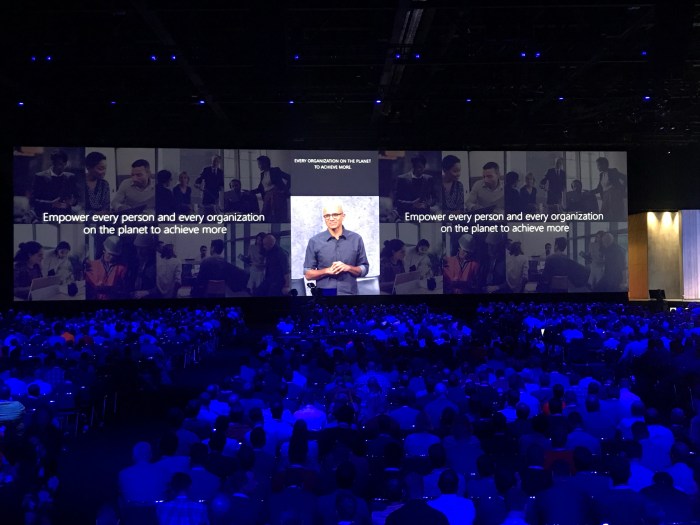
This was not just a Technology showcase. People were a critical part of the dialogue of the day. Julia White asking the audience to see themselves as change agents. Satya Nadella discussed a variety of people themes inspired by Microsoft’s purpose to “empower every person and every organisation on the planet to achieve more. Every session echoed with the constant discussion of changing culture and enabling new creative, new value and purpose in work and new teamwork.

We are not creating modern workplaces to sustain the work culture and practices of the last century. We are creating modern workplaces to drive change in culture, transform the nature of work and enable human potential. Even the strong focus on AI and automation that is usual threatened as a way to eliminate the humanity of work was strongly positioned as enhancing human creativity and enablement. The jury is out on that but don’t blame the technology. Humans will chose whether to use it to accelerate the industrial machine model of business of the past or to embrace a new frontier in human potential, tackling massive social and global issues and removing the mundane frustrations so all work has more meaning and value.

IMG_9634.JPG

Modern Workplace Tools

At the heart of the new approach to the Modern Workplace is a focus on the diverse nature of work and the different patterns of collaboration. Microsoft has been long criticised for its seemingly complex product landscape and overlapping and at times competitive product teams. The new Modern Workplace strategy embraces that complexity as the ability to meet diverse work scenarios. One tool will not rule them all.  Microsoft begins to help customers navigate that landscape through a focus on Microsoft Teams as the inner circle of goal directed work with predictable peers, for your work teams and projects and tools like Yammer as part of an outer circle of work involving unknown connection across the organisation for the benefits of discovery, diversity, inclusion and serendipity.  Teaming and Collaboration have new focus in the digital workplaceIMG_1284.JPGIMG_1285.JPG

Microsoft Teams will be heavily driven as the new platform for the Microsoft365 suite and its deep integration across Office365, Windows10 and more. Teams will begin to encompass the communication tools of Skype for Business and become the go-to hub for the inner circle of work. Email retains an important place in this landscape but so do increasing investments in LinkedIn integration, Bing Search integration, 3D, mixed reality, and analytics to power surprisingly seamless experiences on devices and driven by Cortana. Employees using Teams at Ford to share Virtual 3D designs may be a conceptual demonstration today but it’s clearly not too far ahead. That integration of collaboration & security for defined groups of workers using Teams will be appealing for many organisations dipping there toes in more agile and more collaborative work.

Most reassuring for a speaker at this event on the Digital Transformation potential of Yammer, we saw new investment in Yammer. With its new positioning on the Outer Circle of surprise, discovery, diversity and serendipity of work, comes a reiteration of its value for conversations organisation-wide, in communities and strategic initiatives. As Swoop Analytics research highlights, Yammer is one of the few tools that breaks Prof. Allen’s 50 meter rule – that the majority of interaction is with people within 50 metres. Working Out Loud played a key role in this focus in any discussion of Yammer or the Modern Workplace.

IMG_1296.JPG

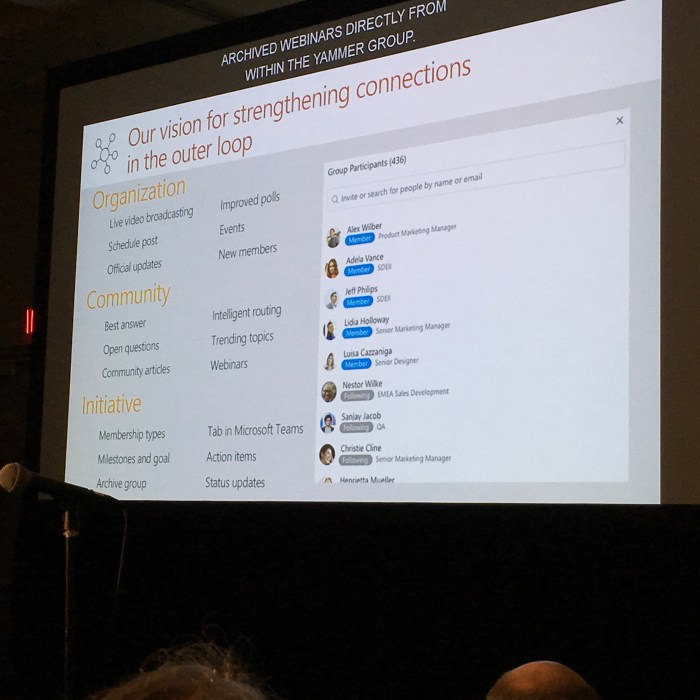
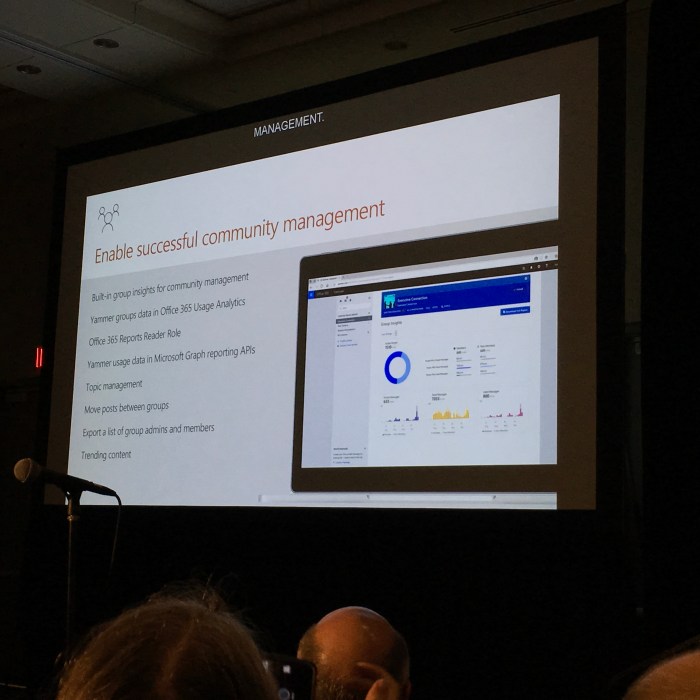
The significant investment in Yammer’s product roadmap belies the doomsayers. This begins with the interactions between Teams and Yammer. There’s new focus on Yammer’s depth of connection with Sharepoint, a great partner in the wider circle of sharing. The roadmap also included specific examples of better analytics, better integration with the Microsoft365 underpinnings, profiles and other apps, better mobile apps, greater breadth of APIs and continuing enhancement of user features like reactions, rich text and more. Most exciting for anyone who is an advocate for the value of community management was a new commitment to the community manager experience in Yammer from roles to access reports, to tools to help manage Yammer posts and groups, and a recommitment to the valuable but long ignored hashtag, a topic in Yammer. The future roadmap also highlights the focus for the next year on Yammer’s role for the whole organisation, communities and initiatives.

IMG_1294.JPG

My Inner and Outer Circles In Real Life

I came to MS Ignite in large part to connect and reconnect. Today was an extraordinary day of conversation, challenge, learning and fun with collaborators and communities that support and enable my work. Opportunities to learn face to face from a breadth of these two circles makes the experience an intense one. You don’t want to miss a chance to learn and to share.

IMG_9648.JPG

Lots to Digest. So What?

If you believe work is not changing, email is the only safe interaction pattern, and you won’t have employees soon, I doubt you read to the end of this post. If your views differ in any way, then the challenge for you and your organisation is to consider these questions:

  • Strategy: Do you have a strategy to realise the value of the Modern Workplace for your employees and your organisation? Your competitors are becoming more engaging, more agile, more customer-focused and more innovative organisations now as these tools extend and adoption of new practices is developed. When will you see this potential?
  • Investment: Do you have the investment in people, skills, capabilities, information and change necessary to leverage the potential today and into the future? Too many organisations see workplace, change and community management as peripheral roles. They are enabling all your people and all your work. Invest accordingly
  • Culture: Does your organisation have the culture it needs to be effective in the next few years? Experiments, autonomy, new approaches, new practices, and new work styles need to be embraced now.

Lastly, an abstract mathematical thought for the day: “The square root of anything is more powerful”. Whatever it means, it is a testament to human genius and human potential. When we understand what that means we will have discovered the emergent value opportunity in both circles of the Modern Workplace.

IMG_9614.JPG

What I am Looking for at Microsoft Ignite 2017

Microsoft Ignite kicks off Monday 25th in Orlando, Florida. This conference is a massive opportunity for the community of IT professionals, business leaders and Microsoft partners to gather, learn and share work going on. I’m speaking twice in the week on Wednesday with talks on Breaking Down the Value of 20 a Yammer post in 20 minutes and a joint talk with Cai Kjaer and Scott Ward on Yammer as a platform for digital disruption.

Here’s what I’m looking forward to this week at Ignite:

Connect

Gathering a global community of practitioners means the Ignite Conference presents a fantastic opportunity to connect with people who I have admired, read about their work and interacted over the years. No matter how many social channels you share or how many video conferences you have had meeting face to face is a great chance to deepen relationships.

I’m looking forward to meeting my Change Agents Worldwide colleagues, Susan Scrupski and Lesley Crook. A large part of the talented community of Yammer MVPs and Yammer Adoption Specialists will be at the event and I’m particularly keen to meet Melanie Hohertz, Noah Sparks, Chris Slemp, Martina Grom and Tom Kretzmer who I have not yet met. I will also spend some time during the week helping Alistair Pugin and Darrell Webster of the REgarding365 team with their reporting of the event.

The week also offers fantastic opportunities to engage with the Microsoft Product team leadership and understand their roadmaps thinking. Now is a critical time in the ongoing transformation of Microsoft. Satya Nadella has released his book on that change to coincide with this event. I look forward to what we can learn as Microsoft continues its transformation to a cloud services company and insights into how it will engage with the new opportunities and threats.

Share

Ignite is a place for plenty of learning. Over the 5 days we will hear updates on product roadmaps and strategy, learn from experts and hear clients describe their case studies. A few that I am particularly looking forward to seeing are:

There’s much more goodness across the five days and even narrowing down that list required me to omit many talks. Your tastes may be wider than just collaboration and there are great talks on Office365, Sharepoint, Azure, Security, Analytics and much more. All the talks are recorded and will be available through the Microsoft Tech Community. If you feel like you are missing out, follow the talks and the conversation there.

Ignite

Last year, I left Microsoft Ignite with a deeper understanding of the opportunity for community management to create new value in collaboration. I was passionately inspired to tell that story and to work with clients to transform how they saw the value creation role of collaboration in their organisations. That inspiration has driven much of what I have done over the last year.

I look forward to the next level of inspiration from this year’s event. I suspect the ideas and passion that I will be taking away will be on the theme of “Collaboration as a Platform for Digital Transformation”. We are reaching a moment where digital transformation is not an edge practice in organisations. Digital transformation is core and now organisations are looking to change management practices, organisational structures and other approaches in the pursuit of new levels of customer focus, agility and innovation.