Chair and Non-Executive Director, Advisor, and CEO helping healthcare, finance, and educational organisations drive growth, leverage technology innovation, and realise the strategic value of transformation
This morning’s #esnchat led by my Change Agents Worldwide colleague and change management expert, Jennifer Frahm involved a vibrant discussion about how to launch an ESN quickly. A strong theme of the discussion was that collaboration takes time to build and you should take care not to rush that development. The Value Maturity Model above is founded in the growing sense-making and culture change in a community that surrounds that community’s embrace of new ways of working.
Launch Quickly. Succeed Slowly
In part the question is not the real issue. Launching a social collaboration solution of any kind is not the problem. Launches can be put together in days or weeks depending on your passion for chaos. Send some communications, enable the network, have a fancy launch event and you are done. Launch is complete.
However, a successful launch, even with a high level of engagement, is not the point of collaboration in your organisation (this article was pre-reading for the #ESNChat discussion). Your organisation and your employees work to create business value. Until your collaboration platform is sustainably creating that level of business value your job is not done. The Value Maturity Model describes some of the key steps to that growing maturity over time.
What if you don’t have the time?
We don’t always have the stakeholder support to take time. Many organisations want or need to get going quickly. Launch dates become fixed in the calendar before organisations understand why they are seeking to launch a collaboration platform. The key issue in my experience is that the same organisations who want to go quickly are usually those who think that going fast will make their collaboration network cheaper to launch and run.
The value of a purposeful, strategic & vibrant collaboration community is that it becomes self-managing. The community begins to develop the value and the engagement that drives its own future success and growth. The community becomes the example to all new users as to ‘what we do here, how we do it and why’. Over time that self-managing, self-promoting and self-correcting characteristic of successful collaboration platforms is what reduces their cost to operate and accelerates their value creation.
Setting up a community to become purposeful, strategic and vibrant takes time and money. If you want to do that quickly, it will cost you more money up front in the planning, leadership and communication, not less. You will also need to invest more money over the life of the community to manage the higher risks of failure and to sustain the community after launch until it becomes self-sustaining.
A5 If you want to go fast you have to invest enable employees to make meaning quickly. That means you need to invest up front in strategy, leadership, communication and change support. Fast and cheap isn’t a thing. #esnchat
A5 You also need to allow that fast might fail or fade. (You cut corners. That can hurt) Invest in the long term value and back your community managers to see out strategy #esnchat. #cmgr
People forget building community saves money. A vibrant purposeful self managing community doesn’t need push. If you skip building the human community you push all the time forever. #esnchat.
When there’s no community, the value for people and org is not there to answer the demands of reasonable business. leaders. Don’t fear or avoid that question. Embrace it. #esnchat.
Community managers often bemoan the continued focus of business leaders on the costs of their work. Many organisations seek to continuously cut budgets and resources for community management over time. Let’s be clear that organisations decrease investment when they lose confidence in the returns from an activity. Community managers are the agents and architects of strategic value in collaboration. They need to embrace the challenge and justify their ongoing investment in their growing returns.
Given there are many platforms in the market that promise fast engagement (& with good evidence to support it), the issue is not how quickly you engage in use of the platform. The key challenge for any user and any organisation is how quickly their use of a platform becomes a self-sustaining contributor to the fulfilment of purpose and sustained value creation. When clients ask me why the investment in developing their community using the Value Maturity Model is required, my answer is that they can skip the work, but they risk skipping the value. The value of a clear strategy and an effective approach is that it accelerates the value of strategic collaboration. If you want to go fast, you need to plan for more costs, now and later.
A new scientific truth does not triumph by convincing its opponents and making them see the light, but rather because its opponents eventually die, and a new generation grows up that is familiar with it – Max Planck
If science advances one funeral at a time, management ‘science’ advances more slowly. For management to advance, there must be a radical transformation in the nature of work and our organisations that makes old management practices extinct. That change is now underway as digital transformation changes our industries and our work.
Changing the Paradigm
The word ‘paradigm’ fits niceley into a buzzword bingo square for most in management. It is a fancy term that consultants like to throw around. However, paradigms are why science advances ‘one funeral at a time’. Prevailing theories in a scientific discipline create culture and power structures that are self-reinforcing. Thomas Kuhn referred to this as a paradigm – “the practices that define a scientific discipline at a certain point in time.” Those practices shape who has seniority, what looks like a right answer, who gets to decide what is published and which research directions are acceptable. By shaping what is measured, what questions are asked and how answers are interpreted, a paradigm has a long reach shaping the continuation of that approach. As long as the proponents of the current paradigm are in power, alternative approaches are often suppressed or at least confined to the periphery.
Management likes to see itself as a science of measurement and performance, but the reality is that it is far less scientific. Much of management is complicated resulting in difficult or remote or multi-factor connections between cause and effect. Much of management is still run on intuition or prevailing opinions. These elements reinforce the prevailing paradigms. If we look for dramatic changes in the theory of management, they are few and far between, many of the everyday principles we have today can be traced to the beginning of the industrial revolution or to Taylorism at the beginning of the mass manufacturing age.
How can these ideas be so enduring when in many cases there is strong evidence a management approach is ineffective. There is plenty of evidence that pay for performance remuneration and highly targeted performance environments can be ineffective, costly and even counter-productive. However, these approaches remain the default way that organisations manage, measure and reward performance. Dan Pink gives some examples in this short video.
Why does it takes a radical shake-up in the nature of industry and our organisations for managers to reflect on whether there is a fundamentally better way of fulfilling their roles? Management theorists like Gary Hamel have been calling for management innovation for some time but the progress has been weak. The few managers who have sought to lead change have been seen as mavericks with the adjective ‘dangerous’ held back for private conversations. Even successful examples of new management approaches such as those flowing from the Toyota Production System have been either isolated to a few organisations or been adapted to fit within the prevailing management paradigm for general consumption.
Here’s my hypothesis. Failing ideas in management survive because the measurement is weak so proving failure is less direct than in a university experiment and the social pressures to conform in management are so strong. Career progressing in management is entirely dependent on being a right thinking leader like other past successful leaders. Worse still the paradigm in management has become ingrained in processes and systems so that efforts to change require radical overthrow of the way businesses work. The outcome is that change is not a question of a generation of management dying off. Change in the paradigm can require a whole industry model to die off under the competitive assault of new models. The first industrial businesses powered by water, steam and machines killed off the craftsman model of industry. The mass-manufacturing businesses and Taylorism killed off the first industrial models of work.
The Next Great Extinction of Management
The next great extinction of management has already begun with the digital transformation of business. With the rise of new digital competitors, we are seeing a new found energy in the innovation of management. This time around the innovators have management directly in their cross-hairs with new work management practices like Agile and approaches like increased use of analytics and prediction seeking to either remove traditional management roles or reshape them entirely.
Traditional organisations have begun to look at their practices afresh as they see traditional management role models struggle and fail. At the same time, they admire and seek to replicate the success of newer organisations, hiring their talent and seeking to bring new practices across at the same time. The change is not always driven by evidence or even success. In many cases, the shifting management paradigm is simply driven by a fear of being left behind and the need to create evidence of change that enables the next career opportunity.
With a great deal up for debate and much of the future paradigm in flux, the market for management is as confronted with much insightful and proven practice and a great deal showmanship & thought leadership. The lack of a clear path and the flailings of traditional managers to either defend old ways or jump on new approaches can be frustrating for change agents looking to consistently build new and better approaches to work. The better organisations are embracing their change agents and realising that they cannot import ‘best practices’ whole they must adapt new ways of working to their own circumstances and organisation.
Change Agents are critical for organisations navigating these changes. Management is less a science and more about the creation and shaping of a culture of performance. That culture is inherently local to each organisation and influenced by the complexity of the environment, team, purpose and goals of that team. As the surrounding environment in organisations becomes more complex and the pace of business continues to drive change, businesses cannot rely any longer on importing best practices and copying them onto their organisation. They must be looking to develop adaptive cultures of perfomance within their organisation that are learning and continuously changing. Platforms that enable change agents to sustain this change will be critical.
By the time you hear about the next great management book that everyone is reading, the paradigm will have changed. Focus instead on how your organisation can manage the process of learning and adaptation to deliver excellence in performance and the realisation of human potential. That’s the future of management
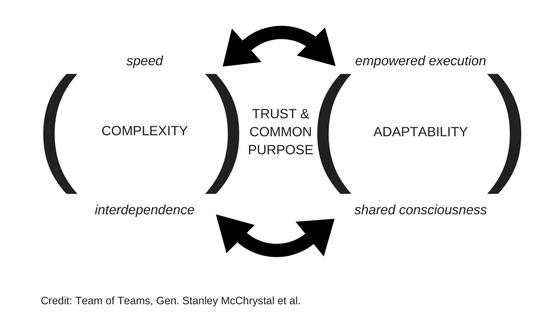
Last week I had a couple of long flights and I read ‘Team of Teams’ by Gen Stanley McChrystal et al. again to refresh my understanding of the authors’ insights into creating agility and responsiveness in an organisation tackling complex rapid change. At the conclusion of the book, the authors describe their model for an effective team of teams combining speed, empowered execution, interdependence and shared consciousness in an environment of high trust and common purpose.
‘Team of Teams’ highlights that traditional hierarchical environments struggle to adapt to the pace and complexity of change. The cost of information exchange across a hierarchy and the lack of autonomy prevents effective adaptation. Teams can ameliorate this at a local level if properly managed but a hierarchy of teams will have limitations on its ability to adapt. Structuring a more fluid structure that allows for constellations of teams working as a network is the key. This Team of Teams can adapt and reorganise itself while sharing information across the network in a rapid and responsive way through practices like working out loud.
McChrystal et al. note that complexity comes from the speed of change and the interdependence of parts of the organisational system and surrounding environment. Adaptability depends on being able to manage individiual execution in a pervasive awareness of the system and the role that players are taking and the actions that they are undertaking. Coordinating these elements requires a universal understanding of purpose and high levels of trust across all in the organisation.
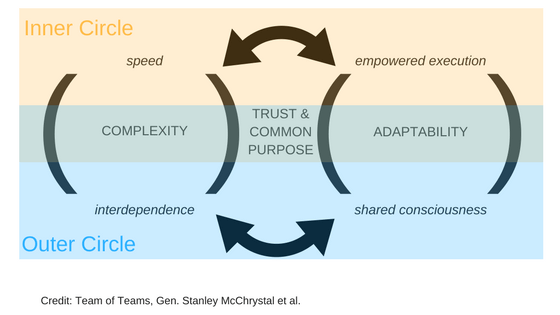
What struck me was the alignment to the Inner and Outer Circles of work that are at the heart of Microsoft’s Collaboration product strategy. The Inner Circle in the Microsoft version is the environment of speed and empowered execution. This is the environment that solutions like Microsoft Teams are designed to support. The Outer Circle is the work environment of organisational connection and discovery. In the Outer Circle teams have the opportunity to share the visibility of their work with others widely across the organisation and explore unexpected connections around their work.
There is overlap in both circles and as noted in my previous post, the shaded areas above only capture the core environment of each circle. You can push the circles and their associated products to cover the entire domain of a Team of Teams if required. However, each pattern of work is different and there is value in specialisation.
What is critical to note is that Trust and Common Purpose are issues in both an Inner Circle team and and Outer Circle community. Both depend on purpose for shared connection and a sense of direction and trust for effective collaboration. The work of community managers and leaders is to foster trust and shared purpose. This is the work of change and adoption and where the alignment to the value maturity model supports the development of community.
Every digital transformation project needs to build a platform for the critical capability for success in digital – human learning and change. Ensuring your people have the tools to collaborate and the freedom to change is essential for the rapid and scaled digital learning and change to be able to deliver strategic value to your organisation.
Platforms for Digital Transformation
The evolution of digital transformation has put a high value on platforms because platforms offer more than just the opportunity to connect and transact efficiently and effectively. Digital platforms bring together diverse players within and across markets and enable them to connect easily with standard API interactions, interact in standard easy ways and offer a predictable stable environment of trust.
Platforms help interactions in digital to scale quickly because the platform gathers an active community of users building the network effects and the benefits of diversity of capability and information. Standard interaction patterns allow an innovation ecosystem to develop despite this diversity and users are spared the cost and complexity of dealing with each other’s complex processes costs and systems. The growing user commitment to the community, the learning that occurs in the platform and the growing trust helps further to reduce the cost of any transaction and increase the appeal of the platform as a place to solve problems.
So platforms work because they:
connect users in a market
provide easy standard processes to reduce the cost and complexity of action
provide transparency and other processes to improve trust
build an innovation and learning ecosystem that creates ongoing valuable change for users
In a platform environment, participants can benefit from greater transparency, greater learning and greater innovation, while retaining their freedom of choice and control over how they participate. We have seen over time the power & value of eBay & Amazon as an auction & commerce platform, Google & Facebook as advertising platforms, and many more. Increasingly organisations pursuing digital transformation are looking to the opportunity to create these two-sided market opportunities in their digital strategy or to participate in digital ecosystems effective which demands at least the ability to interact with these platforms, whether through APIs or other forms of integration.
The Human Platform for Digital Transformation is Collaboration
At Microsoft Ignite, I spoke with Cai Kjaer and Scott Ward on the role that collaboration plays as a platform for digital transformation enabling employees to transition easily between the inner and outer circles of their work.
Organisations that want to accelerate the digital transformation in their organisation need to develop ways to accelerate this learning and feedback process for their employees. A standard human platform for digital transformation on their collaboration platform will play a critical role in reducing the cost of learning and feedback and increasing the trust and effectiveness of the resulting change.
Traditionally, the biggest barriers to learning and feedback in organisations are:
not knowing where to go or who can help (no clarity of the human market for learning)
an uncertain, costly and slow process of engaging others (high complexity and transaction costs in this human community)
fearing that you will be judged adversely for asking for help or exposing work that is incomplete (lack of trust in the organisation)
concern that learning and change is likely not to be valued in a risk-averse compliance-oriented environment (lack of value in learning and change in the organisation)
The value of organisations building a collaboration platform in their organisation is to specifically address these three issues to help accelerate learning, feedback and change, whether in the domain of focused execution or in the wider enterprise challenges of alignment, engagement and discovery. Organisations that invest in change and adoption to build effective collaboration platforms for their employees see the growing maturity of the use of the platform by their employees through the Connect>Share>Solve>Innovate maturity model. This growing maturity itself enhances the ability of the organisation to deliver its strategic agenda and manage its day-to-day processes more effectively.
Let’s examine for a minute those key items on the top right of the chart that describe the rising benefits of collaboration platform as it matures. How does the platform increase the value, trust, empowerment, collaboration and agility of the organisation? An effective collaboration platform is a human digital transformation platform:
Market: employees know where they can find a vibrant marketplace of other employees willing to Connect>Share>Solve>Innovate: the collaboration platform becomes a straightforward home for any need for learning, feedback or change (connect a market). Community managers and their agents in the community champions will play a key role in bringing people together in the community and fostering day-to-day use. Leaders can help by using their positional power and participation to bring people along and set the direction for the community.
Standards: employees have standard processes and interactions to get the learning and feedback of others – this is why effective collaboration launch and adoption programs focus on developing user behaviour around common uses cases, hashtags and groups. Building vibrant communities means that each of these areas that an employee will have a standard expectation in the community as to how it is to be managed, a culture of collaboration that facilitates interactions like a human-to-human API.
Trust: employees can see on the platform the culture of working out loud, others role modelling the behaviour that they want, the contributions of leaders and the lack of negative consequences and benefits of interacting. Experimenting with working out loud at scale reduces the trust cost of working out loud for any user. Importantly too when employees can see the authentic interactions of the wider community and come to know them better the cost of seeking learning, feedback or change is reduced. Community managers, leaders and champions play a critical role in creating a culture that fosters this.
Ecosystem: As these networks mature to the Innovation stage, employees will be exploring potential to take the strategic goals of the organisation further and have a demonstrated freedom to act building on the capabilities of the collaboration platform. This role-modelling helps foster the degrees of freedom individual employees need in a digital organisation to learn and to adapt through needed change. A vibrant community of collaborators and access to leadership reduces the human cost of employee innovation and helps improve the alignment of these innovation activities to strategic goals.
Creating a Human Platform for Digital Transformation
You cannot rely on the technology tools you are using to create this platform. The most challenging aspects of this change are human and no matter how strong the engagement techniques are in the technology it cannot provide human elements like purpose, connection, trust, leadership, and alignment. It is important to remember that employees first and foremost concern will be their safety and success in the everyday workplace off the technology platform. That is where change and adoption must help support employees.
Creating this human platform to accelerate the organisation’s digital transformation and to deliver real strategic value takes an investment by organisations in a number of key elements:
champions who lead the community day to day and develop its norms and practices
organisational leadership that understands its role in networks and in fostering digital innovation.
the experimentation, change programs, launch activities and other ongoing efforts to engage the wider organisation in collaboration, to maintain connection and to grow the value of the collaboration.
From the experience of organisations around the world, it is clear that it takes more than ‘launch and forget’ to realise this human dimension of collaboration. Changing the collaboration in your organisation is a cultural change that impacts all your employees. The benefits to your organisation and its digital strategy are transformative if you are prepared to invest in the change.
Simon Terry enables organisations to realise the strategic value of collaboration as a platform for digital transformation. Simon is a Yammer Adoption Specialist, a Microsoft MVP and a Workplace by Facebook Adoption services partner. Through Change Agents Worldwide, Simon and a global network of future of work professionals help organisations to lead change, collaboration and new ways of working.
Don’t wait for formal processes to manage accountability. Foster the little acts of courage that deliver accountability in real-time when required.
One of the reasons that traditional organisations struggle with the transition to digital ways of working is that they lack a consistent flow of accountability conversations. Accountability conversations are little acts of courage. Traditional organisations build elaborate structures and processes to ensure that accountability conversations occur. That’s why there is so much emphasis on reporting lines, performance management processes, peer review, measurement, business reviews, reporting and service level agreements. These activities are all proxies to force people in the organisation to have accountability conversations. Often these proxies become ends unto themselves with a bureaucratic efficiency that frustrates their purpose. We have seen meetings that were ostensibility to discuss accountability devolve into a series of formal set-pieces to ensure everyone avoids the difficult accountability conversations.
Forcing people to have an uncomfortable and risky conversation, usually results in compliance not commitment. People may duck the moments of little acts of courage, but still comply with the formal processes ensure that empty or confusing conversations are had. The consequence of a remote, formal, delayed and intermediated process of accountability is that these conversations are often unwanted by all involved. The resulting conversations are full of euphemism, deflection and opinion, feedback delivered by those who weren’t involved and the need to investigate further new issues raised. All this ensures that they are largely ineffective. Worse still the delayed and formal process has the outcome of taking small acts of feedback and blowing them up into major dramas and relationship breakers. Forcing people to have a conversation that involves little acts of courage just guarantees a conversation. It doesn’t guarantee courage, learning, or value.
Digital organisations focus on bringing forward the courageous conversation and getting into the conflict quickly. Every accountability conversation, especially those based on a difference of opinion, is a learning moment. The agile pace and real competitive demands of digital organisations mean that learning is valued, outcomes are the highest priority and conflicts must be surfaced early. These digital organisations have focused to varying degrees on different approaches to foster the psychological safety and directness required for the small courageous acts of accountability. Agile, Scrum, Lean, Holocracy, OKRs and other approaches are all paths to solve the absence of acts of accountability in traditional organisations.
We must remember that no process is an effective substitute for a purposeful, timely, respectful and brave conversation. Leaders in digital organisations must be on the alert for signals of misalignment and lack of timely conversations of accountability. Encouraging these conversations and fostering a culture of little acts of courage must be the first work of leadership in digital organisations. When digital organisations can deliver a consistent flow of these little conversations about accountability, issues of alignment, customer focus and performance disappear quickly and learning is accelerated.
Fixing the accountability issue for all organisations does not require a new process. It requires a relentless focus on fostering the kinds of conversations that resolve issues, improve performance, and allow people to learn and grow. The fix begins and ends with little acts of courage.
Recently in Change Agents Worldwide we were discussing the challenges of change leadership. What struck me in that conversation was that there is a real challenge of courage for leaders. Change leadership is difficult, not always a positive experience and fraught with failure. Leading change takes people to have the courage to push for change.
The challenge of leadership courage in change is not the big risky acts that demand bravery. Big risky acts are those people are expected to pursue in leadership roles. There are rewards for taking the big risks even when you fail.
Little Everyday Acts
Earlier this year I read my Change Agents Worldwide colleague Lois Kelly’s book, Naked Hearted. The book is about removing the filters and getting to the real issues. Besides being beautifully written, Lois shares a series of personal essays in which she examines many of the ways we can duck the chance to be open and show courage in being ourselves. Lois has taken this theme further and is now running a series of Courage Camps to enable others to examine how to be bolder.
The book was a reminder to me that the hardest form of courage is the little everyday acts of courage. These opportunities for leaders to take these small risks come so hard and so fast that it can be easier to take the easy option and avoid them. There is rarely praise and accolades for these everyday actions. At times, there can be enormous social pressure to “accept the status quo”, “fit in and get along”, not to raise “the elephant in the room” or to “go with the flow”. We have lots of phrases to describe surrendering our little acts of courage.
We can at times feel that even a single missed moment of action on these little acts creates insurmountable barriers to future action. These little acts offer little reward for action to overcome doubts. With doubts and barriers leading to inaction, over time expectations can arise that certain issues won’t be addressed. The expectations are how toxic cultures are built over time.
The little acts of courage include:
presenting ourselves openly, honestly and without gloss
separating yourself from a group
pointing out a difficult, hard or inconvenient truth
sharing hidden or suppressed stories
listening when the conversation makes you uncomfortable
Each of these acts of courage takes no more than a moment. We barely notice whether they are there or are missing. These are the moments that can often shock us into inaction and we think of things later that we should have said. Often we have to reflect deeply to understand what happened in the rush of our days and how we could act differently.
While these acts are small, they are missed if not addressed in the moment. High-performing teams and vibrant cultures create an environment of psychological safety such that these little acts of courage become the expectation. Cumulatively, a cascade of these small acts of courage creates an enormous difference as they role model better culture, enable hard change and enable others to act.
Failing the Test
I have found myself testing my own little acts of courage a great deal over the last year. I have a strategy of not engaging in political debates because, in our highly partisan climate, open debate rarely creates change or creates productive learning environments. The upswell of discussion in the last year around the world on topics like privilege, sexual harassment, sexism, racism, immigration, gender, sexuality, and nationalism, and more has tested my resolve to sit out. I have made some efforts to discuss the general non-political implications of these issues for communities and society like our need to foster civil society.
However, my caution and doubts have been sorely tested. The toxic political environment and lack of civil society around these critical human issues have also seeped beyond political contexts and social media. People have felt emboldened to express intolerance, to foster division or to dismiss the contributions of the marginalised. In the last year, I have had more conversations in both business and personal contexts where people have expressed ugly views in the interests of ‘not being politically correct’.
I wish I could say that I had lived up to my own expectations of calling out all these behaviours and displaying the necessary little acts of courage. I was brought up to value politeness and good relations. Staying silent in the face of difficult conversations is too easy. However, it is ducking the hard work that we need to do to create the kind of relationships, organisations and societies.
I have kept silent at times too because as a well-educated middle-class grey-haired white male who has held senior management positions I am a representative of the group that has much to learn by listening to other voices. I know I have been the beneficiary of extraordinary privilege in my career. When opportunities keep opening up for you, you know that is more than talent, hard work or luck. Too many hardworking people of talent don’t get the luck they deserve. Privilege also acts an insurance policy. That privilege means that mistakes and shortcomings that might have had ended or held back others have not had that effect on me. I can be an ally to others and I can be braver in helping others to take action on these moments, both little and big.
I have kept silent at times too because I have made my own mistakes and not been called on them. Part of privilege is this protection. I’d love to be able to say the only issues were those where I silently acquiesced in decisions or actions of others, but my fingerprints are on too many moments to list. My privileged situation actually protected me from my own failings when others didn’t have the courage to tell me where I let them down. I had one team in my career where I thought I did a great job of management. The team seemed to have a great culture & great performance. In support of those goals, I engaged directly with the team consistently, including regular skip level meetings and working on development plans for the whole team. Only years later did I discover through a third party that one of my team felt bullied by their manager, one of my direct reports. My high expectations, support for the team and praise of their progress was taken as my unwillingness to hear bad news and my alignment to my direct reports. Despite regular interactions, a flat structure and regular open communication, nobody felt it was OK to point out an issue. One little act of courage could have changed that situation by opening a different conversation. I sailed on oblivious convinced in my leadership while others suffered in silence. It makes me wonder how many other stories that I may never know. I can be an ally to others and search harder for the stories that need to be told.
Putting Little Acts of Courage into Action
The value of being an ally was emphasized yesterday. Oprah Winfrey spoke at the Golden Globes accepting her Cecil B. DeMille Lifetime Achievement award. The response to the speech was dramatic with an upswell of enthusiasm for her leadership and calls for her to run for President.
Much of this call misses the message of Oprah’s acceptance speech. It is full of little acts of courage and explicitly a call for action for others to follow her lead. She asks all of us to:
listen to the hidden stories
help others to tell their stories
take action to improve our workplaces and society by exercising little acts of courage to push for change in the culture
Realising Oprah’s vision of a new dawn won’t take a new heroic leader bring about big change. We don’t need to follow. We need to act on the little everyday acts of change.
Adapting to circumstances matters more than following a plan. Don’t stress if your resolutions or plans need to change when your priorities change.
Cleaning up my office for the new year, I found the plans for the year that I wrote carefully in January 2017. I had delivered on much of the plan, but a great deal of the great ideas went undelivered. Largely, I had pursued the parts of the plans that were about how I positioned myself and Change Agents Worldwide, how I developed a few new areas of work and how I made new relationships. The products I intended to build and some of the events I planned to create did not materialise.
Would it have been good to deliver those new products and events? Yes. Was it an accident or an oversight that they weren’t delivered? No, they actually sat on my to do list right through to the end of the year. They didn’t get done because the time I planned to allocate to them was taken up by new challenges and new work that was far more important to my purpose and long term plans. The work that I did do on my plan for 2017 created better opportunities than I expected and I changed my priorities. Managing priorities is by far the most valuable way to manage your work.
The opportunities that arose for me in 2017 that were unplanned were all meaningful steps forward like contributing to a Social Business book, helping launch Jen Frahm’s Conversations of Change, building a new consulting and speaking focus on the future of HR, working on a number of agile projects, becoming a Yammer Adoption Specialist, becoming a Workplace by Facebook partner, speaking at Microsoft Ignite again, joining Lantern Pay as Head of Markets and becoming a non-executive director at Bank First. In the latter case it achieved a personal goal I had set for years hence. Everyone of those outcomes came about because I kept engaging my networks and followed the opportunities that the network delivered. I kept my eyes open for new opportunities that were higher priorities than those I had planned.
So as I start the process of planning 2018, I know that my plan will change. What matters most is using the planning process to be clear on my understanding of:
my purpose;
my priorities;
how my networks can help; and
how to advance my goals.
The actions I set will be the first draft. What happens in 2018 will depend on how I use those four to adapt my plans. Where I end up depends on my continuous process of adaptation, the opportunities and challenges that arise and the actions of others.
The tactical result of an engagement forms the base for new strategic decisions because victory or defeat in a battle changes the situation to such a degree that no human acumen is able to see beyond the first battle. In this sense one should understand Napoleon’s saying: “I have never had a plan of operations.” Therefore no plan of operations extends with any certainty beyond the first contact with the main hostile force. – Helmuth von Moltke the Elder
A new year is a time to reflect on what we want for the year ahead. It is a time to reflect on what needs to change and what kind of world we need to create. One desire rises strongly for me – a world where we have relationships and communities with the least collateral damage.
Collateral damage is a term borrowed from military contexts for deaths, injuries, or other harm inflicted on someone other than the target. For me, it is a useful way to consider how dysfunctional relationships can have wide and unintended negative impacts.
Collateral Damage of Commission
Reckless, thoughtless, or dangerous behaviour by individuals in our society or our relationships can cause long term collateral damage on those inadvertently impacted or merely around the activity. When we act with simple self-interest or without concern for the broader consequences of our actions we see often devastating impacts of actions that can last a long time into the future.
A wide variety of our social challenges offer us an opportunity to reflect on the unintended harm and victims of actions of others and ourselves: climate change, domestic violence, the social ramifications of rising inequality, and so on. 2017 was a year in which we saw many consequences surface of actions taken without regard for consequences on others. Worse still in business and political domains we continued to see leaders act without regard for collateral damage. We can all benefit by taking greater consideration of those indirectly impacted by our actions and looking for paths that minimise the collateral damage.
Collateral Damage of Omission
A wider category of collateral damage occurs when we simply fail to take action on matters that could prevent issues for others. I see so many situations in work contexts, in relationships and society where the consequences of minor omissions lead on to damage to others.
A simple example is the undiscussable issues that exist in many organisations and relationships. Topics like racism, sexism, privilege, discrimination, and many more uncomfortable issues easily fall into the undiscussable category. These issue are real but people will rarely raise them or seek to address them. Undiscussable issues are often those that cause discomfort, embarrassment, loss of status, or confront a given in the current culture or relationship. As a result of a topic becoming undiscussable, collateral damage can occur widely, particularly if silence perpetuates or endorses the current negative impacts. Some times there will be lots of action to address the symptoms that arise in this damage but because the principal cause remains undiscussable the issue persists and in many cases spreads.
The global upswell in focus on sexual harassment becoming public is an example of a previously undiscussable issue coming out. The stories that have come forth are harrowing examples of the damage that can be imposed on others when people know of issues but neither take action to fix them and feel constrained by power, consequences, or other social circumstances to discuss them publicly. Every person who didn’t contribute to making this discussion more open.
More Compassions & Less Collateral Damage
Unintended consequences are by definition challenging to prevent. However, we can reduce the collateral damage of our actions by addressing the root causes of harm. Thinking more broadly about consequences, including wider groups of people in our consideration and fixing the problems. Importantly, we can also take action to exclude from our relationships and even societies those who continue to act without regard for the collateral damage on others.
Creating better relationships, better communities, and a world with more compassion demands we all work harder to reduce the collateral damage of our actions and our omissions.
Organisations spend a lot of time talking about values. They spend less time exploring their use in practice. The most dangerous for corporate values is rarely an attack on the heart of a value. Corporate values collapse not because of direct attack but by creeping conflict at the edges that create a culture of corruption.
Values – Easy to Say. Harder to Do.
Announcing a new set of corporate values is a remarkably common corporate action, particularly in a transformation or after a crisis. Senior executives, boards and regulators feel more secure when there is a clear standard of the values endorsed by the organisation. However, we always have the stark reminder of Enron’s fine values statement to be reminded that the practice of values matters more than the words.
Values are easy to say but hard to do, because the first thing that happens once they are announced is that they become inconvenient. If values don’t drive choices and action, they aren’t values. As John Stewart famously said:
If you don’t stick to your values when they’re inconvenient, they’re hobbies, not values.
Values are also hard because often organisations find that the values feel like they are in conflict in common scenarios. What do we do if ‘collaboration’ and ‘accountability’ feel like they are in conflict in a scenario? Because values are often imposed and much rarely discussed, employees can find these situations difficult to resolve, even when they are aware of the values and seeking to follow them. One of the benefits of having a strong organisation culture of storytelling is to help embed one word values into practical guides for decision making in situations like this. In a story, collaboration and accountability have specific meanings in context and usually can be resolved based on the past practices of the organisation & its cultural expectations.
Fraying at the Edges
Resolving these conflicts and other edge cases is important in organisational culture. Values don’t like compromise. The point of declaring some values as pre-eminent should not be to then trade them away when matters become difficult.
The worst corruption of values in organisations is never a direct attack on a corporate value. If the value is real and embedded, The culture of the organisation will usually push back on a direct attack. The sneaky corruption is the gradual erosion of inconvenient values at the edges. Every single time an employee excuses a minor variation from values or a policy or process is created without consideration of the values then no matter how convenient that choice, it is a threat to the future effectiveness of the values. Employees take their lead on values not from posters but from practice. All of those frayed edges are a signal of what matters and what doesn’t.
Senior executives are usually the worst at fraying the edges of values. They have power and status. They have fewer voices to question their decisions. They are busy and important and not prone to stop and ponder inconveniences. Their actions are highly public. When that senior executive stops and says ‘Just this once I will order a limousine in breach of the expense policy, because I really need to get to that flight’, they send a signal that integrity can be traded away for convenience.
To prevent fraying, organisations need a rich ongoing conversation about values that is full of stories, debates and practical examples. The values need to be embedded in employee practice and encompass all of the employees, even the most senior. Most importantly of all, conflicts of values or fraying at the edges should be areas of great concern and common topics of discussion. Treat fraying at the edges as as much a cause of concern as corruption, because that is where corruption starts.