Writing

The Courage to Follow

‘There go the people. I must follow them, for I am their leader.’ commonly attributed to Alexandre Auguste Ledru-Rollin

2017 has been a year where we have seen the power of the follower. Change in society takes the weight of those who follow the lead of a change agent.

The quote above is likely apocryphal and widely used as a mockery of a form of ‘leadership’ that is all to common in modern politics. Politicians poll the populace and then follow their opinions. Their ‘leadership’ lags public opinion and is at the whim of media cycles and perceptions. In many cases this means politicians follows the swings of opinion. More rarely it means that politicians focus their efforts on supporting late movements of social change whose work is well advanced in society.

Modern politics with a focus on the news cycle and the next election seems to be losing the ability to set a vision and influence action towards in. While this form of following is driven by fear and a lack of influence, 2017 saw many braver examples.

Around the world individual change agents started huge movements of social change by speaking up. The moment of courage came when others rushed to support them and share their own stories or passion for change. The impact of the discussions of domestic violence, sexual assault, racism, mental illness, sexuality and gender around the world has been driving by wave after wave of brave sharing and has forced many to consider their role in a system that can have cruel consequences to those it doesn’t currently support.

Derek Siver’s story of the first follower of the lone dancing guy has been so widely shared the message can be lost. Choosing to be the first follower of the mad, embarrassing or difficult change agent is also an act of bravery. Following takes courage too. Every act of following is an individual act of leadership to influence others.

The value of a community around a change agent is to make it easier to follow and to encourage more of these acts of bravery. Change Agents and their early followers take huge risks in their advocacy. Many suffer greatly as they sacrifice more to lead change in society.

In 2017, Lois Kelly, a colleague on Change Agents Worldwide, ran a Courage camp to help people to explore their courage to make change in their lives and their communities. Having read Lois’ book Naked Hearted this year and knowing her work with Rebels at Work I can see her qualification to facilitate others. We all need to invest in giving others the courage to support change.

Following is less dangerous in a community than a network because we are connected with others in shared purposes, values and relationships. When we build rich communities and a strong civil society we create the conditions for more bravery and following. We create the conditions for society to demand more of its leaders and better support those who follow. We must value the courage of the followers too.

Transitioning Between the Inner and Outer Loop

At Microsoft Ignite in September, Microsoft unveiled the logic underpinning its collaboration suite: the Inner & Outer Loop.  In this model, Microsoft Teams is for high-velocity communications with direct teams members and Yammer is a platform to connect with people across the organisation. The model explicitly called out there was a role for Sharepoint underpinning these two platforms and email as a channel of targeted communication.

The model resonated strongly with people at Microsoft Ignite because it reflects users different work patterns.  At the time, I quoted George Box that “all models are wrong but some are useful” and noted that for many at the conference the two loops model brought clarity in what had been an overlapping and complex suite of solutions often with little sense of how they worked together.  Since the conference, this new clarity of positioning has driven Microsoft’s product development & marketing activities for Yammer and Teams and even how the two products interrelate. The Inner and Outer loop has been shaping the future for the Microsoft Modern Workplace suite.  At the same time, people have focused on arguing about the model, reinterpreting the model, elaborating it or improving on it (Encouragement for the ‘what tool when’ crowd to redesign their many infographics).

Transition: Working Out Loud in Both Loops

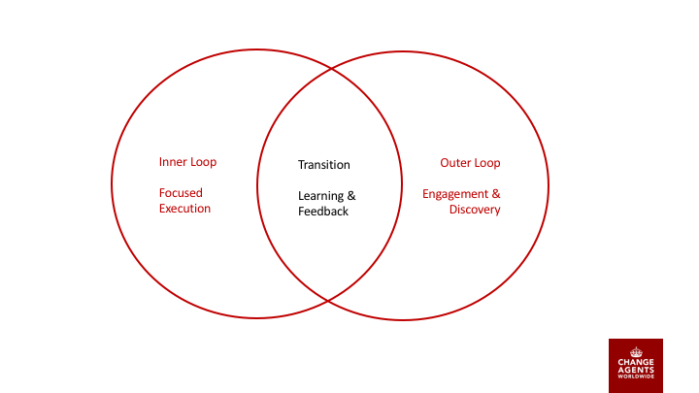
One thing struck me when I considered the idea of Inner and Outer Loops: nobody works in only one loop. All our work involves a continuous process of transition between an Inner Loop of focused execution and an Outer Loop of learning, collaboration and discovery. The Loops are not places or tools. The Loops are patterns of our interaction around our work. Those patterns are ever-shifting based on our work needs. After a decade working on the adoption of social technology one thing is clear to me, we need to spend more time focused on the right ways to help users transition to more effective ways of working.

Working out loud can play an important part in aiding users to see the need to change their work.  Working Out Loud can occur in both loops. Working out loud also helps the process of transition to improve the effectiveness of work. We work out loud in the inner loop to enable our immediate team to self-organise, be better aware of status and be more agile.  We work out loud in the outer loop to benefit from serendipity, learning and discovery. One of the benefits of working out loud is that when we share our work openly other people can prompt us to open up further to the Outer Loop or coach us on the need to be more focused.
Slide1


If we are always in transition between the two loops then what I thought was missing was an examination of that phase where people make a change in their way of working from one mode to the other. People don’t need to know ‘what to do where’ so much as they need to know when their current mode of work is ineffective. If we consider all the work that is thoughtlessly done as closed targeted communications in email, we quickly see the problem is not a problem of email as a tool.  The problem is that people do not consider when they might need to change their way of working. When twigged to the need to change their approach to work or the tool that they use most people find ways to make that change work for them and their goals. The transition from one style of work to another is our opportunity to enrich and expand the understanding of value of collaborative work. This transition is the key moment in user adoption. It is also an opportunity to ensure we focus on the user behaviour in work, not the technology.

The transition phase between Inner and Outer Loops is also a reminder to all the enthusiastic and passionate advocates of particular collaboration platforms that transition is continuously happening and that tools like Yammer and Teams are ‘better together‘. There is value in exploring the complementary use of both tools. The better we are able to explain to users the value of a way of working and when we transition to another mode of working the better we will support their work. That goal is far more important to individuals and organisations than advocacy or adoption of a platform.

Focus on the User

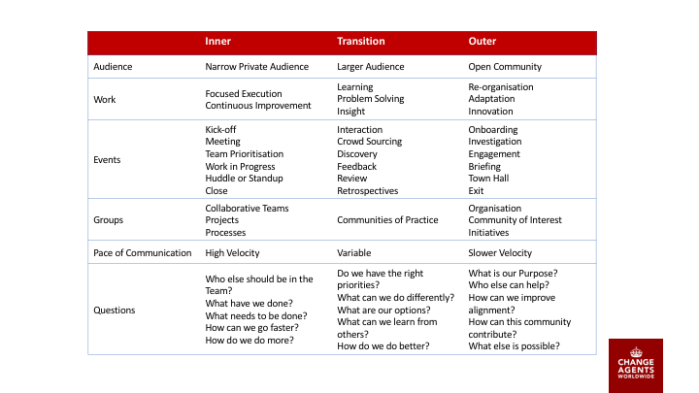
For fear of taking a simple, easy-to-understand idea and making it so complex as to be useless, I thought it was worthwhile to tabulate characteristics of the user behaviour at work in the three modes: inner loop, outer loop and the moments where we transition.  Each mode of work meets different needs and is better suited to different challenges.  In the spirit of working out loud, here’s a first table which looks at the domains under a number of different user behaviour lenses. I have also included in the table common questions that might be asked in each of these phases as the work progresses:
 

Slide2

Triggering Transition

A focus on this moment of change in the pattern of work raises the following important questions:

  • what is it that prompts a user to look for a different way of working?
  • how might we coach ourselves to transition effectively?

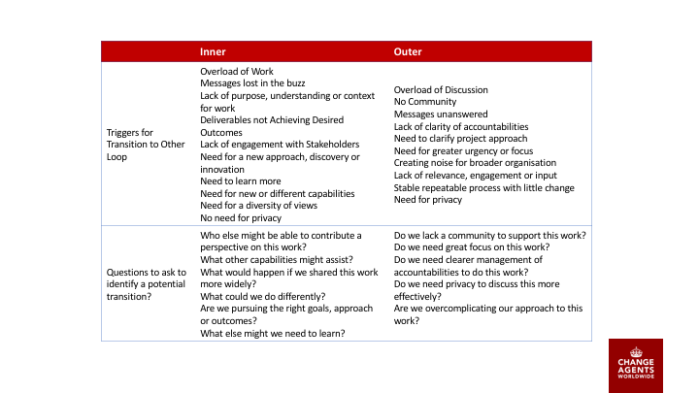
If we look at both the Inner and Outer Loop we can see some signs of stress when these modes are used in the wrong ways for work.  The table below highlights some of these stresses and also some questions that leaders and team members can use to query whether it is time for a transition to a different mode of work:
Slide3


Transition Into the Future

When you consider the first table above, you see that the items listed in Transition can occur in both the Inner or the Outer loop.  These transition items are why you see enthusiastic supporters of one product or the other pushing across the divide. The Transition is also a realm where the two Product Marketing teams need to collaborate as competition will risk devaluing both products with further duplication and confusion over time.  We will leave aside for the moment that you can expand Teams to manage a whole small organisation an InnerOuter Loop or run a daily team transparently in Yammer, the OuterInner Loop.

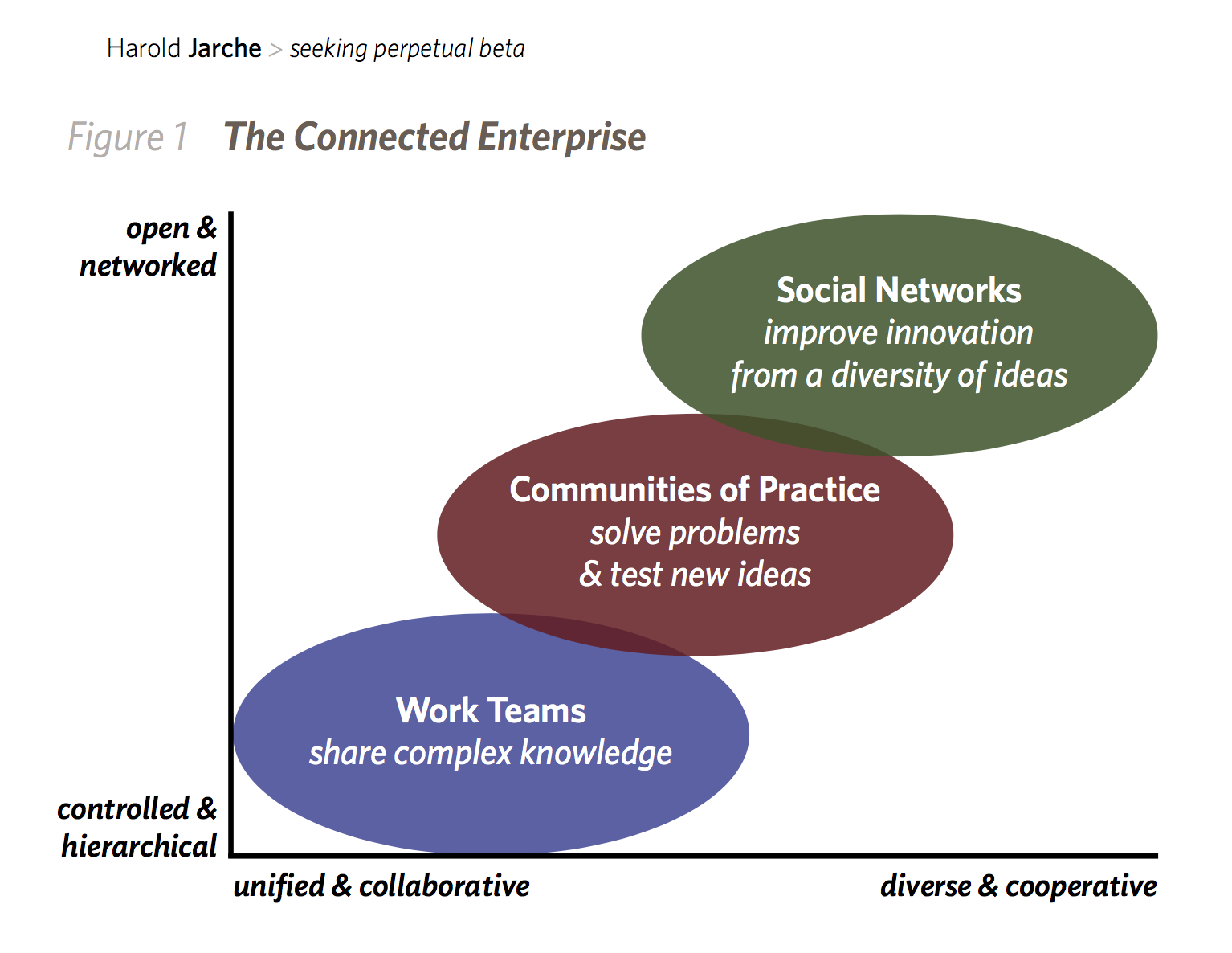
Bringing the Transition into focus also aligns the Inner and Outer Loop model into alignment with a model that Harold Jarche has been advocating for some time that draws an explicit distinction between Collaboration in teams, Communities of Practice and Cooperation in Networked Communities. The value of this connection is that Harold Jarche has developed extensive materials on his blog and in his books on the 3 different domains and patterns of work.
connected-enterprise-spb.png

Source: jarche.com

For example, Harold has explored the use of this model in Innovation at Work and even the connection to the Value Maturity Model of Collaboration that I have discussed at length here.  A growing maturity of work across the four stages of the Value Maturity model comes as people are better able to handle the transition from connecting with an immediate team through to exploring innovation in the widest context. Mastery comes when people can hold all four stages at once around their personal work challenges and freely transition between the Inner and Outer Loop to Connect>Share>Solve>Innovate for greater value.

In future blog posts, we will explore other dimensions of the user behaviour of the Inner Loop, Outer Loop and Transition process.  Examples of these issues include the nature of the networks involved, the leadership styles and the time periods involved:
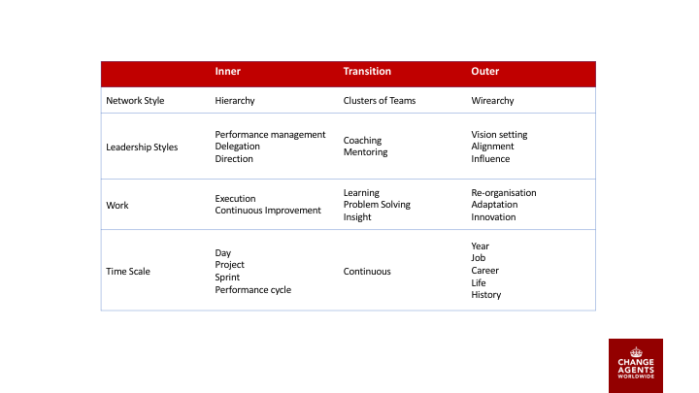
Slide4


Begin and End with User Behaviour

The focus on transition between the Inner and Outer Loop is also a reminder that for all the technology and all the powerful models what matters most is influencing new user behaviour. To do this effectively we must begin and end our work in change and adoption with a focus on what work users need to do now and what work we want them to be able to achieve in the future.  Tools alone merely enable new interactions.  The way people work requires them to make sense of new opportunities and to manage the change to new ways of working.

We must keep in the centre of consideration that these tools aren’t tools, media or technology we use for its own sake. These are tools of work interactions. Those human work interactions involve all the complexity of our human relationships with their questions of cultural expectations, trust, understanding and community. Our focus on the Inner and Outer Circle must keep the needs of these interactions at the centre of our new ways of working. The deeper we dive into how users can better leverage these tools to create new meaningful interactions, the richer the value we will create for both the users and the organisations of the future.

This is post is shared in the spirit of working out loud to gain feedback & start a discussion of the application of Inner and Outer Loops from a user behaviour, rather than a technology platform perspective. I would appreciate your thoughts and comments.  My thanks to Steve Nguyen & Angus Florance of the Yammer team for their suggestions on how to turn the initial idea into something of more value to users and community managers.

Sharks and Suckers

We need to invest in our civil society. One simple way we can start this work is to stop venerating and rewarding those who seek to benefit by bending or even breaking the rules (For want of term let’s call these folks ‘the sharks’). Those who abide by society’s social rules aren’t suckers. They have a richer, more values-based and more relational view of community.

We Venerate The Sharks

We have a lot of terms for the sharks: sharp operators, smooth movers, power players, the 1%, regulatory disruptors, teflon, Sharp elbowed, queue jumpers, and more. Sharks are those folks who see a rule as no barrier to their personal advantage.

Sharks free ride on the general rule abiding nature of society. They see everyone else’s good nature and rule following as an opportunity for advantage. Sharks benefit from all the good society brings but they duck their share of the effort to create a civil society in the interests of their own personal advantage.

Worse still sharks see themselves as special. The advantages they gain reinforce to the cleverness of their stance. When the costs of their actions are widely spread on others, there are few negative consequences. Acting like a shark can seem the only smart way to act and those who follow the rules must be suckers. The role of sharks is to take advantages of suckers in as many transactions and interactions as possible to maximise personal gain.

The Sharks are Proliferating

A civil society requires constant maintenance. Civil society is based on shared relationships, shared values and shared norms.

Sharks eat civil society. They reject the norms and relationships on which it is based. They expect its protections but reject its burdens. Too many sharks and civil society breaks down, because the culture shifts from community interest to self-interest. Once sharks are seen as the smart way, more people become sharks.

My favourite measure of sharkness is not business. There have always been too many sharks in our commercial world. We encourage sharks in that context.

I measure sharkness by behaviour in social contexts: traffic, queues, crowds & government. We have laws and rules that apply in these contexts. However, in the instant of an interaction the consequences of laws and rules are often quite remote. For these contexts to function, we rely on suckers to follow the rules and keep everyone safe.

Having spent time in countries where there are few of any social restrictions on behaviour in these contexts I hope the number of sharks doesn’t keep growing. It’s a subtle shift from some edge freeriding to a complete breakdown of the system and the lack of social safety that follows. Re-establishing social rules in the face of endemic cheating is incredibly challenging because of the lack of social trust and the pernicious effect on the institutions of enforcement.

Turning the Tide

There will always be sharks. Sharks seek short term advantage in transactional interactions. Provided there are benefits to trust and relationships, sharks lose in the long run, even without direct consequences of cheating. As a wise senior executive once put to me ‘the people in the white hats win in the second half of the movie’.

We need to invest in our relationships, norms and our institutions. Civil society depends on the community-minded actions of proud suckers investing in relationships and social outcomes over time.

There is a reason fish school. The united actions of a school of fish can confuse and frustrate the shark. A community of suckers can use their norms and relationships to similar effect. Sharks don’t really understand civil society.

Sharks will be sharks. The suckers win by creating a society of shared purpose, shared norms and mutual advantage. Let the sharks enjoy their own company.

Status as a Tool

Our status in society or an organisation is not who we are. Our status is not a hat we wear. Status is woven into social networks. Status is a tool we use in life.

When I became an independent consultant four years ago, the biggest adjustment was the change in how others treated me. I had been a senior bank executive with a CEO title. I didn’t change overnight but my status clearly did. Many of my social connections struggled to place what I did and how I fitted in to the social order of relationships. What surprised me the most was the assumption that my new role as a consultant couldn’t have been my choice, because it was too great a fall in status.

Acquiring New Status

Four years later, I have just added to my portfolio a new senior management role at Lantern Pay. Joining a new organisation and starting work with a new team is always a challenge and a learning experience. In a start-up that learning experience is always accelerated by the challenge, the adaptive environment and the pace of business. I’ve learned much in a few weeks, but one learning is unique. I’ve discovered I have a new social status and I feel like I have a new relationship with that status.

With my new job, I am an employee again which fits me into a known quantity, even if I retain a part-time consulting practice. I am a senior manager in the new company. The organisational purpose and ambitions are clear. Suddenly people are affording me a new status. People have congratulated profusely on the new status in a way that doesn’t seem to fit with the change in circumstances. They are happy I am ‘back where I should be’.  I was advising and working with senior executives before and I am still doing the same. However, because an employee role fits with a standard hierarchical social expectation, I’ve got a new status. Because that role is a leadership role, I am afforded a more elevated social position in their eyes. My uncertain state has been clarified and I am better off in their view.

I haven’t changed. The level or complexity of work I am doing hasn’t changed. In a sense my life is a little easier because I have a consistent source of challenging work and some key work relationships that continue. My rising status is because the perspectives of the community around my work.

This experience makes it abundantly clear what status is. We often think our status is tied to who we are. It isn’t. We might even think of status as a hat that we wear because of a role or what we do. It isn’t. The hat doesn’t come from the role. It comes from the views of others in our networks. You can have the status without the role and vice versa. Status is a change in our influence with others. Status is a Tool.

Status as a Tool

Recognising that status is given by others and exists only in those relationships is important. Not everyone grants that status or cares about who am I or where I work. The joke of people saying “Don’t you know who I am?” reflects the fact that many people might have status in some contexts, but not all. There is no such thing as a universal status. We are granted status by specific others and can uses it only in certain relationships.

Seeing status as something that depends on the other person and that we use only in specific relationships helps us put status at a distance. We have to accept that this kind of status is ever shifting, depending on a two-way flow of influence in those relationships, like Jon Husband’s concept of the workings of a wirearchy. The status does not have a permanent state. It is something we discover and change as we use it for influence, authority, respect and trust. Importantly, this interdependence highlights the mutuality of our status. If we disrespect or abuse it, it will be lost. Very few leaders survive a mutiny.

Growing comfortable with status as something that sits not with us but in the relationships we hold is also a great relief. We are no longer so beholden to the fears of a universal loss or change of status. Changes are more gradual, more partial and more to do with how we act in those relationships. We have the ability to retain status through those relationships, even when our jobs or our work changes. Most importantly, this insight means we are clear that we are not our status. Changes in status don’t impact who we are or our ability to act. Status is a tool we use in our relationships with the support of others.

Seeing status as something at arms’ length from us and something that exists only in the network web of relationships is an enabler of new freedom of action. New relationships offer new potential for action. Building relationships can develop new status. It shows us how we can help others to build their status, because status is not innate and immutable. Most importantly of all we face fewer personal risks of change and more willingness to see that status comes from action in relationships, not inherent right. If status is a tool, it is one we must use in mutual interest or we lose it.


A Great Privilege

The ability to keep working and improving is a great privilege for someone building a portfolio career. Not every day is a success but you learn and improve as the game goes on. When you are in the game, things happen. You can still make your way and make change happen. Value your chances inside the game and reflect on those struggling to get in.

Stay in

The last month has been a very busy month for me. I have been to speak as Microsoft Ignite in Orlando as a Microsoft MVP and reconnect with a global community of IT professionals who are changing the world of work. I have begun my work at Lantern Pay as an executive and advisor. Another startup I have advised has raised significant capital and created an exit event. Change Agents Worldwide is growing well, attracting new members and attracting client attention. My board roles see organisations that are performing well and realising exciting new opportunities for growth. At the same time, I have had some exciting new projects arrive as clients grapple with agile work, collaboration, working out loud, innovation and the future of HR. 

I set out over 4 years ago to build a portfolio career. That portfolio is now coming in to place. All this looks like success but it doesn’t feel that way. As we all know you don’t judge success on the outcomes alone. Some times the outcomes are temporary, just luck or timing. Some of the things listed above are beginnings not endings. If you had asked me a year ago, I would have described my position as on the brink of failure. Experiments had failed. Projects had fallen through. Bank balances were low. My confidence was waning.

What’s the difference a year later? I stayed in the game. I kept my faith and worked to build my portfolio of work, business and opportunities. By keeping going, I learned from my experiments. By keeping going, I made new contacts. By keeping going, I let time help me in growing reputation, connections and decision-making. Most of all, in the last year I became a whole lot clearer on what success looks like for me and what I need to do. As I had forecast earlier on this blog, I became a lot more disciplined in my approach to the business, to my products, my relationships and to my opportunities.
Value Your Privilege


One of the other things that became clear to me over the last year was the privilege of the position I have. No matter how glum I felt a year ago, people were still envious of my position & future opportunities. Those conversations helped me to understand that my past advantages are helping my success today. 

Understanding this made me value my privileged position more. 
Whatever you do, many more people want to get in to the game, but can’t see the opportunity to start. Whether it is financial position, networks, experience or mindsets, there are many barriers for those who haven’t yet begun. Many people have helped you achieve your current position in the game, whether that is family, friends sponsors or mentors. Having cleared those barriers puts you in a privileged position. Value the opportunities that come from this position. Work hard & learn to make the most of them.

The most important part of being privileged is working to help others overcome those barriers. I know many others helped me get started on this portfolio career. Many of those friends and partners still do provide support, contacts, insights and opportunities. This recognition reiterates to me the importance of reaching out and helping others build their careers and their work opportunities. We can all be better collaborators, coaches, sponsors and mentors for those starting out or struggling on their journey. There is a lot we can do to help each other stay in the game.  

The Work of Civil Society

Last night I read Niall Ferguson’s The Great Degeneration, an extended essay on potential causes for slowing growth and rising political and social issues in Western Economies. While I don’t necessarily agree with every aspect of the argument, I do agree with one of the key principles that shapes the essay. Our societies and their performance is shaped by the institutions we have and in particular by the relationships we have beyond commercial transactions, our civil society. Our institutions matter in many cases to the extent they foster or impede these civil relationships. 

For organisations, wanting to improve financial performance and effectiveness, their employee’s civil society can play a critical role. Culture and the institutions that shape and reinforce it matter for every organisation.  
Joining in

At University, I was a joiner. I was a member of many clubs, both sporting, social and political. In my twenties, I lost the these civil society connections and my world was narrower for it. Travel, relocations, changing jobs and life’s many demands became excuses for focusing solely on my personal achievement and life. My community relationships and connections were poorer for it. 

Part way through my time at NAB, I rediscovered the importance of these social connections in enriching life and shaping your experience of society. I realised I valued belonging. I became a joiner and even took on community leadership roles in not for profit arts and sporting organisations. I reminded myself of the value of volunteering and meeting new connections in my community. The rewards are many. I know far more people in my local communities, I have the rewards of making a contribution and these civil relationships have led to commercial relationships too. 

One of the reasons I am so passionate about Change Agents Worldwide is that it offers those working on change in large organisations their own civil society. Change leadership can be lonely, hard and isolating. A community of peers can provide information, skills, trust and support. I have seen the same surge of civil society in client organisations when we work on collaboration.  They are always richer for the connections, understanding and trust built even if the participation is only in non-work social groups. 

New Institutions 

As work changes, organizations and individuals are going to need a panoply of new institutions to support the civil society around work. I was recently interviewed for the Breaking Banks Asia Pacific podcast with Simon Spencer. Simon asked what innovations I expected around the future of work. 

My response that I hoped we might see a return to the flowering of financial institutions of the late 19th century. As the economy industrialised, workers and business people came together to found a range of social financial services institutions. Niall Ferguson highlights the effect of these mutuals, friendly societies, building societies and more. Many have lost momentum under the onslaught of global financial services competition and competition from the social safety net of welfare state. 

When we look at the changing work dynamics of the next century, there will be a demand for new social institutions to help underpin the changing relationships of civil society. Our government social safety nets are fraying in societies with ageing populations and political deadlock.  We need new social institutions to help with new contingency of work, the risks and opportunities new work and the structural adjustment of lost work. 

This opportunity is more than the asset sharing of the sharing economy. The challenge and opportunity is to create new models of social risk sharing, social support and to found these on deeper connection and trust in our civil relationships. The robots win if it is each person for themselves. The great success of human civilisation has not been our intelligence, it has been our collaboration and our ability to invent institutions to sustain and grow that collaboration.

For organisations, the challenge now is to begin to consider the future culture they need and how their present institutions and actions support this need. Organisations that work with talent in volatile networks compete on more than just a narrow subset of employee experience.  The field of competition opens to the entire gamut of social relationships, including purpose, reputation, trust agility, security, and more. If your sole model of adaptation is a period restructure from one inflexible model to another then you will lose.  One of the reasons I am a passionate advocate for community managers in organisations is that the community building work that they do and the strategic value they create runs far beyond the collaboration platform or social network. These communities are new relationships and the foundations of new civil society as they grow and mature. 

We can’t predict the future well. However, we can shape it by creating it. That act of creation will take new civil society within and without organisations.  We need leaders and change agents to foster these new relationships and institutions.  

Choose AND

In business, we are used to making priority calls. We can’t do everything. It always feels like we are up against a hard choice between A OR B.  Limited resources must be carefully allocated. When it comes to collaboration in a community, this attitude can get in the way of inclusion. A community can embrace AND using the diversity, contributions, and engagement of all participants. A community doesn’t have to choose OR, it can choose AND. The generative potential of a diverse network is one of the key benefits of collaborative communities. Don’t squash that for a false choice.

The Limits Don’t Apply

The traditional decision-making constraints of business are all driven by a flow of resources, decisions, and priorities from the top of the hierarchy down. When allocation is the principal business challenge then we must make either/or choices.

The resources owned by the hierarchy are limited because the flow of information is limited. The hierarchy must manage with limited information of the circumstances of the business, surpluses and shortages in the plan and often a generic understanding of the processes, roles and human capabilities in the network. Hierarchies narrow choices and standardise options to make the complexity of the network easier to manage. In traditional businesses which sought to scale proven processes, the costs of this approach in loss of information, flexibility and potential were overwhelmed by the scale advantages of standardised execution.

The networks of a collaborative community have the ability to manage a wirearchy, Jon Husband’s concept of ‘a dynamic two-way flow of power and authority, based on knowledge, trust, credibility and a focus on results, enabled by interconnected people and technology’. Standardise models, limited information and simple either/or choices can be exchanged for the information of the people on the spot, the capabilities of the individual and the needs of the business and its customers.  The wirearchy can also pull from beyond the organisational resources extending its reach beyond the organisational boundary to pull in information, resources and people needed to manage delivery.

The fast-moving digital economy has put a priority on businesses having the ability to learn, adapt and leverage opportunities, not just scale execution of standard processes. A collaborative community working as a wirearchy better reflects this goal.

Nice Theory, So How Does it Apply to Collaboration in Communities

When we apply our typical constraints mindsets to the launch of a collaborative community, there can be a lot of debate around limiting the employee choices of use of collaboration. Many organisations develop prescriptive what to use when guides trying to channel the fluid collaboration of knowledge work as if it is a production line process. Other organisations focus on restricting their employees valid uses and objectives for collaboration in an effort to ensure efficiency in a community process. Some even go as far as trying to prescribe particular activities and use cases. The mindset underlying all these efforts is the traditional hierarchical management by constraint.

However, collaboration in communities cannot be programmed. Effective collaboration in communities is emergent. Organisations can scaffold the development of value in the community, helping users to more quickly find value and leverage collaboration, but they do not need to constrain the choices for users. Users will make rational decisions to allocate their time, efforts and potential to solve the issues that matter to them, their peers and the organisation. Well managed this is a highly inclusive process where people bring new ideas, new capabilities and new approaches into the organisation and socialise them with their peers to find the best fit to the organisational and personal goals of the community. This process of finding a community fit is an adaptive learning process and a source of new abundance in organisations.

Fostering this process requires organisations to signal that AND is a valid option. The need to encourage inclusion and value the diversity of approaches. Employees can pursue multiple paths simultaneously reflecting different circumstances and capabilities. Employees are given the opportunity to engage as they see fit, not forced to engage in the standard way. The test of success is fitness or as the definition of wirearchy puts it “a focus on results”.  If the results are being achieved, does it matter that everyone got there a different way? Working out loud will create transparency and learning to help align better approaches and foster sharing of success. In time, this process of diverse experimentation will discover new standards and new approaches.

We have a lot yet to learn about new ways of working. What is clear is that we will get there faster if we embrace the diverse power of AND.

The Now of Work

When you spend a lot of time focused on helping organizations prepare their people for the future of work, you are in danger of forgetting to describe how the present state of work has shifted. 

Agile is the Goal

Only a few years ago, advocates of organizational change were actively proposing new models for the organization. Terms like Responsive organization, Holocratic organization,  Adaptive organization and the like were being promoted widely in the search for influence. These models all shared similar goals of aligning the organization around purpose, improving its effectiveness and enabling self-empowered and self-organising teams to get their work done with less dysfunction. 

In Australia, at least, the debate has a clear winner. You know an idea is hot when all your inbound client queries are asking about it.  Agile is the management practice that has swept  out from software development and now captures the attention of organizational leaders. Agile has the diversity of approaches and the flexibility to mean different things for these organizations. However all of them share a goal of being more innovative for customers, more effective for their purpose and more engaging for their people. 

Digital Transformation is the Work

Everything is or will be digital. We are no longer just building digital channels or digitising process.  We aren’t just moving from on premise to the cloud or mobile.  When Microsoft is talking AI first applications and the battle is for the winning personal assistant, we are beginning a new era of always connected, data-driven experiences powered by massive computing power. 

Enabling digital transformation is the core program of work. Radically better customer and people experiences are now possible. New and existing competitors are bringing them to market at the pace of agile projects and the aggressive disregard for traditional business models of startups. 

People are the Key

We’ve spent the last decades focused on the technology opportunities. Organizations are now realising the value of their people. Restructures and downsizing still dominate the structural adjustment across industry as it adapts to new leaner digital models. 

However, positive signals suggest the future is not entirely bots. People experience is on the rise as a topic of debate. Organizations are as focused as ever on attracting and retaining the talent to win in a digital economy. This includes an awareness that climbing a greasy pole of hierarchy is not everyone’s sole goal. 

Importantly, Organizations are investing in the capabilities of their people to survive and thrive in this digital landscape. New capabilities of learning, leadership, collaboration and innovation are keenly sought. People need new practices for a digital economy and I’m seeing clients tackling personal knowledge mastery, working out loud, Adaptive leadership and lean experimentation as a result. 

We mustn’t forget the fitness of a digital organisation is its ability to learn & adapt at scale. More an more organizations are preparing people and systems for that competitive advantage in a complex changing world. 

Collaboration is the Platform

Last week was a big week for collaboration in the organization. Microsoft put Teams at the heart of its Microsoft365 strategy and recommitted to Yammer with a new roadmap to support wider ‘outer loop’ collaboration. Workplace by Facebook announced Walmart had chosen them bringing on the world’s largest private client to collaboration across its wide community of associates. 

Collaboration is the platform for digital transformation.  Working out loud brings transparency to foster alignment and accountability. A new openness enables learning, generosity discovery and serendipity of work. Open work helps organizations solve problems faster and drive digital cultural change more edffectively. Ultimately  open collaboration connects customer need to the insights and capabilities of the organization fostering innovation. 

In a connected digital age, nobody is an island of performance. Powering our people with new effective collaboration tools that support agility and enable digital transformation is the key challenge people are tackling now. 

Don’t wait for some abstract future to make change. That moment will be too late. Culture change and new work practices are endless journeys of mastery.  Start now. Your competitors will have. 

Stopping Multi-level Marketing Social: Value Influence over Rank

Everywhere you go in social media you find people practicing the commonly recommended strategies: win followers, promote yourself relentlessly, leverage SEO strategies, use the magic words, always comment on trendy topics, keep it short, simple, easy and engaging, share repeatedly at different times, and so on. These strategies have confused influence with rank.

Is Social just Multi-level Marketing 2.0?

If your social network is not social, in the sense of supporting human interaction, then it is simply an advertising and sales network. We know how those work. They are multi-level marketing schemes like Amway, Avon, Herbalife, and so on.

Most people have had an experience of meeting a multi-level marketer. In general, we find multi-level marketing to be something we would prefer to avoid. Multi-level marketing schemes are network sales and marketing systems designed to reward people for their rank in accumulating followers. The bigger your downstream the more money you have a chance to make. In multi-level marketing it doesn’t matter if a person in the downstream actually know you, it just matters that they are in your downstream. Value comes from volume. The negative experiences that most people have from multi-level marketing come from this relentless drive for volume. Value to followers and human relationships are completely lost in the need to pump the numbers.

The commonly recommended social media strategies are turning social media into multi-level marketing where everything is a numbers game so that you can sell your rank in the system, not to your followers, but to advertisers for return.

Saving Social: Influence over Rank

In my work in collaboration inside organisations, I have been a passionate champion of the reality that numbers of employees using a platform alone is not a goal. The strategies to win the numbers game distract from a business focus on value creation opportunities and can at times even be be counterproductive to the focus on work and value for users and the organisation. In this work, I need to reiterate to organisational leaders that what matters more than rank or follower counts is influence. Influence in networks is the currency that enables a leader to create value.

We need to remember the same principles in social media. Influence comes from relationships, trust and conversations. There’s no guarantee that scale delivers influence. I have seen plenty of people with hundreds of thousands of twitter followers who get no response to their tweets.  There are no magic set of topics, words or phrases to create influence. Influence comes from connecting personally with people and helping them achieve something that matters to them.

Kevin Kelly has written about the idea that all we need for success is 1000 True Fans, people who we deeply influence. This lowers the necessary rank for success to a much more human scale in social media. Importantly, it also focuses our attention on the extent of our influence and our relationships with others.  The best way to save social from the numbers game is to continue to build the niches where networks create real human relationships of influence and avoid the multi-level marketing. If those playing the numbers and rank game end up playing on their own, their influence & value will collapse.