More Poetry at Work

image

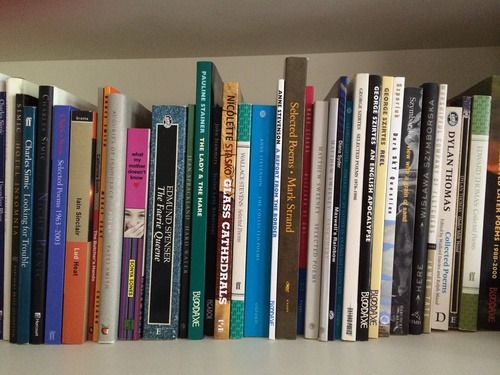
The magic of social collaboration is when you become part of a conversation, then others bring their insights.  After the last two posts, this has become poetry week (or so it seems).  

Two Quick Reads

My last two posts discovered two further good reads on the power of poetry:

Deeper Reading

For anyone who wants to dive deeper into this topic, I can recommend:

Action

Lastly, go to your favourite bookstore and buy a book of poetry. There is no better way to realise the power than to dip into the inspiration of a collection of great poems.

One book can make a difference. My journey into the power of poetry began when a good friend, Geoff Higgins, gave me a copy of Seamus Heaney’s The Haw Lantern. Geoff did me an enormous favour because great poetry is a passion that can sustain a life of creative work.

You could do worse than to decide to follow this practice by the wise Lois Kelly:

image

Obstacles are the work

Is it really December?  Businesses and schools are winding down for the summer break. The cricket has started. Christmas is rapidly approaching.  With that comes a quick close to 2013.

2013 has been a year of adventures, obstacles and challenges. More than anything else it has been a year of new momentum. I could not be more excited by the incredible opportunities that have arisen this year:

Embrace the Chaos and all its Obstacles

I was reflecting on all that has happened this year when Dany DeGrave tweeted yesterday about the need to maintain momentum in the face of obstacles:

Obstacles are the work. They show you have chosen to have an impact. They help us see our purpose. They provide the challenge and interest.

Obstacles are proof that your work matters to others. These challenges remind us that change is human and social. They encourage us to share knowledge with our networks, to work aloud and to pay attention to the knowledge moving around us.

Obstacles help us reflect on what matters. Pushback make us ask new or obvious questions.  An orderly progression of success can be quite tedious and generate its own doubts.  If success is that easy, are we missing something?

If there weren’t obstacles, our talents would not be required, we would not learn and not grow in the work. If there weren’t obstacles, we would not get the rewards of overcoming them.  If there weren’t obstacles, we would not have the joys of collaborating with others to move forward around over, under or through.

Your Obstacles. Your Momentum. Your Year.

So next time you are considering a year of obstacles, remember the hard work proves that you are on the right track. Obstacles are proof of your momentum.

I bought this poster at the midpoint of this year. It has been a reminder ever since that every year is my year.

image

Every year is your year too. Move past challenges. Reflect on the successes.

Maintain momentum in doing whatever you need to do to make it your year. Your impact is up to you.

If you would like your own or other great posters, the source is The Poster List. 

Assigned. Chosen. Earned.

  • Job = what you need to do. May come with rank in a hierarchy. Assigned
  • Role = how you manage yourself in response to a constantly changing environment. Chosen
  • Authority = your leadership influence. Earned

Your job does not define how you behave in a situation or determine your leadership influence. Job, role and authority each come from a different source and respond to different circumstances. They will never perfectly align.

Your job may provide authority over some of your network. The impact you have in one interaction may give you authority in another part of your network. Frustratingly, it is equally likely that they both will not.  

When we see hierarchies, we confuse these three distinct concepts.  We think the hierarchy determines, and more commonly limits, our actions and our influence. 

The role you play is your choice. The influence you have can only be earned from others.

Hierarchies might give you a job. Hierarchies rarely help you do it. Let the poor hierarchy be. Stripped of roles and authority, a hierarchy is harmless enough.

You determine your actions in each context. Your network gives you the power.

Choose to have influence.

PS: For a richer discussion of these concepts and tools to help, read The Australian Leadership Paradox by Liz Skelton and Geoff Aigner

Having social fun (at work)

Remember fun?

image

Those little activities that bring a smile to your face and connect you more deeply with colleagues over a laugh or a giggle.

It is not too late. You too can be responsible for bringing the fun back to your workplace. The perfect place to start is your organisation’s enterprise social network. Everyone’s there. Waiting for fun to break out. Your audience is crying out for something a little more engaging than the latest link to a compliance policy update.

I recently saw this call for help

Here’s a few ideas that I shared with Jakkii and a few more to pad out the list. They just might help get you started with your own fun. Be inspired:

  1. Offer free steak knives: Marketers do it for a reason. People go silly for steak knives. Start a fun competition today with steak knives as a prize. Your local supermarket has really cheap steak knives. 
  2. Do introductions: Ask everyone to introduce themselves in 140 characters or less. Ask people to describe their worst job, most embarrassing moment, best day, etc.  Offer prizes (see steak knives above) for the most likes, most creative, funniest, etc
  3. Memes: They work on the web for a reason. Search for a meme generator. Send your next serious message in an amusing meme image. You will be surprised how much attention it gets. You might even start a trend of posting more memes, gifs, cat pictures, etc.
  4. Pictures: The sillier the better. Yes, including cat pictures.
  5. Baking competitions:  If two people in your office bake, then have a competition. If you don’t have two, make someone senior bake as a challenge. You might inspire a few more cupcake makers. Who doesn’t like fun that you also get to eat for morning tea?  Photos & reviews go on the network
  6. Event themes: Does your ESN dress up for cup carnival, sporting events or the holiday season? If not, why not? 
  7. Create groups for water cooler conversations, movies, television programs, jokes or any other topic that might engage people.  Most radically of all, let people create their own groups. To have fun (at work)
  8. Set challenges: A quiz, a treasure hunt, a challenge, a target, a quest, etc. Design activities that engage with a smile and preferably generate photos and stories.
  9. Recruit champions of fun: If someone has previously created a smile, invite them to an offline meeting of funsters. Plan your next attacks.
  10. Lists: I got to ten. So can you. I could go on, but where’s the fun in that?

The power of social networking at work is the opportunity for people to engage socially while working. Rapport building involves the little stuff as well as the serious stuff.  If you take the lead, others will follow. Post in line with your company’s culture and you will be fine. Don’t try to do standup. Start small and it will grow.

If your organisation will not allow any fun: Then absolutely make sure that you don’t have any. Deprive others of fun (and try not to have fun doing that). Most importantly ask yourself how long you will last.

The point of all this fun: Aside from the obvious, you will engage a lot more people and give them an opportunity to try their first post or first like.

PS: Forgot this when writing the original post. Don’t forget #funhashtags. #needisaymore ?

Purpose & Practice grow together

Purpose beats entropy. Adaptive leadership practice renews.

Most learning experiences fade. Some fade very quickly. In general only a small proportion of any experience is retained. Even less makes it into sustained practice.

Almost seven years ago, I had my first experience of a learning program that introduced me to adaptive leadership. That amazing experience, the Accelerate Program at NAB, involved work inside and outside the organisation on complex issues.  These issues required the practice of the skills of a different type of leadership than traditional transactional and expertise based command and control leadership. That leadership experience has been one that has grown every day since.

What makes the power of adaptive leadership lessons grow in practice?

Purpose & practice.

Entropy is the normal process of decay in systems.  Negentropy, or syntropy, is its opposite where things grow in strength over time. My experience is that purpose is a great way to beat entropy.  The Wikipedia for negentropy notes that even scientists see power in purpose:

Indeed, negentropy has been used by biologists as the basis for purpose or direction in life, namely cooperative or moral instincts.

My first experience of adaptive leadership in the Accelerate Program forced a great deal of personal reflection on purpose. That clarity drove new action in a range of different domains. Purpose is an incredible force for energy and drives the desire to see these new skills in practice. Naturally I began tentatively and with a great deal of discomfort.

In all the years since, I have learned that continued Adaptive leadership practice refines the clarity of personal purpose. I have become more aware of my effect on others and on the importance of collaborative solutions that engage many people in the system. Those interactions reinforce the growing energy. The purpose sustains you through the challenges of practice. A continuous iteration of purpose and practice, grows the effectiveness of your leadership.

The purpose is in the work. Adaptive leadership work especially.

The Purpose is in the Work

Leadership is work with others to fulfil a purpose. From where does purpose come?

The work.

Many people want to find their personal purpose to guide their leadership work. For some, purpose is quickly evident with a little reflection. Often reflection will only take you so far. For others drawing out any strong sense of purpose is more of a challenge.

Leadership is work, not a status. Purpose is a strong personal impetus to action, not an abstract & perfect idea. You don’t need purpose perfect to act. Just as leadership gets better with experience in the mess of the work, so does purpose evolving to a clearer expression through interaction with others.

The best guide is that purpose is what compels you to act, to lead and to have an impact on others. So ask these questions:

– What do I enjoy doing most in my work? What drives that?

– What work do I keep coming back to do? What drives that?

– What kind of impact do I have? What kind of impact do I want to have? What makes me choose these things?

– What do others call on me to do? What is it about me that makes them choose me?

– What do I want to do next?

There is little value in endless reflection to perfect a purpose. Purpose is refined in practice. Purpose in leadership necessarily involves others. Demonstrate leadership in work, learn from interactions with others and see where your purpose is strongest.

Do. Focus on the work. Purpose is there. Purpose comes.