Coach the Community to Create Value

We may have begun to move from an adoption conversation to a value conversation. However our hierarchical mindsets can still hold us back. A responsive organisation needs to shape how value arise from collaboration, not try to specify it top down.

Embrace Value

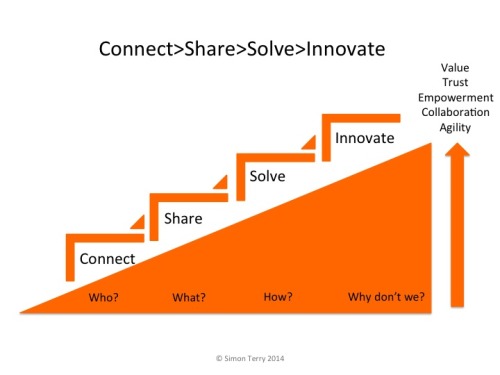
More and more organisations are focusing on how to create strategic business value in their organisation through the use of collaboration. They are seeing the value that can be created as a community journeys from Connection to Innovation. They recognise that adoption & use should reinforce the strategic goals of the organisation and is not an end in itself.

The Temptation to Specify

When an organisation identifies the way that it can create value in a community, our hierarchical tendencies begin to kick in. We start to specify how a community shall work to create value. This is how most organisation’s strategy planning processes usually work. We end up with a plan of what other people have to do. 

Some guidance can be useful at the beginning of a community’s life when people are sense making. However, too much instruction will become a constraint on the value creation if the goals of value creation remain externally imposed on the community.

The best value comes when a community can use its knowledge, capabilities and ideas to create value in new ways. That won’t happen if the community has specified usage cases and a limited focus on the value that it can create.

Coach the Community to Create the Own Value

A large part of the difference between management and leadership is the difference between direction and coaching. Responsive organisations demand leaders who can coach teams managing highly adaptive situations, rather than direct.

Organisations need to coach the members of their communities to create valuable new ways of working using collaboration:

  • Coaching begins by clarifying goals: How do you help your communities understand the alignment between organisations strategic goals and the goals of their own work? 
  • Coaching should enable action & experimentation: How do you help people to translate the opportunities that they can see into work that they can do alone or with the support of others?
  • Coaching should build capability: What skills do people need to manage this process for themselves? What barriers need to be cleared? How can they learn to create, deliver and coach themselves going forward?

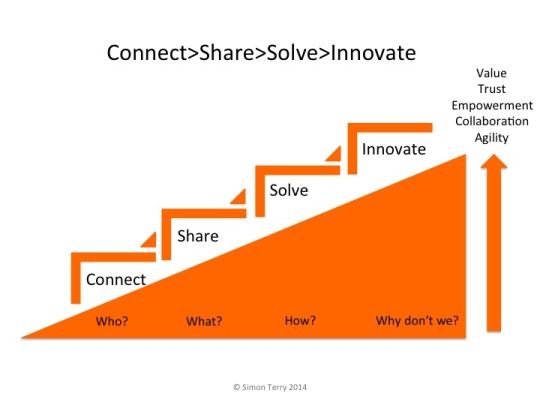
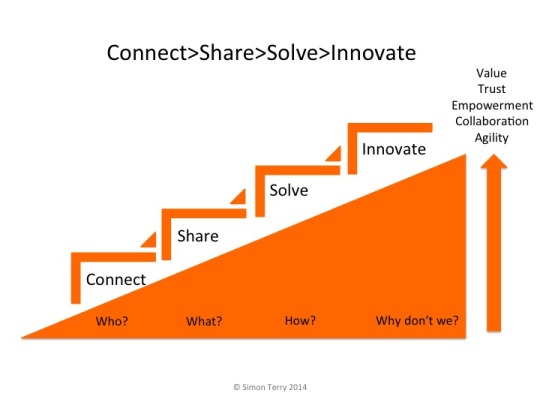
The Value Maturity Model Collaboration Canvas is a coaching framework to help community leaders, champions and managers to shape the creation of value through collaboration. The tool asks members of the community to think through the questions that will enable them to create their own value. Spreading this coaching mindset through your organisation is the most powerful way to transform the value created by collaboration & communities. Spreading a coaching mindset through your organisation builds capability as it builds alignment and creates value.  Enabling people to coach themselves helps your organisation become more responsive. It is the only way that you will get the value you didn’t plan and to adapt to the challenges you did not forecast.
Why doesn’t your community plan involve your community?

image

Many organisations want the benefits of better collaboration and the potential of better leveraging the potential of their people in a community. Increasingly with the availability of enterprise social networking, social mobile apps and integration into other productivity tools, organisations have the network capabilities to create the communities at hand.

A Network with a Demanding Boss

Too many plans for enterprise social networks and communities are developed without any community participation. The organisation wants something from the network. They set about getting that goal. When realising the goal proves harder than they expect, the organisation resorts to communication, performance levers, gamification, or maybe even ‘change management’. Many of these remain efforts to impose an external rationale on a network.

If the goals of a network are imposed externally, it is not a community. It is a network with a demanding boss. Any network of this type will lose energy over time as people query the benefits of their participation.

Use the Network to Create a Community

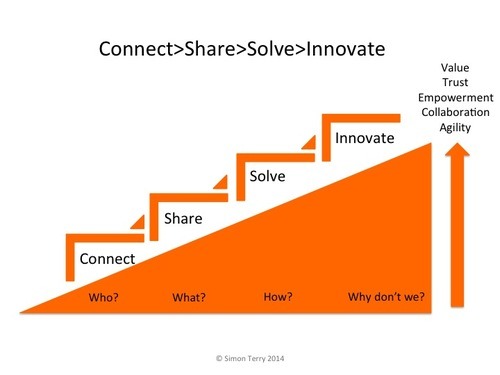
A community comes together around a common set of purposes.  Use your network to discover, discuss and align those goals. Engage the people that you would like to form a valuable community to find out how they want to engage.  My work shows that people have their own great reasons for adopting the practices that accelerate value at work and build communities. Those practices are those of the Value Maturity Model –  Connect>Share>Solve>Innovate.

The organisation’s goals will become a part of that discussion naturally.  Everyone works for the organisation and there will be some shared purpose. By engaging people you will discover the greater potential of the community and leverage its rich diversity of talent and perspective.

Ask leaders to lead

Much has been discussed about executive participation in enterprise social networking. Often it is seen as the panacea that will make people do the ‘right things’ in the network. Even the busy senior executives struggle to participate when it is imposed on them as an externally mandated task.  Again, the effort is to impose an external logic for networking.

When you focus on the community, what is clear is that what is needed is leaders. We don’t need participation from senior executives, when need people who are willing to take on the role of leader in the community to help the community to achieve its purposes. Leadership should come from senior executives, but it can also come from other community leaders, influencers and champions.

Don’t focus solely on senior executives. Focus on finding leaders willing to help create a community and drive change.  These people may well be your organisations mavericks and change agents.  Embrace their ability to lead.

The Value Maturity Model is an approach to help organisations create strategic value in collaboration and social networking. The Value Maturity Model Canvas helps organisations to develop agile plans for communities using participation of community members. To learn more, get in touch with Simon Terry via about.metwitter or Linkedin.

Networks connect. Communities mature.

Connection = Network

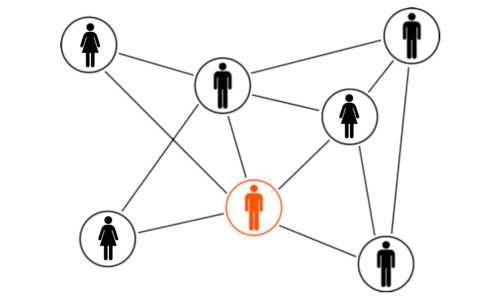
Connect is the first stage of the Value Maturity Model of collaboration because connection is what creates a network. Until people are connected together you don’t have any ability for someone to exceed their individual potential.

Connection only gets you a network. One of the reasons many people have been disappointed by their enterprise social network or their social media strategy is that they have not seen beyond creating the connections. A network has no vision.  A network has no purpose. A network is neutral in creating value.

Community = Value

Community creates the value. Community is how people come together to share their talents and create greater value together. Communities can create visions, realise the shared purposes of individuals and work together to achieve more.

Network connection happens immediately. Community develops over time as people learn to trust others and as people learn the new interactions that create value for themselves and others. Sharing, solving problems and innovating together deepens the community and enables individuals to grow in their potential. These communities also always exist within larger communities, like companies and society, that are often more important in shaping the way people act.

People = Potential

Focus on the potential of human communities. Remember that bringing people together in a network is just the beginning of the potential that people can create. Communities will mature with common goals, leadership and action over time.

Create a Reputation Economy

image

Connecting and Sharing create a reputation economy in your organisation to underpin the trust and collaboration required to Solve and Innovate.

Four topics are commonly discussed in communities around enterprise social networks:

  • Why would anyone go out of their way to help others?
  • How do we increase the value of collaboration in our organisation?
  • What is the role of leaders?
  • How do we cut down the gossip and non-work conversation in our network?

The answer to these four questions are connected to one element of successful networks: they create a reputation economy in the community that fosters collaboration.

The Value of Reputation

Humans aren’t the rational economic machines that most organisations try to manage with role descriptions, performance plans and other incentives. Humans do things outside the job description and the process every day.  We work around the hierarchy.  Importantly, we collaborate because we value relationships and we know that the returns from collaboration exceed the costs in our effort.

One of the challenges of collaboration is the danger that others will free ride on your efforts, improving their performance but bearing none of the costs. Mark Pagel’s Wired for Culture uses evolutionary approaches to behaviour to examine an important part of our defences against free riding, reputation.  Because our relationships with our work colleagues are not transactional, over time we build a level of trust and a reputation for each colleague based on their behaviour.  This reputation system influences who and how we collaborate with others.

Ever wondered why a users first ever request for help or crowd sourcing of ideas will usually struggle?  They have no reputation in the community and others will hang back until someone shows they can be trusted. 

Increasing the transparency and connection of reputation in your organisation will accelerate collaboration not just in a social network or other tool.  Collaboration across the organisation will leverage the new transparent reputations developed.

Building Reputation

We don’t build reputation with our status in the organisation or by declaring we can be trusted.  We build reputation through with who we are associated and how we act, particularly when we act against our interest.

The Connect and Share phases of the maturity of a collaboration community enable people to develop these critical stages of reputation. Working out loud for the benefit of others can accelerate that trust.  As can demonstrating and encouraging a growth mindset.   Sharing information, insights and solutions, particularly when there is no reason or benefit to the sharer is a powerful way to build a reputation.  Others sharing without penalty and preferably receiving benefits establishes the view in the community that it is safe.

The reputations and the trust built in Connect and Share are what powers the value in the later stages of the model.  People contribute later because they know that their contributions go to those who they respect and have the interests of the community at heart.

The Importance of Leaders

Leaders bring status into communities. However, as noted above, the presence of status is not enough to create or sustain trust.  Actions by leaders count.  

Leaders can play a critical role in showing the way to build reputation and in establishing that collaboration is safe and beneficial.  Importantly, leaders can use their authority to calling out free-riding behaviour and encourage participation by others. Leaders can acknowledge the reputations built in the community giving them greater influence in the organisation.

Leaders also need to be aware that their status also brings a fragility to their own personal reputations.  If they fail to act in the community to reinforce their authority, it will erode rapidly.

The Critical Role of Gossip & Non-Work Conversation

Organisations hate gossip and non-work conversation. They are seen as a threat to the singularity of corporate messaging and a waste of time.

However, gossip and non-work conversation are critical parts of reputation systems.  Gossip is how we share our views of others reputations. Non-work conversation is another way for us to share and build our reputations with others.

Create a reputation economy in your collaborative community by fostering connection and sharing.

The Value Maturity Model is an approach to enhancing the value of collaboration in your organisation.  The Model is supported by a range of tools and practices to enable leaders and community managers to maximise the potential in collaboration.  If you would like to learn more about the Value Maturity Model, get in touch with Simon Terry.

The Growth Mindset of Collaboration

Over the last week I have been speaking to a number of organisations across SE Asia around how they can start to realise the value that collaboration can create.   I was outlining my Connect>Share>Solve>Innovate model and helping organisations to plan their collaborative communities using the approach. 

One question kept coming up. The commonest question I was asked was a variant of the following:

How do we encourage our employees to share and try to solve problems when they are afraid to make a mistake?

At the heart of this anxiety is what Carol Dweck of Stanford refers to in her book Mindsets as a fixed mindset. If an employee believes that their ability, status or position is fixed, then they do not want to risk anything that might show themselves as performing below expectations. In a fixed mindset, you avoid testing your inherent capabilities for fear that you will be disappointed. Highly hierarchical organisations encourage a fixed mindset.

Collaboration demands what Carol Dweck calls a growth mindset. To collaborate, we have to believe that through work and effort we can learn and get better together. Mistakes, embarrassment and other challenges are learning opportunities that are overcome with effort.

Shifting to a Growth Mindset

My answer to the question above came down to a simple recommendation:

Make sure in the culture of your organisation there is a personal accountability on employees to improve their work every day.

This recommendation sounds so obvious. Surely we can expect this from any manager.  However, many organisations treat their employees as if their capabilities are unchanging, that improvement is the work of specialists and managers and that daily productivity is all that matters. Mix in hierarchical relationships and you have strongly reinforced a fixed mindset in the culture of the organisation i.e. do your job with minimum effort to the best of your ability only and wait to be changed.

There are many ways a personal accountability for improvement can be created in organisations:

  • customer experience, customer service improvement, etc
  • continuous improvement, productivity, kaizen, six sigma, etc
  • rising financial or performance expectations
  • personal leadership expectations
  • innovation, experimentation, agile, lean startup principles, etc
  • organisational values of improvement, growing impact on purpose, etc
  • talent development and on the job learning

Use one or all of the above. Whatever way it works in your organisations culture and strategy, the requirement is that your organisation expects and rewards people for the daily effort to improve. Over time that helps to create an expectation that every individual will work to make their work better.

The growth mindset in your organisation will drive the value of more mature forms of collaboration. Importantly, it will also drive an uplift in performance overall.

Episode 6: Executive Engagement in Enterprise Social Networks / Work out Loud Week with Simon Terry | The Yaminade

Paul Woods and I discuss strategic value, leadership, authority, executive engagement and working out loud on the Yaminade podcast.

Episode 6: Executive Engagement in Enterprise Social Networks / Work out Loud Week with Simon Terry | The Yaminade

Dear CEO: This Enterprise Social Network Doesn’t Work For You

Dear CEO

Re: This Enterprise Social Network Doesn’t Work For You

The purpose of this note is to clarify our most recent discussion in the executive leadership team about our enterprise social network. Thanks to your help we have now clarified that the enterprise social network is the last thing we need.

However our discussion on executive engagement in the network was again challenging. Initially there was a great deal of division in the executive leadership team as to how executives should use the network and their willingness to be involved. We did not get to explore your perspective on the role of executives in using our network when you left the room for another commitment declaring ‘this enterprise social network thing doesn’t work for me’.

We must admit we were initially disappointed by the comment. However, the remaining members of the executive team spent some time considering your insightful remark. We set out below the outcomes of that discussion:

Employee Engagement will deliver our Strategy

We realised that employee engagement, leveraging new ways of working in every role and discretionary effort to achieve our strategy is what will deliver better results. We believe that building a community in our enterprise social network will be another way for our employees to connect, to share, to solve problems and to innovate. The critical question we should consider is ‘Does this new approach to work deliver value for employees?’. The views of executives are less important than the value created for this community of value creators. All the evidence to date is that the network does work for our employees. Employees are more engaged and working more effectively.

This helped us understand that this enterprise social network doesn’t work for you but it works for our employees.

Leadership Helps Create Employee Engagement

We realised that employees need help to make sense of how to use the network, need help to solve problems and make change occur. That means employees need the support of leadership in networks. Importantly, that leadership does not have to come from the most senior executives. Leadership is a role not a job. We had hoped our most senior executives would play that role to ensure that the activity in the network aligned to strategy and best realised the potential of our people. However, we are already seeing new leaders rise up to fill the gap. The senior leaders who are involved can do more to foster this.

This enterprise social network doesn’t work for you. A strong community works for leaders who will help it achieve its potential and the community will surface new leaders to help shape and foster engagement.

Attitude & Capability are a Question of Leadership

We realised that much of the discussion in the room about lack of time, doubts about effectiveness of managing in networks or lack of skill were problems of attitude or of capability. These issues can be solved because they are the kind of challenges our executive leaders solve every day in other domains when required. People learn new skills, they work in new ways to fulfil the strategy and we ask people to be more efficient and better prioritise their time to do what matters. We ask exactly the same from our employees when we want them to achieve more. We don’t accept their refusal to change.

Towards the end of that discussion an interesting question was asked ‘If engaging in the community that creates value in our organisation doesn’t work for you, why are you a leader here?’. We wanted to share this question with you. 

Conclusion: Our Enterprise Social Network Doesn’t Work For You

We didn’t see at first. We now have come to agree with you that this enterprise social network won’t work for you. 

As a result, we have started a thread in the network asking our employees to contribute to the choice of who should takeover as CEO. That conversation is currently favouring the CMO. The community value her authenticity, respect her authority and trust her leadership. We aren’t surprised that the board seems to agree. Sorry leadership of this organisation’s community did not work out for you. We wish you the best in your future endeavours. You may find some useful suggestions as to what to you can do next in the thread that has started with advice on that topic.

Thanks for contributing so much to our efforts to engage the community, realise our strategy and improve performance.

Engage an executive in your enterprise social network. A great chance for executives to get involved is International Working Out Loud Week from 17-24 November 2014. Help an executive to see the leadership potential of working out loud. Find out more at wolweek.com

Celebrate Outcomes

The process is just a process. Often the process is one of many competing paths. Outcomes matter more.

In a recent conversation about customer experience, we were discussing the way people fixate on processes. Processes appeal to our industrial management mindsets. Processes are an engineering challenge of neat inputs and defined steps delivering an outcome in a mechanical fashion. Processes are so easy and alluring.

As a result we see troubling signs:

  • people compete for the beauty of their customer journey map. Have a look at Pinterest there are hundreds that are so gorgeous they reflect no real customer experience ever
  • organisations obsess about adoption over value creation because adoption is far more susceptible to a process
  • change management becomes an exercise of templates and measures rather than a series of changes in human relationships and mindsets
  • leadership is discussed an exercise in steps or processes to be managed rather than work to realise of the potential people in real complex circumstances 
  • measures, averages and other abstractions of the process mindset take precedence over human considerations.

Raising process to an exalted state devalues the complexity of humanity. The computer does not need to say no. Putting process over outcome leads to the outrage economy as people try to fight their way out of a narrow industrial mindset.

We need to focus on real human relationships. We need to allow for the mess and power of human emotions. We need to consider networks with learning, change and feedback, not just linear processes. Importantly, we can allow for human scales, learning and flexibility. Most importantly, we can allow for human conversations. That is the path to achieving the real messy and complex outcomes that we need.

Our organisations, our customer experiences and our relationships will be better for a broader more human approach.

Standing In: The Future of Work

image

What are you doing to cut through the challenges of attention in the future of work?

Attention Discriminates

Yesterday a client found me in a busy activity-based workspace by my colourful socks. There were too many dark suited males sitting at desks but only one was wearing loud socks. A distinctive trademark cut through the challenges of attention.

Our attention discriminates. We deliberately focus to exclude distractions. When humans lived on the African savannah there was already too much information and attention was a way to economise.

When we enter the future of work that issue of attention explodes. Streams of updates, flat networks of relationships to follow and complex rapidly changing environments create a load on our attention. If you want to be recognised for your efforts in this environment you will need to stand out.

Wearing colourful socks won’t cut it. Socks don’t scale. The traditional response of the extroverts among us just adds to the noise. One pair of colourful socks is a discriminator. Many are noise. We see the same with the ‘look at me’ cries on social media.

The future of work might not be about standing out. Perhaps it is about standing in.

Standing in

The way to get noticed in a network is to be a valuable node. Your goal is not to push yourself to isolation at the edges, it is to contribute to value creation at the core. In short, you need to stand in (networks).

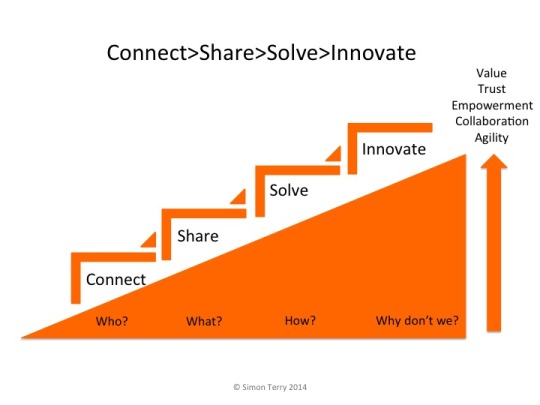
How can we stand in more effectively? The Value Maturity Model offers us a guide:

  • Work for a purpose and gather those around you who share that purpose
  • Make connections between people to improve the efficiency of the network
  • Share relevant information, add new information to your networks and don’t pass on the dross. Working out loud is a great practice that helps others and John Stepper has described how working out loud works for introverts.
  • Help solve problems of others in your network
  • When you see an ability to make a unique difference, take that chance. Innovative opportunities don’t happen often. Take a risk and leverage your network to make something unique happen.

To fight the discrimination of attention in the future of work, focus on standing in (networks).

image