Running or dancing?

We talk about how companies run. We rarely discuss how they dance.

Our machine metaphor for the organisation leads us to talk of how companies run. Running was an apt metaphor for the industrial organisation with hierarchical management, process orientation, and efficiency as its goal.

Running is domination of a single dimension, distance. Runners maximise efficiency to get the best speed over the distance for their effort. Running is ultimately an individual effort. Running together involves parallel tasks. Running is about individual performance.

The network economy demands Responsive Organisations. We are starting to challenge organisations to be more human, to be more agile, to be more innovative, to learn and ultimately to be more effective. We start to sound like we need an organisation to dance.

Dancing involves exploration of three dimensions. Dancers explore those dimensions for the beauty of the experience. Dancing is a response to changing external stimuli, particularly the movements of others and the music. Dancing is far more interactive and collaborative. Dancing is a performance for the individual and the collective.

We run machines. Humans dance.

What would be different if you asked how well your company danced?

Who says elephants can’t dance? – Lou V Gerstner Jnr

Truth, Persuasion & the Future of Work

image

We often slip into use the language of force to describe transformation of our organisations in the future of work: rebels, revolution, vanguard, etc. In so doing, we inadvertently romanticise the force & power dynamics that are at the heart of traditional organisations. Using the language of persuasion is more aligned to the changes advocated by the future of work.

Managers will transform to a new way of working when they are persuaded it is truly a better way. The future of work needs the employee’s engagement. We are transforming work to make it more human. Let’s use more human means in that transformation.

Satyagraha

Satyagraha is the term used to describe Mahamatma Gandhi’s approach to nonviolence. This approach has inspired non-violent change since. Focused on ‘insistence in truth’ it sought to focus on action that would bring forth persuasion of the opponents of change and strength in those arguing for change:

pursuit of truth did not admit of violence being inflicted on one’s opponent but that he must be weaned from error by patience and compassion. For what appears to be truth to the one may appear to be error to the other.

Gandhi also said:

Satygraha is a weapon of the strong; it admits of no violence under any circumstance whatsoever; and it ever insists upon truth.

Critical to Gandhi’s approach was the recognition that arguing for a new truth is an act of strength and that the means matter. Adopting the means of the oppressor to justify change weakens the cause.

Changing to the Future of Work

The future of work will not arrive in a revolution. As tempting as it may be to declare that there will be a moment of radical transformation, the changes that will come to the way we work will arrive as one by one managers change to new and better practices.  If they fail to change, it will come as their organisations are replaced by those who work in better ways.

The critical challenge for those advocating change is to endure and persuade. Those managers clinging to old ways genuinely believe that they are better. Use of these means is often a ‘self evident truth’ or ‘what management means’. Change agents must continue to advocate, to seek new arguments to demonstrate the truth of better practices and to take their arguments to those who need to hear change. Most of all they must retain compassion.

There will be no storming of corporate barricades. No new flag will be raised to herald a new era. There will be victories one person at a time as persuasion wins managers over from old models of management. 

Change Agents Must Endure, Prove their Truth and Persuade

Advocating for this change will take endurance. Old models of management are not beyond using force, punishment and exile to preserve their turf. The change agent must understand and embrace the setbacks and difficulties of the challenge.

Change agents must be humble enough to put their truth to the test. Managers will not be convinced by speeches and hype. They are convinced by value and results and when they are comfortable against the risks and emotions of change from the very practices that have founded their success and identity. Their minds will change when they accept a better truth.

If we are to make work more human, more driven by human purpose and human relationships, we must accept the means of change matter. Persuasion is the acceptable means. We must demonstrate better ways, prove the value of experiments and argue the case for change until it is accepted. Our new networks run best on integrity, influence and trust. Let’s make these core to our transformation to the future of work.

The Cultural Renaissance

The way people behave matters. We are experiencing a renaissance in focus on culture in our organizations. After emphasising process and systems, we are recognising the value of culture for collaboration, innovation, agility and the ability to realise the potential of an organisation. However culture is a challenging realm for managers more used to tangible systems to change.

Culture is Behaviour

‘Culture is how people behave’ – Mary Barra

Many organisations don’t understand culture. They treat it as an abstraction or a communication issue. The mindset believes that posters, communications and effective change management workshops can drive culture change. If everyone is clear on our values then the culture will change.

Nobody changed a corporate culture with a values statement. Values are subject to conflicts, interpretation and there is a gap to implementation in action.

What Behaviour do you Expect?

‘Culture is what happens when managers are not in the room’

Culture is about behaviours. A culture appears in action, not ideas. That’s why it has a positive or negative impact in a business.

Watching the actions of others is how we determine what actions are required and what is allowed. When a group of people form an expectation that some behaviours will happen and others are prohibited, those expectations shape their actions.

We know words mislead. The surest test of a culture is what behaviours happen when nobody is watching. We know a single action might be a fluke. We want consistency before we change our expectations of how people behave. Leaders need to take particular care to not announce new behaviours that they can’t live consistently.

Changing Culture Takes Actions

‘Culture eats strategy for breakfast’ -Peter Drucker

If your culture change program remains in the realm of ideas and ideals then the culture of the organisation will defeat it. Make sure you consider the following questions:

– what are your actions today before the change?
-are the actions you expect clear practical and realistic for people?
– who will lead the way in consistently & visibly demonstrating the new behaviours?
– which actions will you discourage?
– how will you ensure the changes in action are noticed and shared widely to reinforce the need for change?

Action is the heart of culture. Change the actions to change the behavioural expectation that is culture.

The Responsive Bank. Feature article in Q factor Oct 2014

Responding to a disruption and applying the Responsive Organisation principles to financial services

Note: the reference to an MBA in the bio at the end of the article is an error.

The Responsive Bank. Feature article in Q factor Oct 2014

The OODA Loop of Blogging

Work out loud and accelerate the benefits of blogging.

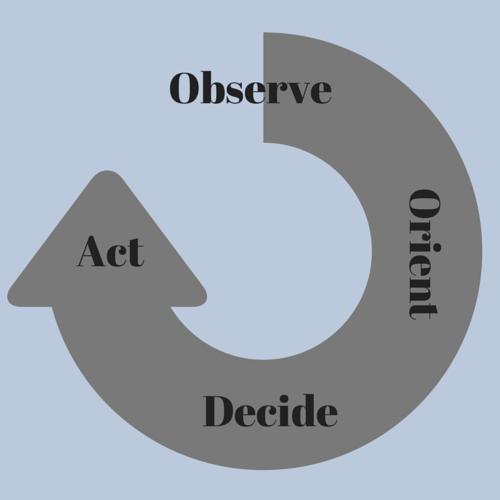
The OODA loop is one of my favourite strategic tools because it highlights the competitive advantage in speed and learning in a Responsive Organisation. I have also found OODA a useful mindset for my blogging and a way to ship posts consistently.

What is the OODA Loop?

Developed by a U.S. Airforce strategist Col. John Boyd the OODA Loop is the concept that strategic advantage goes to the party who can best navigate the decision loop through observing the situation, orienting themselves, deciding what to do next and translating that decision into action. Through transparency, autonomy and experimentation, a responsive organisation moves decisions to the edge of the organisation accelerating its OODA loop to deliver better business value.

How does OODA accelerate my blogging?

Observe: My blogging is built on a foundation of being constantly on the look out for insights. Every day as we work we are exposed to great ideas, wonderful learning and exciting conversations that challenge our thinking. The more I capture the more I learn and the more I have to share. Are you tuned to observe and capture these opportunities to share through a blog? Managing your attention to observe these moments and building a system to capture notes at the moment helps.

Orient: A blog is an expression of your cumulative knowledge and experience. Finding a way to orient a new observation against your current knowledge matters to building a consistent philosophy. You need to know how a new post fits into your blog. Once I have an insight I try to quickly connect it to other ideas on the blog and elsewhere that extend the thinking. Building this system of links helps reassure you of the value of a new post. Ultimately I would like these links to provide an ever evolving network structure to the ideas on my blog.

Decide: Struggled with a white screen? Found your 500 word post is 2000 words long? These are challenges of deciding what you are writing about. Decide to share one small simple idea. Keep it simple. Stop when it is done. If the idea gets complicated break it into a series. If you have oriented well then the decision on the role and scope of a post is a little easier.

Act: Write. Just start. The best way to solve a problem in a post is to write. You can always throw out and start again later. Only by writing and posting do you generate the interactions that create new insights. Embrace permanently beta. Ship the post and let others help you learn more. This focus on action in blogging is the power of working out loud.

Accelerating the OODA cycle on your blog reduces the risk of a writer’s block or a monster post that can be finished. Work out loud one idea at a time and invite others to share and accelerate your learning.

International Working Out Loud week is from 17-24 November 2014. For more on #wolweek check out wolweek.com. International Working Out Loud week is a great time to put OODA into action in your working out loud.

Responsible or Accountable

In a hierarchy, power moves down from their top. The focus of power is the allocation of responsibility to act to individuals and the management of their performance. Holding people accountable is a conversation driven by top down over those responsible. 

Hierarchies retain decision making continues at the top, so in theory that should be where the buck stops. However, the nature of the power relationship internally creates weak accountability for higher level decisions. Traditionally the only accountability for these decisions is through signals from shareholders or some times customers. 

The signals from the stock market and shareholders on management decisions are often weak. We accept high turnover in shareholders, customers and employees and explain away discontent.  Dealing with exit of frustrated shareholders, employees and customers is often as easy as adopting a growth orientation. Management need not consider the voices of those leaving as a source of accountability or a source of performance improvement. 

In an increasingly complex network world, this approach to accountability is no longer sustainable. While you retain a hierarchy for the allocation of responsibility, internally and externally your organisation needs to leverage networks to manage the complex relationships and challenges it faces. Suddenly we need to consider the shifting flow of authority and power in a wirearchy.

Traditional decision making (& the associated accountability) is also backward looking.  We examine history to determine what to do and what should have been done. As Harold Jarche points out we can’t look back to the past to predict the next decision or even who to hold responsible for action. Increasingly the question around accountability is ‘how will this decision be viewed at some point in the future by our stakeholders?’

New Network Accountability

With the increasingly networked world comes new sources of accountability. Employees, customers, shareholders and the community now have voice and the ability to organise.  They can leverage their relationships with the organisation and others to express their concerns. Organisations must increasingly enable all their employees to respond to these situations when and where they arise. That demands a more responsive organisation. 

These new internal and external accountabilities can’t be ignored or managed away without jeopardising business relationships. A decision not to participate in social interactions or the network won’t stop the conversation. It simply means your voice goes unheard In the conversation and might harm your business. Those who better respond to the needs and concerns of your employees, customers and community in the network will see their influence grow as those who ignore the accountability to the network will see influence fade.

The opportunity for responsive organisations is to embrace the new accountabilities in the pursuit of more effective performance.  With these accountabilities comes:

  • new information on the performance of your products, services, opportunities with your customers and your impact in the community
  • new relationships with influencers in the networks within and around your organisation
  • opportunities to leverage the talent and potential of people internally and externally who may not be within the consideration of the current hierarchy.

You may not change your strategy, your products and services or your organisation as a result of this additional network insight.  However, if you will have done much to better understand the true performance opportunities in your business and to remove risks that the weak accountability and weak information flows of a hierarchical approach may miss.

We encourage accountability in business as a driver of performance and an opportunity to improve.  Shift your accountability from the hierarchy to the network. You will discover new opportunities for your organisation.
 

This post is the first in a five part series on managing accountability in the network era. The posts deal with:

The Outrage Economy

image

I was brought up to take the good with the bad, to be polite at all times and always see the other person’s position.

I have spent a lifetime unlearning this upbringing. I have been forced to learn the fine art of outrage.

The Outrage Economy

We now live in an outrage economy. Outrage is the only engine of action in many service organisations:

  • want escalation of a slow process? Resort to outrage
  • want a variation in narrow rules? Resort to outrage
  • want the service you paid for? Resort to outrage
  • want to be heard? Resort to outrage
  • want attention? Resort to outrage at scale

Outrage now powers basic interactions. Organisations have taken customer service flexibility away. Employees are constrained, optimised and disempowered. In many cases this means that they are unable to do their jobs. They need customer outrage to be able to escalate, to loosen processes and solve recurrent issues. The only way to get something done is to invoke the customer retention or a complaint resolution process in response to customer outrage. I have even been invited by customer service employees to express greater outrage so that they could help me better. For example “What I am hearing is that if we don’t solve this for you now, your business with us will be at risk. Is that correct?”

This pattern of interaction means organisations are training their customers to resort to outrage with ever increasing speed. You don’t want to go through the IVR again so you had better get outraged now and hope the team leader has more power. If it going to take outrage to fix a process, why not get outraged now.

If the only channel of service that works is social media, then I will rant there first. Some organisations even have pre-emptive outrage on social media with customers complaining about service processes before they start. Social media seems to be the only place many organisations care about their reputation with customers.

Stop the Escalation of Outrage

Nothing goes better because of outrage. Outrage only destroys value. Outrage weakens relationships and destroys brands.

Let’s start looking for ways to solve issues without requiring customers to rant and complain. There are a few simple steps:

  1. Understand how your processes actually work for customers in interactions: Processes that make sense around the board table often fail in human interactions. Requiring a warning that the warranty will be voided if an item has been used inappropriately might be wise when taking an item for repart but it may also sound like a criticism or a threat to a frustrated customer who just wants the item fixed. Follow issues back from the frontline to those distant places in the organisation that cause them.
  2. Give your people the power, resources and support required to do their jobs: You measure their performance. Do you spend as much time measuring how well you support their interactions with customers? In an age of global integrated logistics, does it make sense that you only move things between your locations once a week? If a morning of flights are going to be delayed by fog, advising customers is great but have you planned how you will manage the situation? If calls are unusually high, is it time to put on extra staff or suggest alternatives to resolve the issue? Enabling single point resolution is more than designing a narrow question that a customer must answers yes to confirm that you have solved their needs.
  3. Give your people the discretion to empathise and delight customers: It is really hard to be outraged at someone who is allowed to be human.  Empathy can be the second most important element to de-escalating the situation for an outraged customer. Let your people apologise for genuine errors. Move beyond the platitudes because otherwise we know your aren’t really concerned about our ‘inconvenience’. Give them the freedom to do a little more than needed to fix things pre-emptively.

An organisation that cannot respond to its customer needs fails the sole reason the organisation exists. If your customers are getting even slightly outraged it is time to learn how to become more responsive.

Separating Ownership, Decisions, and Returns?

Capital intensive industry united Ownership, Decisions and Returns 

At the beginning of the industrial era, establishing a corporation was a challenge of capital. Manufacturing plants demanded ever larger amounts of capital for plants, equipment, raw materials and to fund the costs of production and distribution. The providers of capital were the entrepreneurs and were rewarded with the returns of the venture and control of the decisions. This was reinforced with the adoption of hierarchical manage structures to manage assets and information and control decision making.

We have carried through to modern management practice the unity of ownership, decision making and return. We simply inherited these concepts from original corporations. One of the few adaptations is a necessity of scale that in many large organisations with diversified shareholding boards and senior management have taken the decision making (and in some notorious cases the returns) as agent of the shareholders. Even still the prevailing dialogue is the maximisation of shareholder returns.

The Future of Work Changes the game

Increasingly we work in networks as knowledge workers, often spanning the boundaries of organisations in our sharing and work in the process. Knowledge work is rising as a share of the work in the developed economies. 

Dan Pink popularised that purpose, mastery and autonomy are sources of motivation and engagement. Knowledge workers particularly benefit from a sense of ownership of the work and the ability to make decisions as to how work will be delivered. Freeing these enables the development of mastery of the craft of knowledge work.  Harold Jarche has highlighted that work gets better with freedom to share and connect as well.

Importantly in manage knowledge working roles, value creation is potentially exponential and directly related to the worker’s talents and outputs. An engaged knowledge worker is far more productive than one filling a role in a hierarchy and a process. 

Ownership, Decisions and Returns aren’t tied together

We need to move from a default position of uniting ownership, decision making and returns. The process and approach we use for each should be a unique decision in our organisations.

Own Purpose: Ownership of capital differs from ownership of the purpose of the organisation. Shareholders rarely provide the means to bring people together and give them the meaning to contribute their efforts.  This broader sense of ownership of purpose and a commitment to the community of the organisation is a far more important leadership challenge in the networked knowledge working organisation.

Free Decisions: We can separate decision making from shareholding. Modern management would not be possible without this. However we still allocate decision making to hierarchy as proxy for shareholders. With appropriate coordination, knowledge workers can have far greater autonomy to make their own decisions in line with the strategy of the organisation, to experiment and use networks to coordinate and resolve issues.

Reward Talent: Capital may still needs its return. Returns are needed to attract the people who fund the start-up, help with infrastructure and provide the working capital to enable a knowledge worker to be paid before a customer pays. Those returns may not always be financial. Importantly, this return will often be after the substantial returns to knowledge workers for their contributions. Again this concept is not new. Professional service firms, investment banks, movie studios and other businesses dependent on the value creation of knowledge workers have paid high shares of returns to their knowledge workers. 

Legal Structures Change All the Time

The corporation is just a legal structure. Legal structure change when needed. We have employee owned businesses, not-for-profit companies, B companies, social enterprises and many novel forms of organisation because people saw the need to work in a different approaches to ownership, decision making and returns. 

These changes apply to for-profit businesses too.  Look at any joint venture between two large corporates and it will have a complex series of agreements implementing different models of decision making, ownership and returns than that which flows from the traditional shareholding approach. Many global corporations already have different classes of shares to separate ownership, decision making and returns. Management can use the same approaches internally to separate and improve ownership, decision making and returns.

Responsive Organisations need to ask themselves the question:

What approaches to ownership, decision making and returns will help our people to better engage with our purpose and respond to our customers?

Change that leverages these answers will help make work more human

So What Now?

Leadership is always a fallible hypothesis.

Leaders must be capable of being wrong to be engaged in leadership. If you are telling people what they want to hear, it isn’t leadership. If you are speaking in platitudes, then you aren’t leading anyone.

Leaders engage others in the hard work of change.

A testable hypothesis

The surest way to test the hypothesis of your leadership is to engage others and ask them to work with you. They will either follow or they won’t. Nobody can be forced to follow you. Your views aren’t always going to be right.

A leader must take a position that is specific enough to be potentially wrong and specific enough to be actionable in hard work. The change needs to be something detailed enough that others can fight for it or fight with it. Remember being proved wrong or working through opposition can be the critical learning experience in any change.

‘So What Now?’

Avoiding the risk of failure through management speak and motherhood statements only accelerates leadership failure. Any attempt to deceive or avoid simply delays the inevitable.

Too many leaders never discover the failure of their leadership. They leave the room confident but all that remains is question echoing in the minds of the audience:

“So what now?"