On Accountability in Networks

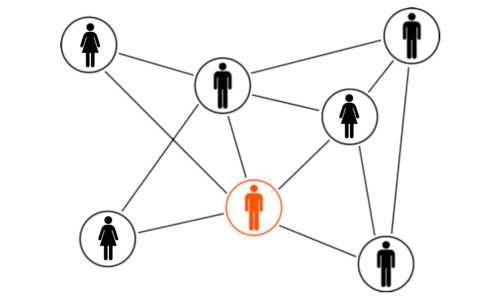
Following on from my recent posts on accountability in networks, I was asked recently whether a network could be accountable for an action or an outcome over an individual. This is an important question as we move into new ways of working. Anxiety over changes from the perceived effectiveness of alternatives to hierarchical models of accountability is a major barrier to management adoption. 

Answering a question about accountability usually involves a number of layers because management tends to be vague when it uses the term accountability. The linearity of hierarchy makes accountability an easy concept to use loosely.  Hierarchy often conflates accountability to make decisions, accountability for the outcome and responsibility to do the work

Let’s pull apart each of these meanings of accountability. 

Accountability vs Responsibility

First, we need to separate responsibility to do the work from accountability to deliver an outcome. Of course, you can have single accountability with networked responsibility. We do that every day. Almost every work scenario has one person to hold to account.

However you will need the holder of the accountability to understand the network leadership required to ensure the outcome from the network. This is why CEOs should not fear working like a network. It is how they actually work.  Most CEOs know their orders go through so many layers that influence and authority in the organisational network matters more than the power inherent in their order.

Accountability in a Group

If you wish for network accountability, remember every network has sub-networks that will hold & manage that accountability on behalf of the group and manage the responsibility of other sub-networks to do all or part of the work. An every day example is a board of a volunteer, movement or not for profit organisation. Often the accountability can be diffused in a formal or informal executive committee of managers, the chair and other key influencers.  The responsibilities for work are widely spread in free agent volunteers. This kind of accountability works but requires strong leadership in the group and the wider network.

Remember human networks have lots of accountability mechanisms like gossip, trust, reputation, authority, shunning and ultimately exclusion to manage situations where there may not be a hiearchical power to enforce accountabilities. Many of these techniques work without resort to force even against countervailing power. There’s a good reason volunteer organisations have lots of ructions.

Accountability to Decide

If you focus specifically on accountability as defining who holds the decision making rights, then network accountability needs a decision making system. Humans have lots of network decision making systems from consensus to democracy to more authority based models.

Networks work

Networks are how humans get stuff done. We have solved these issues in our history. Jon Husband’s definition of wirearchy captures this capability of networks neatly:

“a dynamic two-way flow of  power and authority, based on knowledge, trust, credibility and a focus on results, enabled by interconnected people and technology”.

We need to work differently and we need to use different approaches to leadership, trust and authority to make network accountabilities work. That doesn’t make it less effective. Managers just need to learn new skills to leverage the exponential potential of human networks.


Learning from the shared practice of bread making

image

Tonight I started making a new loaf of bread. The one I made this morning is gone. As I began I reflected that what once terrified me as a mysterious challenge has become a practice I can tackle with confidence. Mastery is still a long way off, but the practice has its rewards.

Making bread is a simple practice but one with remarkable options for complexity. The simplicity begins with ingredients. There are only four required – flour, water, yeast and salt. However each of these is a natural product and yeast is a living organism. Variations in flour, temperature and vitality of the yeast interact with the practice of kneading, rising, shaping and baking to introduce complexity. Additional ingredients, processes and time spin bread off in other complex ways.

The complexity means there is a lot to learn and learning from the practice of masters is invaluable. My first loaves were flat and inedible. My own starter was weak, I lacked a grasp for developing the structure of the gluten and I was unaware of what to do when my following of recipes went awry, usually through some minor error of mine.

Here’s a few examples of how I learned from studying the practice of masters:

  • My master sourdough recipe came from the Fabulous Baker Brothers with accretions from all my reading. 
  • A sourdough course at the Brasserie Bakery gave me a better hands on appreciation of kneading and a better starter. 
  • I learned about letter folds to improve the dough from the recommendations of many recipe books. 
  • The Bourke Street Bakery’s Bread and Butter Project cookbook introduced me to a new effective kneading technique for the amateur
  • No knead recipes helped me to understand time and wet dough was my friend and trained me in the ability to plan a loaf ahead.
  • I worked out how best to slash and steam loaves in my home oven from the advice of others and my own experiments. 
  • Reading widely on styles of bread helped hone my confidence to build my own recipes and fix those that drift off track. Particularly useful were The Bread Bible, the Italian Baker, Nordic Bakery and Local Breads 
  • I have become a keen watcher of bakers at work from my lock pizza store to videos online.

If you reflect on the diversity of these influences, you will understand that my loaves aren’t copies of anyone of these sources. They draw from each in different ways, often at different times.

Complexity means each person needs to develop their own unique practice to leverage their opportunities and meet their own needs. There isn’t always a simple to follow recipe when techniques need to be learned. Experimentation is required to make sense of the practice and to make our own changes to make those practices suit.

However, we don’t do that learning and experimentation alone. We stand on ‘the shoulders of giants’ if we connect and learn from those masters around us. However, I can only learn from others if they are prepared to work out loud and share their approach. That working out loud is not all a free gift. I have paid for courses, a library of books and bought a lot of bread in my quest to learn.

The practices of the Responsive Organisation are far more complex than bread making. They involve the purposes, concerns and perspectives of many people in pursuit of common goals with agility and an external focus on customers and community. Sharing and building from our shared practice will help all of us to develop success. Working out loud fuels this learning and connection.

Practice is Habit – Make This Your Year

“We are spinning our own fates, good or evil, and never to be undone. Every smallest stroke of virtue or of vice leaves its never so little scar.” – William James

Complex changes like realising the Responsive Organisation and developing the future of work need people to connect in communities and along networks of practice. Forming new habits will be essentially to developing the richness of practice required.

Habits are required in Practice

How are those New Year Resolutions tracking? A week into the new year and many people are already struggling with new practices that look like failed intentions. New practices struggle to embed unless we turn them into habits.

I was planning to write today about the need for habits to reinforce practice when tumblr served up the William James quote above thanks to the Explore blog and the work of Maria Popova. The article on William James says many wise words on the value of habit in reinforcing habit. 

However I can point out the serendipity.  Maria’s relentless and excellent curation is a habit. My practice of writing this blog is a habit.  Without these habits and many more the coincidence would not be possible.  Similar serendipity is found in the practice of working out loud.  These moments of encouragement extend the practice further. 

To create change we need to start developing suites of new future of work practices and turning them first into experiments and then embedding the successes as habits.  Through the long practice of habit will come innovations, solutions to problems and a richer connection with others pushing the practice forward. We need to create the habits and connections that enable the serendipity to power change for Responsive Organisations.

Habits bring time to Practice

Habits bring the gift of time to practice.  They ensure that our feeble new practices are not killed by lack of attention or effort. Habits sustain us through the hard days and the days we would rather not. We all love quick wins but focusing on new practices reminds us that not everything transforms immediately. There are obstacles, new skills and lessons to be learned in practice.

Successful practice takes time and learning. Habits are the key to winning that time.

This is Your Year

This year is definitely my year. I would like it to be yours too. That will take some new habits.

This poster first featured on this blog a year ago when its claims were decidedly uncertain. The poster celebrated that the obstacles are the work. It sits in my office in my eye line as a reminder that it is relentless practice and good habits that will deliver me the year that I seek. There are many ways I can ensure it will be my year:

  • If I practice what I preach consistently
  • If I experiment, to learn and to build new good habits
  • If I keep focus and avoid the distractions of the bright and shiny things
  • If I keep looking for ways to move forward, overcome the obstacles and achieve my purpose; but most of all
  • If I keep translating the believe that ‘This is My Year’ into action

image

This year is your year too. Like it or not, it will pass with every action and omission you make. The choice is yours to make it a year to remember. Create the habits required to own your year. The resulting practice will deliver great rewards.

Habits don’t have to be big things. Small steps accumulate. Small steps that can be consistently repeated in a process of learning accelerate success.

What would make it really your year? What do you need to do consistently to make it happen? What is your new habit?

Leveraging Accountability in Networks

In networks we are less able to leverage power to enforce accountability. Leveraging accountability requires a different focus as we are challenged to consider how we connect to personal purpose, relationships and reputation. Considering these approaches benefit leaders in each domain.

Accountability in Hierarchy is Done to You

In traditional hierarchical management, accountability is the responsibility of those in power. Accountabilities are enforced leveraging the power of leaders to reward, punish and exclude.

As a result accountability can be an imposed experience.  Decisions made remotely have impacts on status, rewards and other benefits. Accountability is a transaction of consequences that may not endure. An individual depends on good leaders to fully understand the process by which they are held to account and the rationale of the consequences.

Accountability in Networks is Personal

Confronted by an absence to enforce consequences with power many traditional leaders assume there is no accountability in networks. Individuals collaborating as peers are coming and going under their own authority. How could anyone hold them to account for their actions or decisions. We are too familiar from discussion of trolls and lurking with the idea that in a network domain there is little accountability.

Accountability in networks has not gone but it must be founded in personal decisions, relationships and reputation. Trust is the fundamental commodity of collaboration in networks and trust is a human process with swift and effective accountability.

For an individual to have any accountability in a network, they must have made a personal decision to engage.  The best of these decisions are founded in and reinforce personal purpose. Individuals rarely walk away from commitments aligned to their personal purpose. One of the reasons, efforts to hold lurkers to account fail is that the individual has usually made no explicit commitment to do anything. 

Communicating the decision to engage to others in a relationship is the the foundation for accountability in that relationship. Once the personal decision is shared it creates expectations in another.  How an individual performs against those expectations has implications for their ongoing relationship, their reputation in the community and the trust that others have in them.  Trolls explicitly avoid this relationship. They leverage anonymity to escape personal consequences and explicitly reject the norms of the communities that they attack. Trolling is a transaction in a community built on relationships. The major enterprise social networks rely on verified identities of employees to draw into the organisations community these relationships and their consequences.

Individuals who fail this relationship based approach to accountability will feel consequences. They may not be excluded or punished but they will find their influence decline as people decline to engage with them. Individuals will lose their authority to act. Having proved themselves untrustworthy the network routes around them like a blockage. The consequences of this for an individual can be harsh, devastating and enduring. Ostracism is a punishment for failing accountability in many ancient communities for this reason.

Leverage Accountability in a Relationship

To leverage accountability in networks, even those woven through our hierarchies, leaders need to follow some key practices:

  • Get personal: The best accountabilities are personal so we need to move from imposing accountability on groups to a focus on the individual and the individual’s actions and decisions.
  • Stand for a purpose: Purpose underpins deep accountability. If you stand for a purpose, you have a better chance of drawing the commitment of others who share that purpose and also of those people holding themselves to account.
  • Discover & share common truths: Shared context strengthens accountability. Focus on discovering and sharing common truths. You will be held to account for spin
  • Ask for explicit public commitments: Public commitments become part of relationships. Be explicit. Encourage people to share theirs and ask others in the community to hold them to account 
  • Lead adaptively: Creating tension that enables individuals and the community to reflect on performance and identify opportunities to improve is a key skill. The network will not always listen to leader’s answers but it is more likely to engage with a great question.
  • Enable in a Responsive Organisation: The focus of a Responsive Organisation on autonomy, transparency and experimentation increases the focus on personal commitment and relationships. A Responsive Organisation reduces the excuses around process and policy and seeks to extend the accountability of relationships to customers and community external to the organisation.

Accountability in hierarchies is based on transactions of power. In networks it demands a much more personal and relationship based approach.

This post is the last in a five part series on managing accountability in the network era. The other posts deal with:

Accountability and Email

The rise of digital networks is changing accountability in organisations. Hierarchy’s power to dictate is being eroded in favour of the voice and influence of the network.

Push The Story Better?

A common & failing response to the new internal and external accountability is for senior management to decide that we need a better job of getting their story out. This may take the form of a new marketing campaign, PR, letters to shareholders or even all staff emails.

Management choose these means of communication because there is little realistic prospect of a response. Only a tiny percentage of the audience traditionally replies to ads or PR messages. Not many more notice them. However by issuing one-way communications management has satisfied the challenge that something should be done.

While these approaches get a message out, they do not change the dynamic in an engaged network seeking authority and holding each other to account. An ‘official communication’, even that all too rare transparent and authentic communication, will be only one voice in a highly engaged conversation. That official message will have less influence without the support of champions to hold a conversation around its content, to answer queries and discuss objections.

Email is One-way

We see this experience play out in email. The surest way to avoid a conversation is email. No wonder email is so popular in management.

Email initially looks like a two-way communication choice but in practice emails down the hierarchy, whether to an individual or to all staff, are one-way media. Emails down the hierarchy are an exercise in pulling rank.

Only a brave employee will respond to the display of rank with an exercise in speaking back to power. If there is a response, it will be small scale and private. Nothing that can’t be managed.

An all staff email doesn’t start a conversation. It is usually an effort to end a conversation that is inconvenient. The effort to end the conversation is one reason these days that all staff email will inevitably leak. Frustrated by the message, employees respond externally.

Email appeals to management because it is a great way to push message or task and rely on the privacy and power gap to silence any objection.

Email is an Evasion of Accountability

Email is also commonly used as a way to avoid difficult conversations. Emails are sent to avoid the relationships and engagement that creates accountability or holds people accountable.

‘I sent you an email’ is not an answer. It is an evasion. Any glance at the email servers of a major corporate will see too many emails sent to shift work, responsibility or information to others with the minimum amount of engagement.  Seeking clean industrial conversations, email offer a clean toneless way to avoid emotional human conversations & human relationships. In many cases all email does is move to do lists around the organisation.

Hierarchies seem to think that people can be held accountable by email. An email might allocate a responsibility but it is a slippery way to hold people to account for their actions or decisions. Holding someone to account for decisions requires a conversation built on trust, shared purpose and understanding. Email rarely delivers that much engagement and context.

There is no accountability without clarity of responsibility and consequence. Email does not assure clarity of responsibility. Worse, there is less consequence in an email conversation than a two-way and open conversation. Even the exertion of the power of rank in email is less effective than in a context where the social value of rank matters to the recipient and audience.

The best accountability is personal. Personal accountability arises from engagement in conversations to create shared purpose, trust and enduring relationships.

Email is Toneless 

One reason so much corporate communication and the messages of senior executives are tone deaf is that they are not used to being questioned or listening for a reaction. Tone improves with shared context and accountability. That clanging sound is a failure to understand the context and a failure to acknowledge personal accountability to others in pursuit of one’s own message. Think through how your message will be received and what queries others may have and your tone will be better. You have made yourself a little more accountable to the audience

That lack of tone can be devastating when a network holds the individual or an organisation to account for their emails.  What many organisations miss in creating these bureaucratic emails shifting accountability and avoiding responsibility is that they are also creating the records that will be used later to judge their decisions. Whether those emails become public through a leak or in discovery in court proceedings, the future accountability for decisions in the network will be through a review of the emails, often long out of the context in which they were sent. As a result, the broader networks are often holding people accountable for a poor choice communicated by email.

To improve accountability step out of your email, leave behind the hierarchy and engage others in an authentic two way conversation in the network. There will be benefits in your leadership approach, the relationships created and the performance of the organisation.

This post is the third in a five part series on managing accountability in the network era. The other posts deal with:

Accountability, Rank and Authority

We assume people who hold rank in a hierarchy are accountable. Rank is rarely the measure of accountability. Accountability in networks is more likely to be found with social constructed authority.

Accountability in hierarchy can be attenuated by the distance of people in positions of power from customers, employees or others stakeholders. Our expectation that the buck stops with those with highest rank increasingly disappoints us. Without trust, those in hierarchical positions can continue to operate and exercise power.

Authority is earned and lost in networks

However, authority is earned in networks. Authority is not given or imposed.  The status of authority as a social construct means accountability to the network is built in.  

Importantly, in a network authority will often attach to the most authoritative figure who is a part of the conversation, whether they seek it or not.  Nilofer Merchant described this phenomenon well recently highlighting that leaders who step up to engage in social conversations will be expected to act. The reach of this expectation will run to their supposed authority, well beyond their power or their rank. In a societal conversation, leaders may be expected to act on their own power and influence their industry or society. By chosing to bring their rank to the conversation, they start with an expectation and an authority. The challenge is what they do next.

An authority who fails to exercise their status will lose it. Any authority that becomes unreliable, malicious or inauthentic will quickly lose their status. Losing the authority that is the underpinning of influence and action, is the swift form of accountability found in network relationships that depend on trust.

As we lose our trust in hierarchies, we will go looking for trusted authorities in networks. Should they fail us, we will change them rapidly.

This post is the second in a five part series on managing accountability in the network era. The posts deal with:

Responsible or Accountable

In a hierarchy, power moves down from their top. The focus of power is the allocation of responsibility to act to individuals and the management of their performance. Holding people accountable is a conversation driven by top down over those responsible. 

Hierarchies retain decision making continues at the top, so in theory that should be where the buck stops. However, the nature of the power relationship internally creates weak accountability for higher level decisions. Traditionally the only accountability for these decisions is through signals from shareholders or some times customers. 

The signals from the stock market and shareholders on management decisions are often weak. We accept high turnover in shareholders, customers and employees and explain away discontent.  Dealing with exit of frustrated shareholders, employees and customers is often as easy as adopting a growth orientation. Management need not consider the voices of those leaving as a source of accountability or a source of performance improvement. 

In an increasingly complex network world, this approach to accountability is no longer sustainable. While you retain a hierarchy for the allocation of responsibility, internally and externally your organisation needs to leverage networks to manage the complex relationships and challenges it faces. Suddenly we need to consider the shifting flow of authority and power in a wirearchy.

Traditional decision making (& the associated accountability) is also backward looking.  We examine history to determine what to do and what should have been done. As Harold Jarche points out we can’t look back to the past to predict the next decision or even who to hold responsible for action. Increasingly the question around accountability is ‘how will this decision be viewed at some point in the future by our stakeholders?’

New Network Accountability

With the increasingly networked world comes new sources of accountability. Employees, customers, shareholders and the community now have voice and the ability to organise.  They can leverage their relationships with the organisation and others to express their concerns. Organisations must increasingly enable all their employees to respond to these situations when and where they arise. That demands a more responsive organisation. 

These new internal and external accountabilities can’t be ignored or managed away without jeopardising business relationships. A decision not to participate in social interactions or the network won’t stop the conversation. It simply means your voice goes unheard In the conversation and might harm your business. Those who better respond to the needs and concerns of your employees, customers and community in the network will see their influence grow as those who ignore the accountability to the network will see influence fade.

The opportunity for responsive organisations is to embrace the new accountabilities in the pursuit of more effective performance.  With these accountabilities comes:

  • new information on the performance of your products, services, opportunities with your customers and your impact in the community
  • new relationships with influencers in the networks within and around your organisation
  • opportunities to leverage the talent and potential of people internally and externally who may not be within the consideration of the current hierarchy.

You may not change your strategy, your products and services or your organisation as a result of this additional network insight.  However, if you will have done much to better understand the true performance opportunities in your business and to remove risks that the weak accountability and weak information flows of a hierarchical approach may miss.

We encourage accountability in business as a driver of performance and an opportunity to improve.  Shift your accountability from the hierarchy to the network. You will discover new opportunities for your organisation.
 

This post is the first in a five part series on managing accountability in the network era. The posts deal with:

Celebrate Outcomes

The process is just a process. Often the process is one of many competing paths. Outcomes matter more.

In a recent conversation about customer experience, we were discussing the way people fixate on processes. Processes appeal to our industrial management mindsets. Processes are an engineering challenge of neat inputs and defined steps delivering an outcome in a mechanical fashion. Processes are so easy and alluring.

As a result we see troubling signs:

  • people compete for the beauty of their customer journey map. Have a look at Pinterest there are hundreds that are so gorgeous they reflect no real customer experience ever
  • organisations obsess about adoption over value creation because adoption is far more susceptible to a process
  • change management becomes an exercise of templates and measures rather than a series of changes in human relationships and mindsets
  • leadership is discussed an exercise in steps or processes to be managed rather than work to realise of the potential people in real complex circumstances 
  • measures, averages and other abstractions of the process mindset take precedence over human considerations.

Raising process to an exalted state devalues the complexity of humanity. The computer does not need to say no. Putting process over outcome leads to the outrage economy as people try to fight their way out of a narrow industrial mindset.

We need to focus on real human relationships. We need to allow for the mess and power of human emotions. We need to consider networks with learning, change and feedback, not just linear processes. Importantly, we can allow for human scales, learning and flexibility. Most importantly, we can allow for human conversations. That is the path to achieving the real messy and complex outcomes that we need.

Our organisations, our customer experiences and our relationships will be better for a broader more human approach.

Standing In: The Future of Work

image

What are you doing to cut through the challenges of attention in the future of work?

Attention Discriminates

Yesterday a client found me in a busy activity-based workspace by my colourful socks. There were too many dark suited males sitting at desks but only one was wearing loud socks. A distinctive trademark cut through the challenges of attention.

Our attention discriminates. We deliberately focus to exclude distractions. When humans lived on the African savannah there was already too much information and attention was a way to economise.

When we enter the future of work that issue of attention explodes. Streams of updates, flat networks of relationships to follow and complex rapidly changing environments create a load on our attention. If you want to be recognised for your efforts in this environment you will need to stand out.

Wearing colourful socks won’t cut it. Socks don’t scale. The traditional response of the extroverts among us just adds to the noise. One pair of colourful socks is a discriminator. Many are noise. We see the same with the ‘look at me’ cries on social media.

The future of work might not be about standing out. Perhaps it is about standing in.

Standing in

The way to get noticed in a network is to be a valuable node. Your goal is not to push yourself to isolation at the edges, it is to contribute to value creation at the core. In short, you need to stand in (networks).

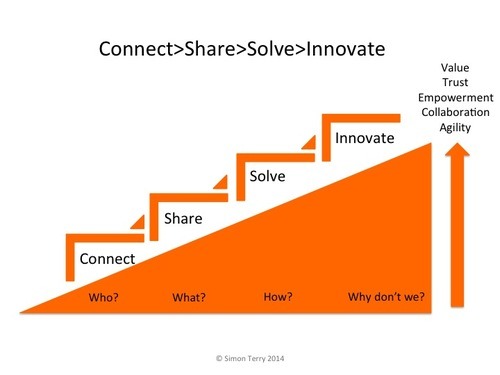
How can we stand in more effectively? The Value Maturity Model offers us a guide:

  • Work for a purpose and gather those around you who share that purpose
  • Make connections between people to improve the efficiency of the network
  • Share relevant information, add new information to your networks and don’t pass on the dross. Working out loud is a great practice that helps others and John Stepper has described how working out loud works for introverts.
  • Help solve problems of others in your network
  • When you see an ability to make a unique difference, take that chance. Innovative opportunities don’t happen often. Take a risk and leverage your network to make something unique happen.

To fight the discrimination of attention in the future of work, focus on standing in (networks).

image

Orderly Processions are Over

Hierarchy likes order. Networks manage complexity.
Hierarchy walks in an orderly procession. Networks hustle.
Hierarchy wants projects to go from a through to z. Networks experiment across the alphabet.
Hierarchy wants a clean status. Networks solve for problems & mess.
Hierarchy reinforces status. Networks value results
Hierarchy manages stocks. Networks manage flows.
Hierarchy likes secrets. Networks share.
Hierarchy approves, authorises and allocates. Networks learn, enable and do
You can wait for your spot in the orderly procession. However the orderly procession might never reach you or might pass you by blind to your talents to walk in lockstep.

Join the network of doers instead.