
The Extraordinary is the Ordinary Consistently Applied

image

Inconsistency is the norm. The extraordinary is the ordinary consistently applied.

I attribute all the success that I have had in my career comes down to one point.  My successes came about because I tried harder for longer at some simple thing.

  • I became a CEO because I tested myself with the little acts of change leadership every day for over a decade that built my skills and understanding of how to influence, to set a strategy and to lead a business
  • was invited to join Change Agents Worldwide because of my change advocacy and the thought leadership on this blog and I had been working on change every day for years and building my thoughts and writing daily for more than 4 years
  • my current consulting work in change leadership, collaboration and customer experience is not the outcome of any single insight. It is the consequence of learning more every day.

Whatever talents I might have were much less significant to my success than the willingness to put in the daily effort over a time span of years. After all, there are a mighty lot of talented people out there. It is far easier to outstay them than out perform them. If you put in the effort, you will discover, many extraordinarily talented people never start or give up at the first, second or tenth setback.

My actions aren’t extraordinary. I am a generalist, not a specialist. It is rare when I have the capabilities to make a unique difference. In our complex networked collaborative world, it is increasingly rare someone delivers on their unique capabilities alone. The generalist knows to leverage a network and is more likely to attend to all the disciplines needed for success.

When others are trying to achieve the extraordinary, often it is the small steps of change that are over looked. Consistently attending to these small efforts is much more likely to deliver the results. 

I have also discovered that luck is the outcome of effort, opportunity and preparation. Luck rewards those prepared and still trying. Working and learning consistently means when a new opportunity arises you have a better chance of success.

Just as talent rises from a community, extraordinary performance rises from consistency of effort. If you read biographies and history the theme recurs; Overnight success is an outcome of years of effort.

So don’t despair at the lack of an obvious way to be extraordinary.  Remember inconsistency is the norm. Your path to the extraordinary is the ordinary consistently applied.

Pay better attention

I stood at the traffic lights this morning beside a toddler in a pram. As the gathered adults stared blankly ahead absorbed in their thoughts or their phones, the toddler intently studied the traffic passing. Every car and truck got intense focus. The toddler was trying to learn something about its strange loud and colourful new world. The adults were elsewhere.

If you want to start small and start now, you need to pay attention to the little things. Small problems, small opportunities, small conversations and small moods all need to be noticed and acted on.

Here’s a question: do you know the shoe colour of the five people nearest you? Shoe colour is not that important but the act of paying better attention is. Paying better attention leads to other insights. For example, if all five are wearing black shoes, perhaps you might want to move somewhere more diverse.

Attention is a sign of respect. Attention is the foundation of learning. Attention drives the opportunity to change.

What small things can you notice today that can lead to a small action of change?

In the spirit of paying better attention, RU OK Day is 11 September. Find out more about how a little attention and a little conversation can make a difference at https://www.ruok.org.au

Start small. Start now.

Each journey of a thousand miles, begins with a single step – Lao Tsu

If you have time to email, then you have time to work out loud. Find one email to reply out loud instead. Repeat.

If you have time to talk, then you have time to lead. Find one person to influence. Repeat.

If you have time to do, then you have time to experiment. Find one hypothesis to test in action. Repeat.

If you have time for a meeting, then you have time to start a movement. Find a group to engage in a purpose and action. Repeat

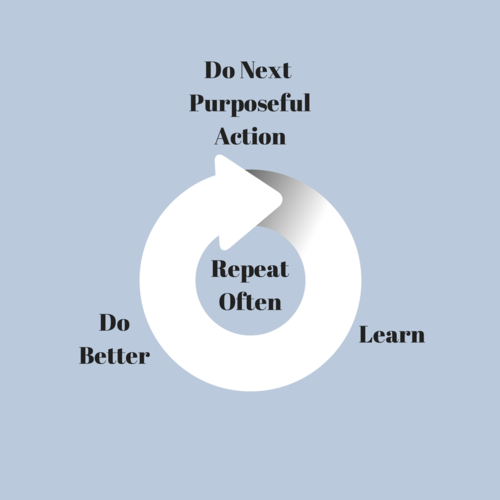
If you have time for a coffee, then you have time to learn. Find one moment to reflect on how to do better. Repeat.

If you have time to fix, then you have time to make change. Find one way to make the system better. Repeat.

Small scale changes accumulate given the time. Small interactions reinforce change and build community.

You have the time and the work. Start now. Start small. Repeat.

Learn these skills

Follow an unusual career paths and you will pick up a diverse set of skills. Later in life it will be that unusual skillset that enables you to make a mark when others get stuck in the pack.

In a rapidly changing world, diversity of personal skills is as important as the diversity of the teams that you join. Nobody is tied to a job. Everyone can learn something new. Make it your challenge to learn another skill every year at a minimum. Pursue opportunities that broaden your skills, knowledge and experience. We are all increasingly working in portfolio careers. The challenge is to be prepared.

Here are some skills & capabilities that I’ve found critical:

  • Persist: life throws challenges. The obstacles are the work and the reward. Learn how to push on to your goals and sustain the journey. Knowing why and understanding your own needs is critical here.
  • Listen: a completely underrated skill. Learn to listen between the lines. Learn to listen to what is not said. Listen actively questioning for understanding and learning. Don’t compose your reply. Listen deeply for insight.
  • Learn a new language: Jargon is everywhere. Learn the new language quickly. The faster you speak the lingo the better you build rapport. Plus understanding the grammar of the new business language tells you what matters in a business.
  • Tell a story: a story is not a list of events. A story engages with challenges, conflict and drama. You need to be able to share your passion for the story. The ability to tell a genuinely engaging story with passion is an art. Practice it every day.
  • Influence: before you can lead, you must influence others. Study and practice the art. Understand how to find the alignment of others’ agendas and your own. Learn how to hustle and to sell. Remember listening is more important than talking in influence.
  • Construct an argument: understanding how to communicate an argument quickly and effectively to an audience is key. Whether you are writing an email, preparing a PowerPoint or having a debate in a meeting know how to argue to influence. That’s different to arguing to win.
  • Negotiate: everything is negotiable. Learn how to negotiate effectively.
  • Learn to say no: Often and early. Priorities and values are a key to success. You will need a polite no to preserve them.
  • Use visual images: visuals work. The better your visual grammar the better you will understand how to engage others.
  • Run a project: the basics of project management help get stuff done. Most failed projects break simple rules. Learn how to manage simple project to delivery.
  • Risk everything (aka swim in the deep end): you are not learning if you are doing something you can already do. Risk=Reward.
  • Patience: no matter how young and brilliant you are you will have to wait at some point. Timing is everything in life and a career. Some times things just need to line up first. Make sure you have patience for when it is needed.

What are the Ethics of Work?

A great discussion on the ethics of working out loud broke out yesterday across my social streams prompted by a thoughtful blog post by Kandy Woodfield. The post and the many discussions it prompted have been insightful and a few key points have arisen for clarification in my strong advocacy of the benefits of working out loud:

  • While I have not been explicit on this, like other forms of social collaboration, working out loud is in my view a voluntary practice. It is not meaningful to describe an activity that involves forcing someone to work out loud as a learning experience or as social collaboration.  
  • Kandy’s call for support for learners through the vulnerability of the learning experience is critical. The objective is to better realise people’s potential and that takes a supportive culture, the right systems and the focus of leadership.

This last point for me was the clue to a broader issue that began to be discussed with many colleagues: 

What are the ethics of work?

If we are right to subject working out loud to an ethical investigation, then perhaps we should extend the same challenge to work. Many of the risks and vulnerabilities that occur in learning experiences are magnified in daily work, but occur with little consideration of the impact on the individual. Worse still work experiences are often designed by managers to exaggerate these vulnerabilities in the name of motivation or performance.

Culture creates an Environment of Support or of Risk

As young children we learn and we make mistakes freely and publicly. It is our approach to the world. As children, we mostly laugh as we learn. At times this process may be frustrating for child and parent.  Either might experience the odd temper tantrum but this learning process is expected of children. As a result, they are supported and encouraged in learning by a family and social environment. Their pace of learning is phenomenal becuse they are free to make sense, to experiment, to observe, to ask questions, to get into new environments and to try.

By the time we reach the workplace, things are not always as supportive. Mistakes are frowned on. Questions can be discouraged. Experimentation is dangerous. People have a status, a job and a place. Failure to learn adequately fast and accurately is treated a performance issue. Public sharing of shortcomings is common with leader boards, rankings, status and accreditation levels, gamification, etc. None of this has anything to do with working out loud or even learning. These practices are widely adopted as best practices from our traditional industrial management model. It is how we work.

Many of the dangers that Kandy raises for working out loud arise not because of the work is out loud, but because it is work. Traditional workplaces using industrial management thinking are often unsupportive of learning and the learner. 

To extend the argument of the blogpost, the way we work presents ethical issues. The danger comes not because of the visibility of working out loud. Mistakes will always happen. People will always be vulnerable if they are doing. The danger comes from the lack of a supportive work environment that encourages learning.

When the majority of learning is unstructured and on the job, this is a much more dangerous situation.  Everyday on the job individuals are trying to improve their performance by learning to work better.  The organisation must be hoping to see the growing benefits of an employee’s work. If we don’t support learning, all of this is at risk.  

Professional learning managers are ensuring that the 10% and the 20% of learning is managed ethically. Who is responsible for the 70% on-the-job learning? 

Leadership is the Technology of Human Potential

We need to ensure our approaches to learning and the development of the potential of people are effective and ethical wherever they occur.  Leaders at all levels in organisations need to work to create an environment that supports learning and supports learners.

We don’t need more of empty platitudes of declaring a learning organisation. The leadership hard work is considering how all the systems in the organisation support or encourage learners, learning, the sharing of knowledge and the development of personal & community potential. That is a great and highly rewarding ethical challenge for leaders in organisations everywhere.

We can start simply:

  • we can support people to learn and discuss the value of learning
  • we can coach people through the challenges of learning
  • we can encourage people to experiment with new and better ways of working
  • we create a voluntary community that shares the vulnerability of the learning experience and supports the learner with peers
  • we can support all of this with fun

A key to the rapidly changing environment of our networked economy is that organisations need to get better at learning and leveraging the potential of our people.  If we take Kandy’s query to heart in respect of on-the-job learning & the very nature of our work, organisations will be better at managing this challenge.

Our organisations will be more responsive.

The Pineapple Effect: Learning to See the New World

image

Discovering the New World was a difficult enterprise, as we have all been taught. But even more difficult, once the New World was discovered, was seeing it, understanding that it was new, entirely new, different from anything one had expected to find as new

…the Old World catch the imagery of the New most forcefully when it still does not know precisely what it is dealing with, when information is scarce and incomplete, and it is difficult to separate reality from mistakes and fantasy.

from ‘How New the World Was’ by Italo Calvino found in Collection of Sand

We see the new through our old world. The new presents us challenges and mysteries of which we need to make sense. We make mistakes, learn and in the process we experience a Pineapple Effect.

The Pineapple Effect

The original meaning of the word pineapple was the cones of conifer trees. After the new fruit was found in the Americas, it was named pineapple for a perceived resemblance to what we now call pinecones. The discoverers of this new world fruit needed to made sense of it so they explained it with the tools they had at hand from their old world. Of course, the name was grossly misleading. There’s little beyond a surface resemblance between the two. Thankfully, pinecone came into usage and the terms went separate ways to avoid further confusion.

For those advocating for changes in the world of work this Pineapple Effect presents a quandary. How do we help people make sense of the new world of work?

Do you advocate for change using old models? or

Do you engage people in the creativity of the new with some mystery, mistakes and fantasy?

Build out from the Old

We see a lot of people choose the former path. The new world of social collaboration and new forms of work organisation are promoted often in very traditional terms that reflect management’s view of where benefits may lie:

  • reducing email
  • a new kind of intranet
  • increasing efficiency
  • making communications more effective
  • improving business processes or technology system adoption and use with a social layer

For many organisations, there is value in these approaches, if it begins the journey of adoption and further learning. New tools and new ways of working take new practice and new skills.  They must be learned the hard way, often by experimentation. Importantly, they often introduce new attitudes, thinking and elements of culture to the organisation. There is an important period of sense making that occurs as people engage.  As Buckminster Fuller said:

If you want to teach people a new way of thinking, don’t teach. Give them a tool, the use of which will lead to it

However, if this new thinking and new practice is not specifically enabled by the culture of the organisation, real limits will be met. Unless the potential of the new tools and practices can be realised in change, employees & their managers will see the new approaches as Old World v2.0. That alone will limit the sense people can make of the changes, the discovery and the ultimate extent of change.

Worst of all, it may mean that the organisation may come to see change as unnecessary or faddish. With heavily technical approaches to adoption of tools, there is a similarly technical expectation of quick returns. In many cases, that shortens the timeline for people to learn new ways and to demonstrate the value of the changing practices.

Explore a little mystery

The business world is usually reticent to live long with the dangers of uncertainty. Mystery, mistakes and fantasy are seen as sources of concern in most organisations.

Occasionally we see a burst of the froth and bubble of the new in the business media, such as the recent discussion of Zappos’ decision to pursue Holacracy as a decision making process internally. While few organisations are likely to adopt the same decision as Zappos, the conversations of managers around the world about other models of work are potentially creative, if they provoke new thoughts and experiments in new models.

Embrace a little chaos. Be prepared to make new sense. Accept that these new ways of working offer the potential for entirely new models of work,sharing knowledge and decision making. Accept that the new way of work can be an agent of significant cultural change. When organisations have stepped into that potential, they can discover:

  • people fundamentally redesign decision making processes to leverage social’s potential to engage more people regardless of their place in a function or their expertise
  • new forms of trust built as people have a richer sense of other’s agendas and purposes – trust is an extraordinary enabler of so much that organisations need like collaboration, performance and creativity.
  • innovation arise in many new and varied places as people are enabled to experiment with new and better ways of working.

Transformative change occurs when people have the liberty & support to experiment. That means allowing the opportunity to embrace discovery of new meaning and the accompanying chaos, mistakes, & fantasy. Importantly that also means the time for new meaning to grow in a community of people. Many initiatives are cut short before they mature into new meaning and innovations.

The new world of work presents us with the Pineapple Effect. We need both smart leverage of traditional approaches to encourage adoption and a willingness to experiment for new meaning.
The Pineapple Effect: Learning to See the New World

image

Discovering the New World was a difficult enterprise, as we have all been taught. But even more difficult, once the New World was discovered, was seeing it, understanding that it was new, entirely new, different from anything one had expected to find as new

…the Old World catch the imagery of the New most forcefully when it still does not know precisely what it is dealing with, when information is scarce and incomplete, and it is difficult to separate reality from mistakes and fantasy.

from ‘How New the World Was’ by Italo Calvino found in Collection of Sand

We see the new through our old world. The new presents us challenges and mysteries of which we need to make sense. We make mistakes, learn and in the process we experience a Pineapple Effect.

The Pineapple Effect

The original meaning of the word pineapple was the cones of conifer trees. After the new fruit was found in the Americas, it was named pineapple for a perceived resemblance to what we now call pinecones. The discoverers of this new world fruit needed to made sense of it so they explained it with the tools they had at hand from their old world. Of course, the name was grossly misleading. There’s little beyond a surface resemblance between the two. Thankfully, pinecone came into usage and the terms went separate ways to avoid further confusion.

For those advocating for changes in the world of work this Pineapple Effect presents a quandary. How do we help people make sense of the new world of work?

Do you advocate for change using old models? or

Do you engage people in the creativity of the new with some mystery, mistakes and fantasy?

Build out from the Old

We see a lot of people choose the former path. The new world of social collaboration and new forms of work organisation are promoted often in very traditional terms that reflect management’s view of where benefits may lie:

  • reducing email
  • a new kind of intranet
  • increasing efficiency
  • making communications more effective
  • improving business processes or technology system adoption and use with a social layer

For many organisations, there is value in these approaches, if it begins the journey of adoption and further learning. New tools and new ways of working take new practice and new skills.  They must be learned the hard way, often by experimentation. Importantly, they often introduce new attitudes, thinking and elements of culture to the organisation. There is an important period of sense making that occurs as people engage.  As Buckminster Fuller said:

If you want to teach people a new way of thinking, don’t teach. Give them a tool, the use of which will lead to it

However, if this new thinking and new practice is not specifically enabled by the culture of the organisation, real limits will be met. Unless the potential of the new tools and practices can be realised in change, employees & their managers will see the new approaches as Old World v2.0. That alone will limit the sense people can make of the changes, the discovery and the ultimate extent of change.

Worst of all, it may mean that the organisation may come to see change as unnecessary or faddish. With heavily technical approaches to adoption of tools, there is a similarly technical expectation of quick returns. In many cases, that shortens the timeline for people to learn new ways and to demonstrate the value of the changing practices.

Explore a little mystery

The business world is usually reticent to live long with the dangers of uncertainty. Mystery, mistakes and fantasy are seen as sources of concern in most organisations.

Occasionally we see a burst of the froth and bubble of the new in the business media, such as the recent discussion of Zappos’ decision to pursue Holacracy as a decision making process internally. While few organisations are likely to adopt the same decision as Zappos, the conversations of managers around the world about other models of work are potentially creative, if they provoke new thoughts and experiments in new models.

Embrace a little chaos. Be prepared to make new sense. Accept that these new ways of working offer the potential for entirely new models of work,sharing knowledge and decision making. Accept that the new way of work can be an agent of significant cultural change. When organisations have stepped into that potential, they can discover:

  • people fundamentally redesign decision making processes to leverage social’s potential to engage more people regardless of their place in a function or their expertise
  • new forms of trust built as people have a richer sense of other’s agendas and purposes – trust is an extraordinary enabler of so much that organisations need like collaboration, performance and creativity.
  • innovation arise in many new and varied places as people are enabled to experiment with new and better ways of working.

Transformative change occurs when people have the liberty & support to experiment. That means allowing the opportunity to embrace discovery of new meaning and the accompanying chaos, mistakes, & fantasy. Importantly that also means the time for new meaning to grow in a community of people. Many initiatives are cut short before they mature into new meaning and innovations.

The new world of work presents us with the Pineapple Effect. We need both smart leverage of traditional approaches to encourage adoption and a willingness to experiment for new meaning.
Obstacles are the work

Is it really December?  Businesses and schools are winding down for the summer break. The cricket has started. Christmas is rapidly approaching.  With that comes a quick close to 2013.

2013 has been a year of adventures, obstacles and challenges. More than anything else it has been a year of new momentum. I could not be more excited by the incredible opportunities that have arisen this year:

Embrace the Chaos and all its Obstacles

I was reflecting on all that has happened this year when Dany DeGrave tweeted yesterday about the need to maintain momentum in the face of obstacles:

Obstacles are the work. They show you have chosen to have an impact. They help us see our purpose. They provide the challenge and interest.

Obstacles are proof that your work matters to others. These challenges remind us that change is human and social. They encourage us to share knowledge with our networks, to work aloud and to pay attention to the knowledge moving around us.

Obstacles help us reflect on what matters. Pushback make us ask new or obvious questions.  An orderly progression of success can be quite tedious and generate its own doubts.  If success is that easy, are we missing something?

If there weren’t obstacles, our talents would not be required, we would not learn and not grow in the work. If there weren’t obstacles, we would not get the rewards of overcoming them.  If there weren’t obstacles, we would not have the joys of collaborating with others to move forward around over, under or through.

Your Obstacles. Your Momentum. Your Year.

So next time you are considering a year of obstacles, remember the hard work proves that you are on the right track. Obstacles are proof of your momentum.

I bought this poster at the midpoint of this year. It has been a reminder ever since that every year is my year.

image

Every year is your year too. Move past challenges. Reflect on the successes.

Maintain momentum in doing whatever you need to do to make it your year. Your impact is up to you.

If you would like your own or other great posters, the source is The Poster List.