CEO: This job is almost impossible

I am very pleased to be sharing with you today my first post as CEO. Apologies if it seems a little frazzled. I am by the challenges ahead but that’s also because I am writing at home surrounded by the turmoil of my young family. I thought I would pass over the usual inspiring memo and start a conversation here in our enterprise social network. I am humbled by the many posts here that saw me selected as your CEO. I now have a great challenge ahead to honour that confidence in my potential as a leader and to use my new position wisely. We have many challenges ahead and we will need to work together to solve them.

As he was leaving the organisation, my predecessor remarked “This job is almost impossible. You are going to need a lot of help to fix things”  Yet again he was incredibly insightful. 

A Big Challenge

I suspect I see the job of a CEO slightly differently to my predecessor but I agree on its challenges. I see the CEO as less of a commander atop a hierarchy. I haven’t won this role for my expertise or ability to make all the decisions needed. For me a CEO is a guardian of the organisation’s purpose and its impacts for customers, community and people. Ultimately, the CEO is held accountable by these stakeholders for their ability to facilitate great outcomes from the whole team.

To advance our purpose and improve our effectiveness, I will be less of a boss and leading the way as a change agent helping to create the needed focus, better performance and accountabilities in our organisation’s network. At the same time I recognise in a time of rapid change I need to lead the way as learner in chief. That will be easy for me. One of the reasons I am frazzled is that I have a big learning curve ahead and our organisation has a lot to learn.   

Learning on the job as CEO is almost impossible, how can you help me to learn the role, learn better ways of working and learn the future of this organisation?

Only A Job 

I am acutely aware that CEO is only one job. Some CEOs confuse the job and the role thinking that their personal power and expertise is the answer to the organisation’s challenges. I know too well that I don’t have the expertise and I don’t have the answers. You know that well. It was discussed aloud when you chose me.

My authority comes not from the role but from your confidence in my ability to help realise our purpose and to create the answers we need together. That is the only sustainable basis of your decisions to follow. We need to replicate relationships based in understandings of capabilities, effectiveness and authority for every role in the organisation so that anyone can lead, can contribute their expertise and realise their potential. Working together in this way and working explicitly on our relationships will make our interactions can be rich in trust and quickly identify those who would rather work elsewhere. 

Changing our leadership approaches and relationships is almost impossible, how can you help me to create new relationships in this organisation?

We’re Together in Change 

We need trust and strong relationships because we are going to work to use all our talents to fixing things together. We need the people closest to our customers and those with new ideas and new information to have the authority to make change and to call on the support of their colleagues to see it through. At times, we have valued processes and rules over outcomes for our customers and our people. Not all of our ways of working deliver the outcomes we want. We aren’t as responsive as we would like. We have work to do. All our employees have the responsibility to find fixes to the issues that they see in our business. They won’t be able to do that on their own. They will need your help too. 

We will only succeed in the harsh competitive environment if we have the ability to better leverage the talents and potential of all our people. Together we will focus on how we improve everyone’s effectiveness, autonomy and agility to deliver better outcomes for the organisation, its customers & community and importantly for themselves. Our collaboration will be critical to connect us, to share information and to solve the daily obstacles we face to better performance. Everyone has a role to play in this.

Realising the potential of all our people to contribute to purpose is almost impossible, how can you help me to accelerate our change?

Let’s Continue the Conversation

Attached to this post is a memo that the executive sent to the CEO some time ago outlining the importance of this enterprise social network to our strategy. Unfortunately, as it was a email it was only seen by the CEO and the executive team. As all our employees will contribute to creating value for our customers through collaboration and continuous improvement, it would have been wiser to share this with you earlier. As we move forward, our leadership team has agreed to write fewer politely worded memos and to engage in real conversations out loud here in the enterprise social network. I would ask you each to work out loud too.  Sharing our work as it progresses is a way to help us learn and improve.

Our future success is a real challenge. It always is. You might even say it is almost impossible, but nothing less would suit our very capable people. We will improve and deliver our purpose one day at a time. I am frazzled but I couldn’t be more excited as CEO as I have confidence that this amazing group of people will help find each day’s answer to the question: 

‘What Do We Need to Improve Today?’

It is almost impossible to believe that I am CEO of this great network of talented people. I know you will help me get over that too!

Previous posts:

#1 The Last Thing We Need Is An Enterprise Social Network

#2 Dear CEO: This Enterprise Social Network Doesn’t Work For You
Coach the Community to Create Value

We may have begun to move from an adoption conversation to a value conversation. However our hierarchical mindsets can still hold us back. A responsive organisation needs to shape how value arise from collaboration, not try to specify it top down.

Embrace Value

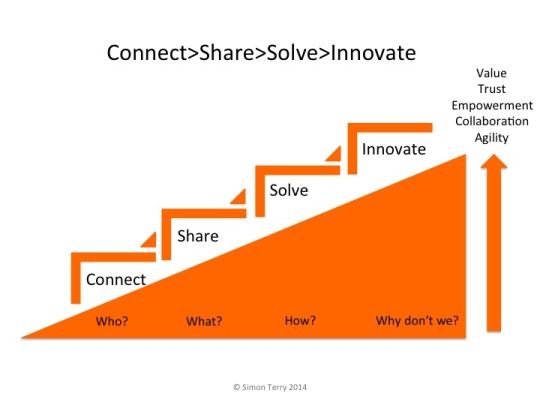
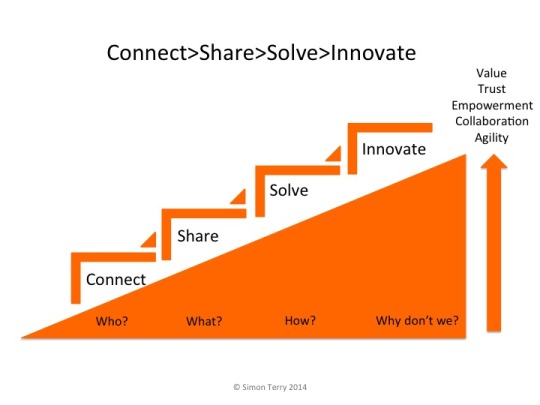
More and more organisations are focusing on how to create strategic business value in their organisation through the use of collaboration. They are seeing the value that can be created as a community journeys from Connection to Innovation. They recognise that adoption & use should reinforce the strategic goals of the organisation and is not an end in itself.

The Temptation to Specify

When an organisation identifies the way that it can create value in a community, our hierarchical tendencies begin to kick in. We start to specify how a community shall work to create value. This is how most organisation’s strategy planning processes usually work. We end up with a plan of what other people have to do. 

Some guidance can be useful at the beginning of a community’s life when people are sense making. However, too much instruction will become a constraint on the value creation if the goals of value creation remain externally imposed on the community.

The best value comes when a community can use its knowledge, capabilities and ideas to create value in new ways. That won’t happen if the community has specified usage cases and a limited focus on the value that it can create.

Coach the Community to Create the Own Value

A large part of the difference between management and leadership is the difference between direction and coaching. Responsive organisations demand leaders who can coach teams managing highly adaptive situations, rather than direct.

Organisations need to coach the members of their communities to create valuable new ways of working using collaboration:

  • Coaching begins by clarifying goals: How do you help your communities understand the alignment between organisations strategic goals and the goals of their own work? 
  • Coaching should enable action & experimentation: How do you help people to translate the opportunities that they can see into work that they can do alone or with the support of others?
  • Coaching should build capability: What skills do people need to manage this process for themselves? What barriers need to be cleared? How can they learn to create, deliver and coach themselves going forward?

The Value Maturity Model Collaboration Canvas is a coaching framework to help community leaders, champions and managers to shape the creation of value through collaboration. The tool asks members of the community to think through the questions that will enable them to create their own value. Spreading this coaching mindset through your organisation is the most powerful way to transform the value created by collaboration & communities. Spreading a coaching mindset through your organisation builds capability as it builds alignment and creates value.  Enabling people to coach themselves helps your organisation become more responsive. It is the only way that you will get the value you didn’t plan and to adapt to the challenges you did not forecast.

The Normative Value of Failure Comes from Your Next Act

Embrace failure. Fail fast. Fail small and early. Everyone has failures. Few failures are fatal. 

Despite all the good advice about failure, people find it very hard to sit comfortably with failure. When outcomes matter and achievements are celebrated failure is often a disappointment regardless of the amount of official imprimatur. Failure attracts a whole lot of personal and cultural baggage. This is a significant issue when willingness to risk failure is a large part of an organisations ability to adapt.

Reading The Pirate Organization by Durand and Vergne gave me a somewhat different perspective on failure. Noting that many pirate organisations were short-lived and easily defeated by the forces of the state, Durand and Vergne still noted that pirate organisations helped establish new norms for international trade and even the way organisations worked. Pirates showed where states were weak, where trade was broken and where traditional organisations needed to become more agile and adapt. Their thesis is these fragile and often failing pirate organisations are a critical part of the process by which sovereign states and capitalist organisations adjust to new territories of economic endeavour.

Failures Create Norms Too

Projects that end in failure can play a critical role in defining norms in an organisation in a similar way. They also set norms that shape future activity as well. Failure draws human attention and with that attention there is a chance to influence the way that people perceive culture – the how we work around here expectation. Critically culture is an expectation of how we will interact. It is shaped more by what you do about failure than what you say.

Failure has a big influence because the activity that follows failures sends signals that shape people’s perspective on a few key elements of organisational activity:

  • People worth supporting: How do you treat those whose projects fail. Give them the plum choice of the next project. Support them to learn what they need to learn to make their next efforts more successful. Whatever you do, don’t pretend the failure didn’t happen. They know it did. Hiding it loses the lessons and the uncertainty of silent treatment can be worse for people involved than blame. 
  • Purposes worth achieving:  The surest way to signal that a purpose is important, is shared and is worth achieving is that people persist after a failed attempt and start developing new ways to achieve the goal based on the lessons from the failure.
  • Problems needing fixes: Failures often highlight problems in supporting areas, systems or processes that need attention. This is how lessons are revealed by a chaos monkey. Whether or not people are prepared to learn and adapt to remedy these problems following failure is a major signal of the culture of an organisation. Do nothing and you can’t expect anyone else to care for those issues.
  • Ways worth working: Failures often take down more than just a specific objective or a specific project. Small specific failures in organisations can be used as a weapon to sabotage wider transformations, particularly ones that change the way an organisation works. We’ve all heard some version of the refrain of the cynics “How can they succeed in the whole organisation if they can’t get their first pilot to work?” Whether an organisation persists, adapts or abandons a new way of working following a related failure sends a critical signal.

Norms Come From Actions. Not Posters.

You are going to struggle to convince people that you love and desire failure. The achievement orientation in your organisation culture will work against you all the way. Hiring a few change agents will help show tolerance and foster some adaptation but it won’t necessarily make failure acceptable.

Take down the posters encouraging people to risk failure. Show them instead how you act after failures happen. That moment is when you get to signal what matters to your organisation in terms of purposes, people and processes.

Why doesn’t your community plan involve your community?

image

Many organisations want the benefits of better collaboration and the potential of better leveraging the potential of their people in a community. Increasingly with the availability of enterprise social networking, social mobile apps and integration into other productivity tools, organisations have the network capabilities to create the communities at hand.

A Network with a Demanding Boss

Too many plans for enterprise social networks and communities are developed without any community participation. The organisation wants something from the network. They set about getting that goal. When realising the goal proves harder than they expect, the organisation resorts to communication, performance levers, gamification, or maybe even ‘change management’. Many of these remain efforts to impose an external rationale on a network.

If the goals of a network are imposed externally, it is not a community. It is a network with a demanding boss. Any network of this type will lose energy over time as people query the benefits of their participation.

Use the Network to Create a Community

A community comes together around a common set of purposes.  Use your network to discover, discuss and align those goals. Engage the people that you would like to form a valuable community to find out how they want to engage.  My work shows that people have their own great reasons for adopting the practices that accelerate value at work and build communities. Those practices are those of the Value Maturity Model –  Connect>Share>Solve>Innovate.

The organisation’s goals will become a part of that discussion naturally.  Everyone works for the organisation and there will be some shared purpose. By engaging people you will discover the greater potential of the community and leverage its rich diversity of talent and perspective.

Ask leaders to lead

Much has been discussed about executive participation in enterprise social networking. Often it is seen as the panacea that will make people do the ‘right things’ in the network. Even the busy senior executives struggle to participate when it is imposed on them as an externally mandated task.  Again, the effort is to impose an external logic for networking.

When you focus on the community, what is clear is that what is needed is leaders. We don’t need participation from senior executives, when need people who are willing to take on the role of leader in the community to help the community to achieve its purposes. Leadership should come from senior executives, but it can also come from other community leaders, influencers and champions.

Don’t focus solely on senior executives. Focus on finding leaders willing to help create a community and drive change.  These people may well be your organisations mavericks and change agents.  Embrace their ability to lead.

The Value Maturity Model is an approach to help organisations create strategic value in collaboration and social networking. The Value Maturity Model Canvas helps organisations to develop agile plans for communities using participation of community members. To learn more, get in touch with Simon Terry via about.metwitter or Linkedin.

The Rise of Effectiveness

In the last century management’s overwhelming focus was efficiency. An industrial mindset influenced our definition of effectiveness to be driven largely by delivering more for less.

The influence was straight forward. The efficiency of a machine is how well it turns inputs into its fixed outputs. If a machine’s quality is stable (a risky but common assumption), then a focus on efficiency works as a proxy for effectiveness. Effectiveness slipped from sight in a period of unmet consumer demand, long growth and expanding global markets. We focused our organisations almost solely on efficiency. When changes in effectiveness were required, they came in the form of new disruptive innovators and innovations that rewrote the quality definition and a focus on efficiency resumed.

Human effectiveness cannot be defined as simply as that of a machine. Our traditional industrial machines turn simple inputs through process steps into fixed outputs. Humans can be reduced to that work too. For many organisations it became the goal of human work to make it fixed, repetitive and predictable. It is not a surprise that they discovered that the quality of this repetitive work was rarely stable. 

Humans are capable of more than machine work. We are also capable of turning complex and diverse inputs into a simple open-ended output, like an action, a decision, a sentence, a service, a piece of knowledge or a song. Suddenly we can’t assume that inputs are consistent, quality is stable and that outputs are known. Our proxy has broken down and we need to return to a more direct focus on effectiveness.

The last decade has seen the slow rise of effectiveness as a management challenge and management grappling with new skills:

  • quality movements, continuous improvement and other disciplines have revisited the assumption around stable quality and even stretched to query whether the predetermined output matches what customers need
  • customer experience, design and similar disciplines have begun to look at the potential to shape new and better effectiveness of our products and experiences. 
  • increasing focus on disruptive innovation has raised the challenge of why the traditional model must break and new strategy models query the narrow focus on efficiency vs other ways to achieve greater effectiveness (see Blue Ocean Strategy, Roger Martin, etc)
  • realisations about the shifting nature of work has caused many to reflect on whether efficiency is the best or at least only model for connected knowledge workers or any other role.
  • consumers questioning the need, quality, sustainability, morality, environmental and social impact of the products of industrial machine models 
  • examining new models of leadership, organisation and development of people that encourage the development of true human effectiveness and realise untapped human potential.
  • rearguard actions to find ever more efficient machines (robots, big data, management algorithms, etc) that can replace humans in increasingly complex roles and work.

Responsive organisations recognise that the proxy of efficiency for effectiveness is fundamentally broken. The skills of efficiency remain relevant but they can no longer replace a focus on effectiveness.

The rise of effectiveness is on us. Our challenge is to adapt our approaches to work to make the most of our opportunities, not just to minimise our waste.

Networks connect. Communities mature.

Connection = Network

Connect is the first stage of the Value Maturity Model of collaboration because connection is what creates a network. Until people are connected together you don’t have any ability for someone to exceed their individual potential.

Connection only gets you a network. One of the reasons many people have been disappointed by their enterprise social network or their social media strategy is that they have not seen beyond creating the connections. A network has no vision.  A network has no purpose. A network is neutral in creating value.

Community = Value

Community creates the value. Community is how people come together to share their talents and create greater value together. Communities can create visions, realise the shared purposes of individuals and work together to achieve more.

Network connection happens immediately. Community develops over time as people learn to trust others and as people learn the new interactions that create value for themselves and others. Sharing, solving problems and innovating together deepens the community and enables individuals to grow in their potential. These communities also always exist within larger communities, like companies and society, that are often more important in shaping the way people act.

People = Potential

Focus on the potential of human communities. Remember that bringing people together in a network is just the beginning of the potential that people can create. Communities will mature with common goals, leadership and action over time.

What Matters for the CEO

Looking up the hierarchy employees can believe that being CEO must be a game changing experience. However, the reality is that the imagined power comes with its own constraints. Here are a few words for the new CEO (or any new manager) on what matters. This is where the reality and the illusion diverge:

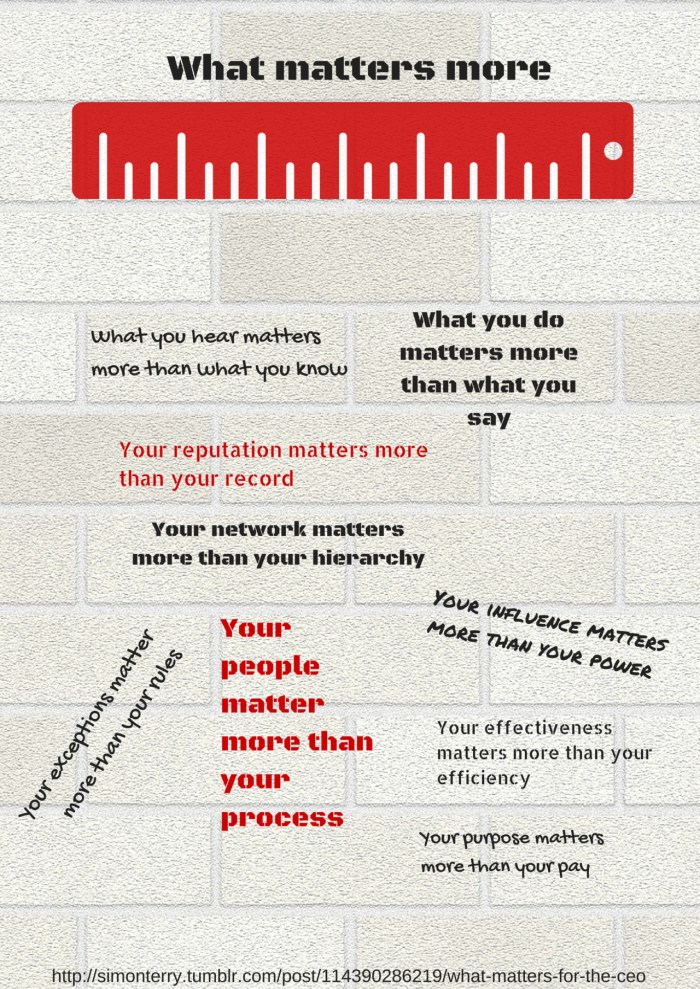
What You Hear Matters More Than What You Know: You have plans and agendas. You know the place & the ropes. You have great skills, knowledge and wisdom. Show it by going and listening to the people who matter most – those doing the work, your customers and your community. Ask their views and change your own. Let what you hear guide what you do.

What You Do Matters More Than What You Say: You are surrounded now by people who want to listen to you. You are supported by teams of professional communicators. You can order an expensive new brand campaign if you want. You have a soapbox but the smartest way to roll is to get down off the soapbox and go to work. Let others work out who you are by what you do.

Your Reputation Matters More Than Your Record: You must have a great record or you wouldn’t have the job. Nobody cares about what you did now. They only care about how you did it. The how determines your reputation internally and externally. Everything you do is added or subtracted from your reputation. Everybody wants to discuss your reputation because they want to predict what you will do next. Your reputation has more influence on what you will get done than you think.

Your Influence Matters More Than Your Power: Congratulations on being top of the hierarchy (excepting of course for your accountability to the board, the chair, shareholders, analysts, community activists, politicians, your family, and anyone who ever had a view about your company, etc). You have the power now, but mostly you can’t use it. You can’t sack everyone. You can’t survive a revolt. You can’t do the work yourself. You can’t answer every question. Accept that with all your power the best way to get anything done is still with influence, the same way you climbed the ladder.

Your Network Matters More Than Your Hierarchy: The hierarchy mutes your influence. A hierarchy is only one part of your network. Some of your direct reports are openly campaigning for your job. You’ve been there and you know they won’t wait long. The further down the hierarchy you go the less your voice is heard and understood. Importantly, you are now the face of the organisation to customers and the community. Looking down the hierarchy won’t help you deal with those critical stakeholders. Start leveraging the networks through and around the organisation. Those networks helped you on the way up and they will help you now. That’s where you should use your influence. The network magnifies your influence. That’s where you do your best work.

Your People Matter More Than Your Process: Nothing in the organisation gets done without people. The best processes, technology and organisations will fall apart without the right people. Start focusing on building their capabilities and changing the processes to adapt where required. Your customers and community will appreciate the immediate increase in your organisation’s responsiveness.

Your Exceptions Matter More Than Your Rules: If everything was predictable, great people wouldn’t be required. Focus on how you identify, manage and adapt for exceptions, anomalies and surprises. Don’t let your team explain them away. Many exceptions hide insights, risks, threats or breakdowns that your current processes can’t handle. Exceptions are where the disruptive innovations lurk and where reputations are won or lost. See exceptions as a chance for you to lead make changes, especially to help your people and your customers.

Your Effectiveness Matters More Than Your Efficiency: Your new staff are going to make your life extremely efficient. They will quickly create a schedule, cut access and manage a protective bubble of carefully selected information. That’s the best way for them to make their life easy and predictable again. However, obstacles are the work, exceptions hide insights and you will need to experiment on your personal effectiveness. Without slack, freedom to connect and thinking time you won’t be able to do this. Incidentally the need to focus on effectiveness of purpose goes for the whole organisation too (see ResponsiveOrg).

Your Purpose Matters More Than Your Pay: You’ve spent a lot of the crazy pay already and here I am saying it doesn’t matter. What matters is the impact you have on the world. The internal motivator called purpose pushed you so hard to get here. You wanted to make a mark, not cash. Delivering on purpose is what makes the role worth doing and will be how your tenure is judged. Years from now you will barely remember the money but you will see the faces of those in the network around the organisations whose lives you changed. Which way do you want to influence their lives? Let’s hope they are smiling later. 

The Job Matters More Than You: Unless you are a founder or a complete failure, the role you play existed before you came along and will exist afterwards. That role means a lot to the hopes and dreams of all the employees, customers and community. Those dreams deserve your respect. The role is not yours. You are no better because you have it. You are just the current steward. Leave it better for the next person and make sure that you have the influence to choose them wisely. That may be the best legacy you can leave.

Create a Reputation Economy

image

Connecting and Sharing create a reputation economy in your organisation to underpin the trust and collaboration required to Solve and Innovate.

Four topics are commonly discussed in communities around enterprise social networks:

  • Why would anyone go out of their way to help others?
  • How do we increase the value of collaboration in our organisation?
  • What is the role of leaders?
  • How do we cut down the gossip and non-work conversation in our network?

The answer to these four questions are connected to one element of successful networks: they create a reputation economy in the community that fosters collaboration.

The Value of Reputation

Humans aren’t the rational economic machines that most organisations try to manage with role descriptions, performance plans and other incentives. Humans do things outside the job description and the process every day.  We work around the hierarchy.  Importantly, we collaborate because we value relationships and we know that the returns from collaboration exceed the costs in our effort.

One of the challenges of collaboration is the danger that others will free ride on your efforts, improving their performance but bearing none of the costs. Mark Pagel’s Wired for Culture uses evolutionary approaches to behaviour to examine an important part of our defences against free riding, reputation.  Because our relationships with our work colleagues are not transactional, over time we build a level of trust and a reputation for each colleague based on their behaviour.  This reputation system influences who and how we collaborate with others.

Ever wondered why a users first ever request for help or crowd sourcing of ideas will usually struggle?  They have no reputation in the community and others will hang back until someone shows they can be trusted. 

Increasing the transparency and connection of reputation in your organisation will accelerate collaboration not just in a social network or other tool.  Collaboration across the organisation will leverage the new transparent reputations developed.

Building Reputation

We don’t build reputation with our status in the organisation or by declaring we can be trusted.  We build reputation through with who we are associated and how we act, particularly when we act against our interest.

The Connect and Share phases of the maturity of a collaboration community enable people to develop these critical stages of reputation. Working out loud for the benefit of others can accelerate that trust.  As can demonstrating and encouraging a growth mindset.   Sharing information, insights and solutions, particularly when there is no reason or benefit to the sharer is a powerful way to build a reputation.  Others sharing without penalty and preferably receiving benefits establishes the view in the community that it is safe.

The reputations and the trust built in Connect and Share are what powers the value in the later stages of the model.  People contribute later because they know that their contributions go to those who they respect and have the interests of the community at heart.

The Importance of Leaders

Leaders bring status into communities. However, as noted above, the presence of status is not enough to create or sustain trust.  Actions by leaders count.  

Leaders can play a critical role in showing the way to build reputation and in establishing that collaboration is safe and beneficial.  Importantly, leaders can use their authority to calling out free-riding behaviour and encourage participation by others. Leaders can acknowledge the reputations built in the community giving them greater influence in the organisation.

Leaders also need to be aware that their status also brings a fragility to their own personal reputations.  If they fail to act in the community to reinforce their authority, it will erode rapidly.

The Critical Role of Gossip & Non-Work Conversation

Organisations hate gossip and non-work conversation. They are seen as a threat to the singularity of corporate messaging and a waste of time.

However, gossip and non-work conversation are critical parts of reputation systems.  Gossip is how we share our views of others reputations. Non-work conversation is another way for us to share and build our reputations with others.

Create a reputation economy in your collaborative community by fostering connection and sharing.

The Value Maturity Model is an approach to enhancing the value of collaboration in your organisation.  The Model is supported by a range of tools and practices to enable leaders and community managers to maximise the potential in collaboration.  If you would like to learn more about the Value Maturity Model, get in touch with Simon Terry.