If Your Company was a Country, Would You Live There?

image

Imagine a country like this:

  • Run by a small group of powerful individuals (let’s call them oligarchs)
  • Transitions of power only occur when those in power hand it hand down to chosen successors or as a result of bloody coups
  • Status in the society is intensely hierarchical. Changes in status are managed carefully after interviews and testing by those responsible for correct human behaviour
  • The rewards to oligarchs can far exceed those of others in the country
  • Resources are subject to allocation and expropriation. Individuals engage in barter and black market activities to work around resource constraints
  • There is a constant state of war with the country battling external threats and the daily activities and goals are often meaningless
  • Decision making can be arbitrary and decisions are often made without consultation or explanation
  • The oligarchy engages in continuous propaganda.  There is a black market in real information
  • Freedom of speech and action is tightly constrained by policies and process. 
  • Any form of rebellion against these stringent rules results in exile or a significant loss of status and livelihood.

Sadly, countries like this are all too common in human history. Most prompt a consistent flow of refugees fleeing an environment that stifles human potential and human relationships.

How many of these characteristics apply to your organisation?

If you company was the country above, would you choose to live there? Are some of these characteristics driving engagement in your organisation?

Today more talented individuals are choosing careers that avoid the kinds of experiences listed above. They are refugees who ‘voted with their feet’ to leave dysfunctional organisations

In a country, arbitrary decision making power used without consultation is seen as bad thing, risking unrest, poor policy outcomes and corruption. In business, it is called ‘strong management’. Many organisations are beginning to see the limits of these traditional models.  

Rethink Power, Purpose and Potential

The answer is not necessarily that we should make every organisation function like a country using a political system like democracy or an anarchy. We know from looking at our own countries that these systems have real issues too. For almost all organisations that transition is too great a leap to make in one step.  Few organisations that have led working in new ways are copied. However we can learn by reflecting on what refugees are seeking.

There are three transitions most people would seek in fleeing the country above, if they could. Anyone who becomes a refugee knows that the life ahead is hard and that they must put up with many new challenges.  People flee to escape oppression and experience better leadership, fulfil purpose and to realise their potential.

These are the key transitions that leaders of organisations can help create to avoid that exodus:

  • From Power to Participation: A move from arbitrary hierarchical power to a situation where people, customers and community are respected and there is an opportunity for all to lead and contribute transparently to the discussion and the work.
  • From Subsistence to Purpose: Giving people the opportunity to find intrinsic meaning and to work for a purpose, not just a pay check.
  • From Subjugation to Potential: Recognising that everyone has the ability to contribute more if given information, flexibility, a chance to learn and the opportunity to grow.

Those three transitions don’t even require leaders to surrender final say in decisions, their hierarchies and their processes today. However, these transitions build trust and enable new conversations about how the organisation will work and the consequences of its actions.  Those insights will form the basis of the next phase of transformation of the way the organisation works.

Leadership is the way to better realise human potential.  Leveraging the innovation inherent in human potential is the way to improve our leadership and our organisations.


Danger on the Door

Too many of our organisations need ‘Danger’ written on the door. We need to remind Leaders that they must lead change to succeed in the a disruptive world outside. We also need leaders to work to make organisations a safer place for employees to realise their potential.

image

The Warnings of Network Disruption are Around Us.

Walk through any city and you can see the evidence of disruption from the technologies of the network era. That evidence needs to be a warning to all of us of the dangers of not changing our organisations to stay relevant to employees, customers and community.

In Burnley, a suburb of Melbourne near the railway station you will find this derelict building with grass growing on the roof, its windows smashed and concrete crumbling away. The Danger sign on the door is a warning to us all.

image

This little piece of history of the railway organisation is now redundant. Upgrades to more modern networked power and switching technology in the railway means that this building is no longer required as its functions are now managed better elsewhere in the network. With the building’s function disrupted, nobody needs to work here any more and the building is left to decay, except for the odd coat of paint when the graffiti gets out of control. 

The future of your organisation looks like this, if you don’t embrace the network era and lead the change required to keep your organisation relevant to customers and to your people. This building is one small warning that your organisation needs to be a Responsive Organisation.

Too Many Organisations have the Danger Sign on the Inside.

Many organisations are confident that their history, people, bricks, iron and concrete are good defences against a hostile environment. Leaders of these organisations do not face outwards to help lead the change required. Instead they turn inwards to shore up power and protect themselves.

Simon Sinek eloquently explains the dangers of this approach in his talk to 99U.  Leaders need to take up the challenge of realising human potential and making work a better place for people.

In organisations where leaders don’t work daily to realise human potential, the danger is not outside in the environment.  Danger reverberates around inside these organisations as big and little threats to safety, affecting employees and customers every day. These organisations need a Danger sign on the front door to warn employees of the risks of their work.

Start leading human potential.  Start leading the changes to your organisation for a network era. 

No organisation should have Danger written on the door.

You Can’t Buy Employee Engagement

We sure have tried.

New workspaces. New technology. Changes to benefits, remuneration systems and more. Great systems to measure and track employee engagement. Generous community, pro bono and volunteer programs. Investments in training & other career support. Programs to improve compliance with HR processes, drive diversity & address key issues of engagement. Lots of expensive communication materials. No end of efforts to make employees feel better about work. 

Mostly, we still don’t have engagement. Some of the above helped, particularly to remove hygiene issues that get in the way. Usually, the impact of these initiatives is temporary. Employees respond only as long as misread the investments above as signalling real change. When the hoopla passes and the bills are paid, the culture of the organisation is still the same.

You can’t buy employee engagement. You lead it. It is not a program. It is work. Hard leadership work.

Engagement is not something your employees do. Engagement is something that they feel. It is a belief that arrives from and is reinforced daily by your culture, your decisions and your conversations. Just as you can’t buy a transformation, you cannot buy this change with a management decision to spend money or work harder.

Employee engagement comes when people feel that they will realise their purpose and potential better in their work. Helping people to experience that takes conversations, your visible actions and their daily progress in their work.

Before you sign off another employee engagement initiative, ask these three questions:

  • Do the organisations daily decisions value your employees’ purpose and potential? Before you reflexively answer yes, when was the last time you changed a management decision because of its impact on employee purpose or potential? How often is that even discussed as a genuine factor in decisions?
  • Do all individual leaders consistently have genuine 2-way conversations about purpose and potential with their teams, collectively and individually? Not speeches, IDP templates or emails. The hard personal conversations. All leaders. Every day.
  • What is the hard evidence that your leaders are advancing individual purpose and potential? Your employees don’t rely on feel good measures. They look for hard proof of your intent. So should you.

Leadership is the technology of human potential. How well you use leadership is what your employees are judging every day. Don’t wait for the next employee engagement survey to decide to do something about it.

Zeitgeist warning: the future of work is human

image

Talk of the changing future of work and human potential is growing. There is discussion of the need to make the future of work more human in many different ways. The conversation runs from thought leaders to vendors to managers to employees.

Why now?

The cynics will attribute this to the last gasp of dreamers before a new networked information revolution of automation takes over. Hope you enjoyed your daydream: Welcome to Skynet and the singularity. The market pressures from global competitors, disruptive innovation and capital markets are as intense as ever. Management is doing a its job driving rising efficiency.  Technology will continue to advance its potential under human ingenuity.

We choose the path for humanity

So why be an optimist?

We get to choose. Remember there is no external power determining the course of history. Humans collectively get to choose and to make it happen. The evil external force we fear is us. The peers, management teams, the markets & the competitors are other people too.

In the last thousand years collectively we have chosen paths that lead to great knowledge, productivity, wealth and freedom. We have embraced major social changes that have changed our institutions, markets and our organisations because they made our lives more human.

There are decisions that deprive people of their potential that others can no longer make without consequences. No CEO will stand and argue for the profitability of slavery, discrimination, violence or tyranny in our workplaces. We have used leadership to realise this potential and make the changes required. With enormous cost, turmoil and effort we have created change.

If you want to make a bet on the future of work, bet on humanity. Leadership is the technology of human potential and we would waste our lives of we did not work to realise that greater potential. Networks now give us the power to use leadership to connect and engage people in change. Use your leadership and creativity to help make work more human.

I know where I will put my efforts. I am comforted to know many others are working for the same goal.

Note: If you are interested in working to change the future of work, then check out Change Agents Worldwide, The Responsive Organisation, read anyone of a dozen other manifestos or get in touch with me. I would love to help

End Collaboration Silos

Help the Future of Work break out of its silo. The social collaboration & leadership required for the future of work is central to how we organise for human potential & productivity, not a bolt on. We can’t create great Responsive Organisations playing around the edges.

Why bother with the Social Collaboration? Isn’t that an HR issue?

Ask most CEOs and they will tell you they wish their people could better leverage what they collectively know. Look closely at the broken processes in your organisation and you will find consistent issues of poor engagement, knowledge management or collaboration. Senior managers want to be more ‘digital and more agile’ but they are frustrated they can’t generate more innovation and change in their organisations. The poor customer outcomes, broken processes and the purposeless work that results are at the heart of the issues impacting productivity, employee engagement and the customer experience. 

Each of these issues are a sign that traditional management mindsets and approaches are failing to deliver what our organisations need. Importantly they are also failing to realise the potential of people at work. Yet most organisations respond to these issues with more of same structures and systems along with more technology and more management effort. We need an alternative that better leverages human potential, networks and social collaboration. The people who work in the organisation need to be a part of building that alternative. Building that alternative is the Future of Work and it will take leadership and collaboration.

Get Human Potential out of a Silo and into Work

Transformation requires a new conversation about how we work leveraging new organisational structures, new approaches and technologies. The fact that many organisations can’t decide who owns enterprise collaboration technology is a terrible start. We need to shift from questions of who owns collaboration. Traditional thinking leaves ideas like leadership, collaboration, organisational design and the future of work to soft functions and lets hard managers deal with organisational processes and performance.

The future of work offers an exponential opportunity to realise the potential of people. Realising this opportunity will take enterprise-wide leadership & change. You can’t realise people’s full potential without offering them the opportunity to change the core structures, systems and processes of the organisation. Until leaders use enterprise collaboration to create systemic change, it can’t generate the kinds of benefits management wants. If new ways of work stay on the periphery, at best they work only as an employee engagement bandaid.  At worst, they are just technologies organisations have to be trendy.

Collaboration silos and layers lose momentum and fail eventually because collaboration is human and purposeful people need to be empowered to create real change in their day-to-day work. Customers & employees want whole systems of work to improve, not just parts or peripheral tasks.  Without the pressure of demonstrating impact for people to improve their day-to-day work, competing collaboration solutions flourish to the frustration of employees, generating new silos that undermine the benefits for all. Positive impact on the value of work for an employee is a critical test of the value of any collaboration solution.

Moving Collaboration out of the Silo and to Value

Here are a few first steps to help your organisation leverage the potential of its employees and embrace the Future of Work:

  • Embrace the development of human potential: Make the measure of leadership in the organisation the delivery of results through the development of people’s potential.  Anything less is just management and wastes the potential of your people to help.
  • Explore transparency: Ask leaders to role model working out loud. Help them understand the new mindsets. Encourage employees across the organisation to work out loud too. Shift the default disclosure model to open sharing of information in a culture of trust.
  • Empower people to improve their work: Start a leadership conversation at all levels in your organisation about how work can be improved. Define value as value to a customer or other external stakeholder. Give your people the power to make changes as a result of the conversation. Leaders will need to support, participate and facilitate. A critical role for leaders is to ensure participation of others. The conversation will fail if processes or silos are off limits to change.
  • Experiment and learn: Give your people permission and the capability to experiment with creating value in new ways of working. Embrace learning and ensure that the successful experiments are adopted as wide scale change 

With the right leadership conversation, your organisation will begin to explore new models of trust, new ways to create value and start to discover its purpose on this journey. You will know your employees are embracing this new model when they begin to question the other structures & systems in your organisation, like organisational structures, performance management processes or technology systems, that get in the way of their productivity and potential. Your next challenge will be to work with your people to change these bigger systems to realise further value from work.

That work leads directly into the future of work and to a much more responsive organisation. 


Image source: Grain Silo by Hakan Dahlstrom

Leaders help realise potential

An insightful quote by David Foster Wallace on leadership in which he describes leadership in terms of the development of human potential

A leader’s real “authority” is a power you voluntarily give him, and you grant him this authority not with resentment or resignation but happily; it feels right. Deep down, you almost always like how a real leader makes you feel, the way you find yourself working harder and pushing yourself and thinking in ways you couldn’t ever get to on your own.

In other words, a real leader is somebody who can help us overcome the limitations of our own individual laziness and selfishness and weakness and fear and get us to do better things than we can get ourselves to do on our own

Authority is earned. Authority comes when others judge you ready. Development of the potential of others in your networks is the work.

How are you working to earn the authority of others? How do you help them realise a potential that they couldn’t reach on their own? Show that potential and people will follow.

That is the future of leadership

Swapping Hard and Soft

Image

Management likes to talk about the hard skills and the soft skills of managers. These terms are usually applied backwards.

Hard skills are the decision-making, analytical, performance oriented skills of traditional management. Hard skills are a matter of education, experience and practice. The hard skills are mostly transactional, process-driven and mechanistic. Done right there is little variation in the outcome of the hard skills. If you are a manager for long enough, you can do the hard skills. They are just a ticket to the game.

Soft skills are the people & stakeholder skills, like building trust, fostering motivation, developing people, managing conflict and team building. In most cases, it is a challenge to know whether you have done these skills well and the results of actions in any scenario can vary widely.  These are the skills essential to realising the potential of people in any context but particularly in a world of networked knowledge work. This is the work of leadership and it must be learned the hard way.

Time to Swap

The terms hard and soft are backwards. In a culture of hierarchy, command and control andengineering mindsets, it suits management to think of the manager as engineer tackling the hard work of decisions, managing the machine and delivering results. Hard skills start to sound like they are most important in a culture where power really matters.

Except it is easy to make a decision. It is far harder to have that decision stick and be embraced by other people. Try to coach another person and you soon realise that developing their potential and helping them is not easy.

The soft stuff is what unravels the hard stuff. You need both people and power in management. The soft stuff is far harder than setting the levers on a machine.

Leadership is work.  Hard work.  Importantly, it is the hard work that matters most to realise the potential of your people and to benefit from the future of work in a networked knowledge economy.

Swap your view of what is hard and what is soft.  Better yet leave them both behind as terms that belong to the last age of management.

Image source: Swan feather – http://pixabay.com/en/swan-feather-spring-swan-slightly-16313/

Swapping Hard and Soft

Management likes to talk about the hard skills and the soft skills of managers. These terms are usually applied backwards.

Hard skills are the decision-making, analytical, performance oriented skills of traditional management. Hard skills are a matter of education, experience and practice. The hard skills are mostly transactional, process-driven and mechanistic. Done right there is little variation in the outcome of the hard skills. If you are a manager for long enough, you can do the hard skills. They are just a ticket to the game.

Soft skills are the people & stakeholder skills, like building trust, fostering motivation, developing people, managing conflict and team building. In most cases, it is a challenge to know whether you have done these skills well and the results of actions in any scenario can vary widely.  These are the skills essential to realising the potential of people in any context but particularly in a world of networked knowledge work. This is the work of leadership and it must be learned the hard way.

Time to Swap

The terms hard and soft are backwards. In a culture of hierarchy, command and control and engineering mindsets, it suits management to think of the manager as engineer tackling the hard work of decisions, managing the machine and delivering results. Hard skills start to sound like they are most important in a culture where power really matters. 

Except it is easy to make a decision. It is far harder to have that decision stick and be embraced by other people. Try to coach another person and you soon realise that developing their potential and helping them is not easy.

The soft stuff is what unravels the hard stuff. You need both people and power in management. The soft stuff is far harder than setting the levers on a machine.

Leadership is work.  Hard work.  Importantly, it is the hard work that matters most to realise the potential of your people and to benefit from the future of work in a networked knowledge economy.

Swap your view of what is hard and what is soft.  Better yet leave them both behind as terms that belong to the last age of management.

Image source: Swan feather – http://pixabay.com/en/swan-feather-spring-swan-slightly-16313/

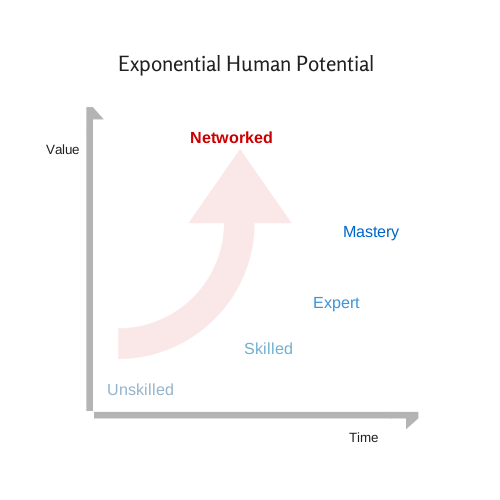
Human Potential is Exponential

Managing the productivity of people is increasingly important as our economy adjusts to increasing an increasing share of knowledge work. For many organisations labour is already the most significant cost of production.

Many organisations adopt a traditional efficiency management mindset when it comes to managing people. The view that their people have a fixed potential contribution means that the organisation will miss the opportunity that flows from increasing human potential.

Leverage the Growing Potential of People

People are the most unique input to your production process. Their contributions offer the potential for exponential increases in value. The potential of people is not fixed. You will struggle to make steel exponentially more useful in your process but you can quickly help your people to create exponential increases in value in their work.

We know people’s skill can increase over time as the learn and gain experience in their roles.  Most organisations work to foster the learning of its people to better leverage their growing productivity from new skills. Growth in skills delivers significant improvements in the potential of your people.

As benefit of the leadership conversations to develop people you also discover that your people have capabilities to contribute to your organisation in ways far beyond their current role & performance. Leveraging this potential through new assignments, new challenges and new roles is essential to development of talent and better performance.

Networks Accelerate Potential

However, people have one other critical capability over most factors of production. People can also network to accelerate their learning and productivity. Metcalfe’s law tells us that in a network the value increases exponentially with the number of people connected. People working, learning and sharing in a network experience this exponential impact on their potential.

How can networking with others, through working out loud deliver exponential increases in value to people working in your organisation?

Networks enables your people to realise greater potential through:

  • greater access to knowledge, a faster pace of knowledge flow and most importantly accelerated opportunities for people to share and to learn from each other
  • access to consult perspectives, skills and experience that they have not yet acquired through conversations with peers and others.
  • the ability to accelerate the growth of their own personal connections by leveraging networks to find additional friends, colleagues, stakeholders, experts or others who can help add value to their work
  • building purpose, trust & engagement within and outside your organisation. Lack of trust is a major barrier to productivity in organisations. A sense of purpose and engagement have major influences on people’s contributions at work, particularly discretionary efforts.

Most importantly of all, people aren’t just an input to your work. People organised and empowered by networks can work together on improving your system & processes of work. All of a sudden you have the potential for major leaps in the value of your work as collaboration drives innovation

image

If you are wondering how to get started to leverage the exponential potential of your people in networks, then Harold Jarche just described the way to get going with working out loud, personal knowledge management, distributing authority and building a common vision.