Leadership is changing. Leadership in networks is the future of work.
A 1 minute video to provoke some thought on how we best use leadership to realise human potential in the network era.
Transcript:
Innovation, Collaboration, Learning & Leadership
Leadership is changing. Leadership in networks is the future of work.
A 1 minute video to provoke some thought on how we best use leadership to realise human potential in the network era.
Transcript:

‘Less Talk More Action’ is a common refrain in management. The best next step may involve more talk and more action.
A bias to action in management is a good way to overcome the inertia of bureaucracy. It helps foster change by requiring that we find ways to move forward. Like all good things a preference for action can be overdone. The traditional engineering mindset of management can come to view talk as a wasteful distraction. In management conversations in all kinds of organisation it is not uncommon to hear,
“This talk is too complicated and going on too long. Let’s do this”
In complicated and complex scenarios that involve systemic issues like culture, the best next step at times may involve more talk and more action. Realising the potential of people as a leader can often mean having to step back from one’s own action orientation to discuss the way forward with others, to gather inputs and to allow others to shape the path through collaboration. We need to recognise in leading the network complexity of the new ways of work that action alone may not be the wisest path.
The Time for Action
The Cynefin framework offers us a useful model to see where we need to demonstrate a bias for action over talk. If the situation falls in the Simple domain, where cause and effect is clear, then action is straightforward once the position is known. We should have a strong bias for More Action and Less Talk.
If the situation is truly in a Chaotic domain, where cause and effect are unrelated, then action offers the best chance to move somewhere else. talk may add some value after we act to help understand the environment is chaotic. However it is action first that will get us out.
Much of our work in organisations is spent in the Complicated or Complex domains of the Cynefin model where launching straight into Action may not be all that is required.
When The Action includes Talk – Sense Making
Each domain of the model requires decision makers to make sense of what is going on in the environment. That sense making process may need discussion with other participants, particularly in the complicated and complex domains where patterns of cause and effect are unclear. For example discovery and analysis are both tasks that need not be purely data-driven exercises. People may need to debate the situation and the work collaboratively to determine the relationships in place. Action have a collaborative element too, requiring discussion as the action progresses to implementation.
Making collective sense of an environment where cause and effect is not straightforward is essential to winning people’s engagement in action and especially action that creates change. The more complex the environment the more important this engagement will be. Without an ability to make sense of the environment and the strategy to be put into place, people will be at best disengaged and at worst actively oppose the approach.
When Action and Talk Go Together – Working Out Loud
In a Complex domain, the recommended course of action is to probe. A probe is an action done with an intent to learn. In other words, it is an experiment.
To maximises the value of the learning and the effectiveness of the experiment, we often need to communicate that experimental intent. A strategy of probing, sensing and responding can appear confusing to others without a declared intent. Leaders who are trying to take their team on a series of experiments need to be clear on the nature and learning goals of the experiments.
Leverage others to design the experiment and keep you true to your goal of learning. Too many experiments get converted into actions by the management mindset of showing progress at any cost. Think of all the pilots that slid into full-scale launch because nobody wanted to declare them a failure. Working out loud can also help with accountability and also leverage the contributions and learnings of others to develop the collective sense of a complex domain.
Why Talk Matters – Realising Potential in the Future of Work
As Harold Jarche explains in his description of the Cynefin model for the future of work, a key role for leadership in the changing workplace is to help employees use capacity that is released. That capacity can be used to transition employees from the domains most susceptible to automation, the simple and complicated, to working in those where human contributions are most valuable.
“Less talk, more action” is what we expect of machines. As we see our world of work move into networks and more complex domains, leaders must remember the value and human potential in communication.
Perhaps we should choose to lead with “More Action and More Talk”.


Talk of the changing future of work and human potential is growing. There is discussion of the need to make the future of work more human in many different ways. The conversation runs from thought leaders to vendors to managers to employees.
Why now?
The cynics will attribute this to the last gasp of dreamers before a new networked information revolution of automation takes over. Hope you enjoyed your daydream: Welcome to Skynet and the singularity. The market pressures from global competitors, disruptive innovation and capital markets are as intense as ever. Management is doing a its job driving rising efficiency. Technology will continue to advance its potential under human ingenuity.
We choose the path for humanity
So why be an optimist?
We get to choose. Remember there is no external power determining the course of history. Humans collectively get to choose and to make it happen. The evil external force we fear is us. The peers, management teams, the markets & the competitors are other people too.
In the last thousand years collectively we have chosen paths that lead to great knowledge, productivity, wealth and freedom. We have embraced major social changes that have changed our institutions, markets and our organisations because they made our lives more human.
There are decisions that deprive people of their potential that others can no longer make without consequences. No CEO will stand and argue for the profitability of slavery, discrimination, violence or tyranny in our workplaces. We have used leadership to realise this potential and make the changes required. With enormous cost, turmoil and effort we have created change.
If you want to make a bet on the future of work, bet on humanity. Leadership is the technology of human potential and we would waste our lives of we did not work to realise that greater potential. Networks now give us the power to use leadership to connect and engage people in change. Use your leadership and creativity to help make work more human.
I know where I will put my efforts. I am comforted to know many others are working for the same goal.
Note: If you are interested in working to change the future of work, then check out Change Agents Worldwide, The Responsive Organisation, read anyone of a dozen other manifestos or get in touch with me. I would love to help

Help the Future of Work break out of its silo. The social collaboration & leadership required for the future of work is central to how we organise for human potential & productivity, not a bolt on. We can’t create great Responsive Organisations playing around the edges.
Why bother with the Social Collaboration? Isn’t that an HR issue?
Ask most CEOs and they will tell you they wish their people could better leverage what they collectively know. Look closely at the broken processes in your organisation and you will find consistent issues of poor engagement, knowledge management or collaboration. Senior managers want to be more ‘digital and more agile’ but they are frustrated they can’t generate more innovation and change in their organisations. The poor customer outcomes, broken processes and the purposeless work that results are at the heart of the issues impacting productivity, employee engagement and the customer experience.
Each of these issues are a sign that traditional management mindsets and approaches are failing to deliver what our organisations need. Importantly they are also failing to realise the potential of people at work. Yet most organisations respond to these issues with more of same structures and systems along with more technology and more management effort. We need an alternative that better leverages human potential, networks and social collaboration. The people who work in the organisation need to be a part of building that alternative. Building that alternative is the Future of Work and it will take leadership and collaboration.
Get Human Potential out of a Silo and into Work
Transformation requires a new conversation about how we work leveraging new organisational structures, new approaches and technologies. The fact that many organisations can’t decide who owns enterprise collaboration technology is a terrible start. We need to shift from questions of who owns collaboration. Traditional thinking leaves ideas like leadership, collaboration, organisational design and the future of work to soft functions and lets hard managers deal with organisational processes and performance.
The future of work offers an exponential opportunity to realise the potential of people. Realising this opportunity will take enterprise-wide leadership & change. You can’t realise people’s full potential without offering them the opportunity to change the core structures, systems and processes of the organisation. Until leaders use enterprise collaboration to create systemic change, it can’t generate the kinds of benefits management wants. If new ways of work stay on the periphery, at best they work only as an employee engagement bandaid. At worst, they are just technologies organisations have to be trendy.
Collaboration silos and layers lose momentum and fail eventually because collaboration is human and purposeful people need to be empowered to create real change in their day-to-day work. Customers & employees want whole systems of work to improve, not just parts or peripheral tasks. Without the pressure of demonstrating impact for people to improve their day-to-day work, competing collaboration solutions flourish to the frustration of employees, generating new silos that undermine the benefits for all. Positive impact on the value of work for an employee is a critical test of the value of any collaboration solution.
Moving Collaboration out of the Silo and to Value
Here are a few first steps to help your organisation leverage the potential of its employees and embrace the Future of Work:
With the right leadership conversation, your organisation will begin to explore new models of trust, new ways to create value and start to discover its purpose on this journey. You will know your employees are embracing this new model when they begin to question the other structures & systems in your organisation, like organisational structures, performance management processes or technology systems, that get in the way of their productivity and potential. Your next challenge will be to work with your people to change these bigger systems to realise further value from work.
That work leads directly into the future of work and to a much more responsive organisation.
Image source: Grain Silo by Hakan Dahlstrom
Management likes to talk about the hard skills and the soft skills of managers. These terms are usually applied backwards.
Hard skills are the decision-making, analytical, performance oriented skills of traditional management. Hard skills are a matter of education, experience and practice. The hard skills are mostly transactional, process-driven and mechanistic. Done right there is little variation in the outcome of the hard skills. If you are a manager for long enough, you can do the hard skills. They are just a ticket to the game.
Soft skills are the people & stakeholder skills, like building trust, fostering motivation, developing people, managing conflict and team building. In most cases, it is a challenge to know whether you have done these skills well and the results of actions in any scenario can vary widely. These are the skills essential to realising the potential of people in any context but particularly in a world of networked knowledge work. This is the work of leadership and it must be learned the hard way.
Time to Swap
The terms hard and soft are backwards. In a culture of hierarchy, command and control andengineering mindsets, it suits management to think of the manager as engineer tackling the hard work of decisions, managing the machine and delivering results. Hard skills start to sound like they are most important in a culture where power really matters.
Except it is easy to make a decision. It is far harder to have that decision stick and be embraced by other people. Try to coach another person and you soon realise that developing their potential and helping them is not easy.
The soft stuff is what unravels the hard stuff. You need both people and power in management. The soft stuff is far harder than setting the levers on a machine.
Leadership is work. Hard work. Importantly, it is the hard work that matters most to realise the potential of your people and to benefit from the future of work in a networked knowledge economy.
Swap your view of what is hard and what is soft. Better yet leave them both behind as terms that belong to the last age of management.
Image source: Swan feather – http://pixabay.com/en/swan-feather-spring-swan-slightly-16313/

Managing the productivity of people is increasingly important as our economy adjusts to increasing an increasing share of knowledge work. For many organisations labour is already the most significant cost of production.
Many organisations adopt a traditional efficiency management mindset when it comes to managing people. The view that their people have a fixed potential contribution means that the organisation will miss the opportunity that flows from increasing human potential.
Leverage the Growing Potential of People
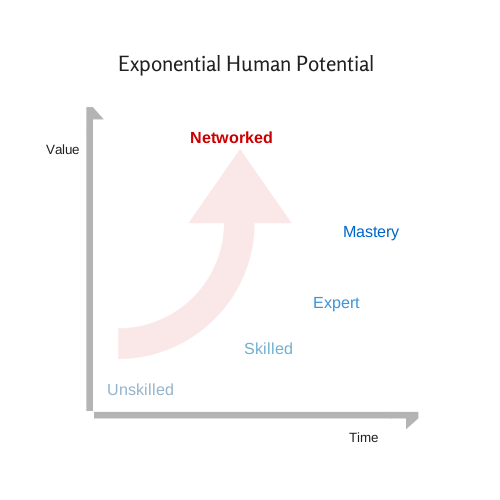
People are the most unique input to your production process. Their contributions offer the potential for exponential increases in value. The potential of people is not fixed. You will struggle to make steel exponentially more useful in your process but you can quickly help your people to create exponential increases in value in their work.
We know people’s skill can increase over time as the learn and gain experience in their roles. Most organisations work to foster the learning of its people to better leverage their growing productivity from new skills. Growth in skills delivers significant improvements in the potential of your people.
As benefit of the leadership conversations to develop people you also discover that your people have capabilities to contribute to your organisation in ways far beyond their current role & performance. Leveraging this potential through new assignments, new challenges and new roles is essential to development of talent and better performance.
Networks Accelerate Potential
However, people have one other critical capability over most factors of production. People can also network to accelerate their learning and productivity. Metcalfe’s law tells us that in a network the value increases exponentially with the number of people connected. People working, learning and sharing in a network experience this exponential impact on their potential.
How can networking with others, through working out loud deliver exponential increases in value to people working in your organisation?
Networks enables your people to realise greater potential through:
Most importantly of all, people aren’t just an input to your work. People organised and empowered by networks can work together on improving your system & processes of work. All of a sudden you have the potential for major leaps in the value of your work as collaboration drives innovation.

If you are wondering how to get started to leverage the exponential potential of your people in networks, then Harold Jarche just described the way to get going with working out loud, personal knowledge management, distributing authority and building a common vision.

A large part of the history of our technology has been the effort to use technology to control human behaviour. Technology transformation is often sold on the potential to better make humans do things that they should be doing. The failure of so many transformational technology programs is proof that human behavioural changes are a subtler and more elusive challenge. Changing the conversation is as important as changing the process.
The Business Case for Technology Transformation
Leadership mindsets from the industrial era often lead to the management question:
“What can we do to make people do the right thing?’.
Technology transformation is sold on a promise of offering the answer. Too commonly management will choose a new technology system or process as delivering a way to make people ‘do better’. For example:
However, these technologies are usually only an infrastructure to support new behaviours and new conversations. Their capabilities underpin human behaviour. New processes will encourage change. New data capture and reporting may help measure activity. Without a willingness to change to new behaviours from users, the systems alone cannot make change without risk of major disruption or disengagement.
Technology rarely can require a new behaviour or a new conversation. Human creativity enables remarkable ways to cling to old ways in the face of new technology. Even to the extent that these technologies deliver better measurement of human activity, organisations are often frustrated to discover that the ability to measure and target activity simply generates activities to solely meet the measures, not behavioural change. Quantities are achieved as the cost of both productivity and quality.
Change the Conversation
Changing the leadership question can have a dramatic impact on how an organisation makes decisions. Here’s a different question for management to ask about a transformation of technology:
‘What do our people need to better deliver our goals?’
There are a number of advantages that flow from changing the conversation around change and transformation in this way:
Technology transformation can be a powerful enabler of organisational change. However, it is merely an enabler. Changing the leadership conversation is often the critical element to ensuring the success of a transformational change.
Image source: http://pixabay.com/en/ravens-black-birds-conversation-236333/
An insight about the future of work dropped this morning as I discussed leadership in the network era with Harold Jarche and Jon Husband, colleagues from Change Agents Worldwide.
The Future of Work is the Future of Leadership
The future belongs not to the leadership of technology. The future belongs to the technology of leadership.
Our opportunity is not incremental improvement in the leadership of change to implement network technologies. Our opportunity is a much more important transformation of the critical human technology of leadership for the network era. Only new leadership capabilities & concepts will enable us to realise the potential of the future of work
Realising Human Potential is What Matters
If you are one of the thought leaders, consultants or vendors working to bring about the adoption of social collaboration technology, you know there is a raging debate about what changes in social and network technology means for organisations. However, there is much that is unclear in the debate about the future of work. Social Business is dead, not dead or even not enough. The biggest challenge is adoption, lack of executive buy-in, return on investment or even organisation’s success. You need a collaboration layer, you need purposeful collaboration or you need cooperation instead.
If you are a manager in an organisation trying to achieve outcomes in a rapidly changing business climate, you most likely missed this entire conversation. The debate about the impact of social collaboration technology is not even on your radar (unless a consultant or vendor has caused you to reflect on it for a moment before you returned to the daily challenge of running your business).
What matters most to managers is more effective human collaboration – collaboration that improves the performance of your business for your customers and delivering better work experience for your people. Managers everywhere wish there were better ways to tap the talents, innovation and engagement of their people to help deliver better outcomes. That is at the heart of the discussion of employee engagement in our organisations.
The technology that engages people and realises potential is called leadership. That’s why so many investments are made by organisations in leadership development and in a push for leadership in every role. Leadership is the most effective technology to solve for the management wish.
Network Era Leadership Realises Human Potential
Work is a human task. Leadership is the work of mobilising others to action. Leadership is how we help people to realise their human potential. Much of our network and collaboration technology is just an infrastructure for the work and leadership required. The network can magnify the culture of the organisation, but we need the right leadership models for managers to realise the potential of a network era of work.
Traditional management & leadership approaches inherit many of their concepts from process models borrowed from the industrial era. In this mindset human potential is measured in productivity terms. The command and control culture focuses on using the right processes to drive human productivity and align that productivity with the right tasks. The engines of human potential (engagement, knowledge creation, experimentation, innovation & enablement) are driven out as sources of volatility & waste. What many call leadership is better described as a process of command of people with an efficiency mindset. That is not leadership at all.
These traditional management concepts also get baked into organisational systems. We have built much technology to explicitly or implicitly reflect these industrial models of management and work. Look inside any organisation and you will find plenty of systems designed from the top-down that reinforce hierarchical command and control. Pull out your system process maps and look for your employee’s ability to do exception handling. In many cases there is no exception process. Exceptions are handled in hacks.
Transparency, responsiveness, the ability to work across silos and effectiveness are often surrendered to tight control of process, narrow measurement of process outcomes, compliance and efficiency. Critical systems in customer management and human resources systems offer some of the most striking examples of these constraints and are widely copied from organisation to organisation. To the frustration of everyone, managers and people must work around these systems to collaborate and cooperate effectively while managing waves of top down change management to bring them back to compliance with process.
The disruption of the networked era is evidence of the scale of change that networks are bringing to our lives. ‘Kodak Moment’ has an entirely new meaning today. This pace of change focuses our attention on a need for change in the concepts of leadership & organisation to support a changing world of work.
We need not focus much on the threats of this era. The opportunities of new models of work and leadership are greater. New network technologies give a glimpse of the potential for leaders to better leverage the people of organisations for work and innovation. However, realising the potential of human collaborative and cooperative knowledge work in networks demands new leadership models.
We Know How to Start Leading in the Network Era
Each new era brings social changes and requires new more effective concepts. We updated the concepts of leadership and management at the birth of the industrial era, leveraging existing concepts from the military and other spheres of human life. Now people need to work to develop new models to leverage the infrastructure delivered by networks and collaboration technology.
The good news is that many of these concepts are already clear and have been developed by practitioners to the point where they are capable of application in everyday work. These practices now work highly effectively and can be taught. Managers now need to pick these up and build the capability in their people to lead in new ways, using:
However, we cannot expect managers do to all the work alone. We will need to support them with learning, coaching and the opportunity to practice the new skills and mindsets. We need to change the organisational systems and processes that hold back this opportunity to better leverage human potential.
Making these changes is the great challenge of leadership is in the new network era. It is the work I will be focused on with my colleagues in Change Agents Worldwide as we help others to navigate these changes.
The future of work is the future of leadership for everyone in organisations. Building a better more effective model of leadership will help realise the human potential of this future. Join the effort in your organisation to build a new technology of leadership to make this possible.