Speaking to Senior Managers

Senior leadership engagement in change is a hot topic. Social collaboration makes the absence of leader engagement obvious. I’m often asked to speak on collaboration, learning and leadership to senior executives. As I used to be one, people want me to share a little of my passion for these topics. Here are some suggestions to guide you in your senior leadership engagement.

It’s not a priority

Collaboration, leadership and learning is unlikely to be a priority for your senior leaders. Sure they’ll discuss it but they don’t want to do it. They don’t know anyone who got made a CEO because his team was the most collaborative or the most agile. There is always a bigger business or customer problem that is on their mind.

Rather than engage in an argument as to why this mindset is wrong (it is – see Big Learning), I start with understanding the real business problems that they want to solve. Once we understand the business problems we can connect collaboration, learning and leadership as solutions to that problem.

Avoid Capitalised Nouns

Senior executives are busy and distracted. They don’t want jargon and hype. They are allergic to empty captalised nouns. The more you use words like Collaboration, Leadership, Engagement etc without making them tangible the less credible you are. The more it sounds like a futuristic vision or a quixotic quest the less relevant you are to their world.

Tell Stories

Stories make change tangible to busy & smart people. Ben Elias of ideocial.com remarked to me recently that it is hard for people to conceive of how their organisation could be highly collaborative. They have never seen it, so the ideas and practices don’t connect with their reality. Specific stories make that connection. Tell rich and engaging stories of how things can be and how to get there.

Ask for something specific

There’s nothing worse that taking the time of senior leaders, winning their support and not being able to define exactly what you want them to do. Always have a specific ask of them ready to go. Have two in case they say yes to the first. Better yet have a personal ask that is framed as something simple that they can agree to do to sustain change. The 3 simple habits of working out loud was designed as one such example.

When you are done, Stop. Leave.

Senior executive time is precious. Give it back to them. Tempting as it may be to bask in the glory of a good meeting and deepen rapport, you will win more credit by leaving when you have done your job. Remember when something is not a priority you are always on borrowed time.
Dumb by Choice – Foreword to ‘Collaborating in a Social Era’ by Oscar Berg

The following is my foreword to Oscar Berg’s ’ Collaborating in A Social Era’. The piece was inspired by the themes of the book, particularly on how organisations need to better use information. It was an honour to be able to contribute a few words to Oscar’s great work.

Dumb by Choice

Traditional hierarchical organizations are designed to make us dumb. These organizations work to deliver the predictable execution of a stable, proven business model. We have designed these organizations to exclude information from decision-making and isolate employees to focus on efficiency, predictability, and control. Without better ways of distributing and filtering information, we chose to create the many layers of management, channels of communication, and decision making processes. Each of these familiar elements of organizations limit the information we use and the way we work. The consequence was an improvement in efficiency, but limited adaptability to exceptions, challenges, and change. Our employees and our customers feel the costs of these limits. We have created organizations that treat people, whether customers or employees, as a cog in the machine of value-creation.

In the last century, with the opportunities presented by expanding global consumer markets, our dumbness, loss of human potential, and inflexibility were small prices to pay. There were real financial barriers to better use of information. The lost opportunities were overwhelmed by the ever-growing market opportunity. Most organizations used the same operating model and faced the same economics of information, so the threat of disruptive competition was muted.

As Oscar Berg highlights in this book, the competitive marketplace for organizations has now fundamentally changed. Information networks and digital capabilities have reduced the cost of creating and sharing information and expanded the access to information of businesses, consumers, and communities. Increasingly, organizations are dealing with knowledge work and complex situations. The cost of a dumb process and the missed human potential is rising. Organizations can see competitors better leveraging the potential of their people to learn, to adapt, and to collaborate.

The challenge for managers and for employees in this new world, is how to change our ways of working and how we create, share and make use of information. We need our organizations to make us smarter. We need our organizations to help us to learn and to realize our collective potential. This book sets out to equip us all with some key tools to begin this redesign of the way we work.

Getting Smarter

Work has always involved people coming together to achieve more than one individual can do on their own. The most effective organizations enhance the knowledge, capabilities, and potential of their employees. Changing our ways of working to better use information and foster new forms of collaboration is a critical design element to the future of work. Rather than being passive participants in a process, employees can become a crucial element in the way our organization gathers, shares, and creates value from information.

In this book, you will find a number of key concepts and tools that will help your organization to realize the opportunities and the value offered by new models of social collaboration. Change is not easy. New capabilities will need to be learned and practiced. New mindsets will be required to foster effective communication. Ultimately, teams will need to mature their practice to work in increasingly valuable and visible ways. This book highlights these concepts, provides examples of the new approaches, and supports each of us to put them into practical use.

If we want to work in smarter ways and to see our organizations prosper, leadership is required. These changes to established ways of working won’t happen on their own. We can’t rely on technology to change established practice in our work communities. We will need change agents and leaders to take on the role of building new capabilities, advocating for new mindsets, and role modeling new practice. Adaptive leaders, collaborating in and beyond their organizations, will change established practice and help organizations experiment with the potential of new ways of working.

Take up the challenge of this book and experiment with new ways of collaborating in your organization. You have the opportunity to be well equipped to begin leading the change and making your organization smarter and more effective. Most of all, you will be contributing to making the future of work that much smarter and more human.


To order the book in a variety of formats see Oscar’s launch announcement today

Backchannels

The public in social media and enterprise social media gets all the attention. However often the greatest connection goes on out of view.

With social media channels inside and outside organisations comes the direct message and the private message. These are key parts of the value created by a network.

Private messages are the communication channels that are most comfortable for many users. These messages don’t offer the value of full working out loud but they can play key roles:

– creating access
– building and deepening relationships begun in public
– exchanging confidential information or additional context
– coaching users
– helping connect community management and community leaders.

In the passion of adopting new public ways of working, we cannot overlook the value of integrated private messages. After all some times the first step to working out loud is sharing something with just one other person.

Why doesn’t your community plan involve your community?

image

Many organisations want the benefits of better collaboration and the potential of better leveraging the potential of their people in a community. Increasingly with the availability of enterprise social networking, social mobile apps and integration into other productivity tools, organisations have the network capabilities to create the communities at hand.

A Network with a Demanding Boss

Too many plans for enterprise social networks and communities are developed without any community participation. The organisation wants something from the network. They set about getting that goal. When realising the goal proves harder than they expect, the organisation resorts to communication, performance levers, gamification, or maybe even ‘change management’. Many of these remain efforts to impose an external rationale on a network.

If the goals of a network are imposed externally, it is not a community. It is a network with a demanding boss. Any network of this type will lose energy over time as people query the benefits of their participation.

Use the Network to Create a Community

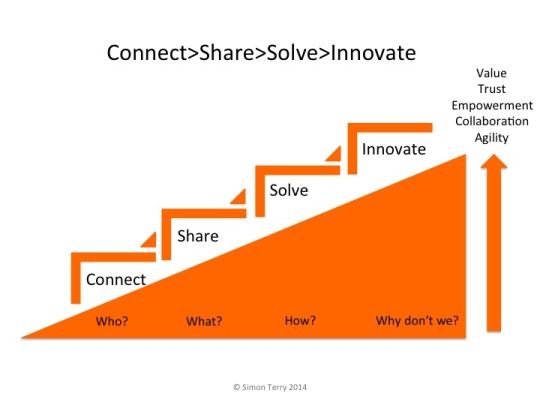
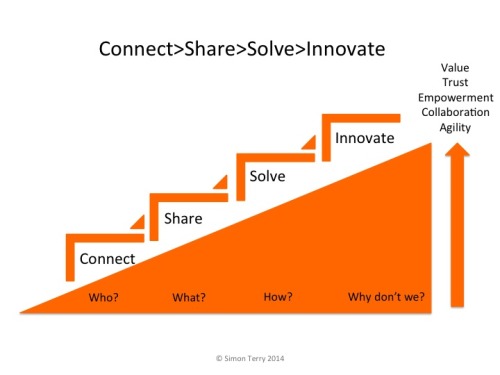
A community comes together around a common set of purposes.  Use your network to discover, discuss and align those goals. Engage the people that you would like to form a valuable community to find out how they want to engage.  My work shows that people have their own great reasons for adopting the practices that accelerate value at work and build communities. Those practices are those of the Value Maturity Model –  Connect>Share>Solve>Innovate.

The organisation’s goals will become a part of that discussion naturally.  Everyone works for the organisation and there will be some shared purpose. By engaging people you will discover the greater potential of the community and leverage its rich diversity of talent and perspective.

Ask leaders to lead

Much has been discussed about executive participation in enterprise social networking. Often it is seen as the panacea that will make people do the ‘right things’ in the network. Even the busy senior executives struggle to participate when it is imposed on them as an externally mandated task.  Again, the effort is to impose an external logic for networking.

When you focus on the community, what is clear is that what is needed is leaders. We don’t need participation from senior executives, when need people who are willing to take on the role of leader in the community to help the community to achieve its purposes. Leadership should come from senior executives, but it can also come from other community leaders, influencers and champions.

Don’t focus solely on senior executives. Focus on finding leaders willing to help create a community and drive change.  These people may well be your organisations mavericks and change agents.  Embrace their ability to lead.

The Value Maturity Model is an approach to help organisations create strategic value in collaboration and social networking. The Value Maturity Model Canvas helps organisations to develop agile plans for communities using participation of community members. To learn more, get in touch with Simon Terry via about.metwitter or Linkedin.

Create a Reputation Economy

image

Connecting and Sharing create a reputation economy in your organisation to underpin the trust and collaboration required to Solve and Innovate.

Four topics are commonly discussed in communities around enterprise social networks:

  • Why would anyone go out of their way to help others?
  • How do we increase the value of collaboration in our organisation?
  • What is the role of leaders?
  • How do we cut down the gossip and non-work conversation in our network?

The answer to these four questions are connected to one element of successful networks: they create a reputation economy in the community that fosters collaboration.

The Value of Reputation

Humans aren’t the rational economic machines that most organisations try to manage with role descriptions, performance plans and other incentives. Humans do things outside the job description and the process every day.  We work around the hierarchy.  Importantly, we collaborate because we value relationships and we know that the returns from collaboration exceed the costs in our effort.

One of the challenges of collaboration is the danger that others will free ride on your efforts, improving their performance but bearing none of the costs. Mark Pagel’s Wired for Culture uses evolutionary approaches to behaviour to examine an important part of our defences against free riding, reputation.  Because our relationships with our work colleagues are not transactional, over time we build a level of trust and a reputation for each colleague based on their behaviour.  This reputation system influences who and how we collaborate with others.

Ever wondered why a users first ever request for help or crowd sourcing of ideas will usually struggle?  They have no reputation in the community and others will hang back until someone shows they can be trusted. 

Increasing the transparency and connection of reputation in your organisation will accelerate collaboration not just in a social network or other tool.  Collaboration across the organisation will leverage the new transparent reputations developed.

Building Reputation

We don’t build reputation with our status in the organisation or by declaring we can be trusted.  We build reputation through with who we are associated and how we act, particularly when we act against our interest.

The Connect and Share phases of the maturity of a collaboration community enable people to develop these critical stages of reputation. Working out loud for the benefit of others can accelerate that trust.  As can demonstrating and encouraging a growth mindset.   Sharing information, insights and solutions, particularly when there is no reason or benefit to the sharer is a powerful way to build a reputation.  Others sharing without penalty and preferably receiving benefits establishes the view in the community that it is safe.

The reputations and the trust built in Connect and Share are what powers the value in the later stages of the model.  People contribute later because they know that their contributions go to those who they respect and have the interests of the community at heart.

The Importance of Leaders

Leaders bring status into communities. However, as noted above, the presence of status is not enough to create or sustain trust.  Actions by leaders count.  

Leaders can play a critical role in showing the way to build reputation and in establishing that collaboration is safe and beneficial.  Importantly, leaders can use their authority to calling out free-riding behaviour and encourage participation by others. Leaders can acknowledge the reputations built in the community giving them greater influence in the organisation.

Leaders also need to be aware that their status also brings a fragility to their own personal reputations.  If they fail to act in the community to reinforce their authority, it will erode rapidly.

The Critical Role of Gossip & Non-Work Conversation

Organisations hate gossip and non-work conversation. They are seen as a threat to the singularity of corporate messaging and a waste of time.

However, gossip and non-work conversation are critical parts of reputation systems.  Gossip is how we share our views of others reputations. Non-work conversation is another way for us to share and build our reputations with others.

Create a reputation economy in your collaborative community by fostering connection and sharing.

The Value Maturity Model is an approach to enhancing the value of collaboration in your organisation.  The Model is supported by a range of tools and practices to enable leaders and community managers to maximise the potential in collaboration.  If you would like to learn more about the Value Maturity Model, get in touch with Simon Terry.

Transparency is a Disinfectant

image

‘Sunlight is said to be the best of disinfectants’ Louis Brandeis

Transparency is a disinfectant. Openness highlights the need for change. Just as hygiene enables but does not deliver good health, transparency alone will not change the behaviours in an organisation. 

From Transparency to Transformation

Many people hoped the transparency of social business would transform organisations. We are now in an era when an organisation is more transparent internally and externally than ever. Networks & conversations reach across organisational boundaries. Opportunities exist to connect, to share information about opportunities and issues and solve problems together.

Many hoped that with this new transparency would mean organisations followed a path that looked something like this:

Transparency > Greater awareness of issues> Experiments towards a Solution > Autonomous leadership

In this model, increasing the transparency and connection across the organisation highlights the problems. The visibility of problems enables individuals to experiment with new models to address the issues. Those experiments foster the evidence and the leadership to complete the transformation. 

This model has the appeal that people need do little. Simply add technology to make the organisations more transparent and change begins. However we have learned that organisations are communities of humans and that greater transparency is a positive, but it not enough to catalyse transformation. There are real human forces like power holding us back from this change.

Transparency is a Prerequisite not a Solution 

Speak to any change agent and you will hear a common refrain: ‘My organisation can see the problem but it still won’t do anything’. 

Transparency is essential to highlight problems & opportunities. Transparency in networks is good at finding new issues that have been hidden by historical ways of seeing things. Customers and community can raise their issues directly, often for the first time. Employees can share frustrations.  People can use the new transparent organisation to find those with the ability to make a difference to the issue. What transparency doesn’t do is guarantee that person does anything.

Brandeis is right that transparency is a wonderful disinfectant. Transparency also changes behaviours. When people are aware that their actions are transparent they are more likely to consider others and feel the accountability of the community. The rarity of bad behaviour in enterprise social networks is a case in point.

However, more likely does not mean a guarantee. Transparency will not overcome the wilfully blind leader, the resort to arguments, justifications and excuses or the use of power to enforce an exception. Each of these may be seen by all but they also might be accepted in the culture of the organisation.  When organisations have strong cultural or power forces that resist the issues, people may see something but still refuse to acknowledge, to discuss or act on it. 

Transformation takes Transparency, Accountability and Leadership

Organisations need transparency. Effective organisations thrive on it and particularly on the most difficult forms of opening their organisation up to external parties like partners, customers and the community. These organisations make accountability to respond to what flows from transparency part of their leadership conversation.

The sunshine of transparency helps create safer and more human organisations. Accountability and leadership leverage that transparency to complete the transformation.

A future post will describe the characteristics of an organisation’s leadership conversation that leverage transparency to foster transformation of organisations.

Dear CEO: This Enterprise Social Network Doesn’t Work For You

Dear CEO

Re: This Enterprise Social Network Doesn’t Work For You

The purpose of this note is to clarify our most recent discussion in the executive leadership team about our enterprise social network. Thanks to your help we have now clarified that the enterprise social network is the last thing we need.

However our discussion on executive engagement in the network was again challenging. Initially there was a great deal of division in the executive leadership team as to how executives should use the network and their willingness to be involved. We did not get to explore your perspective on the role of executives in using our network when you left the room for another commitment declaring ‘this enterprise social network thing doesn’t work for me’.

We must admit we were initially disappointed by the comment. However, the remaining members of the executive team spent some time considering your insightful remark. We set out below the outcomes of that discussion:

Employee Engagement will deliver our Strategy

We realised that employee engagement, leveraging new ways of working in every role and discretionary effort to achieve our strategy is what will deliver better results. We believe that building a community in our enterprise social network will be another way for our employees to connect, to share, to solve problems and to innovate. The critical question we should consider is ‘Does this new approach to work deliver value for employees?’. The views of executives are less important than the value created for this community of value creators. All the evidence to date is that the network does work for our employees. Employees are more engaged and working more effectively.

This helped us understand that this enterprise social network doesn’t work for you but it works for our employees.

Leadership Helps Create Employee Engagement

We realised that employees need help to make sense of how to use the network, need help to solve problems and make change occur. That means employees need the support of leadership in networks. Importantly, that leadership does not have to come from the most senior executives. Leadership is a role not a job. We had hoped our most senior executives would play that role to ensure that the activity in the network aligned to strategy and best realised the potential of our people. However, we are already seeing new leaders rise up to fill the gap. The senior leaders who are involved can do more to foster this.

This enterprise social network doesn’t work for you. A strong community works for leaders who will help it achieve its potential and the community will surface new leaders to help shape and foster engagement.

Attitude & Capability are a Question of Leadership

We realised that much of the discussion in the room about lack of time, doubts about effectiveness of managing in networks or lack of skill were problems of attitude or of capability. These issues can be solved because they are the kind of challenges our executive leaders solve every day in other domains when required. People learn new skills, they work in new ways to fulfil the strategy and we ask people to be more efficient and better prioritise their time to do what matters. We ask exactly the same from our employees when we want them to achieve more. We don’t accept their refusal to change.

Towards the end of that discussion an interesting question was asked ‘If engaging in the community that creates value in our organisation doesn’t work for you, why are you a leader here?’. We wanted to share this question with you. 

Conclusion: Our Enterprise Social Network Doesn’t Work For You

We didn’t see at first. We now have come to agree with you that this enterprise social network won’t work for you. 

As a result, we have started a thread in the network asking our employees to contribute to the choice of who should takeover as CEO. That conversation is currently favouring the CMO. The community value her authenticity, respect her authority and trust her leadership. We aren’t surprised that the board seems to agree. Sorry leadership of this organisation’s community did not work out for you. We wish you the best in your future endeavours. You may find some useful suggestions as to what to you can do next in the thread that has started with advice on that topic.

Thanks for contributing so much to our efforts to engage the community, realise our strategy and improve performance.

Engage an executive in your enterprise social network. A great chance for executives to get involved is International Working Out Loud Week from 17-24 November 2014. Help an executive to see the leadership potential of working out loud. Find out more at wolweek.com

Action Changes Culture

It’s easier to act your way into a new way of thinking than to think your way into a new way of acting – Millard Fuller. 

To many in management, culture seems like a soft topic best left to Human Resources or Communications . To this mindset, culture is a matter of getting the words right, saying the right things and having the right tools & programs to change culture. Culture change is a communications issue. Often this results in culture change programs dictated by senior management with a goal of uniformity of culture in the organisation. These approaches at best fail quickly and at worst are counterproductive, generating employee cynicism.

Culture doesn’t work this way. Culture arises in a group of people when there is an expected pattern to interactions. The expectation forms from a consistent and predictable pattern of actions. Rituals are a classic example of how culture is transmitted. Words may help us to notice a change and tools may enable new actions but only the actions done consistently create the new mindsets.

The focus on expectations and actions also highlights how unlikely uniformity is. With consistent behaviour to shape expectations groups may develop a commonality of expectation. However uniformity of expectations remains unlikely. There will always be local variations for good reason. A good reason may be that a different pattern of action is better at fulfilling the organisation’s purpose or customer needs in this context. The heart of embracing diversity as an organisation is understanding these variations and leveraging them too

Expectations cannot be imposed. Begin with discovery of the expectations and the actions that really exist. Be honest. Failure to accept reality won’t help. Creating change then becomes a matter of understanding how to change actions to consistently deliver new patterns and to shape different expectations.

I am often asked ‘how does an enterprise social network change culture?’ There is no universal answer to that question. There are no guaranteed changes in expectations and actions in an enterprise social network just as there is no universal culture. Enterprise social networks in the right circumstances enable transparency, leadership, learning, problem solving, innovation and enablement of people. Where the culture is hostile to these things they do not, without significant investment in changing the way people act and interact.

Better questions are ‘what actions and interactions in our culture will be facilitated by an enterprise social network? How can we encourage these actions to become more consistent? What would these actions do for the expectations of our people as to how we behave here?’ These questions focus attention on the hard work of creating consistency in a community of new and different actions.

The impact of culture on the actions and interactions in the organisation is ultimately why Peter Drucker famously said ‘Culture eats strategy for breakfast’. Strategy that hopes for action inconsistent with the culture’s expectations will fail.

Start new and different actions now. Start small. Build new habits. Experiment with new ways of working. Action matters

Action creates culture. Focus on the actions, not the words or the tools.

Interactions over Transactions

In working with organisations who are implementing enterprise social networking I often hear the same kind of complaint: ‘we wanted to use our network to [insert use case], but that has failed here. How do we fix it?’

One of the dangers of a use case approach is that it engenders a transactional mindset. There is a big difference in a human interaction that is framed to ‘get information’ vs one that is framed to ‘ask politely, learn and acknowledge help’. Often the failed use cases are where the network participant are taking a transactional mindset and not considering the needs of the other person involved. Without interactions that benefit all participants the community, the benefits of the use cases fall away.

A network has transactions. Communities have human interactions. Community creates greater business value. A community has interactions that build long term relationships of trust, learning and collaboration. That’s far more valuable and much more human.