Forget Forward Deployed Engineers. The real challenges of your most valuable AI projects aren’t in the engineering. The most complex AI use cases to realise will demand Forward Deployed Entrepreneurs in your organisation who are able to identify, test and learn and transform business models. Brace yourself for an onslaught of intrapreneurs redesigning your business models, value chains and business processes powered by AI. This activity will challenge your organisation to govern learning at scale.
Are you ready to redesign your governance to enable the investments, the exponential value creation and the new risks this creates for businesses based on stable economic models?

From Engineers to Entrepreneurs
The Australian Financial Review had a great piece today on how the AI vendors are assisting clients to leverage their models with Forward Deployed Engineers. This takes the technical expertise into the client to enable them to better leverage the power of AI models in organisations. The Engineer joins into client teams to help them see and execute the potential to do better.
As noted in my recent piece on Clusters of AI Use Cases, the Unlock and Reinvent phases realise significant value because they leverage AI to start tackling change to business models, value chains and customer propositions. Your team members who work with a Forward Deployed Engineer need to be Forward Deployed Entrepreneurs to be able to make the changes required to transform your organisation.
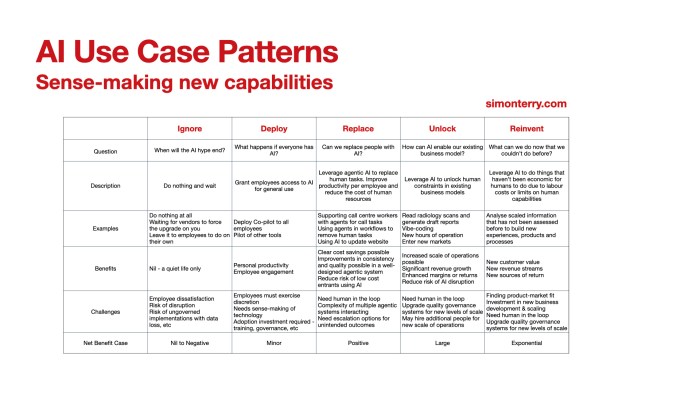
The Entrepreneur part of this is relatively easy. Most organisations can find the creative and motivated individuals who want to test and learn a better way of doing business. Hiring them and keeping them is a much bigger issue. It’s not the capabilities or the challenge of the work. Entrepreneurs get a buzz from learning and overcoming challenges.
Lifting the valleys of the sea
my father moved through griefs of joy;
praising a forehead called the moon
singing desire into begin

ee cummings. my father moved through dooms of love
Entrepreneurs change things a lot
The biggest barrier to success of a Forward Deployed Entrepreneur and the key issue with their retention is whether you will let them make the changes needed.
The single biggest blockage is likely to be your long standing static, safety first, no loss, plan-based internal governance processes. The Forward Deployed Entrepreneurs need to be able to make changes to systems, processes, business models, customer relationships, products and more. They need to make those changes fast, iteratively and with a willingness to fail. They need investment, access to specialists and supportive stakeholders who are willing to take a risk to find much better.
Business model transformation happens iteratively. The business part of this adventure is far harder than the technology part because it involves not just doing something but all the considerations that your organisation makes any change work its way through such as implications on other lines of business and customers, risk considerations, sustainability considerations, IT security, financial business cases, investment hurdles and many many more. All these are designed around incremental changes like launching a new product or fixing a broken process. The work required to pass through these for a fast moving and transformational change driven by new AI technology is likely to be exhausting, especially if every iteration has to follow through every step.
If you want Forward Deployed Entrepreneurs to work on the big issue of Unlock and Reinvent then you need to support them with investment for the learning required, the autonomy to make big changes iteratively and also a governance process that adapts to the very different challenges that come from entrepreneurship.
csince feeling is first
who pays any attention
to the syntax of things
will never wholly kiss you;

ee cummings, [since feeling is first]
Redesigning Governance for Entrepreneurs
I was asked recently the biggest difference between governance in a fintech and governance in a large organisation. My response was that the governance in a fintech was all focused on the lessons from the activities and how they informed decisions to pivot or persevere and what those lessons were revealing about the future opportunities and value of the organisation.
Because there was an expectation of learning the governance understood that a lot might change from one governance meeting to the next. Autonomy was baked into the way the organisation ran and was an expectation in all roles. Risk was an accepted part of this learning process and the risks were managed actively. The plan was a guide to that learning experience and a measure of runway.
In most cases, large organisations use governance as a backwards looking exercise to understand variances to plan, reduce volatility, and what that means for the forecast. Risks were to be mitigated or avoided. Autonomy is within agreed plans. Investments and business decisions were slow and long processes designed around an annual planning cycle. This difference in governance makes test and learn business model transformation a challenge and will drive Forward Deployed Entrepreneurs (& their Engineering colleagues) to despair. Because your existing business model is proven and relatively stable you have built governance to secure that stability, not for rapid learning.
To explore the opportunities to Unlock and Reinvent your business models, value chains and customer propositions, you need to have entrepreneurship and an environment in your organisation for that learning to thrive. How are you enabling your people to learn at scale, to make the changes required for success and how are you changing your governance to support them?
For whatever we lose(like a you or a me)
it’s always ourselves we find in the sea

ee cummings, maggie and milly and molly and may
Simon Terry is a consultant, advisor, and non-executive director who focused on how organisations can better leverage technology, collaboration, leadership and learning to achieve innovation and business growth, particularly in financial services, healthcare and education.