Change Agents Worldwide E-Book Released

The Change Agents Worldwide e-book: Changing the World of Work One Human at a Time is now available. Get yours now:

CAWW e-Book

The book is a series of essays that answer the question “what step should organisations take to make the most of the future of work?” The answers reflect the diverse and insightful perspectives of the members of Change Agents Worldwide on leveraging social collaboration, networks and trust.

My essay in the book is entitled “Do You Trust the Talented People You Went to Great Care to Hire?”

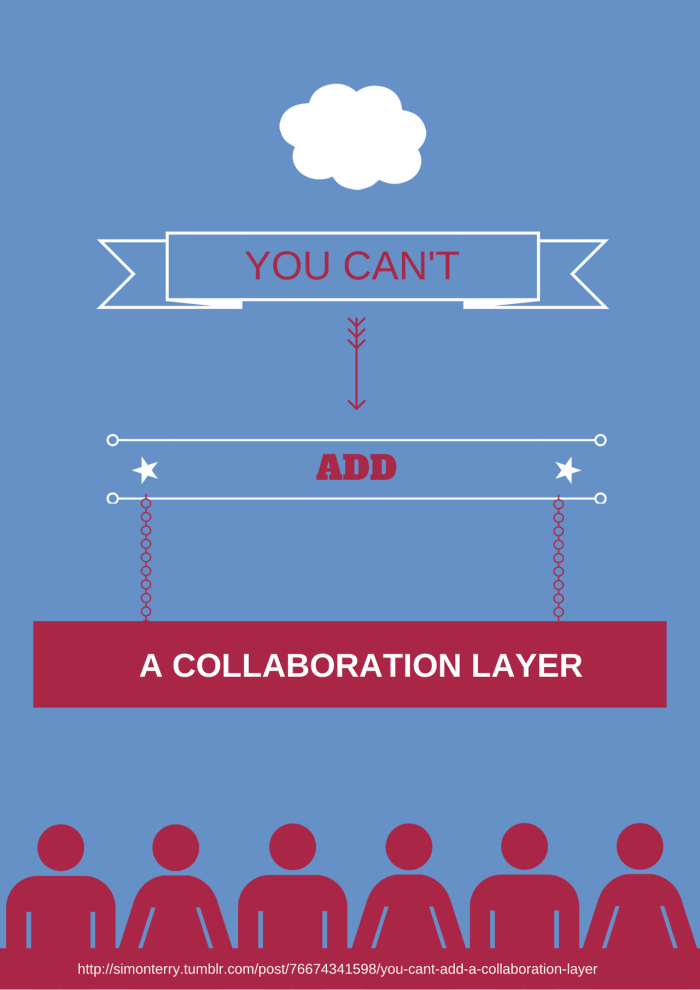
You Can’t Add a Collaboration Layer

Collaboration is human-to-human interaction. We are rich, creative and diverse, given the chance. You can’t add a collaboration layer to your existing processes.

Collaboration is not something that helps with the work. Collaboration is not something you integrate into your existing systems. Collaboration requires a fundamental rethink of the way work gets done. Collaboration is not a layer because it changes the whole system. Great collaboration goes the whole way through.

The phrase ‘collaboration layer’ is common. The idea of a collaboration layer most likely has its origins in information technology architecture. Collaboration systems are often represented as a different layer of the system stack, similarly to the user interface. As a result vendors and others talking to an IT audience will often promote the need to add a collaboration layer to existing processes. After all adding a collaboration layer sounds relatively painless – all the benefits of collaboration without the change.

As the application of the phrase shifts from systems architecture to the business conversation on how work gets done, something gets lots in translation. Success in the application of social collaboration systems does not come from integrating one more piece of technology into the stack. Collaboration is not an integration challenge. Collaboration is not about machine-to-machine or even machine-to-human interaction. Collaboration is human-to-human.

Collaboration can’t just be layered in on top of everything else. Collaboration requires a rethink of the entire process to foster the best of human interactions. Networks are required for collaboration. However, great communication requires more than a network. Great collaboration requires a community. The highest value collaboration goes beyond a community and builds a change movement.

To bring community to life you need to do more than add a layer of machine-to-human and human-to-human communication over the top of your Taylorist processes. The goal of social collaboration is not to make dumb workers better informed. The goal is to leverage their collective knowledge, intelligence and creativity. Allowing workers to share purpose, connect and create new and better ways of working together comes from giving them the opportunity to connect deeply and to rethink the processes and entire systems that they use to do their work. The best innovations in social collaboration are when entire traditional processes disappear because a newly engaged workforce finds a better way.

People will not stay long in a conversation where machines send them status updates. There is much less value in collaboration, little community and no change if the process is the process and can’t be rethought. This is one of the reasons so many enterprise social networks struggle. Without the prospect of creating a sense of community and the ability to change things, what is the point of participating?

If you want the benefits of rich collaboration, growing community and powerful change driven by your people, then you will need to move beyond a collaboration layer on existing processes. Letting your people use collaboration to change the whole system for the better has to be possible. Collaborative humans will demand it.

The New to Social Executive: Actions to Get Ready

As a senior executive starting to use social collaboration there will be a little nervousness when you engage at first, unless you are supremely confident or incredibly extroverted. You need opportunities to practice your new mindsets and learn new skills of social collaboration before you hit the main game. Even if you are confident and extroverted, you may need practice, because you may need to learn to adjust to the expectations of others.

Here are a few actions to help the new-to-social executive to get ready for the art of social collaboration: 

  1. Start by being social: The technology is just a facilitator of conversations. Do you go out of your way to have social conversations in your organisation now? Are you mentoring and helping others across the organisation now? When did you last have a coffee meeting with no agenda? It is no good running chats on twitter or posting think pieces on Linkedin, if you don’t talk to your own employees or customers in the foyer. Start using your new social mindsets and engaging a wider audience in other ways first.
  2. Choose a purpose: When starting out in social collaboration, focus helps build reasons for connection.  Choose the one topic on which you want to start to engage purposefully with others. If you can’t think of anything else, choose one of your corporate strategy, meeting talented people or better understanding customers. Add these topics to your everyday conversations and your team. Refine your purpose as you go. Eventually this purpose will flower into a personal manifesto.
  3. Reflect & Start to share your learnings: New-to-social executives often say “But what do I have to say?”. The things that you share are going to come from the interactions in your day and responses to the activity of others. Reflect on what you experience and read each day. Start to take some notes about what these experiences mean for you and what you learn (Tools like Evernote are handy for this). Those insights are ideas that you can share. Explain to others how these ideas came about. They might seem minor to you but to others without your experience your thought process can be incredibly valuable. Over time this will become a form of Personal Knowledge Management where you constantly refine what you read, capture insights, and also learn how you share your insights with others.
  4. Test the influence of your insights: Most senior executives are used to their teams listening to their words. Social audiences are busy with many competing voices. You may need to test how influential your ideas are before you debut them to a wider and more discerning audience. You may need to adjust your style of communication. Social favours the short, sharp and punchy. Run some tests sharing your thoughts in a variety of different means through email, internal social posts, voluntary talks or blogging internally. Measure the response and seek feedback. Use that feedback to refine your style and your messaging. 
  5. Start Working Out Loud in your Enterprise Social Network:  There is no better place to practice social collaboration than in your organisation’s Enterprise Social Network.  You will be practising in front of an audience that is well aware of your fame, power and influence. They will be forgiving. Use your enterprise social network to start to practice Working Out Loud. Develop new habits that you can carry over to external social media. Make sure you get the network’s mobile applications so that you can easily access, share and respond to others as you go about your busy life. Most important of all, learn the lessen that the value of social collaboration grows with your consistency and your effort.

From that point on there are plenty of experts that tell you how to use Linkedin, Facebook, Twitter, Instagram, Pinterest and other social tools for business.

Search, experiment and keep the practices that work for you 

This is the second of two short posts on tips for the senior executive looking to move into using social collaboration tools inside and outside the enterprise. This post deals with actions to get you started. The previous post dealt with mindsets.

The New-to-Social Executive: 5 Mindsets

Your mindset matters to how you are perceived and connect in social media. Whether internal or external to your organisations, the way you think and the way you lead play a critical role in your ability to influence others.  As a senior leader atop the hierarchy, you have power and influence in your organisation (Admittedly that’s rarely quite as much as you would like). When you take your leadership position into the realm of social collaboration whether internal to your organisation or externally, there are a few key shifts in mindset from traditional models of leadership.

Keep these in mind these five key phrases:

  1. Be the real human (& sometimes flawed) you”: Nobody is looking to get to know your communication manager’s idea of you. People don’t need you to be the perfect model executive. You can’t have a conversation with a corporate cardboard facade or get help from a PR bot. This is an opportunity to be more human and to use deeper connection and communication. It will demand that you share more of you. If there is more than one of you, one for work and others, then social collaboration will test your ability to maintain the curtain of separation. Using social media works best when you bring your whole self to the activity. You will learn new ways to demonstrate your strengths and authenticity in the process.
  2. Think networks”: Social media flattens out the playing ground. Your current fame, power and fortune won’t deliver worthwhile connections or influence immediately. In this environment, your voice competes with many others and those that are better connected and more trusted will have greater influence than you regardless of their status. Your voice & authority is much more easily challenged and even mocked. Influence works along networks of trust and connections. Valuable business traction comes from deepening connections to stakeholders and influencers in your own world. Start there and build your influence over time as new connections join in to the valuable interactions that you help create.
  3. ListenEngage others”: Listen first. The network doesn’t need to hear you. Mostly it won’t. The network doesn’t need another opinion; it needs your response to and your engagement in the conversations already going on. If you want to deliver on your strategy, the path is through helping others to better align, understand and deliver that strategy with you. How you engage with others is more important in building influence in your network than who you are or what you have to say.
  4. Be helpful”: Make connections & help others find those who can help them. Set context. Guide others. Enable others. Share stuff to help others solve problems for themselves. Ask great, thoughtful & challenging questions. Work aloud and let others prove their value by helping you. Connect with people to deliver them value. People are looking to learn more and help themselves. As a senior leader you can play a critical role
  5. Experiment, learn & change stuff”: The value of human networking is to learn, connect with others and change things. Embrace difference & the chaos that many opinions and desire for change creates. After a while you will recognise the appeal of ‘being permanently beta’, always evolving to better value as you experiment test and learn. If you want to hear your own views, build your personal brand, increase your control or resist change, don’t start in any form of social collaboration. That attitude doesn’t show much respect for the efforts of the others in the network. 

This is the first of two short posts on tips for the senior executive looking to move into using social collaboration tools inside and outside the enterprise. This post deals with mindsets. The next post will deal with how to start engaging.

The Power of Collaboration

I was recently chatting to a doctor who described to me why she still works in emergency rooms well after others may have chosen to retire from a successful career. These days she sees fewer patients but she still plays a critical role in the functioning of a ward.

Her role is to contribute to management of the ward and most important of all she shares her wisdom and experience with her colleagues. She is a sounding board for opinions, guides the choice of tests and scans, helps read charts, and generally available to consult and guide others in the high pressure and high stress environment of an emergency room.

Where is the special value in access to advice and experience vs more hands-on work?

Well, the hospital asked the same question. Hospital budgets are tight and they need to be allocating their resources carefully to produce the best outcomes. Rather than assume an answer the hospital looked at the data and compared the time patients waited and the outcomes for the whole ward on the days the experienced doctor worked versus the other shifts. To everyone’s surprise, there was a dramatic improvement when she was working and advising her colleagues. Wait times for patients were significantly reduced on those shifts. In an emergency ward that time makes a big difference.

Adding a doctor to the shift who had a career of experience and had accumulated years of tacit knowledge made the entire system of the emergency ward perform better. Doctors took less time over their decisions and needed less often to wait to interrupt a busy colleague to get advice. That matters a great deal when many of the decisions are time critical and life threatening.

This is not a story about skills. All the doctors are smart, passionate and talented. They made their own decisions on what to do and when they needed advice. The ward is always well run, but it runs better with the opportunity for more collaboration. What mattered was that the opportunity for collaboration and access to greater experience, improved the outcomes by speeding the exchange of knowledge in the ward.

Tacit knowledge and experience matters to speed and to outcomes in knowledge work. Knowledge is a flow and comes from interactions between people with diverse experiences. Being able to draw on more of these interactions can save a great deal of rework and mitigation of doubts and concerns.

How do you enable sharing of knowledge and experience?

This story resonated deeply with me because I have both benefited from the advice of others and spent a significant part of my time sharing my experience with others. Knowledge work is a growing share of most developing economies (around 40% in Australia, US and EU) In my experience, the use of experience and advice in knowledge work is often undervalued by organisations and they rarely consider the impact of advice and counsel on team performance. This story was a great example of an organisation that measured that impact and saw a dramatic result.

There are a few lessons from this story that apply to all organisations:

  • Recognise that in knowledge work the discussion, debate, advice and counsel is part of the work: Many organisations take an industrial view of knowledge work. If there’s not an immediate tangible final output it is waste. That means any conversations in and around the process of work are seen as waste. It is a common misguided criticism of enterprise social media – ‘why is there so much talk? shouldn’t people be working?’ They are working if they are improving their understanding, gathering insights, learning and solving problems more quickly. That a is all knowledge work. Importantly, that learning is permanent and shared.
  • Design ways of work, teams and connections to leverage experience and other forms of tacit knowledge: People with experience, shortcuts and life lessons can be an invaluable part of the team. Their prior experience as a part of a conversation with the team can accelerate progress and reduce risk. The smartest, most talented and most energetic bunch of people in the world are better with a wise advisor. Drawing out tacit knowledge into conversation improves others learning. Make plans to leverage this. Foster mentoring, make it OK to ask others and build an advice culture. Social collaboration tools are a great start.  
  • Use data, not assumptions, to determine the contribution of individuals to their groups and teams: Individual performance is usually easily measured. It takes a little more effort to understand the contribution of people to group performance. As many organisations have learned to their detriment, the person underpinning team performance may be the person with less visibility but who is sharing the most.

PS Don’t forget the value of diversity too: Another key lesson is the power of leveraging older workers, especially female role models. There may be benefits you have not considered in a greater diversity of experience. This takes effort from organisations to create flexible roles that suit their interests and passions and a work environment to which they want to contribute. With the changing demographics of an ageing workforce, this is an important consideration for all employers.

What are you working to achieve?

‘What are you working to achieve?’

Working out loud is not a common enough experience yet.  Many people are still reticent to share their goals, their challenges and their work.  

That makes a question about what people are working to achieve a very powerful one, because it:

  • helps people clarify their purpose and goals
  • separates wishes from tangible action
  • moves beyond appearances, titles and surface issues to form the basis for a deeper context, connection and conversation
  • enables you to identify how you or others can contribute to help

I ask this kind of question a lot.  I find it is incredibly valuable for simply building rapport.  You have a lot more to discuss when you know where someone is devoting their efforts.  

However, it also enables further action to help.  Just this morning I asked the question of somebody that I did not know well.  Turns out I have networks that will assist them to achieve their goals more quickly. That makes the question a powerful engine of collaboration. You can’t help if you don’t know.

If others are not sharing their work, ask them what it is that they are working to achieve.

Conflict – Don’t Panic. Engage.

image

Many organisations are fine with collaboration and change as long as there is no conflict.  Once the conflict arises, everyone panics. Panic creates the worst reactions because it often leads to these strategies:

  • Freeze: pretending there is no conflict and hoping it fades away
  • Fight: Wading in to the conflict to impose the ‘right’ answer
  • Flight: Shutting down the conversation or even the whole change or collaboration

A panicked response is particularly likely if the conflict arises around one of the long threatening fault lines in the organisation e.g. between sales and marketing, between business and IT, between frontline employees and management, etc. Every organisation has its undiscussables and they are where leadership, change and collaboration begins to fail.

Don’t panic.  Celebrate and engage to shape the conflict into its most constructive form – deep engagement.

Conflict is the first sign of real engagement.  Until conflict occurs, everyone is assuming the collaboration or change is not worth the effort of a fight.

Conflict is also how you learn.  Well managed conflict helps share context between groups.  It will surface feedback and learnings. It helps you find the people to whom the activity really matters. Conflict is where you get to the real questions to be answered.  There is a good chance the real issue lies somewhere in that organisational fault line that everybody knows and nobody wants to discuss.

Any scriptwriter will tell you that every screenplay is driven by conflict.  Humans crave conflict.  Our stories are full of conflict.  We devote a huge amount of our attention to it. All the gossip in your office will relate to stories of conflict and their meaning for the behaviour of others or the culture of the organisation.  Successful change and collaboration needs this energy for human engagement.

So next time conflict breaks out around a change or a collaboration, recognise it as a good sign.  Engage to make it a constructive conversation:

  • Show genuine & deep interest in people’s views as to how to learn and improve
  • Tease out people’s purposes, concerns and context
  • Shift the discussion from opinions toward facts
  • Look for common ground and agreed actions. 
  • Accept that you can’t make every one happy.
  • Demonstrate change in your approach based on what you learn

Getting credit

It is amazing what you can accomplish when you don’t care who gets the credit – Harry S Truman

Yesterday I discussed the vexed issue of ownership of collaboration. Credit for the successes of collaboration is one other reason people are so keen to own it and also why ownership belongs with the users.

Credit is also a vexed issue for innovation. As Harry Truman notes, giving credit away is often the only way to get something done. Far too many change agents are frustrated that their good ideas are quickly taken for implementation, often without credit or further involvement. Sadly, the great ideas don’t get implemented easily.

Three other challenges come for organisations that run on the concept of credit:

  • Credit debates are rarely factual. Credit is usually a part of a performance management process that is not connected to facts. Debates about credit suggests people are much more concerned with appearances of performance.
  • Credit gets in the way of collaboration. Credit tends to assume there is one creator of every outcome. Collaborative outcomes, like design thinking processes, don’t fit the system
  • Credit is distinct from accountability which is much more important. I would rather know who is taking accountability for delivering something than who would like to plans to claim it.

How can an innovator or change agents deal with issues of credit?

  1. Don’t Play the Game:  There is nothing to gain and a lot to lose playing along, keeping ideas secret and trying to hog or claim credit.
  2. Work Aloud: working aloud enables others to understand what you have been involved in and reduces the risk others misjudge your involvement later.  Working aloud engages stakeholders progressively. Working aloud reinforces accountabilities, because it enables others to know who to follow up.
  3. Move on & Work with Collaborators: The advantage of being oriented to innovation is you know you have more ideas and opportunities ahead of you. Many of those clamouring to gain credit know that they don’t have the luxury. Often they will learn their lesson when they need help on the next round.
  4. Give Credit Where it is Due: Innovation processes can be convoluted with lots of participants inputs, reuse of ideas and evolution to a successful implementation. Recognition at the end is hard.  Make sure you recognise others along the way. You will discover building a fact based culture of recognition will flow back in appropriate recognition of your role.
  5. Take Accountability for the Innovation System: Individual ideas matter less in an organisation. What matters more is to have a functioning system of innovation, a consistent process that delivers a cadence of innovations into the market. Innovators and change agents should be build a system that lets everyone in on innovation

Who owns collaboration? You do

Lead users to realise the value of better collaboration

Twice last week in conversation I stumbled across the challenge of who owns collaboration. Once was an organisation grappling with who “owned collaboration”. Once was a tech company who noted that their valuable tools lacked a natural “owner” in their clients. This is such a common challenge at least one vendor proposes the effort of annual reviews of ownership.

In many cases what drives the debate about ownership is the need to cut a cheque to invest in a better solution. Imagine if the English language had a license fee. I can imagine the organizational debate about who owned English and who had to maintain it. People see the immediate inconvenience, the benefits are diffuse and there is often a tricky path to realizing value for the company strategy.

In other situations ownership debates arise from the number of parties involved. Ownership is a problematic concept with something that inherently involves multiple silos and many engaged people.

Having spent much of my working life being asked the question of “who owns the customer?” I have the same answer:

The end user does.

Each customer owns their relationship with an organisation. Decisions should be made to meet the customers needs. We need to reflect the customers right to choose or they will go elsewhere. That means everyone in the organisation needs to put the customer first. Everyone needs to put their ego in check and deliver on the best experience the whole organisation can deliver.

Collaboration is owned by the users

Collaboration is no different. Those who collaborate, the employees and other users, own collaboration in your organisation. After all, they make decisions each day to invest their critical time in collaboration to create value for themselves and the organisation. Increasingly, they can engage elsewhere. Engaging users is the best way to create, sustain and build value from collaboration.

Every organisation needs leaders to make sure that that activity is supported & guided to benefit the organisation’s purpose and strategy. In enlightened organisations, just as with customers, support will come from the highest levels. If not, it is up to you to take responsibility to support the users in your organisation.

How do leaders help users own collaboration?

When nobody else will step forward to advocate for a critical skill for future organisations, it is essential that you do. Leading users to own their own collaboration and create increasing value will deliver huge rewards for you and your organisation.