The Last Thing We Need is an Enterprise Social Network

Dear CEO

Re: The Last Thing We Need is an Enterprise Social Network

The purpose of this email is to explain why the last thing we need is an enterprise social network.

This email is in response to the conversation about enterprise social networking in the executive leadership meeting yesterday. We thought it best to summarise the position of the leadership team, because yesterday’s conversation got derailed by anecdotes about social media, technology terminology, fear of change and discussion of abstractions like collaboration, future of work and new organisational structures. Before you left the meeting, you remarked “Based on this discussion, I think an enterprise social network is the last thing we need”. We agree.

We don’t want faddish technology. We need execution of strategy.

As CEO, you’ve been rightly suspicious of all this discussion of social inside the organisation. It is bad enough that your teenage children never look up from using social media on their phones. Whatever that involves, it can’t be needed activity in our organisation. We are a place of work.

What made this country great was well-run organisations, hard work and increasing effectiveness in creating value for customers. That takes focused strategy, disciplined execution and a willingness to do the hard yards. Great organisations aren’t built by chasing technology whims. They come from executing strategy to create better value. When we need to create better execution on strategy, the latest fashionable technology is the last thing you need.

We need better strategic value creation

Times are tough. Industry is more competitive than ever and change keeps increasing. We know customer and shareholder value needs to go up and costs need to come down. We have a strategy that is about meeting these new customer & stakeholder expectations, improving the organisational efficiency and delivering the returns that shareholders demand. We all wonder from time to time whether everyone in the organisation gets the imperative of the new strategy and whether they are all working hard enough to find new ways to create value. We know that we perform better when we have better conversations to make sure that our employees are aligned to the strategy. What we don’t need are distractions when there’s doubt that people even understand the strategy.

When we need strategically aligned value creation, the last thing you need is an enterprise social network.

We need new more effective ways of working

To fulfil the strategy of the organisation, we know as a management team that we will have to start to work in new more effective ways. There has been too much wasteful duplication of work in the organisation. Too many of our processes & policies don’t line up across the silos, aren’t agile enough for the environment and don’t meet customer needs. Both our customers and our employees complain about how badly we do this. We need to start working in new and different ways to identify, solve and improve this on a continuing basis. We have to focus everyone on find and using better work approaches that help us to fulfil the strategy.

When we need working in new and more effective ways, the last thing we need is an enterprise social network.

We need to change management and leadership in every role

Working in more effective ways will likely require us to change the way management works. We are going to need to push decisions down to people closer to the customer and give our people the ability to fix problems. We will need our managers to move from command and control to a coaching and enabling role. We need to ensure that all our people are realising their potential and able to work to create new sources of value. Of course in this new role, middle management will need to be trimmed and the new flatter organisation will need to change more often as we respond to further changes driven by our customers. Employees will need to step up into a leadership role in these changes and with customers, the community and the organisation.

When we need to change the culture of management and asking every employee to play a bigger role in leadership, the last thing we need is an enterprise social network.

We need different conversations

Changing the culture of management is going to demand very different conversations in our organisation. We are going to have to find ways to make sure that conversations are efficient and effective. We need to leverage the contributions of more people from across the organisation. We won’t be able to rely on long meetings, workshops, speeches, video and emails. Did you see the budgets for communications, off sites & roadshows in the forecast for next year? We have to do something different. We will need to involve our people more in making decisions. If that’s going to happen our people will need to be better informed and better able to channel their contributions. Our people will need ways to inform themselves, learn by pulling what they need, share ideas of how to work better and collaborate to solve work problems. We are going to need to encourage our people to join conversations that use their capabilities to innovate, to create value for customers and create new forms of working.

When you need to change the conversations, collaboration and culture of an organisation, the last thing you need is an enterprise social network.

We need more from our people

We wrapped up the last executive leadership meeting reflecting on how big these demands will be on our people. We will be asking for a lot of change in them, their work and the way the organisation exists around them. We will be asking our people to play an increasing role in the success of the organisation. We will want them to lead new conversations to create the future for this organisation. We need our people to be more engaged because we will need much more from our people.

Conclusion: What we need

After you left the executive leadership meeting to catch up with the board, we realised that we are clear what we need as an organisation:

  1. we need to succeed by fulfilling our strategy to create greater value in a rapidly changing market; and to do that
  2. we need to be able to work in new & better ways that create a more effective, agile and responsive organisation; and to do that
  3. we need a new culture in management and more leadership from our people; and to do that
  4. we need new conversations that enable our people to discuss and act on creating better strategic value; and to do that 
  5. we need more engagement and a better ability to leverage the potential of our people to contribute to and lead this change; and to do that
  6. we need an enterprise social network to support the first 5 steps.

If you are surprised by point 6, think back through the needs again. After all you were the first to say that an enterprise social network is the last thing we need. We don’t want an enterprise social network because it is new technology or because it is good for some abstract goal. We need one to help our people to execute on the changes necessary to achieve the goals of our strategy. Enterprise technology only makes sense when it enables us to work in new ways that deliver strategic value. As your management team we can see that the value creation opportunity is compelling. We couldn’t see it when you made your remark, but we have come around to your perspective.

The paperwork required by our old process is already on your desk, but a number of our people have started experimenting with solutions to see what value we can create. (Interestingly, their first suggestion is a better procurement process.) When you get back from the board, your assistant will show you how to log-in and join us discussing how we implement in the new enterprise social network.

Thanks for challenging us to come up with a better way of working.

Please think of the environment and don’t print this email. We’d encourage you to discuss it on our new enterprise social network instead.

If this post sounds familiar or if you would like to create greater value in your enterprise social network or discuss how the Value Maturity Model applies to assist your organisation to create strategic value through enterprise social networking and collaboration, please get in contact. I am available through @simongterry or Linkedin or www.simonterry.com
SCNOW Webinar Series from Socialcast and Change Agents Worldwide

Change Agents Worldwide and Socialcast have now completed four great webinars on the future of work, enterprise social networking and collaboration:

Recordings of these webinars are available at the Socialcast webinar centre.

Working Out Loud Creates Value

image

Working Out Loud is one of the most crucial practices for value creation in an enterprise social network. For many, it is also the least comfortable. We need to work at this new practice to deliver value.

Working out loud is the core new practice as sharing grows in an enterprise social network. When the conversation moves from sharing personal information to sharing work, value for the individual and organisation rises dramatically. That sharing is critical to the maturity of value creation in an enterprise social network. Without sharing of work, you hold back the benefits from other forms of work collaboration.

Working out loud creates great value in a network because:

  • working out loud gives a work purpose to the connection that has been formed in the network
  • working out loud invites community to form around people and their work enabling others to help, share knowledge and make work easier.
  • working out loud is not natural to many in the traditional workplace, but when people overcome hesitation and practice it they start to see the benefits of new forms of collaboration, that it makes work much easier & the culture much richer – a core driver of personal adoption
  • working out loud is the transition point to much wider collaboration across the organisation and particularly collaborative sharing and problem solving – work that is open is work that can be made better 
  • working out loud exposes the work which allows for better strategic alignment, reduced duplication and importantly recognition of the great work underway.
  • working out loud enables role modelling of transparency, vulnerability, learning, agility and experimentation.
  • working out loud by leaders can change the leadership dynamic from one based in control and expertise to one that leverages networks and collaboration.

Some great resources are available to help you with working out loud:

If you would like to create greater value in your enterprise social network or discuss how the Value Maturity Model applies to assist your organisation to create strategic value, please get in contact. I am available through @simongterry or Linkedin or www.simonterry.com

Beyond Adoption to Value Creation

Slide1

A great deal of attention in enterprise social networking has gone into ‘driving adoption’. A focus on adoption can distract organisations from the real challenge of any business activity, creating value in fulfilment of the organisation’s strategy.

Adoption is an intermediate goal

Adoption is a means to an end. Adoption is a tool of value creation. It is not the result. The desired outcome is the value created by an engaged community that allows for the fulfilment of a strategic goal through outcomes like better alignment, innovation, adaptation, better customer & community focus, greater agility or improved efficiency.

The desire to move beyond adoption is growing. Luis Suarez recently argued that the language of driving adoption is missing the mark. Joachim Stroh has also highlighted ways in which we need to move beyond traditional adoption.

The logical next step from adoption is the end goal of work. Business and people work to create value in line with a strategy. We need our use of enterprise social networking to create value for each users and for the business as a whole.

Adoption as a goal alone can lead us astray

Our focus on adoption is often reflected with concerns from our traditional hierarchical ways of working. For example I have been asked the following questions about adoption that indicate something is going astray:

  • If we don’t have universal adoption, how will people get our messages?: If you are focused on one-way communication, there’s a good chance they don’t listen to your messages already.
  • Can’t we just mandate adoption? You can, but it rarely works to create an engaged & valuable community. Incentives may be a transitional tool to help people engage with the solution but take care that they don’t make participation an end in itself.
  • Won’t our people resist adopting this new solution? If the solution offers no value or is seen as a distraction from real work, they should resist. If it creates value for users and they see its value to the organisational strategy then this is an issue that we will overcome.
  • What’s the right number of users to adopt a social network? There is no magic number. The right answer is enough of the organisation to create enough valuable conversations for users and the organisation. That can be a surprisingly small percentage of the organisation, provided they are well connected into the larger organisation.
  • We have lots of users. Nobody knows what to use it for. What do we do now? You have users but it is likely you don’t have a community that understands how to do things together to create value for your strategy.

Most importantly of all, enterprise social networks are infrastructure, not tools. Employees need to make sense of a new enterprise social network and integrate it into their work. There is no pre-ordained usage that people can adopt like many other technology systems. Adopting a network as another conversation tool may be interesting but rapidly loses relevance in a busy workplace with many high volume channels for communication. The best guide to employees is to direct their sense-making into how it will create value for their work and strategic value for the organisation.

Often adoption drives demand a lot of overhead and effort. They are pushing something into a community. Where this effort goes to creating niche use cases with easy adoption, selling a uniqueness event in an enterprise social network or investing all the time in unusual campaign activities it can backfire. Employees who come to think of the enterprise social network as being used only for a special activities may not consider the opportunities for every day value creation. In these networks, there is a dramatic difference in utilisation between when adoption is being driven and every day use limiting the potential of the platform. Use caution that your efforts to drive use reinforce the connection to value in daily work and strategy.

Importantly adoption is rarely a goal that makes sense to the managers and leaders whose support is needed to foster a collaborative culture and role model usage. Conversations advocating adoption of social collaboration and other future of work practices can seem abstract and a side issue to the work of the organisation to many managers. Managers are looking for how enterprise social networks contribute to value creation.

Personal and Strategic Value

Value is different for every organisation as organisation’s purpose, strategies and goals differ. Value need not be a hard dollar return on investment. ROI can rarely be calculated in the abstract for infrastructure. From an organisation’s perspective defining a contribution to a strategic goal is often more effective.

Value is different for each individual depending on their goals, their role, their work preferences and their needs. Individuals will need to change their work practices in ways that make sense to them. Role modelling and storytelling will assist this journey but they will make their own sense of value.

There are 5 key elements of the work to moving the focus of enterprise social networking to value creation:

  • Create Strategic Alignment: Make explicit the connection between social collaboration and the strategic goals of the organisation. At a minimum, these conversations will educate your employees on the purpose, strategy and goals.
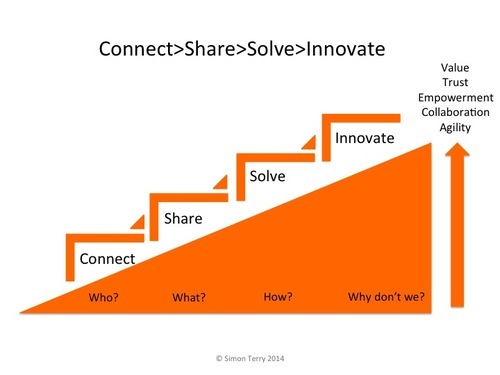
  • Guide Personal Value Creation: Guide employees to understand how the enterprise social network creates value in their work. In my work with organisations, I use a Value Maturity Methodology based on users maturity through 4 stages Connect>Share>Solve>Innovate.
  • Experiment & Learn: Create an environment for employees and the organisation where the enterprise social network fosters experimentation to create new forms of value in work. Encourage sharing and solving challenges.
  • Foster A Learning Community: An engaged and aligned community of employees working together for business goals is the greatest opportunity for value creation in organisations. Focus on how community accelerates value creation and the key roles required in any community. Understanding the roles of champions and leaders is critical.
  • Discuss Value Creation: Social networking accelerates double loop learning. Discuss value creation in the network as the work conversations occur. Celebrate lessons and successes. Back innovations with corporate muscle. Use these new learning conversation to foster alignment with strategic goals and encourage people to find new personal value.

If you would like to create greater value in your enterprise social network or discuss how the Value Maturity Model applies to assist your organisation to create strategic value, please get in contact. I am available through @simongterry or Linkedin or www.simonterry.com
The One Success Secret to Social Collaboration in the Future of Work

image

There is a lot of advice out there for organisations trying to achieve success in social collaboration and new ways of working. The future of work is very popular now so there is a lot of effort to sell the newness, the complexity and its special nature. Much of that advice makes efforts at social collaboration sound difficult to achieve or alien, if you are working today in a traditional organisation.

Despite all that discussion, there is one practice that helps make initiatives in social collaboration successful and increases the value that is created in the future of work. That practice is simply:

Treat it as just work

We work collaboratively every day

Every day people collaborate at work. Mostly they don’t call it collaboration. Instead, it is seen as having a conversation, sending an email, persuading someone, getting advice, getting help or working together on a task or project.

Social collaboration extends the opportunities of who can engage in this collaboration. Social collaboration tools enable this kind of work to be done with more people, faster and with better ability to leverage the knowledge created. If social collaboration tools don’t make it easier or better to do this kind of work, then users won’t and shouldn’t use them.

Treating social collaboration as a special activity distinct from work confuses people. They debate when they should use this special collaboration. They question the value of collaboration. They can’t see the point. And each time they go back to their work and start collaborating with others again.

Work is why we share information

Many people can immediately see the value of social collaboration as a way to share information. Your enterprise social network looks like Facebook. Your corporate blogs look like the ones in the public domain. Your wikis and knowledge management systems may even be familiar too.

However, this familiarity makes people uncomfortable at work. Clearly we don’t usually share the same information at work as we do in Facebook.  Many people ask: What should I share? What do I have that is worthwhile to share? What will happen if I share the wrong thing?

However in any organisation the best reason to share information is to work. People share information to do work together and to create value. Connecting with work colleagues, working out loud, solving work problems collaboratively and innovating with others are the reasons we share information at work.

Work isn’t special

Treating social collaboration as work addresses other issues that organisations face as they move into the future of work.

You have the policies, processes or campaigns to do your work. You don’t need special approaches to start social collaboration. Your normal work rules and processes should cover your social collaboration too, including rules on privacy & confidentiality, behaviours and performance processes.  If these approaches break, constrain or prevent new forms of social collaboration, there is a good chance they don’t work for other forms of collaborative work and should be changed. Don’t create special rules.

Do you gamify your daily work processes? If you don’t gamify everyday work, don’t gamify engagement with a social platform. Remember it is the work that creates the value, not the adoption. Don’t confuse the tool with the result.

Don’t start with special things. Start by helping your people to do their work better. If your organisation has never ever sought any input to its product development processes, doing a special product ideation session can be valuable, but it is a terrible way to start a social collaboration journey (especially if you fail to follow through on the ideas). You don’t want people building an idea that a social collaboration tool as something for special, rare & unique events. You want people realising its potential to do work and solve work problems each day.

Treating social collaboration as work also addresses why senior executives and other leaders should participate. This is not a special domain. This is where the work gets done. If you want to lead, lead here too. 

Work Creates Value

Most importantly, considering social collaboration as work drives our attention to the question of the value that the work adds.  When we work, we know we need to work more efficiently and find ways to make our work add value. That is part of the deal with work.

Focusing on social collaboration as work also reminds us that we should work to realise our strategy as an organisation. The collaboration must realise the organisation’s goals and the goals of the individuals who need to work.  Collaboration for its own sake is a waste.

Start Working to Work Better.

Social collaboration is the same. We shouldn’t focus on the tools. We should focus on the value of the work we do and how we can do better.

If you want to create value from social collaboration and new ways of working, start by treating it as work. Then ask people to improve their work. Experiment and make changes to make work more productive and effective each day. You will need to change processes, policies and organisational structures over time, but you will be guided by the collaboration of your people. That is the way to realise the human potential in your organisation.

The journey won’t be easy. There will be setbacks and lessons to be learned. People will need to learn new ways and adapt to change but an engaged group of people working together will create greater value for your organisation over time.  

That sounds just like work too.

—-

The Connect>Share>Solve>Innovate maturity model assists organisations to accelerate the value of the work their people do in social collaboration tools in practical ways.  Accelerating the progress of collaborative work from Connection to Innovation significantly increases the returns to individuals and the organisation from new ways of work.  Importantly it also engages people in shaping the future of work in their organisation. If you would like to learn more, please get in touch.

Collaboration Fast & Slow

//platform.twitter.com/widgets.js

Christoph Hewett asked this great question attending the #2014FOW conference.  The question set off a huge discussion as people debated the need to move faster in a disruptive economy with an increasing emphasis on collaboration because of the networked nature of that economy.

Much of the discussion was about whether collaboration is really slower. The slowness of collaboration is the common perception. In traditional management terms of clear decision makers and control of resources, collaboration is often perceived as slower and more difficult.

I recognise the concerns raised. I have heard it often. My experience differs in that I have seen collaboration deliver accelerated results. I attribute that concern to the view that collaboration is a ‘softer way’ of management. 

Separate Collaboration from Consensus

Collaboration and consensus are often used as synonyms. They are not.  The involvement in other people in collaborative work does not mean that there need be large numbers, everyone has to have universal agreement or that the work is directionless.

Successful collaborative projects have strong leadership and direction at their core.  This leadership helps them to find and leverage the common direction of the competing agendas of those involved. For example, Linus Torvalds remains the ultimate authority on what gets included in Linux despite its open source collaborative model.

Slow Collaboration – Collaboration as the What

We need to start to distinguish between slow collaboration and fast collaboration. When people see the slowness of collaboration, they often are looking at abstract exercises of stakeholder engagement or consensus. Talk oriented, this approach is the practice of engaging a rolling group of people seeking consensus for its own sake (or in the absence of any other plan).  These forms of activity are rarely satisfying for anyone.  The stakeholders engaged usually end up frustrated at the lack of action and the unwillingness to make a decision.

In this meaning of slow collaboration, collaboration is the point of the exercise (what). Consensus or other collaborative activities that have this approach are where traditional management develops the sense that collaboration is soft and ineffective.

Fast Collaboration – Collaboration as the How

“Collaboration – the action of working with someone to produce something” – Oxford English dictionary

We collaborate every day with other people to do our work.  We just don’t call it collaboration. We call it getting help or using expertise or completing a project together. These small acts of collaboration are not seen as difficult because we understand the work, we understand the goals and who gets to make decisions.

Fast collaboration, at any scale, focuses on collaboration as a means (the how) to achieve a goal (the why) with clear roles for the participants which include decision rights (the who).   

Collaboration is not the point of the exercise. The point of fast collaboration is getting work done better. If things drift, everyone can be reminded that there is a goal to be achieved and one or many leaders responsible for ensuring that the exercise gets to the goal. 

The benefits of fast collaboration can be huge:  

  • Reduced search time for information and resources.
  • Faster and more flexible access to the collective skills, capabilities and experience of other people.
  • Increased passion and engagement leading to more discretionary effort, more creativity and better influence.
  • Reduced time learning, selling change or educating stakeholders because they are part of the journey

With increasing leverage of networks and increasing complexity in our goals,  how we do our work and how we structure our organisations, collaboration is increasingly unavoidable.  The challenge for organisations is not how to avoid collaboration but how to effectively leverage it to gain the benefits of the network era. Those who don’t leverage collaboration will be at a significant disadvantage to those who can reap the benefits above.

Fast Collaboration is Hard

Reaping the benefits of collaboration is not easy. For traditional management focused on power, control and ownership, it can be a radical challenge.

Fast and effective collaboration is hard precise because the investment upfront and ongoing to align people.  Alignment takes tough conversations traditional management often ignores in commands and one-way communication.  In larger groups, these conversations challenge leaders to demonstrate adaptive leadership skills and focus not on their agenda but what realises the potential of the group.

Having hard alignment conversations upfront and ongoing around purpose and decision rights flushes out the real issues that are otherwise ignored and avoids learning, rework, duplication, conflict and waste later. To move fast, this kind of collaboration must manage the conflict in people’s agendas early and it must have ongoing mechanisms to drive accountability and resolve conflicts.

Stop Magical Thinking

image

Magical thinking is any attempt to bend reality to the will or hopes of an individual. Whether by sleight of hand or genuine higher powers, magical thinking leads people into flights of fancy.

Many will remember the Magical Realist school of literature that delivered some extraordinarily captivating novels. Novels would move along telling an engaging story. Then suddenly they would swerve free of reality while magic transformed the world.

Sadly many business plans follow this swerving course at exactly the moment value needs to be created. Instead of exploring the human changes required they swerve into magical thinking. Magical thinking makes for engaging stories, but it makes for terrible plans for the future of work.

Stop Magical Thinking at Work

Let’s leave the magical thinking to creative arts and stop it in the future of work. Value in the future of work is hard work and we will need to create it together.

A really good indicator that magical thinking is creeping in to plans in business is the use of the passive voice. The human contribution to change slips away and magic takes over. Nobody need do anything because great stuff is about to happen suddenly entirely on its own.

The following things are all examples of magical thinking:

  • Adoption will be driven by the right launch, right features, etc.
  • Value will be created by adoption of the terminology, features, systems or processes.
  • Culture will be changed
  • Leaders will be changed 
  • Ideas, changes and new practices will be understood and adopted easily
  • Hierarchy, command and control, micromanagement, etc will be eliminated
  • The desired outcome will be delivered by new policies, processes, measures or systems.
  • More social/analytical/collaborative/cooperative/community-oriented/engaged/innovative work will occur and will be valued by management
  • New forms of value will be created
  • Great new jobs will be created
  • New efficiencies will happen
  • New performance metrics will be adopted

Change is not Magical. Change takes work

None of those things happen without the hard work of leading changes in the attitudes, behaviours and outcomes of the way people work. A real person needs to make that change happen. That special someone has to help others to:

  • Change attitudes about work so as to
  • Change behaviours at work so as to
  • Change the outcomes from work

Only those changes in outcomes create value. Value creation is critical because value creation determines what businesses do and keep doing. Sadly, value does not magically appear.

Before we see any value, at least one leader has to experience those changes in attitudes, behaviours and outcomes themselves. Then that special leader get to work hard to create the value for others through effort, influence and experimentation.

There is no passive voice in leadership. Let your actions speak louder than words.

So when do you start?

End Collaboration Silos

Help the Future of Work break out of its silo. The social collaboration & leadership required for the future of work is central to how we organise for human potential & productivity, not a bolt on. We can’t create great Responsive Organisations playing around the edges.

Why bother with the Social Collaboration? Isn’t that an HR issue?

Ask most CEOs and they will tell you they wish their people could better leverage what they collectively know. Look closely at the broken processes in your organisation and you will find consistent issues of poor engagement, knowledge management or collaboration. Senior managers want to be more ‘digital and more agile’ but they are frustrated they can’t generate more innovation and change in their organisations. The poor customer outcomes, broken processes and the purposeless work that results are at the heart of the issues impacting productivity, employee engagement and the customer experience. 

Each of these issues are a sign that traditional management mindsets and approaches are failing to deliver what our organisations need. Importantly they are also failing to realise the potential of people at work. Yet most organisations respond to these issues with more of same structures and systems along with more technology and more management effort. We need an alternative that better leverages human potential, networks and social collaboration. The people who work in the organisation need to be a part of building that alternative. Building that alternative is the Future of Work and it will take leadership and collaboration.

Get Human Potential out of a Silo and into Work

Transformation requires a new conversation about how we work leveraging new organisational structures, new approaches and technologies. The fact that many organisations can’t decide who owns enterprise collaboration technology is a terrible start. We need to shift from questions of who owns collaboration. Traditional thinking leaves ideas like leadership, collaboration, organisational design and the future of work to soft functions and lets hard managers deal with organisational processes and performance.

The future of work offers an exponential opportunity to realise the potential of people. Realising this opportunity will take enterprise-wide leadership & change. You can’t realise people’s full potential without offering them the opportunity to change the core structures, systems and processes of the organisation. Until leaders use enterprise collaboration to create systemic change, it can’t generate the kinds of benefits management wants. If new ways of work stay on the periphery, at best they work only as an employee engagement bandaid.  At worst, they are just technologies organisations have to be trendy.

Collaboration silos and layers lose momentum and fail eventually because collaboration is human and purposeful people need to be empowered to create real change in their day-to-day work. Customers & employees want whole systems of work to improve, not just parts or peripheral tasks.  Without the pressure of demonstrating impact for people to improve their day-to-day work, competing collaboration solutions flourish to the frustration of employees, generating new silos that undermine the benefits for all. Positive impact on the value of work for an employee is a critical test of the value of any collaboration solution.

Moving Collaboration out of the Silo and to Value

Here are a few first steps to help your organisation leverage the potential of its employees and embrace the Future of Work:

  • Embrace the development of human potential: Make the measure of leadership in the organisation the delivery of results through the development of people’s potential.  Anything less is just management and wastes the potential of your people to help.
  • Explore transparency: Ask leaders to role model working out loud. Help them understand the new mindsets. Encourage employees across the organisation to work out loud too. Shift the default disclosure model to open sharing of information in a culture of trust.
  • Empower people to improve their work: Start a leadership conversation at all levels in your organisation about how work can be improved. Define value as value to a customer or other external stakeholder. Give your people the power to make changes as a result of the conversation. Leaders will need to support, participate and facilitate. A critical role for leaders is to ensure participation of others. The conversation will fail if processes or silos are off limits to change.
  • Experiment and learn: Give your people permission and the capability to experiment with creating value in new ways of working. Embrace learning and ensure that the successful experiments are adopted as wide scale change 

With the right leadership conversation, your organisation will begin to explore new models of trust, new ways to create value and start to discover its purpose on this journey. You will know your employees are embracing this new model when they begin to question the other structures & systems in your organisation, like organisational structures, performance management processes or technology systems, that get in the way of their productivity and potential. Your next challenge will be to work with your people to change these bigger systems to realise further value from work.

That work leads directly into the future of work and to a much more responsive organisation. 


Image source: Grain Silo by Hakan Dahlstrom