AI Effectiveness

Routine tasks have been automated for centuries. Achieving greater efficiency with AI is an inevitable outcome of the ongoing automation of routine work. The greater challenge that few organisations are organised to realise is leveraging AI for greater effectiveness of purpose by serving more customers, doing so better than ever before or through innovation.

Human Limitations

Humans are terrible at forecasting in times of non-linearity. Our mental models do not cope well with the pace of change and the discontinuities that flow from rapid changes in scale. One can see that inability to predict in a recent set of scenarios from the US Federal Reserve shared in the Financial Times. AI is either going to deliver nirvana, destroy us or deliver 2% better growth. Within that range lies all of human history. The Federal Reserve economist are doing their best but with unpredictable non-linear outcomes forecasting is not much value. Remember this when you see any AI forecasts.

When our mental models don’t stretch to imagine a non-linear future, we are tempted to revert to safe and secure heuristics. One reason so much of the AI discourse has been around job losses is that many managers default to ‘new technology = efficiency = job losses’. For organisations that have long believed the goal of business is to deliver a consistent repeatable process and then remove cost through efficiency, at first flush, AI looks like a potential massive cost efficiency. There will undoubtedly be significant cost efficiencies to be realised.

The recent McKinsey State of AI Global Survey highlights that effiency is in the forefront of management considerations. 80%+ of respondents are setting efficiency targets for their organisations in the US of AI. The reality is that the automation of routine work began in the Industrial Revolution and the use of AI to automate even more complex routine tasks is inevitable.

The AI Effectiveness Challenge

The same McKinsey report notes that the best performing organisations in realising value from AI are setting goals beyond efficiency. They are also pursuing AI’s role in Growth and Innovation. Oraganisations can leverage their current cost base to achieve more, though management’s preference for the predictable certainties of cost saving can mean this gets lost in discussion.

A key point to remember is that the model of driving scale efficiencies in a predictable process is one that began long before the internet, let alone AI. Much of the gains of that model came as consumer capitalism spread scale of distribution to global markets. Routine work was in decline in growing mature economies well before AI. With the arrival of a connected global market with real-time information, many organisations have found an efficiency only model more challenging to sustain, either having to re-engineer themselves offshore to lower cost markets or building complex supply chains from global vendors. With these actions comes new threats, such as new distruptions come from those scaled global supply chains or new competitors leveraging global supply in new ways using digital technology. AI is going to drive new levels of threat to the disruption and disaggregation of those predictable business models. Financial services executives are already pondering the implications of consumer AI agents moving money and arranging services at the speed real time finance. No steady scaled franchise is safe in that world. Threats like this one will develop over time into all industries. Just cutting cost won’t be enough to survive. Winning organisations will leverage AI to rethink their customer experiences and their entire value chain using the new economics of AI.

Aaron Levie, CEO of Box, in a long tweet on 7 November 2025 highlighted that an opportunity he is seeing in Box’s client base is leveraging AI to pursue opportunities that organisations would not have seen as economic to pursue with labour. Organisations have let assets like data, content, channels and relationships lie fallow because they were uneconomic to pursue with traditional labour intensive models. Constrained management made people choose the obvious high value use cases to pursue. The rest were deprioritised and simply ignored. That ignored long tail of opportunities is now more in reach for innovation using AI’s capabilities to analyse, sythesize, predict, recommend decisions and automate actions.

What was once uneconomic to do for customers, employees or partners, will slowly become expectations, particularly as other organisations drive expectations of service by deploying AI against those opportunities. AI will drive new competition at new pace, whether startups nipping at corporate heals, international organisations developing solutions with the new economics for the Bottom of the Pyramid or competitors using Clayton Christensen’s disruption to attack from the tail.

Organising for Effectiveness

Being aware of the opportunity or threat is one thing, being able to respond to an opportunity to be more effective is another thing entirely. Most organisations have made it almost impossible for employees or executives to prioritise increasing effectiveness through innovation and growth. Budgets don’t exist for that work as we are used to funding investment through the safety of efficiency. Employees don’t have the freedom to radically redesign business processes or policies to leverage the new capabilities of AI. Even organisational structures (and their power bases) established around existing customer segments and processes will get in the way.

Innovation, growth and effectiveness require agility, entrepreneurship, experimentation and change, not stable consistent scaled processes. To meet the coming AI Effectiveness challenge organisations are going to have to build new capabilities, learn new skills, change systems and unlearn a great deal of ‘modern management theory’. Organisations that do not challenge themselves to be more effective for their customers, communities, employees and partners will find themselves left behind. No matter how few employees they have in their efficient organisations, a more effective organisation will take their customers away with innovation and enhanced experiences.

The time to start radically rethinking propositions, the value chains and priorities of your organisation around the capabilities is now while your competitors are pursuing efficiency. Efficiency is fast follower territory. You can always copy what works later and technology vendors will eagerly assist you to do so by building the easy common use cases into platforms. What is much harder and takes new and unique organisational capabilities are the innovations and growth you will drive with AI. Start the experiments to explore that work today. Investment into this non-linear innovation will yield valuable insights and potentially enduring advantage. Your success will be much harder to replicate and may even be invisible to competitors stuck in traditional management mindsets.

The Little Things – Strategy Execution

Photo by Alexander Grey on Pexels.com

Success is counted sweetest
By those who ne’er succeed.

Emily Dickinson, Success is Counted Sweetest

Effective strategy is the outcome of little decisions. As tempting as it may be to focus on the enthralling big picture, effective execution of strategy depends on the details and the decisions teams make early in the process. Get the right debate running across your team around these little questions and you are a long way to success.

Eight Little Things – 8 questions to answer as a team

There are so many elements to get right in strategy. If you want a valuable strategy framework for every day use and that I have seen work across a wide range of scenarios, then I recommend Playing to Win by Lafley and Martin. The following simple questions are key ones that come from my experience taking organisations through execution of strategy, The tighter the answers to these questions, the better the performance.

Importantly, these are questions that every member of the team should know and understand. Strategy execution is not the domain of an MBA-qualified strategy lead or some fancy executive. Organisations that leverage every person to deliver strategic outcomes drive superior performance.

What does success look like?

Being able to communicate a clear goal for the work makes life easier. Teams can use that goal to track their alignment and also to monitor progress. Clarity of the goal also helps people understand why things need to change and the business needs to do different things to the past. Engaging people in energy around a shared goal will see teams through the challenges. Success needs to be more than customer numbers, financial metrics or some exit event. Ideally it is a rich vision of the future with value for all stakeholders.

Who is your customer? (Segmentation)

The concept of Total addressable market has done many entrepreneurs a disservice. A number you need to raise capital leads people to think they should have every customer on the planet. Delivering a bland mass market proposition without focus on customers is the surest way to fail. Unless your product or service is a pure commodity then you need to be far more specific. Be incredibly focused. Small target segments are better to understand, target and convert. The whole world is comprised of many of these segments.

What are you doing that nobody else can do?

People copy success. Get over it. It will happen. What makes your success impossible to replicate (for a while). What do you do that nobody else can or would do? Long term strategic success demands you continuously assess and enhance this difference.

Why does a customer choose you (over everyone else and nothing at all)?

If you can’t describe in detail why your specific target customer would choose you over a competitor and over doing nothing, you aren’t ready to go to market. It’s that simple. Your sales and marketing teams can’t make this up in market. These reasons need to be built into the heart of your product and be driving your execution. Ideally, this explanation comes from the customers you worked with to develop the product. The reasons to buy need to be so compelling customers are complaining how slow you are in getting to market. Lukewarm interest won’t cut it in a busy world.

What proof points underpin your marketing?

Hype is great. Hype gets attention. Success comes from consistent conversion. Being able to prove your points of difference and hinge the go to market strategy around them is essential. If a marketing director ever asks to change the brand without describing how the proof points have changed ask them to go back to basics. So much effort is wasted on window dressing an absence of fundamentals.

What capabilities do you need to succeed?

When you have a specific target customer and a unique proposition, you need to have the capabilities to deliver. Some might be generic but many will end up being a key part of the differentiation of the business. Understand these capabilities and make sure your work on strategy flows all the way down to people, process, data and systems to make sure you will succeed. You can learn a lot and change a lot as you go, but a strategy helps make sure you have the fundamental capabilities in place when you need them.

What employee experience do you need to drive your customer experience?

Great customer experiences are built on great employee experiences. Design the two together. Make sure that they support each other and you are not asking your employees to pick up the gaps in your customer experience. That’s not sustainable and creates unattractive variation in service. Don’t ever trade off to the detriment of your employees because your customers will feel it immediately.

What won’t you do?

The point of strategy is to make decisions. The most important decision is where to focus your few resources for greatest success. You should not do everything. The most successful business I know can describe clearly all the things they won’t ever do. They have the deals that they have turned down to prove it. Don’t get lured off course or distracted by the quick buck or the moment of hype.

Keeping these questions alive and debated at every level of your business will help your whole team learn and evolve the strategy towards success. It’s very likely the first answer you have to each will be wildly wrong, especially if you are a founder sure of themselves. Over time these questions will be resolved in practice and drive success in execution of your strategy.

If you are interested in discussing further, reach out through the comments or online to discuss.

Of all the questions you might want to ask
about angels, the only one you ever hear
is how many can dance on the head of a pin.

Billy Collins, Questions about Angels

Simon Terry

A Simple Visual History of Digital Transformation

image

Since the Mosaic Browser helped introduce the internet to the world, we have experienced a digital transformation of business. We had digital activities in our organisations before. We had already spend almost 50 years computerising processes. However, the digital connectivity of the internet began more radical change. Here’s an overly simple graphical reminder of elements of that journey.

image

We began by creating digital channels to connect our organisations to their customers.  The website began with simple digital brochures and basic contact information. Very quickly our websites became richer and more valuable.  Innovation began outside the organisation that showed the way for all subsequent phases of digital transformation.

image

We added processes to support the customer interactions. In many cases these processes were new, partial and designed solely to support the new digital channels.

image

We saw potential in these digital processes and started to apply them more widely. These processes worked in the midst of our legacy process and often in unconnected ways.

image

As the breadth of our digital channels expanded and we needed to manage new social and mobile channel needs, we needed a dedicated digital team to manage the expanding offering and to help integrate the core digital processes and infrastructure required to support growing digital ambitions.

image

With a digital team to advocate and lead the way on growing digital opportunities, we saw digital interaction takeover much of the electronic communication in the organisation and new integrated digital processes develop in supply chains, shareholder & community management and other forms of stakeholder engagement. APIs began to standardise digital communication formats in an increasing way for organisations. Organisations could leverage vast amounts of data on interactions and increasingly on activity across the organisation. 

image

With digital interactions dominating & pressure to focus on core business activities, organisations began to become more aware that they operated in digital networks, connected to customers, suppliers and other stakeholders. Importantly, it became increasingly obvious that these networks connected all stakeholders reducing transaction costs and increasing transparency. Most dangerously these networks & data flows gave competitive advantage to those most able to leverage digital technologies in disruptive ways.

image

Seeing potential in connectivity, new and existing organisations saw the ability to focus on platforms that connected system players, creating new value and disrupting the traditional business of intermediaries. These platforms were increasingly agnostic of whether they ran on a computer, a phone or another device, giving them greater geographic and temporal reach.  We began to connect all processes & devices into networks to leverage the power of information. Concepts like employee, contractor, supplier and customer had less secure meaning in a networked world as chains of connectivity ran in all directions & right through the organisation.

image

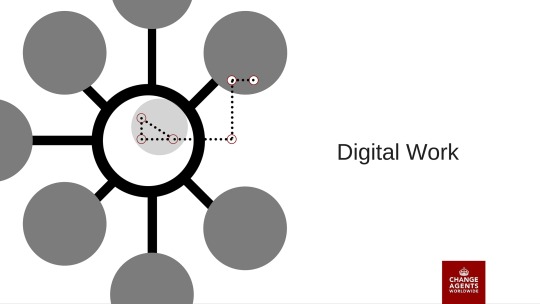
With platforms and networks running through and beyond the organisation, people began to explore the opportunities in new ways of working using digital. The boundaries of organisations no longer constrained the boundaries of work.  Seeking to retain talent, leverage information more effectively and create greater agility, organisations experimented with new digital ways of working and organising work.

This digital transformation has only just begun. There are many more phases ahead. The innovations and experiments of organisations will take us even further into exploring the potential of globally connected digital networks.