You Can’t Predict the Value of Working Out Loud

Working Out Loud is a key practice for learning in networks.  Working Out loud creates value by surfacing opportunities to collaborate and to exchange information around work. Sharing work creates value for both the person sharing their work and others who observe. However, it can be a challenge to convince someone upfront that the value exists.

What is Working Out Loud?

Bryce Willams initially proposed the concept of Working Out Loud as:   

Narrating Your Work + Observable Work

The concept has been developed by a number of others, particularly John Stepper, and there are many related concepts, such as Jane Bozarth’s Show Your Work. With the increased transparency, access and visibility of networks in the digital era, working out loud is a much easier and much more productive practice.  Working out loud enables others to see, understand and contribute to your work.  That delivers benefits for both workers and observers and can play a critical role in shortening the time cycles of feedback, learning and collaboration.

You Can’t Predict the Value of Working Out Loud

Many people are reluctant to share their work for fear of negative feedback or fear of others’ perceptions.  People look to overcome their uncertainty by clarifying the benefits.

However the benefits of working out loud are as unique as the approaches of each individual and the diversity of their networks. Like many forms of social collaboration, there aren’t guaranteed outcomes in terms of benefits and the benefits are tailored to an individual’s situation and needs. Importantly benefits can flow far from the individual who is working out loud.  This latter point is important in corporate context’s where working out loud can play a key role in improving alignment, reducing duplication and facilitating learning on the job.

I have learned to work out loud in a number of ways.  My blog is an ongoing meditation on lessons from my work. I leverage twitter, public and private groups and social streams to share work in progress with others and get feedback. As someone who is relatively new to working out loud I have found that the benefits of working out loud are always a surprise and exceedingly diverse:

  • Making new connections with people doing similar or potentially related work around the world
  • Developing new knowledge using lean start up approaches to the demand and with the input of clients
  • Receiving feedback, ideas and other input into my work from many diverse sources that helps me better understand how it needs to develop and where it will have best impact.
  • Drawing of innovative connections between streams of work that I had not yet seen
  • Feedback from others on their leverage of my work in their own learning and the value that they create.
  • An enhanced understanding of my own strengths and the potential of my networks
  • Business & collaboration opportunities driven from people coming to understand and value my work.

Working Out Loud Requires Experimentation

The form of working out loud will differ for each individual depending on their work, their comfort in sharing, their expertise in social tools and their network. There are few formulas that can be prescribed that are generally applicable.

The best advice for an individual seeking to benefit from working out loud is to experiment with what works for them. A process of adaptation and experimentation will help each individual to develop a set of practices which enables them to be most productive.

If you are looking for a place to start, start by trying to form a new habit and adapt your practice to what suits you and delivers you & your network the best benefits. Consider forming a working out loud circle to help accelerate & share your learning with others. Look out for the next International Working Out Loud Week, a great opportunity to develop your practice of working out loud in the company of a network of global peers.

What I learned from Global Day 1 of #wolweek

image

Lessons are already coming in from International Working Out Loud Week (#wolweek) even though it has only just begun.

While it is the end of Tuesday in Australia, Monday was a holiday and most of the world is only now starting day 2 of #wolweek. Here’s what I have experienced so far:

  • Just do it: #wolweek began as a conversation with Jonathan Anthony and Austen Hunter. Somewhere along the way the idea of a week working out loud had a date assigned and became International Working Out Loud Week. The idea clearly resonates with over 200 tweets alone on day 1. If your idea is good enough put it to test in the market without further ado. We could have spent a year planning the event and got less traction.

//platform.twitter.com/widgets.js

  • Sharing magnifies: The conversation that started #wolweek was public. We discussed our plans everywhere we could. Ideas and encouragement helped us continue. People jumped in to push the momentum up on this because they believed a week celebrating working out loud was worthwhile. As there is no organisation behind International Working Out Loud week and there has yet to be a meeting, enthusiasm and participation driven by sharing sustains the activity.
  • Networks explode: I wondered if #wolweek would be a phenomenon of a few chatty people at first. However when we saw major influencers (Thanks Helen Bevan, Gloria Lombardi, Helen Blunden, Rachel Miller, Jane Hart, Miguel Zlot and many more) and brands with big reach ( Thanks Change Agents Worldwide, NHS, Yammer and more) join the conversation it was clear that the sharing of #wolweek would be magnified by networks. Networks explode the potential of sharing. As Jonathan Anthony likes to say, we discovered the BOOM! moment.
  • You are the person: Bryce Williams first described working out loud. There are many other advocates who are probably better placed have spent more time promoting working out loud than the instigators of #wolweek (for example John Stepper, Jane Bozarth, Harold Jarche, Luis Suarez, Austin Kleon, etc to name only a few). If we had worried about support, their engagement or permissions, it would not have happened. Many of the above have jumped in enthusiastically as supporters of #wolweek.  

//platform.twitter.com/widgets.js

  • Change takes time: I have learned to enjoy the fruits of working out loud in networks, but I have always biased this working out loud to networks that have a common purpose and people I know even, if it may be part of  much larger community. It is still uncomfortable for me to use twitter or another totally public forum for this sharing. #wolweek has already shown me the benefits of being a little more open and a little less final in my sharing in this public forum. I can start to see what Luis Suarez and others have gained from moving beyond email into open conversations.
  • Less noise:  I expected to see a lot of noise (apologies if I am inflicting some, but then adjust your filters). I have been searching for posts with the tags #wol, #wolweek and #wolyo. I expected to find at least some noise. Perhaps it is my purpose in learning about #wolweek, but I have found almost all the posts fascinating, a great insight into other’s work. I am not alone.

//platform.twitter.com/widgets.js

Four more days to go globally.  Let’s see what magic all this sharing can bring.

International Working Out Loud Week 9-15 June

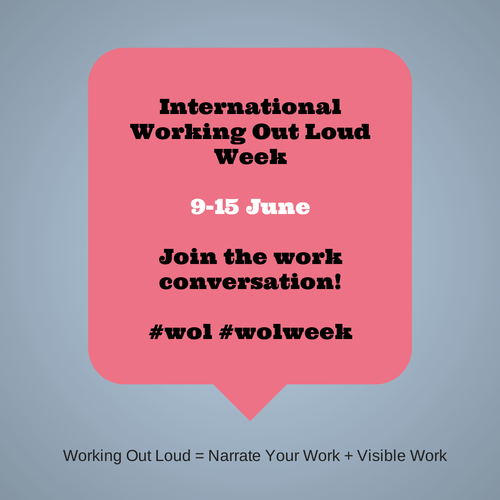
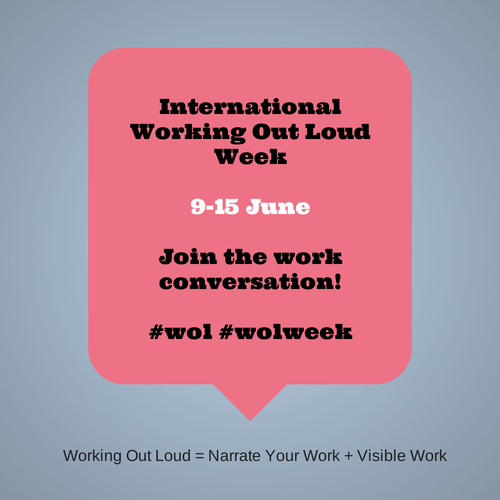
International Working Out Loud week begins Monday 9 June.  The week is an effort to build awareness of the power of working out loud through asking people to participate in a week’s practice of working out loud.

Join a growing community of practitioners working out loud to create better ways of working and build community in their work.

Here’s what you need to know:

  • What it means to Work out loud: The 5 elements by John Stepper
  • How do I get involved: Start sharing your work in what ever means seems appropriate to you. It doesn’t have to be social. It just needs to be public. Make sure you tag your sharing with #wolweek so that others can follow along the broader conversation.

If you need a procedure

1) do something
2) write what you did on an unfeasibly large post-it note
3) attach to your office wall
4) take a photo of it
5) tweet it with the hashtags #wolyo #wolweek

  • Encourage others to Work Out Loud too Working out loud works for everyone.

Thanks to Austen Hunter and Jonathan Anthony for leading the way on the creation of International Working Out Loud Week

The Last Thing We Need is an Enterprise Social Network

Dear CEO

Re: The Last Thing We Need is an Enterprise Social Network

The purpose of this email is to explain why the last thing we need is an enterprise social network.

This email is in response to the conversation about enterprise social networking in the executive leadership meeting yesterday. We thought it best to summarise the position of the leadership team, because yesterday’s conversation got derailed by anecdotes about social media, technology terminology, fear of change and discussion of abstractions like collaboration, future of work and new organisational structures. Before you left the meeting, you remarked “Based on this discussion, I think an enterprise social network is the last thing we need”. We agree.

We don’t want faddish technology. We need execution of strategy.

As CEO, you’ve been rightly suspicious of all this discussion of social inside the organisation. It is bad enough that your teenage children never look up from using social media on their phones. Whatever that involves, it can’t be needed activity in our organisation. We are a place of work.

What made this country great was well-run organisations, hard work and increasing effectiveness in creating value for customers. That takes focused strategy, disciplined execution and a willingness to do the hard yards. Great organisations aren’t built by chasing technology whims. They come from executing strategy to create better value. When we need to create better execution on strategy, the latest fashionable technology is the last thing you need.

We need better strategic value creation

Times are tough. Industry is more competitive than ever and change keeps increasing. We know customer and shareholder value needs to go up and costs need to come down. We have a strategy that is about meeting these new customer & stakeholder expectations, improving the organisational efficiency and delivering the returns that shareholders demand. We all wonder from time to time whether everyone in the organisation gets the imperative of the new strategy and whether they are all working hard enough to find new ways to create value. We know that we perform better when we have better conversations to make sure that our employees are aligned to the strategy. What we don’t need are distractions when there’s doubt that people even understand the strategy.

When we need strategically aligned value creation, the last thing you need is an enterprise social network.

We need new more effective ways of working

To fulfil the strategy of the organisation, we know as a management team that we will have to start to work in new more effective ways. There has been too much wasteful duplication of work in the organisation. Too many of our processes & policies don’t line up across the silos, aren’t agile enough for the environment and don’t meet customer needs. Both our customers and our employees complain about how badly we do this. We need to start working in new and different ways to identify, solve and improve this on a continuing basis. We have to focus everyone on find and using better work approaches that help us to fulfil the strategy.

When we need working in new and more effective ways, the last thing we need is an enterprise social network.

We need to change management and leadership in every role

Working in more effective ways will likely require us to change the way management works. We are going to need to push decisions down to people closer to the customer and give our people the ability to fix problems. We will need our managers to move from command and control to a coaching and enabling role. We need to ensure that all our people are realising their potential and able to work to create new sources of value. Of course in this new role, middle management will need to be trimmed and the new flatter organisation will need to change more often as we respond to further changes driven by our customers. Employees will need to step up into a leadership role in these changes and with customers, the community and the organisation.

When we need to change the culture of management and asking every employee to play a bigger role in leadership, the last thing we need is an enterprise social network.

We need different conversations

Changing the culture of management is going to demand very different conversations in our organisation. We are going to have to find ways to make sure that conversations are efficient and effective. We need to leverage the contributions of more people from across the organisation. We won’t be able to rely on long meetings, workshops, speeches, video and emails. Did you see the budgets for communications, off sites & roadshows in the forecast for next year? We have to do something different. We will need to involve our people more in making decisions. If that’s going to happen our people will need to be better informed and better able to channel their contributions. Our people will need ways to inform themselves, learn by pulling what they need, share ideas of how to work better and collaborate to solve work problems. We are going to need to encourage our people to join conversations that use their capabilities to innovate, to create value for customers and create new forms of working.

When you need to change the conversations, collaboration and culture of an organisation, the last thing you need is an enterprise social network.

We need more from our people

We wrapped up the last executive leadership meeting reflecting on how big these demands will be on our people. We will be asking for a lot of change in them, their work and the way the organisation exists around them. We will be asking our people to play an increasing role in the success of the organisation. We will want them to lead new conversations to create the future for this organisation. We need our people to be more engaged because we will need much more from our people.

Conclusion: What we need

After you left the executive leadership meeting to catch up with the board, we realised that we are clear what we need as an organisation:

  1. we need to succeed by fulfilling our strategy to create greater value in a rapidly changing market; and to do that
  2. we need to be able to work in new & better ways that create a more effective, agile and responsive organisation; and to do that
  3. we need a new culture in management and more leadership from our people; and to do that
  4. we need new conversations that enable our people to discuss and act on creating better strategic value; and to do that 
  5. we need more engagement and a better ability to leverage the potential of our people to contribute to and lead this change; and to do that
  6. we need an enterprise social network to support the first 5 steps.

If you are surprised by point 6, think back through the needs again. After all you were the first to say that an enterprise social network is the last thing we need. We don’t want an enterprise social network because it is new technology or because it is good for some abstract goal. We need one to help our people to execute on the changes necessary to achieve the goals of our strategy. Enterprise technology only makes sense when it enables us to work in new ways that deliver strategic value. As your management team we can see that the value creation opportunity is compelling. We couldn’t see it when you made your remark, but we have come around to your perspective.

The paperwork required by our old process is already on your desk, but a number of our people have started experimenting with solutions to see what value we can create. (Interestingly, their first suggestion is a better procurement process.) When you get back from the board, your assistant will show you how to log-in and join us discussing how we implement in the new enterprise social network.

Thanks for challenging us to come up with a better way of working.

Please think of the environment and don’t print this email. We’d encourage you to discuss it on our new enterprise social network instead.

If this post sounds familiar or if you would like to create greater value in your enterprise social network or discuss how the Value Maturity Model applies to assist your organisation to create strategic value through enterprise social networking and collaboration, please get in contact. I am available through @simongterry or Linkedin or www.simonterry.com
You Can’t Take Your Cat to the Park! So #WOL

Working out loud is a way to share work that might otherwise be missed By sharing this work you create new valuable interactions around that work.

You Can’t Take Your Cat to the Park

The internet loves cats. We share more photos of cats than dogs and even selfies. There have been attempts to explain cat photos as an projection of internet neuroses, for their cuteness, their lack of cuteness, or simply unexplainable.

Rick Wingfield has an elegant hypothesis based in human behaviour for why cats might feature so prominently in internet sharing. Dog owners get to take their pet on walks to the park. They get to interact and receive praise for their dog in a social context.

You can’t take a cat to the park.  If you want interaction around your ownership of a cat, you have to share a photo or video. Other cat owners have the same need for interaction around their cats. Could this be the basis for our cat sharing passion? The hypothesis demands research but it also highlights a common challenge at work that is solved by working out loud.

Most of Your Work Isn’t Known to Others.

Working is more like owning a cat than owning a dog (& just as frustrating at times). Just as you can’t take a cat to the park, much of the work that you do is not known to those around you. This is a major cause of frustration in the performance management process and a cause of loss of employee engagement.

Other people may see some outputs and the few achievements that are celebrated by others. However, the majority of the work and the challenges each of us face are achieved quietly without fanfare or recognition. Like cat owners, the joy & frustrations of this work are a private experience.

Many people want more help, recognition and interaction around the work that they do. We crave the ability to connect with and learn from others doing similar work and facing similar challenges. However, most of the time there is no way for others to see the work that we do.  That work never leaves the small circles in which we operate and the closed systems like emails and hard drives in which we share it.

Working Out Loud = Cat Pictures

Adopting working out loud as a practice enables others to engage us about our work.  

Working out loud facilitates others to guide, help, praise, reuse and share our work. Working out loud also fosters a sense of community around work that encourages better value creation, better alignment and the development of communities of practice.

Don’t forget the sharing of your work can create value for others far from your work place.  Enabling others to reuse, learn from or improve on your experience is an incredibly powerful outcome of the sharing from working out loud.  What seemed to you a small piece of work can create value widely. You may even discover your work is more valuable than you or your boss ever realised. As John Stepper has pointed out, working out loud can add a new dimension to your next performance conversation.

You can’t take a cat for a walk. However, you can share your daily work and start new sharing & interaction around that work. You will be surprised by the rewards.

Working Out Loud Creates Value

image

Working Out Loud is one of the most crucial practices for value creation in an enterprise social network. For many, it is also the least comfortable. We need to work at this new practice to deliver value.

Working out loud is the core new practice as sharing grows in an enterprise social network. When the conversation moves from sharing personal information to sharing work, value for the individual and organisation rises dramatically. That sharing is critical to the maturity of value creation in an enterprise social network. Without sharing of work, you hold back the benefits from other forms of work collaboration.

Working out loud creates great value in a network because:

  • working out loud gives a work purpose to the connection that has been formed in the network
  • working out loud invites community to form around people and their work enabling others to help, share knowledge and make work easier.
  • working out loud is not natural to many in the traditional workplace, but when people overcome hesitation and practice it they start to see the benefits of new forms of collaboration, that it makes work much easier & the culture much richer – a core driver of personal adoption
  • working out loud is the transition point to much wider collaboration across the organisation and particularly collaborative sharing and problem solving – work that is open is work that can be made better 
  • working out loud exposes the work which allows for better strategic alignment, reduced duplication and importantly recognition of the great work underway.
  • working out loud enables role modelling of transparency, vulnerability, learning, agility and experimentation.
  • working out loud by leaders can change the leadership dynamic from one based in control and expertise to one that leverages networks and collaboration.

Some great resources are available to help you with working out loud:

If you would like to create greater value in your enterprise social network or discuss how the Value Maturity Model applies to assist your organisation to create strategic value, please get in contact. I am available through @simongterry or Linkedin or www.simonterry.com
Working Out Loud is the Lean Start-up of Knowledge

image

Working out loud enables early validation and engagement of others in ideas. By putting ideas to the test early when formed only to a minimum viable level wasted effort is avoided and the ideas move to fruition quicker. In this way working out loud reflects the value creation approaches of lean start-up.

Working out loud on Minimum Viable Ideas

One of the exercises in Harold Jarche’s PKM in 40 days program is around Narration of your work. I am a huge fan of working out loud and initially I wasn’t sure that I had much to learn. However, I took a risk and learned something new.

My experiment was to apply some lean start-up thinking to a concept that I am developing and put it out in a minimum viable form and seek feedback on how to develop that idea further in a relevant community. In this case, the idea was represented in minimum viable form as a single diagram and a story of where I was headed. Minimum viability in this case is just enough information to convey the information and test the key hypotheses that I wished to explore. 

We are used to fully thinking things through before sharing them. I am especially cautious around this. We are told that sharing something incomplete might be dangerous as people might form an incorrect impression or might copy the idea. I’d hate to miss an opportunity around something that seems important to my work. We are not use to putting minimum viable ideas forward for debate. 

However, perfecting ideas beyond that point in the quiet of our own workplace often means that when they are delivered they fall flat, miss the mark or need further work. How often have you worked long and hard on an idea that you believe in to have the “is that all?” response? I know it too well.

Working out loud brings Validation

My experience of narration was really powerful validation.  The diagram has drawn a great deal of support and feedback.  People have encouraged me to flesh out the tools behind the work.  They have suggested next steps, connections and applications that I can leverage further.  I have even had volunteers offer to work with me and someone offering to coach me in the lean start-up of this concept.

Working out loud clarifies Hypotheses

The other aspect of this experience was that working out loud enabled me to better understand the hypotheses that were a part of the work that I was doing. Had I gone on alone, I would have just buried these assumptions in the work.

Framing up my engagement of others as a test of the ideas pushed me to understand what were the key hypotheses that I needed others to confirm. Testing the assumptions reduces the risk of investing more time in the idea.

Working out loud reinforces Learning (Permanently Beta)

Because I and others know the idea is in development, improvement is part and parcel of sharing the work out loud. I don’t feel obliged to defend the work as I have less invested. I can be more dispassionate about the feedback of others as to how to improve the work. I learn more faster.

Work out loud to create value

Working out Loud with a Lean Start-up mindset can deliver powerful value in the creation and sharing of knowledge. As knowledge work becomes more important in the future of work, we need to be more effective and faster in our creation and sharing of knowledge. Practices like working out loud will drive real value the productivity, effectiveness and engagement of knowledge workers.

What are you working to achieve?

‘What are you working to achieve?’

Working out loud is not a common enough experience yet.  Many people are still reticent to share their goals, their challenges and their work.  

That makes a question about what people are working to achieve a very powerful one, because it:

  • helps people clarify their purpose and goals
  • separates wishes from tangible action
  • moves beyond appearances, titles and surface issues to form the basis for a deeper context, connection and conversation
  • enables you to identify how you or others can contribute to help

I ask this kind of question a lot.  I find it is incredibly valuable for simply building rapport.  You have a lot more to discuss when you know where someone is devoting their efforts.  

However, it also enables further action to help.  Just this morning I asked the question of somebody that I did not know well.  Turns out I have networks that will assist them to achieve their goals more quickly. That makes the question a powerful engine of collaboration. You can’t help if you don’t know.

If others are not sharing their work, ask them what it is that they are working to achieve.

We need shared context

If you are struggling to get your message across it might not be the message, it might be the context.

You are an expert.  You might be an universally recognised expert, have some special qualifications or you just might be the person who best understands your job, your customers or a problem.  That better understanding of some context, however narrow, makes you an expert.

Any form of work or collaboration will require you to use your expertise. That expertise can also be a barrier to communication and collaboration.  Your challenge is that others don’t share your unique context.  

Unless you share a context, others won’t be able to understand what you are doing or what you want to share.  If we don’t share enough context, we can’t see things, trust or understand what experts tell us.

Here’s a simple example.  Start working with a new group of people and you will find people are speaking incomprehensible new acronyms or using buzz phrases you don’t know. The group knows their history and you don’t. That group has a context and you are not part of it. Until you learn enough of their context and share enough of your own, you won’t be able to follow conversations or contribute.  The friction and surprises will undermine your confidence and potentially your trust in the group.

So how do you make sure others share your context & your expertise?

  • Work aloud: Sharing what you are seeing and doing with your connections enables them to pick up your context.  You don’t need to push it on them, but they can pull what you share when needed
  • Ask questions: The questions that you ask will be some new ones and obvious ones.  The fact that you are asking will enable you to explain a little of your context in response.
  • Be curious and generous: There is no right or wrong context.  Explore the context others have. Ask them to tell your their stories and share your own in reply.  Learn more in the process about what you may not have seen and also how your expertise can help others