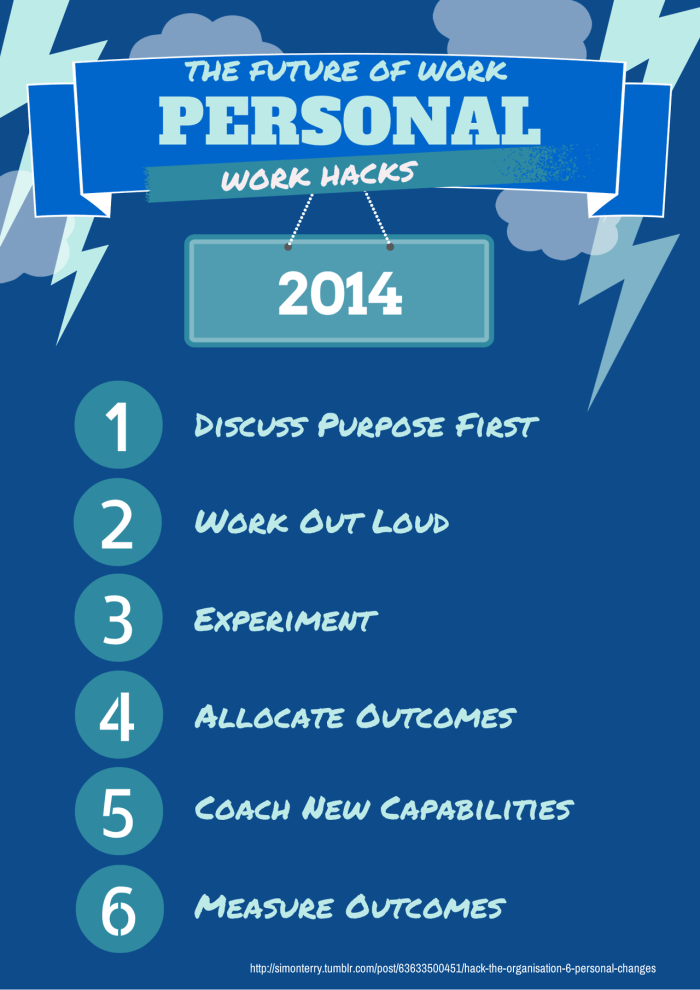
Poster: The Purpose is in the Work
Innovation, Collaboration, Learning & Leadership
Poster: The Purpose is in the Work
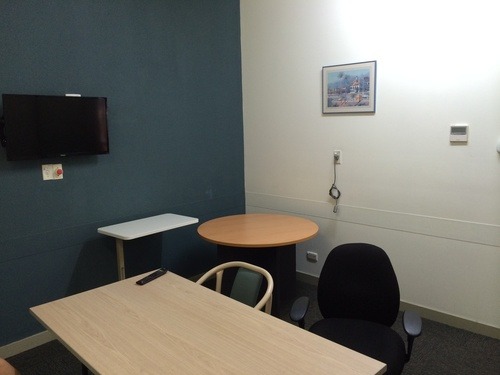
Photo: The hospital experience – empty of design but full of mismatched furniture.
Recently I visited a hospital accompanying someone through registration for a day procedure. The striking thing about this healthcare experience was that it was engineered for the hospital to achieve outcomes but had a complete absence of any design in the patient experience.
Everyone of the staff were concerned and caring. Yet the healthcare experience felt confusing, difficult, alien and uncomfortable. Everything you encounter is engineered for the hospital’s view of that step in the process. The patient experience in each step or across all the steps was not as well considered.
How the Patient Experience can Improve
Here are some examples:
I have been involved in lots of work improving customer experiences. This experience is typical when services have been fractured into individual steps. The model people have is Adam Smith’s pin factory with a focus purely on specialising and optimising productivity in each discrete step for organisational outcomes. However modern factories are no longer run on this basis. Competitive pressures have meant factories constantly improve, removing waste with focus on coordination of the whole production system, continuous improvement and lean manufacturing.
A poor patient experience not only creates unnecessary issues for a patient, it is wasteful & counterproductive for the organisation and demoralising for all the people involved. Patients want the experience to be quick and effective so give them information and a role in the process. Better patient experiences will reduce the cost and improve the quality of care and the environment for everyone.
Making the Patient Experience Better
The steps for change are simple:
In the future of work, we are going to talk a lot about trust.
We will need to consider trust deeply because it is a critical underpinning to success in our new ways of working. We need to recognise the trust that we choose to grant is a design choice. We are likely to need a new precision in our understanding of trust.
Most of all we need to ensure that the distrust that pervades our hierarchies is not a barrier to building new trust in networks.
Our hierarchical organisations often hide an assumption of deep distrust. Organisational structure, role design, silos assume people must be separated to generate clear performance measures. Performance management and reward schemes assumes people will not perform without extrinsic motivations. Management, monitoring and compliance are often set to treat 100% of employees poorly against a tiny risk of failure. People are assumed incompetent unless proven otherwise. If your processes allow no variations, discretion or exception handling, then there is likely little trust in your organisation. If messages are consistently spun and the real news is on the grapevine, not the intranet, then there is no trust in communication.
Trust will emerge in effective networks. However, trust is reciprocal. If your hierarchy is telling people that they can’t be trusted, then it is getting in the way of the emergence of trust in the networks in and around the organisation.
Remember how you treat your people plays a large part in how they will treat each other and their networks, including your customers and communities.
Don’t expect your people to give and build trust over your distrust in them.
In the future of work, we are going to talk a lot about trust.
We will need to consider trust deeply because it is a critical underpinning to success in our new ways of working. We need to recognise the trust that we choose to grant is a design choice. We are likely to need a new precision in our understanding of trust.
Most of all we need to ensure that the distrust that pervades our hierarchies is not a barrier to building new trust in networks.
Our hierarchical organisations often hide an assumption of deep distrust. Organisational structure, role design, silos assume people must be separated to generate clear performance measures. Performance management and reward schemes assumes people will not perform without extrinsic motivations. Management, monitoring and compliance are often set to treat 100% of employees poorly against a tiny risk of failure. People are assumed incompetent unless proven otherwise. If your processes allow no variations, discretion or exception handling, then there is likely little trust in your organisation. If messages are consistently spun and the real news is on the grapevine, not the intranet, then there is no trust in communication.
Trust will emerge in effective networks. However, trust is reciprocal. If your hierarchy is telling people that they can’t be trusted, then it is getting in the way of the emergence of trust in the networks in and around the organisation.
Remember how you treat your people plays a large part in how they will treat each other and their networks, including your customers and communities.
Don’t expect your people to give and build trust over your distrust in them.

Page 1 of The Responsible Company by Yvon Choinard and Vincent Stanley.
Happy New Year: Now Let’s Do Better
The responsibility of a business to stakeholders, like its customers, people and communities, and to broader society is not managed in a department or a report. Responsible business is not the work of others. It is not a glossy wash you put over the top of the way you work to make things look better for stakeholders.
Responsibility
The key word is responsibility. Responsibility begins and ends with how you make decisions in your work. That responsibility applies to everyone. Responsibility is not a good intention, a wise donation or a clever offset. Responsibility means owning the need for better decisions and actions that maximise the value that you create and minimise the waste.
If you are not taking into account the wider implications for society and sustainability of your decisions and actions, then you can do better. You can make sure your decisions and actions add more shared value tomorrow than they did today. The decisions will be different for every organisation, but they will make both the business and the society better. That is good business.
Social Responsibility is Here
You will not escape responsibility. Our social world is making business more networked and more social. With that networking comes a great increase in transparency and accountability to your stakeholders. Every day businesses are being questioned on unthinking actions and decisions. If you are not stepping up to better manage your responsibilities, expect someone to be helping you to change. You do not need to become an ideologue or to become a not-for-profit, you just need to believe in people and want to improve. By looking at a broader frame, you can make smarter business decisions that create shared value in society.
Do Better
Do Better. Start with one step. It is that simple. Find ways to make decisions with better impacts and less waste. Enable your people to help you in this journey of continuous improvement.
Start making yourself aware of the options to do better. Read the Patagonia story and other resources on shared value. Measure the impacts that matter to you and your people. Ask your people to contribute on what matters to them and how you can do better. Make small improvements every day.
Your business will reward you for the new attention. Do something to get yourself started on the path to better business.
Jobs for money.
Work for achievement.
Roles for influence.
Projects for passions.
Creativity for well being.
Community for connection.
Life for fulfilment.
A company that is a role model for valuing culture tries a new way of work with 1500 employees.

These days everybody wants a spot at the top of the hierarchy. In the vain hope that sitting around the big table will fix the issues of our large organisations we are seeing a parade of CXO roles debated.
Life began simply with a Chief Executive Officer and maybe a Chief Finance Officer. Then we started to gather Chief Operating Officers, Chief Technology Officers or Chief Information Officers. The next wave brought us Chief Strategy Officers, Chief Privacy Officers, Chief Product Officers and Chief Marketing Officers. Next came the campaign for Chief Customer Officers and Chief Innovation Officers. I saw recently suggestions that organisations needs a Chief Design Officer, Chief Digital Officer and a Chief Data Officer. Chief Culture Officers, Chief Environmental Officers, Chief Ethics Officers and Chief Community Officers cannot be too far away.
Say chief that many times and it starts to be clear that we think there is magic in a big boss.
Too Many Chiefs. Not Enough Network.
Organisations are systems of lots of people. Great performance on customer, digital, data or in any other arena is rarely the result of one heroic individual at the top of a specialist hierarchy. Great performance comes when elements across the system collaborate to deliver better outcomes. Finance, technology, operations, product and many more teams all support the delivery of consistently great customer experiences. The challenges of collaboration in execution happens a long way away from the CEO’s leadership team.
Adding chiefs around the main table can be an effective symbolic move in a system. A CXO can elevate the importance of a domain that lacks profile. However it is rarely more than the first symbol. The real change must happen out at the edges of the silos and the edges of the system where the organisation’s networks engage with its environment. Without the support of their peers and a broader network, a new CXO is unlikely to change much away from the CEO’s table.
Great CXOs are masters of collaboration, uniting people from across the system, especially middle and frontline managers in change. They are Change Agents on an enterprise wide scale. The hierarchy is not the source of their power and the success of their agenda. Success flows from their networks and their influence as agents of change.
Don’t Hail the Chief.
Maybe it is time to move beyond titles and heroes to fix collaboration.
Any leader can start new forms of collaboration in their organisation and have a positive influence on performance the system, whether at the CEOs table or not. The higher up the hierarchy the more tools, networks and influence you have when you begin. Good CXOs and great collaborative middle managers focus on coordinating the crossover points in silos. Don’t wait for a Chief to be appointed. Make yourself a leader in your domain, network and the silo boundaries near you. Find something to change for the better and engage others to change it today.
The organisation will thank you for your initiative.