Cold Hard Clarity and the Passion to Act

Business culture can be quite reductionist, favouring simple stereotypes. Anything that removes complexity and makes the modern large organisation easier to manage is embraced.

Stereotyping people is a common way to simplify the organisation for managers. For example we often see the use of a simple pair of stereotypes to influence debate around any issue. Someone in an effort to win an argument will type the participants in any debate into two camps:

  1. Managers: The sharp, rational, level-headed, pragmatic, outcome-focused, action-oriented realists
  2. Daydreamers: The fluffy, optimistic, utopian, enthusiastic, do-gooding, people-focused, passionate daydreamers

There is little surprise that in most businesses team 1 is the ‘right team’. These are the people who are trusted to ‘get the job done’ and ‘speak good sense’. These people have the interests of the corporation at heart and are management material. Labelling your opponent as part of team 2 can usually get you a long way towards winning any argument.

If you are an organisation change agent, you are going to find yourself lumped into team 2 often. To expand their influence in organisation, change agents need to learn to unpick these stereotypes. 

These stereotypes play on the fact that many people believe that the passion and optimism of those advocating change are inconsistent with being disciplined and realistic. This does not have to be the case:

  • Realism is now: Seeing things as they are is a challenge for today. Many organisations full of managers who fit the criteria in team 1 struggle to do this. Sometimes the sources of information, stakeholders and impacts considered are too narrow. Often they are beholden to management ideologies that distort perceptions. Risk aversion and other forms of conservatism may force them to resist or ignore the signals of required change. All managers, change agent or not, should aim to have a cold hard grip on the widest possible set of present facts. 
  • Optimism is tomorrow: Optimism is not inconsistent with realism because it does not describe today. Optimism is a hope for a better future. We can’t be realistic about the future, only optimistic or pessimistic. All managers should embrace hope because it is the only way to validate their potential to be the actor that brings about improvement. If you don’t have hope for your own influence, why are you there?
  • Passion is the vehicle for action: Passion is what drives action. Passion is what builds trust and wins support of others. Passion should be the impetus for action and sustain it through all the challenges of making change happen. When balanced with realism, passion is an enormous force for connection and change. 

Let’s help those seeking to bring about change to shift the debate from one between the fluffy no-hopers and the model managers. All parties in the debate needs to be realistic, optimistic and passionate. Only then will it be a fairer fight between the forces of change and the forces of conservatism.

The best change agents convince others because they demonstrate cold hard clarity as to the challenges and issues of today. They make change happen because of their passion and optimism for the future and because of their willingness to act. They do so because making change happen realises their potential and is the impact that they choose to have on the world

Tell me why that is not what every great manager does.

Change Agents Worldwide E-Book Released

The Change Agents Worldwide e-book: Changing the World of Work One Human at a Time is now available. Get yours now:

CAWW e-Book

The book is a series of essays that answer the question “what step should organisations take to make the most of the future of work?” The answers reflect the diverse and insightful perspectives of the members of Change Agents Worldwide on leveraging social collaboration, networks and trust.

My essay in the book is entitled “Do You Trust the Talented People You Went to Great Care to Hire?”

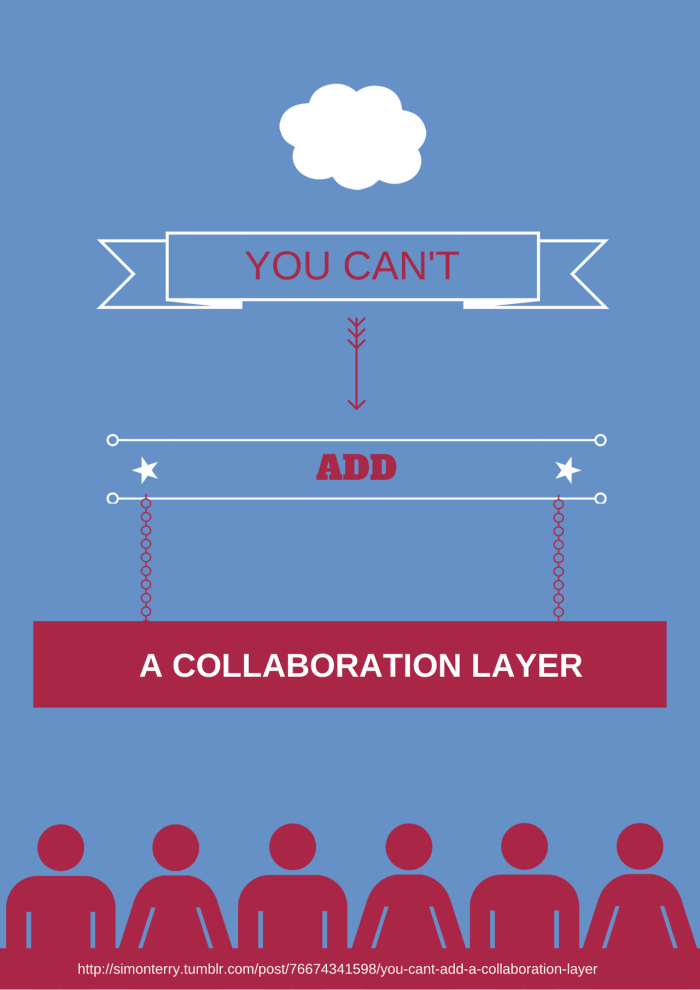
You Can’t Add a Collaboration Layer

Collaboration is human-to-human interaction. We are rich, creative and diverse, given the chance. You can’t add a collaboration layer to your existing processes.

Collaboration is not something that helps with the work. Collaboration is not something you integrate into your existing systems. Collaboration requires a fundamental rethink of the way work gets done. Collaboration is not a layer because it changes the whole system. Great collaboration goes the whole way through.

The phrase ‘collaboration layer’ is common. The idea of a collaboration layer most likely has its origins in information technology architecture. Collaboration systems are often represented as a different layer of the system stack, similarly to the user interface. As a result vendors and others talking to an IT audience will often promote the need to add a collaboration layer to existing processes. After all adding a collaboration layer sounds relatively painless – all the benefits of collaboration without the change.

As the application of the phrase shifts from systems architecture to the business conversation on how work gets done, something gets lots in translation. Success in the application of social collaboration systems does not come from integrating one more piece of technology into the stack. Collaboration is not an integration challenge. Collaboration is not about machine-to-machine or even machine-to-human interaction. Collaboration is human-to-human.

Collaboration can’t just be layered in on top of everything else. Collaboration requires a rethink of the entire process to foster the best of human interactions. Networks are required for collaboration. However, great communication requires more than a network. Great collaboration requires a community. The highest value collaboration goes beyond a community and builds a change movement.

To bring community to life you need to do more than add a layer of machine-to-human and human-to-human communication over the top of your Taylorist processes. The goal of social collaboration is not to make dumb workers better informed. The goal is to leverage their collective knowledge, intelligence and creativity. Allowing workers to share purpose, connect and create new and better ways of working together comes from giving them the opportunity to connect deeply and to rethink the processes and entire systems that they use to do their work. The best innovations in social collaboration are when entire traditional processes disappear because a newly engaged workforce finds a better way.

People will not stay long in a conversation where machines send them status updates. There is much less value in collaboration, little community and no change if the process is the process and can’t be rethought. This is one of the reasons so many enterprise social networks struggle. Without the prospect of creating a sense of community and the ability to change things, what is the point of participating?

If you want the benefits of rich collaboration, growing community and powerful change driven by your people, then you will need to move beyond a collaboration layer on existing processes. Letting your people use collaboration to change the whole system for the better has to be possible. Collaborative humans will demand it.

Re-Dream Often

Dream big. Conventional business and life advice. Hardly worth sharing. Would anyone listen if you told them to dream small?

But a big dream can become a weight on your progress. It can become stale. Eventually you may look at it and wonder why you every dreamt of it at all.

Redream your amazing future often. The dream is not what matters. What matters is the dreaming. Bring your dream up to date. Make it reflect the now. A continuous process of re-dreaming the dream will make it more relevant and more vibrant. It will make it more powerful. The re-dream will help you find new ways to action and new ways to bring it to lfe.

Day-dreaming is a great process to refresh and update dreams. Day-dreaming is when you get to change a dream as it is visualised.

If you are collaborating with others it is even more important to re-dream the dream. People change, circumstances change and people change again. Nobody likes delivering someone else’s dream. Dreams are not inherited or imposed. The process of re-dreaming that future together enables everyone to own the dream and stay engaged.

Dream big. Sure.

Re-dream often.

Leaders don’t know

Every leader faces a challenge. People expect them to know the answer.

Knowing as a leadership challenge

Every day in each leadership interaction whether with one person or thousands of people the same moment occurs. People look at their leader and hope that the leader has the answer. The question is irrelevant. The leader is expected to supply the answer. The leader is expected to make things easier by taking the problem away. In this moment, a leader’s authority is tied to their capability to perform as an answer delivery machine.

Leadership doesn’t work that way. Often supplying any answer is exactly the wrong response. Supplying an answer can disengage, foster work avoidance or leave the leader holding all responsibility going forward. It can be a lonely and challenging place to be trapped in a question against the weight of expectation of the team. 

The pressure to supply the answer and be a source of all expertise is a common factor in the imposter syndrome many leaders experience. Not knowing enough to answer all the questions makes people doubt their capabilities. The feeling that they are an imposter is more than a thing. Imposter syndrome is almost an epidemic.

Why leaders don’t know

If you don’t feel some doubt at leading in a time of great change and complexity then you are extraordinarily talented and well informed. Just take care that you are not one of the leaders who are either delusional or pathological There are some reasons why knowing is a challenge: 

  • Leaders shouldn’t know – role: A leader’s role is not to be an answer person. Their role is to create conversations that engage, deepening understanding, set context and shape direction. Leaders need to hold others in tension so that they do the work necessary to move towards answers.  If you are providing answers all you can expect is compliance or at best agreement. You won’t get engagement or creativity.
  • Leaders can’t know – context: No matter how well they measure their business, no matter how deep their expertise, a leader can’t have all the context required to make a good decision. They should be focused on other things most of the time. They will have a different context to the person on the spot with a problem.
  • Leaders shouldn’t know – waste: Every time you stop to ask a leader everything comes to a halt. The process of asking takes time. That time could be better spent solving and building the team’s capability in the process. Even if the leader does know the answer, that time and the process required to extract information is a waste.  You can’t create agility with a bottleneck of a leader.
  • Leaders can’t know – uncertainty: Often the answer is not clear and will only be revealed in action. Requiring a leader to declare a certain position or outcome in this case is pointless and only serves to undermine the leader.
  • Leaders shouldn’t know – capability: Giving answers rarely teaches people how to find their own. Leaders need to build their people’s capability to answer, learn & lead themselves

Knowledge is a flow

Leaders don’t need to know a particular stock of knowledge. Leaders need to know how to help others to share and develop knowledge as an ongoing flow. Then leaders need to help people translate knowledge to action.

  • Teams know some: In a majority of cases when asking a leader what to do, the person asking has a well-formed view of what to do. They have the context. They understand the challenge well. With a sense of authority, they would have acted by now. If the team doesn’t know the answer itself, they likely know where to start.
  • Stakeholders know more: Leaders who help their teams engage externally with the system & stakeholders around the business, enrich the team’s understanding of what to do next.  What a team is missing, the system around will be able to add. In the conflict between the answer of the team and the broader stakeholders is exactly where the problem and the insight lies.
  • Knowledge is evolving: Knowledge needs to be constantly tested and updated in action. Leaders can make sure that teams understand to track and learn from the experiments that they make applying knowledge. The lessons from those experiments move everyone’s insight forward. 

Next time people expect you as a leader to supply all the answers, lead them & their stakeholders to engagement with better questions instead.

What’s your experiment?

Yesterday a conversation about experimentation, inspired by the Responsive Organisation, prompted this reflection:

To grow in life and work we experiment

We like the comfort of plans, order and progress. We hope that our lives will deliver a straight-line path to our goals. We feel the pressure to be able to lay our actions to others in a plan with a high degree of certainty. This pressure is magnified in a work context where the expectation of  managers is often to demonstrate confidence, certainty and control.

Life is chaotic, uncertain, creative and constantly changing. Just like us.

The only way to manage that volatility is to experiment, to grow and to change a little bit at a time. If we don’t become more responsive, we wither:

  • Some people let the uncertainty overwhelm them. Paralysed by fear they stop and wait for some clarity. Success moves by them.  
  • Some people let the scale of the challenge overwhelm them. They are concerned that they they won’t finish. If you don’t start, you can’t grow the ability to solve for the scale.
  • Some people fear their own goals, worrying that they might be too daunting or not bold enough. Without confidence in a direction to start, they don’t start and miss the chance to shift to better goals as they learn more about the world and themselves.
  • Some people worry about being changed. They experience change is their external environment forces them to change and that’s rarely a path to success.

In every case, the alternative is to do something small one thing at a time, to experiment, to learn and to grow. My experience is that success follows those times that I took a chance.  I grow when I put myself in a place where I have to learn more to get the job done. I may not have known how it would end, often it ended up somewhere new and better, but the lessons of the experience will showed me what I needed to know & do next. You don’t need to be reckless, but take small actions to experiment with the water in the deep end.

It won’t be easy. Success never is. Success is rare and precious. Success is the reward for risk, learning and effort. Success comes when you respond better to the opportunities before you.

Start today

What experiment will you try today that takes you one step closer to your goals?