
What Matters for the CEO

Looking up the hierarchy employees can believe that being CEO must be a game changing experience. However, the reality is that the imagined power comes with its own constraints. Here are a few words for the new CEO (or any new manager) on what matters. This is where the reality and the illusion diverge:

What You Hear Matters More Than What You Know: You have plans and agendas. You know the place & the ropes. You have great skills, knowledge and wisdom. Show it by going and listening to the people who matter most – those doing the work, your customers and your community. Ask their views and change your own. Let what you hear guide what you do.

What You Do Matters More Than What You Say: You are surrounded now by people who want to listen to you. You are supported by teams of professional communicators. You can order an expensive new brand campaign if you want. You have a soapbox but the smartest way to roll is to get down off the soapbox and go to work. Let others work out who you are by what you do.

Your Reputation Matters More Than Your Record: You must have a great record or you wouldn’t have the job. Nobody cares about what you did now. They only care about how you did it. The how determines your reputation internally and externally. Everything you do is added or subtracted from your reputation. Everybody wants to discuss your reputation because they want to predict what you will do next. Your reputation has more influence on what you will get done than you think.

Your Influence Matters More Than Your Power: Congratulations on being top of the hierarchy (excepting of course for your accountability to the board, the chair, shareholders, analysts, community activists, politicians, your family, and anyone who ever had a view about your company, etc). You have the power now, but mostly you can’t use it. You can’t sack everyone. You can’t survive a revolt. You can’t do the work yourself. You can’t answer every question. Accept that with all your power the best way to get anything done is still with influence, the same way you climbed the ladder.

Your Network Matters More Than Your Hierarchy: The hierarchy mutes your influence. A hierarchy is only one part of your network. Some of your direct reports are openly campaigning for your job. You’ve been there and you know they won’t wait long. The further down the hierarchy you go the less your voice is heard and understood. Importantly, you are now the face of the organisation to customers and the community. Looking down the hierarchy won’t help you deal with those critical stakeholders. Start leveraging the networks through and around the organisation. Those networks helped you on the way up and they will help you now. That’s where you should use your influence. The network magnifies your influence. That’s where you do your best work.

Your People Matter More Than Your Process: Nothing in the organisation gets done without people. The best processes, technology and organisations will fall apart without the right people. Start focusing on building their capabilities and changing the processes to adapt where required. Your customers and community will appreciate the immediate increase in your organisation’s responsiveness.

Your Exceptions Matter More Than Your Rules: If everything was predictable, great people wouldn’t be required. Focus on how you identify, manage and adapt for exceptions, anomalies and surprises. Don’t let your team explain them away. Many exceptions hide insights, risks, threats or breakdowns that your current processes can’t handle. Exceptions are where the disruptive innovations lurk and where reputations are won or lost. See exceptions as a chance for you to lead make changes, especially to help your people and your customers.

Your Effectiveness Matters More Than Your Efficiency: Your new staff are going to make your life extremely efficient. They will quickly create a schedule, cut access and manage a protective bubble of carefully selected information. That’s the best way for them to make their life easy and predictable again. However, obstacles are the work, exceptions hide insights and you will need to experiment on your personal effectiveness. Without slack, freedom to connect and thinking time you won’t be able to do this. Incidentally the need to focus on effectiveness of purpose goes for the whole organisation too (see ResponsiveOrg).

Your Purpose Matters More Than Your Pay: You’ve spent a lot of the crazy pay already and here I am saying it doesn’t matter. What matters is the impact you have on the world. The internal motivator called purpose pushed you so hard to get here. You wanted to make a mark, not cash. Delivering on purpose is what makes the role worth doing and will be how your tenure is judged. Years from now you will barely remember the money but you will see the faces of those in the network around the organisations whose lives you changed. Which way do you want to influence their lives? Let’s hope they are smiling later. 

The Job Matters More Than You: Unless you are a founder or a complete failure, the role you play existed before you came along and will exist afterwards. That role means a lot to the hopes and dreams of all the employees, customers and community. Those dreams deserve your respect. The role is not yours. You are no better because you have it. You are just the current steward. Leave it better for the next person and make sure that you have the influence to choose them wisely. That may be the best legacy you can leave.
On Accountability in Networks

Following on from my recent posts on accountability in networks, I was asked recently whether a network could be accountable for an action or an outcome over an individual. This is an important question as we move into new ways of working. Anxiety over changes from the perceived effectiveness of alternatives to hierarchical models of accountability is a major barrier to management adoption. 

Answering a question about accountability usually involves a number of layers because management tends to be vague when it uses the term accountability. The linearity of hierarchy makes accountability an easy concept to use loosely.  Hierarchy often conflates accountability to make decisions, accountability for the outcome and responsibility to do the work

Let’s pull apart each of these meanings of accountability. 

Accountability vs Responsibility

First, we need to separate responsibility to do the work from accountability to deliver an outcome. Of course, you can have single accountability with networked responsibility. We do that every day. Almost every work scenario has one person to hold to account.

However you will need the holder of the accountability to understand the network leadership required to ensure the outcome from the network. This is why CEOs should not fear working like a network. It is how they actually work.  Most CEOs know their orders go through so many layers that influence and authority in the organisational network matters more than the power inherent in their order.

Accountability in a Group

If you wish for network accountability, remember every network has sub-networks that will hold & manage that accountability on behalf of the group and manage the responsibility of other sub-networks to do all or part of the work. An every day example is a board of a volunteer, movement or not for profit organisation. Often the accountability can be diffused in a formal or informal executive committee of managers, the chair and other key influencers.  The responsibilities for work are widely spread in free agent volunteers. This kind of accountability works but requires strong leadership in the group and the wider network.

Remember human networks have lots of accountability mechanisms like gossip, trust, reputation, authority, shunning and ultimately exclusion to manage situations where there may not be a hiearchical power to enforce accountabilities. Many of these techniques work without resort to force even against countervailing power. There’s a good reason volunteer organisations have lots of ructions.

Accountability to Decide

If you focus specifically on accountability as defining who holds the decision making rights, then network accountability needs a decision making system. Humans have lots of network decision making systems from consensus to democracy to more authority based models.

Networks work

Networks are how humans get stuff done. We have solved these issues in our history. Jon Husband’s definition of wirearchy captures this capability of networks neatly:

“a dynamic two-way flow of  power and authority, based on knowledge, trust, credibility and a focus on results, enabled by interconnected people and technology”.

We need to work differently and we need to use different approaches to leadership, trust and authority to make network accountabilities work. That doesn’t make it less effective. Managers just need to learn new skills to leverage the exponential potential of human networks.

Can a large organisation be responsive?

Steve Blank, a lean start-up expert has elegantly described the differences between start-ups and traditional large organisations.  

“the 21st century definition of a startup: A startup is a temporary organization designed to search for a repeatable and scalable business model…
The corollary for a large company is: A company is a permanent organization designed to execute a repeatable and scalable business model.”

These definitions are useful and highly accurate. Most large organisations have chosen to focus on efficiency in execution of a business model as the rationale behind their efforts.

However, it is important to note that a corollary may follow but does not always preclude other logical alternatives. Breaking apart Blank’s structure there are a number of different elements in play:

  • the duration of the organisation: temporary vs permanent
  • the process of the organisation: search vs execution of a repeatable and scalable business model
  • an implicit difference between effectiveness of a search and efficiency of execution

Importantly there are other options that could be chosen for these spots in Blank’s definition:

  • Rather than looking at duration we could look at the ability of the organisation to change – adaptability with a scale from the highly adaptable startup to the fixed processes and systems of efficiency oriented large scale organisations.
  • Rather than focusing on process efficiency we could focus on effectiveness of process at achieving purpose – no scalable business models is permanently enduring; they must be subject to eternal change to be more effective and to better achieve the outcomes for which people came together.

From this we can see that there is at least one more logical model to chose. Let’s define a responsive organisation thus:

“a responsive organisation: is an adaptive organisation designed to search for more effective ways to execute a repeatable and scalable business model.” 

Blank is right that you can’t behave like a start-up if you are trying to be efficient in execution and startups should not be judged by efficiency of execution. However there are more than two models for an organisation to choose. Large organisations can be responsive but they need to choose to adapt and be more effective.

Today it is common for leaders to talk about collaboration as a core strategy, but do little to build the capacity to do it well… Sometimes, what will most limit progress will be the very behaviors that have made organizations effective in the past.

Peter Senge (via scpb)

A Question to ask your CEO:

‘Are your people’s capabilities the most important element to the success of your strategy?’

The question is deliberately closed. There is a yes or no answer. Allow time to think but only one thing can be most important. Don’t accept hedging.

If the Answer is No

Get out now!

That’s a CEO who doesn’t understand that any strategy execution takes real human capability. Process and technology can and will be copied. Without better people and better organisation, any advantage is fleeting.

Even a tech monolith like Google at the heart of Silicon Valley’s tech wizardry gets that people make the difference. Leave before the robots and algorithms get you.

If the Answer is Yes

A capability-led strategy is the best foundation to begin the experimentation that is the future of work. Your organisation is committed to a growth mindset about its people. When the strategic role of people is clear, there is room for the conversations about bettering how they learn, work and organise themselves.

Success comes when an organisation recognises that only through helping its people grow faster can it outperform. There is no strategy in your organisation that isn’t implemented through the capability of your people. Adopt a growth mindset. Be compassionate. Lead and realise the potential of people.

After all, people are the only part of your strategy that can surprise on the upside.

Create a Reputation Economy

image

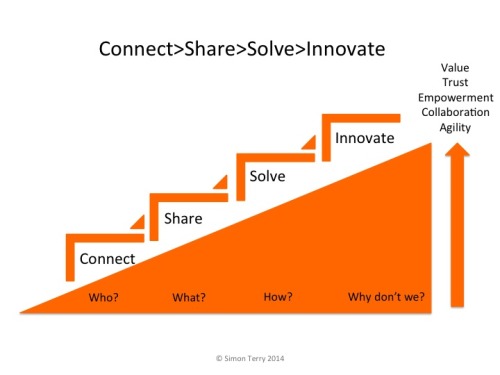
Connecting and Sharing create a reputation economy in your organisation to underpin the trust and collaboration required to Solve and Innovate.

Four topics are commonly discussed in communities around enterprise social networks:

  • Why would anyone go out of their way to help others?
  • How do we increase the value of collaboration in our organisation?
  • What is the role of leaders?
  • How do we cut down the gossip and non-work conversation in our network?

The answer to these four questions are connected to one element of successful networks: they create a reputation economy in the community that fosters collaboration.

The Value of Reputation

Humans aren’t the rational economic machines that most organisations try to manage with role descriptions, performance plans and other incentives. Humans do things outside the job description and the process every day.  We work around the hierarchy.  Importantly, we collaborate because we value relationships and we know that the returns from collaboration exceed the costs in our effort.

One of the challenges of collaboration is the danger that others will free ride on your efforts, improving their performance but bearing none of the costs. Mark Pagel’s Wired for Culture uses evolutionary approaches to behaviour to examine an important part of our defences against free riding, reputation.  Because our relationships with our work colleagues are not transactional, over time we build a level of trust and a reputation for each colleague based on their behaviour.  This reputation system influences who and how we collaborate with others.

Ever wondered why a users first ever request for help or crowd sourcing of ideas will usually struggle?  They have no reputation in the community and others will hang back until someone shows they can be trusted. 

Increasing the transparency and connection of reputation in your organisation will accelerate collaboration not just in a social network or other tool.  Collaboration across the organisation will leverage the new transparent reputations developed.

Building Reputation

We don’t build reputation with our status in the organisation or by declaring we can be trusted.  We build reputation through with who we are associated and how we act, particularly when we act against our interest.

The Connect and Share phases of the maturity of a collaboration community enable people to develop these critical stages of reputation. Working out loud for the benefit of others can accelerate that trust.  As can demonstrating and encouraging a growth mindset.   Sharing information, insights and solutions, particularly when there is no reason or benefit to the sharer is a powerful way to build a reputation.  Others sharing without penalty and preferably receiving benefits establishes the view in the community that it is safe.

The reputations and the trust built in Connect and Share are what powers the value in the later stages of the model.  People contribute later because they know that their contributions go to those who they respect and have the interests of the community at heart.

The Importance of Leaders

Leaders bring status into communities. However, as noted above, the presence of status is not enough to create or sustain trust.  Actions by leaders count.  

Leaders can play a critical role in showing the way to build reputation and in establishing that collaboration is safe and beneficial.  Importantly, leaders can use their authority to calling out free-riding behaviour and encourage participation by others. Leaders can acknowledge the reputations built in the community giving them greater influence in the organisation.

Leaders also need to be aware that their status also brings a fragility to their own personal reputations.  If they fail to act in the community to reinforce their authority, it will erode rapidly.

The Critical Role of Gossip & Non-Work Conversation

Organisations hate gossip and non-work conversation. They are seen as a threat to the singularity of corporate messaging and a waste of time.

However, gossip and non-work conversation are critical parts of reputation systems.  Gossip is how we share our views of others reputations. Non-work conversation is another way for us to share and build our reputations with others.

Create a reputation economy in your collaborative community by fostering connection and sharing.

The Value Maturity Model is an approach to enhancing the value of collaboration in your organisation.  The Model is supported by a range of tools and practices to enable leaders and community managers to maximise the potential in collaboration.  If you would like to learn more about the Value Maturity Model, get in touch with Simon Terry.

Metrics change (an addition)

Disruptors change the measures of effectiveness in business

Are you paying attention to the right metrics?

The story famously goes that there are three kinds of people:

  • those who make things happen
  • those who watch things happen; and 
  • those who ask ‘what happened?’ 

In the transformation called digital disruption, these are matched by three groups: 

  • disruptors (& their customers) creating new measures of effectiveness, success and performance
  • organisations outwardly focused, measuring a wide range of results and wondering why it seems the measures of success have changed; and 
  • the disrupted announcing the disruption can’t last because they are performing fine on their plans and the change doesn’t work on their measures of success. 

The surest way to be blindsided by digital disruption is to fix your attention only to your metrics and to your plan.

Metrics Change

“You can’t bank a percentage” – entrepreneurial wisdom

Disruptive businesses change the metrics that measure success by focusing on more effective outcomes.  How are you rethinking the measures in your business?

Your Metrics Weren’t Always Thus

Metrics are one area where we can easily form views that they ‘have to be this way’.  Metrics are often driven by prior year plans, industry standard comparisons or by the expectations of analysts and investors. It is taken as gospel for businesses and industries to have standard growth rate, cost to income and other metrics. 

If you want to get a sense for the changing dynamic of metrics read back in the history of business to completely different eras. Here we can see innovation in metrics changes the fundamental understanding of business activity.

If you read the biographies of early industrialists and railroad barons in the US you will find a very different perception of shareholder value and company performance.  Shares in the late 19th century in the United States traded like subordinated bonds. The questions of valuation were how large was the dividend the company might pay and how close the shares traded to par. Innovations like consistent approaches to value accounting practices and models of cashflow valuation were introduced to sustain the modern approaches to valuations.

Metrics Illuminate and Create Blindspots

Metrics are how businesses see. As they say, if you want something done, measure it. However, the light that measures cast also creates shadows and blindspots. What doesn’t get measured, doesn’t get done.

A fixed view of metrics makes them a fertile ground for entrepreneur change.  The traditional competitors will struggle to see and understand the performance of new businesses because they will be trapped judging the new threat by old metrics. 

There are many examples of innovations that change the metrics.  Here’s a small sample:

  • Craig McCaw built up and sold huge businesses in both cable television and mobile telephony by having a more effective view of valuation to that prevalent in each industry when he started
  • Online display advertising was sold by effectiveness (cost per click) rather than (cost per thousand). New measures that made it hard for traditional media to see a way to respond to the changes
  • Many industries are dealing with competition that does not value the unit of content or service, but instead values the community of users that is created by giving away the content or service.
  • The taxi industries around the world are faced with moving from the value of a licence and a cost per km to the utilisation of and returns to a driver as a measure of effectiveness
  • Changing the unit of measurement of delivery effectiveness to time enabled courier services to change the game in parcel delivery

Traditional businesses with their measures of success will often miss these changes initially or see them as unsustainable. If you are assuming the irrationality of your competitors, look again at their metrics. Ultimately, new valuation models and new investor expectations develop around the new metrics provided that they prove more effective.

The worst outcome for the future of your business is that you are happily delivering your plan as the value erodes away.

Don’t accept as gospel the returns, growth rates and margins that you have inherited in your business. You can’t bank a percentage. Focus instead on exploring with new metrics to measure the effectiveness of your business in creating sustainable value.

Start Yesterday

The only thing as a manager that you can’t fix is the discovery that you should have started yesterday. Working to create an effective culture is not a realm for the fast follower. Start!

All the Fast Followers

A fast follower mindset dominates much strategic thinking in business. It may not always be explicit, but successful practices are widely followed.

Nobody wants to bear the pain, the effort and the risk of the bleeding edge. Too many of the inventors failed to win the execution challenge. Once a successful approach has been identified it can be rapidly copied. Fast followers compete on execution. Fast following is seen as a safe play with only the danger that you give your competitor a small advantage for the period of time it takes to copy the approach.

You Can’t Fast Follow Culture

Your culture today is different to your competitor’s culture or your role model organisation’s culture. There is a reason you still haven’t caught up to the impact of those GE practices that you are trying to follow (A reminder: Jack Welch retired 14 years ago). 

What will be effective in your organisation differs from what works in another company. Experimentation is required to find the ideal set of behaviours for the purpose, people and strategy of your organisation.

Even if a practice could be guaranteed to work, implementation of cultural change takes time. There is no purchase to make, no switch to flick or no announcement that will let you catch up on an advantageous culture as a fast follower. 

Culture is an expectation of how interactions happen in the networks of your organisation. Networks are one area where fast follower strategies often fail. People can be reluctant to shift once they have adopted a set of beliefs and built skills in interactions in a network.

You need to do the work to change the expectations of behaviours in your company. That will not happen overnight.

Your Future Competitor has Started.

Somewhere a present or future competitor has started experimenting with new ways of working. Disruption is as much about new ways of working and new models of management as it is about new customer propositions.

The extensive discussion of the future of work means that different organisations are starting to explore better ways of working. People are experimenting with new modes of organisation, practices of management, the leadership of communities, and different ways to learn, collaborate, innovate or solve problems. 

These organisations are exploring more effective cultures and modes of achieving higher performance in their team. They know that it will be a long while before you find out what works for them. When you do even knowing what works for them, you will still have to make sense of the change for yourself.  There’s a lot of learning to do.

You can’t catch up without learning what works for you & your network, learning how to implement changes and making the new behaviours expected practice in your organisation.

If you are wondering if it is time to start experimenting with new ways of working, then take a closer look at the practices and experiments of the competitors around you. You can’t start yesterday, but you can run an experiment today.

The Inefficiency of Relentless Efficiency

Any efficiency measure applied relentlessly ultimately becomes inefficient

Business loves too much of a good thing. Relentlessness is a characteristic widely admired in business leaders. Efficiency is a classic area where the impact of a relentless focus on a single practice can be self-defeating. Engineers know this, but managers have not yet learned the lesson.

The first clue to this outcome is the Pareto principle which is widely misunderstood. Pareto highlighted that in many phenomenon a small part of the population has the largest impact i.e. 20% achieves 80% of the impact. Applied to efficiency it highlights that the cost of achieving incremental efficiency using the same measure will increase over time. 

Nicholas Taleb has highlighted in Antifragile that slack in a system is often the source of its Antifragility.  Slack is what enables systems to effectively respond to shocks. We can’t remove the shocks but we can ensure the system does not collapse when a shock hits because it has no capacity to change and respond.

Business practices are widely copied. People develop expertise in a single practice and become like those described by the phrase “to a man with a hammer every problem looks like a nail”. We over-apply efficiency measures because they worked before or they worked elsewhere. We rarely consider their systemic impact on effectiveness

Consider a few of the efficiency measure applied relentlessly in the corporate world that have created new inefficiencies and damaged effectiveness:

  • Time Management: ever waited for a meeting to start because someone is so scheduled that they keep everyone else waiting? Our relentless focus on managing the efficiency of time at an individual level creates collective inefficiency. 
  • Outsourcing and Offshoring: the labour arbitrage and other efficiencies of these measures are often overwhelmed when pushed too far by the inefficiency of the system with fixed processes, misaligned performance standards and poor communication and collaboration. Too many organisations have discovered they no longer can respond effectively to customer needs when they overstepped the efficiency measures.
  • Expense control: Organisations that ruthlessly manage employee ability to spend in a low trust approach often discover employees are far more creative and also spend what they can to retain budgets. New constraints and processes just create new wasteful behaviours because trust has broken down.
  • Specialisation: Similar to outsourcing and offshoring, removing people from connection to customers and fragmenting processes unnecessarily in the name of efficiency creates its own lack of accountabilities and inefficiencies
  • Scale: We live in a world where big likely means too big to sense, decide and react.
  • Performance Management: Employees can calculate expected average returns too. Even with that purpose, autonomy, mastery and relationships are more likely to shape their effort than a relentlessly redesigned reward scheme. The relentless focus on efficiency of performance management schemes and the sense that the rules will be changed to suit the corporate is ultimately ineffective. 

Responsive Organisations recognise that efficiency is not the only goal. Efficiency does not deliver on the purpose of the organisation. It merely ensures resources are well applied. Effectiveness delivers the purpose of the organisation and needs to be a greater part of the management toolkit.  Efficiency measures need to be tempered to reflect their effectiveness and their impact on the effectiveness on the organisation as a whole.