Fishbowl session in Sydney. Photo credit: Michelle Ockers
Put conversation first. There is nothing more powerful than real conversation. Generative discussion is far more likely to engage, inspire and create value than a presentation or a recitation of an individual’s expertise.
I first saw deep generative conversation in adaptive leadership work. Creating a container for a conversation, being able to surface tensions and explore a whole system generates a new perspective for leaders. Conversations like these, can be the foundations for new more effective action.
My passion for working out loud is shaped by the value that I have experienced in putting ego in the background and working with others aloud on ideas and actions. The growth of working out loud globally is testament to the fact that my views are not isolated.
The Anti-panel is another example of work where the value of fostering a real and diverse conversation can be seen. Through multiple formats, engaging a conference audience to create their own panel session has been insightful & rewarding.
Next week I am putting another generative conversation format to the test. Along with Charles Jennings, Rene Robson, Cheryle Walker and Andrew Gerkens we will be discussing learning and performance in a fishbowl format. I have been a part of a number of fishbowl conversations before. Each have been intense, engaging and insightful experiences because they bring the audience into the panel conversation, focus on a conversation and create an atmosphere of collaboration in the discussion and the surrounding audience.
We can’t escape networks as individuals and as organisations. We are embedded in a wirearchy that is far more powerful than we are aware. When avoidance is no longer a strategy we must engage. What is the purpose of your work and leadership in the networks around you?
There is no Island
Let’s say you were a traditionalist manager and you saw social communication as a distraction from the perfect order of your process driven life and neatly structured hierarchical silos. You can ban any form of networking in your organisation. You can ensure that employees never get together physically across the boundaries of teams. You can turn your organisation into closed cells in the name of efficiency. You can replace employees with robots to make the more compliant.
Except:
You still have customers and they are organised into networks that reach around into your organisation
Your competitors are leveraging networks to reach new customers, to learn, to solve challenges and to create new innovations
Your suppliers are using networks that involve your employees and customers to understand how best to create value too
Your employees still have phones & internet connections, friends (some of whom are customers), connections in the real world that may want to influence your organisation or even their own thoughts on what your organisation should be doing from their external community activity.
Even your robots will be networked in an era of the internet of things
Even if you wanted to ignore the network and focus solely on the performance of a hierarchical process driven organisation, you no longer can. The network has subverted the hierarchy. The networks have always been there disrupting your efforts at perfection. They are just more visible and more capable than ever. Your employees, competitors, suppliers, customers and community have always been networked into groups large and small by human interaction. Now those conversations are global, mobile, persistent, transparent and real time.
Purpose in a Network
Welcome to the wirearchy. It doesn’t replace the hierarchy. It works with it, shaping your actions and the actions of others in your organisation with its ‘dynamic two way flow of information, trust and authority’.
The wirearchy challenges you to consider your purpose. Your purpose guides how your actions reach out into the networks around you and have an effect on others. That effect on others is what determines the information you receive, the authority you are given and the trust you earn. Improving these things takes work. It cannot be delivered by management fiat or a great personal or corporate brand campaign in the era of networks.
In a wirearchy, we each have the opportunity to improve our information, authority and trust. We each have the opportunity to lead. Unlike traditional management this is an opportunity, not a requirement. Fail to use it when required and the network will route around you taking away your hard won gains. The network doesn’t require your participation; it simply values it.
The Purpose is in the Work
The purpose is in the work. You won’t find it in a job, a manager’s opinion or in a book. Choose the work that you like to do and go have an impact in your networks doing that. Your role in the wirearchy will be surfaced by action. You will also get a better sense of the value that you create for others, helping you to better appreciate your performance in the network.
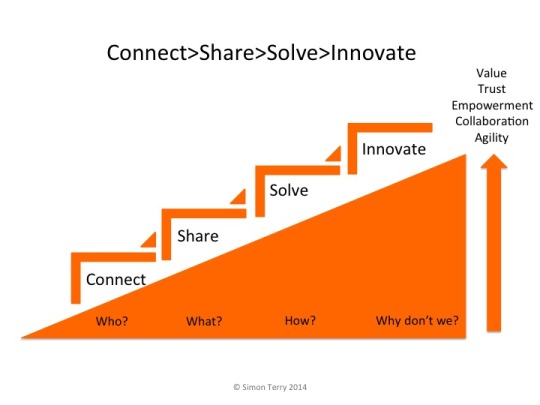
Connect People: Help others find their path & communities in the network
Share our Work and our Passions: work out loud on the activities going on in your life to let others learn and help
Solve Challenges with and for others to share your expertise, experience and capabilities
Innovate and Experiment to create new value together
Start where you feel comfortable. Start where you feel you can make a difference. Your networks and your purpose will guide your leadership work from there.
You aren’t invited to lead because of what it will do for you. You aren’t invited to lead because of what you have done. You aren’t invited to lead because of your role.
People follow because of the value you create for & with others. Leaders help people build shared purpose, vision and understanding, create new capabilities and find paths to action. The action generated from leadership helps people to create new value together.
Anyone who works to help others create value can lead. Give the gift of your talents at this collaborative work and others will recognise your actions with the gift of leadership.
A dichotomy of leadership and management is not particularly useful. We need both. We also need to move beyond seeing these concepts as being fixed hierarchical statuses.
At the moment there seems to be a flood of articles and other content about the difference between leaders and managers. The general themes are that leaders are inspiring and people focused will managers are mechanical and fearsome. This content assumes both leaders and managers are hierarchically superior to their teams and that these two concepts are distinct statuses.
Both management and leadership are required in the future of work. However we need these concepts to mean exercise of the respective verbs, not a group of people holding a status. We need to recognise that the practices of leading and managing are our choices to get our work done. We need to manage our information, resources and relationships to achieve outcomes. We also need to lead others when we influence them to support our work.
Discussing leaders vs managers as hierarchical concepts takes us simply to better managers. The bigger issue is moving beyond leadership vs management. We need more of both. The issue is how we move beyond fixed titles like leader and manager that don’t reflect how we all get work done. We need everyone engaged in both leadership and management. A greater depth of leadership and management in our organisations will better enable us individually and collectively to create needed change.
Senior executives need new mindsets and new capabilities to be effective in the networked work of the future. Four capabilities will help e executives make the most of their networks:
Personal Knowledge Management: Personal Knowledge Management gives executives the personal learning skills to manage the flow of information and to deepen their personal networks. As executives personally learn to Seek>Sense>Share they develop critical digital skills for network leadership.
Working Out Loud: Working out loud is a practice that helps surface the value of work and learning in networks. Leaders are already the focus of attention. Making their work in progress visible to others is a highly valuable step because it accelerates trust and learning.
Leading in Networks: Network leadership requires leaders to surface shared purpose, build trust and influence and enable collaboration. Expertise, rank and orders are replaced with adaptive leadership techniques that manage learning, tension & alignment.
I am very pleased to be sharing with you today my first post as CEO. Apologies if it seems a little frazzled. I am by the challenges ahead but that’s also because I am writing at home surrounded by the turmoil of my young family. I thought I would pass over the usual inspiring memo and start a conversation here in our enterprise social network. I am humbled by the many posts here that saw me selected as your CEO. I now have a great challenge ahead to honour that confidence in my potential as a leader and to use my new position wisely. We have many challenges ahead and we will need to work together to solve them.
As he was leaving the organisation, my predecessor remarked “This job is almost impossible. You are going to need a lot of help to fix things” Yet again he was incredibly insightful.
A Big Challenge
I suspect I see the job of a CEO slightly differently to my predecessor but I agree on its challenges. I see the CEO as less of a commander atop a hierarchy. I haven’t won this role for my expertise or ability to make all the decisions needed. For me a CEO is a guardian of the organisation’s purpose and its impacts for customers, community and people. Ultimately, the CEO is held accountable by these stakeholders for their ability to facilitate great outcomes from the whole team.
To advance our purpose and improve our effectiveness, I will be less of a boss and leading the way as a change agent helping to create the needed focus, better performance and accountabilities in our organisation’s network. At the same time I recognise in a time of rapid change I need to lead the way as learner in chief. That will be easy for me. One of the reasons I am frazzled is that I have a big learning curve ahead and our organisation has a lot to learn.
Learning on the job as CEO is almost impossible, how can you help me to learn the role, learn better ways of working and learn the future of this organisation?
Only A Job
I am acutely aware that CEO is only one job. Some CEOs confuse the job and the role thinking that their personal power and expertise is the answer to the organisation’s challenges. I know too well that I don’t have the expertise and I don’t have the answers. You know that well. It was discussed aloud when you chose me.
My authority comes not from the role but from your confidence in my ability to help realise our purpose and to create the answers we need together. That is the only sustainable basis of your decisions to follow. We need to replicate relationships based in understandings of capabilities, effectiveness and authority for every role in the organisation so that anyone can lead, can contribute their expertise and realise their potential. Working together in this way and working explicitly on our relationships will make our interactions can be rich in trust and quickly identify those who would rather work elsewhere.
Changing our leadership approaches and relationships is almost impossible, how can you help me to create new relationships in this organisation?
We’re Together in Change
We need trust and strong relationships because we are going to work to use all our talents to fixing things together. We need the people closest to our customers and those with new ideas and new information to have the authority to make change and to call on the support of their colleagues to see it through. At times, we have valued processes and rules over outcomes for our customers and our people. Not all of our ways of working deliver the outcomes we want. We aren’t as responsive as we would like. We have work to do. All our employees have the responsibility to find fixes to the issues that they see in our business. They won’t be able to do that on their own. They will need your help too.
We will only succeed in the harsh competitive environment if we have the ability to better leverage the talents and potential of all our people. Together we will focus on how we improve everyone’s effectiveness, autonomy and agility to deliver better outcomes for the organisation, its customers & community and importantly for themselves. Our collaboration will be critical to connect us, to share information and to solve the daily obstacles we face to better performance. Everyone has a role to play in this.
Realising the potential of all our people to contribute to purpose is almost impossible, how can you help me to accelerate our change?
Let’s Continue the Conversation
Attached to this post is a memo that the executive sent to the CEO some time ago outlining the importance of this enterprise social network to our strategy. Unfortunately, as it was a email it was only seen by the CEO and the executive team. As all our employees will contribute to creating value for our customers through collaboration and continuous improvement, it would have been wiser to share this with you earlier. As we move forward, our leadership team has agreed to write fewer politely worded memos and to engage in real conversations out loud here in the enterprise social network. I would ask you each to work out loud too. Sharing our work as it progresses is a way to help us learn and improve.
Our future success is a real challenge. It always is. You might even say it is almost impossible, but nothing less would suit our very capable people. We will improve and deliver our purpose one day at a time. I am frazzled but I couldn’t be more excited as CEO as I have confidence that this amazing group of people will help find each day’s answer to the question:
‘What Do We Need to Improve Today?’
It is almost impossible to believe that I am CEO of this great network of talented people. I know you will help me get over that too!
We may have begun to move from an adoption conversation to a value conversation. However our hierarchical mindsets can still hold us back. A responsive organisation needs to shape how value arise from collaboration, not try to specify it top down.
Embrace Value
More and more organisations are focusing on how to create strategic business value in their organisation through the use of collaboration. They are seeing the value that can be created as a community journeys from Connection to Innovation. They recognise that adoption & use should reinforce the strategic goals of the organisation and is not an end in itself.
The Temptation to Specify
When an organisation identifies the way that it can create value in a community, our hierarchical tendencies begin to kick in. We start to specify how a community shall work to create value. This is how most organisation’s strategy planning processes usually work. We end up with a plan of what other people have to do.
Some guidance can be useful at the beginning of a community’s life when people are sense making. However, too much instruction will become a constraint on the value creation if the goals of value creation remain externally imposed on the community.
The best value comes when a community can use its knowledge, capabilities and ideas to create value in new ways. That won’t happen if the community has specified usage cases and a limited focus on the value that it can create.
Coach the Community to Create the Own Value
A large part of the difference between management and leadership is the difference between direction and coaching. Responsive organisations demand leaders who can coach teams managing highly adaptive situations, rather than direct.
Organisations need to coach the members of their communities to create valuable new ways of working using collaboration:
Coaching begins by clarifying goals: How do you help your communities understand the alignment between organisations strategic goals and the goals of their own work?
Coaching should enable action & experimentation: How do you help people to translate the opportunities that they can see into work that they can do alone or with the support of others?
Coaching should build capability: What skills do people need to manage this process for themselves? What barriers need to be cleared? How can they learn to create, deliver and coach themselves going forward?
The Value Maturity Model Collaboration Canvas is a coaching framework to help community leaders, champions and managers to shape the creation of value through collaboration. The tool asks members of the community to think through the questions that will enable them to create their own value. Spreading this coaching mindset through your organisation is the most powerful way to transform the value created by collaboration & communities. Spreading a coaching mindset through your organisation builds capability as it builds alignment and creates value. Enabling people to coach themselves helps your organisation become more responsive. It is the only way that you will get the value you didn’t plan and to adapt to the challenges you did not forecast.
Many organisations want the benefits of better collaboration and the potential of better leveraging the potential of their people in a community. Increasingly with the availability of enterprise social networking, social mobile apps and integration into other productivity tools, organisations have the network capabilities to create the communities at hand.
A Network with a Demanding Boss
Too many plans for enterprise social networks and communities are developed without any community participation. The organisation wants something from the network. They set about getting that goal. When realising the goal proves harder than they expect, the organisation resorts to communication, performance levers, gamification, or maybe even ‘change management’. Many of these remain efforts to impose an external rationale on a network.
If the goals of a network are imposed externally, it is not a community. It is a network with a demanding boss. Any network of this type will lose energy over time as people query the benefits of their participation.
Use the Network to Create a Community
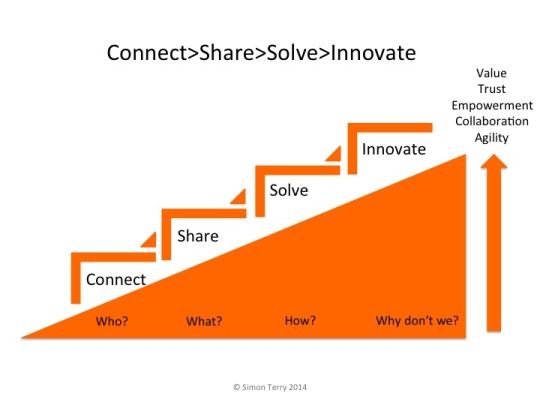
A community comes together around a common set of purposes. Use your network to discover, discuss and align those goals. Engage the people that you would like to form a valuable community to find out how they want to engage. My work shows that people have their own great reasons for adopting the practices that accelerate value at work and build communities. Those practices are those of the Value Maturity Model – Connect>Share>Solve>Innovate.
The organisation’s goals will become a part of that discussion naturally. Everyone works for the organisation and there will be some shared purpose. By engaging people you will discover the greater potential of the community and leverage its rich diversity of talent and perspective.
Ask leaders to lead
Much has been discussed about executive participation in enterprise social networking. Often it is seen as the panacea that will make people do the ‘right things’ in the network. Even the busy senior executives struggle to participate when it is imposed on them as an externally mandated task. Again, the effort is to impose an external logic for networking.
When you focus on the community, what is clear is that what is needed is leaders. We don’t need participation from senior executives, when need people who are willing to take on the role of leader in the community to help the community to achieve its purposes. Leadership should come from senior executives, but it can also come from other community leaders, influencers and champions.
Don’t focus solely on senior executives. Focus on finding leaders willing to help create a community and drive change. These people may well be your organisations mavericks and change agents. Embrace their ability to lead.
The Value Maturity Model is an approach to help organisations create strategic value in collaboration and social networking. The Value Maturity Model Canvas helps organisations to develop agile plans for communities using participation of community members. To learn more, get in touch with Simon Terry via about.me, twitter or Linkedin.
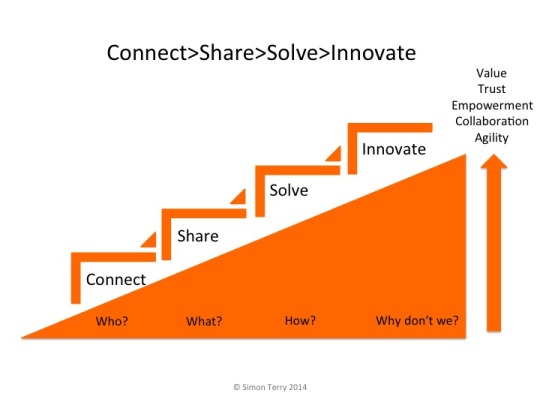
Connect is the first stage of the Value Maturity Model of collaboration because connection is what creates a network. Until people are connected together you don’t have any ability for someone to exceed their individual potential.
Connection only gets you a network. One of the reasons many people have been disappointed by their enterprise social network or their social media strategy is that they have not seen beyond creating the connections. A network has no vision. A network has no purpose. A network is neutral in creating value.
Community = Value
Community creates the value. Community is how people come together to share their talents and create greater value together. Communities can create visions, realise the shared purposes of individuals and work together to achieve more.
Network connection happens immediately. Community develops over time as people learn to trust others and as people learn the new interactions that create value for themselves and others. Sharing, solving problems and innovating together deepens the community and enables individuals to grow in their potential. These communities also always exist within larger communities, like companies and society, that are often more important in shaping the way people act.
People = Potential
Focus on the potential of human communities. Remember that bringing people together in a network is just the beginning of the potential that people can create. Communities will mature with common goals, leadership and action over time.
Connecting and Sharing create a reputation economy in your organisation to underpin the trust and collaboration required to Solve and Innovate.
Four topics are commonly discussed in communities around enterprise social networks:
Why would anyone go out of their way to help others?
How do we increase the value of collaboration in our organisation?
What is the role of leaders?
How do we cut down the gossip and non-work conversation in our network?
The answer to these four questions are connected to one element of successful networks: they create a reputation economy in the community that fosters collaboration.
The Value of Reputation
Humans aren’t the rational economic machines that most organisations try to manage with role descriptions, performance plans and other incentives. Humans do things outside the job description and the process every day. We work around the hierarchy. Importantly, we collaborate because we value relationships and we know that the returns from collaboration exceed the costs in our effort.
One of the challenges of collaboration is the danger that others will free ride on your efforts, improving their performance but bearing none of the costs. Mark Pagel’s Wired for Culture uses evolutionary approaches to behaviour to examine an important part of our defences against free riding, reputation. Because our relationships with our work colleagues are not transactional, over time we build a level of trust and a reputation for each colleague based on their behaviour. This reputation system influences who and how we collaborate with others.
Ever wondered why a users first ever request for help or crowd sourcing of ideas will usually struggle? They have no reputation in the community and others will hang back until someone shows they can be trusted.
Increasing the transparency and connection of reputation in your organisation will accelerate collaboration not just in a social network or other tool. Collaboration across the organisation will leverage the new transparent reputations developed.
Building Reputation
We don’t build reputation with our status in the organisation or by declaring we can be trusted. We build reputation through with who we are associated and how we act, particularly when we act against our interest.
The Connect and Share phases of the maturity of a collaboration community enable people to develop these critical stages of reputation. Working out loud for the benefit of others can accelerate that trust. As can demonstrating and encouraging a growth mindset. Sharing information, insights and solutions, particularly when there is no reason or benefit to the sharer is a powerful way to build a reputation. Others sharing without penalty and preferably receiving benefits establishes the view in the community that it is safe.
The reputations and the trust built in Connect and Share are what powers the value in the later stages of the model. People contribute later because they know that their contributions go to those who they respect and have the interests of the community at heart.
The Importance of Leaders
Leaders bring status into communities. However, as noted above, the presence of status is not enough to create or sustain trust. Actions by leaders count.
Leaders can play a critical role in showing the way to build reputation and in establishing that collaboration is safe and beneficial. Importantly, leaders can use their authority to calling out free-riding behaviour and encourage participation by others. Leaders can acknowledge the reputations built in the community giving them greater influence in the organisation.
Leaders also need to be aware that their status also brings a fragility to their own personal reputations. If they fail to act in the community to reinforce their authority, it will erode rapidly.
The Critical Role of Gossip & Non-Work Conversation
Organisations hate gossip and non-work conversation. They are seen as a threat to the singularity of corporate messaging and a waste of time.
However, gossip and non-work conversation are critical parts of reputation systems. Gossip is how we share our views of others reputations. Non-work conversation is another way for us to share and build our reputations with others.
Create a reputation economy in your collaborative community by fostering connection and sharing.
The Value Maturity Model is an approach to enhancing the value of collaboration in your organisation. The Model is supported by a range of tools and practices to enable leaders and community managers to maximise the potential in collaboration. If you would like to learn more about the Value Maturity Model, get in touch with Simon Terry.