The Problem is Everywhere

The peculiar character of the problem of a rational economic order is determined precisely by the fact that the knowledge of the circumstances of which we must make use never exists in concentrated or integrated form but solely as the dispersed bits of incomplete and frequently contradictory knowledge which all the separate individuals possess. The economic problem of society is thus not merely a problem of how to allocate “given” resources—if “given” is taken to mean given to a single mind which deliberately solves the problem set by these “data.” It is rather a problem of how to secure the best use of resources known to any of the members of society, for ends whose relative importance only these individuals know. Or, to put it briefly, it is a problem of the utilization of knowledge which is not given to anyone in its totality. – Friedrich A Hayek “The Use of Knowledge in Society”

Yesterday I met with an organisation that wanted some of my help as they sought to solve a problem. The organisation was developing a new knowledge sharing system to enable is staff to be better informed about products and processes. There was one slight issue with this problem. The organisation already had multiple systems to enable its staff to be better informed about products and processes: intranets, social networks, training, help & support tools, automation, etc.

Problems Everywhere

As we asked why these other systems didn’t work it became clearer that the project team’s issue was that it was solving a problem for others, rather than with others. The explanations for needing a new system did’t stack up and suggested there was more that needed to be learned from the users:

  • ‘Most of the learning is peer to peer. We need to give them better options’: Why do they prefer to learn from peers who might be inaccurate or unavailable? Why will they change this if you offer a new system? 
  • ‘They won’t use a collaboration system because they say they don’t have the time’ : if time is a question of priority, why isn’t it a priority? To what extent is the culture, leadership and performance management of the team driving this lack of priority? If they won’t collaborate why will they have the time to use something else? What is there time actually spent on? What do they do instead?
  • ‘Those system don’t give them the answers they need so we are building a new one’: If the last system didn’t understand what was required, how do you? What does relevance look like to each user? What does relevance look like to their customers?
  • ‘They want help with process X, but we are building something innovative for all processes’: Why do they want help with that process? What’s innovative about ignoring the demand?

The Answer is Everywhere

The answers to these questions are dispersed in a wide range of people beyond the project team. They draw in questions of culture, of practice, or rational and irrational behaviour by real human beings doing real work under the daily pressures of customers and a large organisation. There’s a lot of learning to do.

We have the tools to solve this dispersion and gather insights into what needs to be done in the practices of Big Learning:

  • we can actively collaborate with the users and other participants in the system to get under the pat answers and explore the deeper reasons and problems
  • we can use the practices of design thinking to better understand and shape employee behaviour & the systems involved in action
  • we can analyse data to understand in greater detail what is going on
  • we can experiment and iterate to ensure that proposed changes work the way that we expect
  • we can enable and empower the users to create changes to their work
  • we can accelerate the interactions and the cycles of learning to move faster to better solutions

These aren’t parallel techniques to be applied independently. The practices of Big Learning work best as an integrated system that draws together the insights from all of these approaches to help organisations learn and work. Big Learning enables organisation to work with and through its employees to deliver change. Change does not have to be done to them.

The reason organisations need to develop systems to facilitate Big Learning is elegantly described by Hayek in the conclusion to his essay “The Use of Knowledge in Society”.  Hayek was critiquing the schools of economists who thought that centrally planned interventions designed by experts would be effective. The context may differ but organisations still use forms of central planning by experts to create change. These changes fall short for a fundamental reason – experts can’t know enough alone:

The practical problem, however, arises precisely because these facts are never so given to a single mind, and because, in consequence, it is necessary that in the solution of the problem knowledge should be used that is dispersed among many people

The practices of Big Learning help bring people together to share insights, learn and work as one.


The Growth Mindset of Collaboration

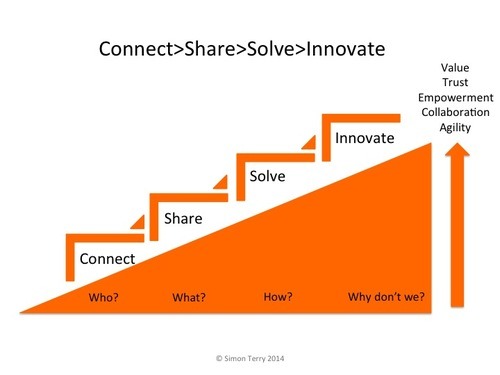
Over the last week I have been speaking to a number of organisations across SE Asia around how they can start to realise the value that collaboration can create.   I was outlining my Connect>Share>Solve>Innovate model and helping organisations to plan their collaborative communities using the approach. 

One question kept coming up. The commonest question I was asked was a variant of the following:

How do we encourage our employees to share and try to solve problems when they are afraid to make a mistake?

At the heart of this anxiety is what Carol Dweck of Stanford refers to in her book Mindsets as a fixed mindset. If an employee believes that their ability, status or position is fixed, then they do not want to risk anything that might show themselves as performing below expectations. In a fixed mindset, you avoid testing your inherent capabilities for fear that you will be disappointed. Highly hierarchical organisations encourage a fixed mindset.

Collaboration demands what Carol Dweck calls a growth mindset. To collaborate, we have to believe that through work and effort we can learn and get better together. Mistakes, embarrassment and other challenges are learning opportunities that are overcome with effort.

Shifting to a Growth Mindset

My answer to the question above came down to a simple recommendation:

Make sure in the culture of your organisation there is a personal accountability on employees to improve their work every day.

This recommendation sounds so obvious. Surely we can expect this from any manager.  However, many organisations treat their employees as if their capabilities are unchanging, that improvement is the work of specialists and managers and that daily productivity is all that matters. Mix in hierarchical relationships and you have strongly reinforced a fixed mindset in the culture of the organisation i.e. do your job with minimum effort to the best of your ability only and wait to be changed.

There are many ways a personal accountability for improvement can be created in organisations:

  • customer experience, customer service improvement, etc
  • continuous improvement, productivity, kaizen, six sigma, etc
  • rising financial or performance expectations
  • personal leadership expectations
  • innovation, experimentation, agile, lean startup principles, etc
  • organisational values of improvement, growing impact on purpose, etc
  • talent development and on the job learning

Use one or all of the above. Whatever way it works in your organisations culture and strategy, the requirement is that your organisation expects and rewards people for the daily effort to improve. Over time that helps to create an expectation that every individual will work to make their work better.

The growth mindset in your organisation will drive the value of more mature forms of collaboration. Importantly, it will also drive an uplift in performance overall.

Practice is Habit – Make This Your Year

“We are spinning our own fates, good or evil, and never to be undone. Every smallest stroke of virtue or of vice leaves its never so little scar.” – William James

Complex changes like realising the Responsive Organisation and developing the future of work need people to connect in communities and along networks of practice. Forming new habits will be essentially to developing the richness of practice required.

Habits are required in Practice

How are those New Year Resolutions tracking? A week into the new year and many people are already struggling with new practices that look like failed intentions. New practices struggle to embed unless we turn them into habits.

I was planning to write today about the need for habits to reinforce practice when tumblr served up the William James quote above thanks to the Explore blog and the work of Maria Popova. The article on William James says many wise words on the value of habit in reinforcing habit. 

However I can point out the serendipity.  Maria’s relentless and excellent curation is a habit. My practice of writing this blog is a habit.  Without these habits and many more the coincidence would not be possible.  Similar serendipity is found in the practice of working out loud.  These moments of encouragement extend the practice further. 

To create change we need to start developing suites of new future of work practices and turning them first into experiments and then embedding the successes as habits.  Through the long practice of habit will come innovations, solutions to problems and a richer connection with others pushing the practice forward. We need to create the habits and connections that enable the serendipity to power change for Responsive Organisations.

Habits bring time to Practice

Habits bring the gift of time to practice.  They ensure that our feeble new practices are not killed by lack of attention or effort. Habits sustain us through the hard days and the days we would rather not. We all love quick wins but focusing on new practices reminds us that not everything transforms immediately. There are obstacles, new skills and lessons to be learned in practice.

Successful practice takes time and learning. Habits are the key to winning that time.

This is Your Year

This year is definitely my year. I would like it to be yours too. That will take some new habits.

This poster first featured on this blog a year ago when its claims were decidedly uncertain. The poster celebrated that the obstacles are the work. It sits in my office in my eye line as a reminder that it is relentless practice and good habits that will deliver me the year that I seek. There are many ways I can ensure it will be my year:

  • If I practice what I preach consistently
  • If I experiment, to learn and to build new good habits
  • If I keep focus and avoid the distractions of the bright and shiny things
  • If I keep looking for ways to move forward, overcome the obstacles and achieve my purpose; but most of all
  • If I keep translating the believe that ‘This is My Year’ into action

image

This year is your year too. Like it or not, it will pass with every action and omission you make. The choice is yours to make it a year to remember. Create the habits required to own your year. The resulting practice will deliver great rewards.

Habits don’t have to be big things. Small steps accumulate. Small steps that can be consistently repeated in a process of learning accelerate success.

What would make it really your year? What do you need to do consistently to make it happen? What is your new habit?

Leadership in Transformation

A common topic of debate in the Responsive Organization movement is whether an organization can become responsive or it must be born that way.

Undoubtedly many of the leading case studies of future of work organizations are organizations created or rebirthed from near death by charismatic founders. Some use this as evidence that the elements of a responsive organization must be present from the beginning. In a previous post, I pointed out that we cannot rely on transparency alone to make change occur for us. The power structures in a traditional organisation will prevent most radical change.

I am unambiguously in the optimist camp. I am not alone and the company in the optimist camp inspires me. I have seen organizations change enough to not recognise their former selves. Change to more responsive ways of working is possible. The question is how.

What gets in the way

Chris Argyris’ classic article Teaching Smart People to Learn is a rich source of observations of what gets in the way of a Responsive Organization transformation.  In particular, Argyris notes that:

… There seems to be a universal human tendency to design one’s actions consistently according to four basic values:

1. To remain in unilateral control;

2. To maximize “winning” and minimize “losing”;

3. To suppress negative feelings; and

4. To be as “rational” as possible—by which people mean defining clear objectives and evaluating their behavior in terms of whether or not they have achieved them.

The purpose of all these values is to avoid embarrassment or threat, feeling vulnerable or incompetent. In this respect, the master program that most people use is profoundly defensive. Defensive reasoning encourages individuals to keep private the premises, inferences, and conclusions that shape their behavior and to avoid testing them in a truly independent, objective fashion.

These hidden values in most organisation get in the way of the transparency-led transformation that many hope to see. The Responsive Organization poses a threat to control, a threat of losing and negative feelings. Importantly the delegation of authority in a Responsive Organization may cause people anxiety as to objectives and rationale for action.

The role of leadership is to act as a counterbalance these natural human values and shift the behaviours to that of a Responsive Organization. We need to create rationales for action more powerful than embarrassment. We need to create community to generate trust, support and connection. We need to enable learning through conflict and experimentation. 

Purpose:

Leaders must create a strong rationale for the transformation. In cases of crisis, startup or near death of organizations, this rationale can often be imposed by a charismatic individual. The external circumstances enable a threat based narrative to bind people together in a defensive rationale for change.

However, most organizations are successful to their own terms. As Argyris notes, we want to feel successful even if our results don’t pass external muster.  

Leaders need to leverage two elements to create a strong rationale for change in this context:  

  • The Purpose of the organization: a purpose is the ultimate rationale for why people come together in an endeavour. It defines the common impact the group of people wish to have on the world.  As a higher agenda, it is the perfect rationale for change for even the most successful organisations.  Purpose is a mastery quest. Very few organizations have the capability to completely fulfil their purpose. They can however strive to better realise it.
  • External orientation: No closed system will find a rationale for change. External orientation is where organizations find the challenges and opportunities that define the purpose into specific improvement opportunities. Leaders need to relentlessly focus the organization on its customers and community to see transparently the challenges and opportunities that exist for change. Well defined external impacts in this community will be what can drive the autonomy of teams in the organization.  Using customer and community data in line with Purpose, also enables change agents to overcome embarrassment-based resistance in the organization.

Community:

Individuals will need support to take on the risks of a Responsive Organization. The role of leaders is to create the sense of community that will support an individual through that change. At the heart of that community will be engagement with others and a growing sense of mutual trust.  Leaders set the tone for any community. They must also work hard to reinforce these key community behaviours

  • Engagement: Engagement begins with transparency and connection. I cannot truly care about the others in my community until I know who they are and understand their purposes, concerns and circumstances. Leaders need to create the conditions to enable people to be more social, to connect, to solve and to share their work challenges together.
  • Trust: Engagement will build trust as it builds understanding. Transparency will reinforce trust. However, leaders need to take on the role of fostering responsibility and accountability as engines of growing trust in the organization.  When people see that individuals and teams are accountable for driving change then they will have greater trust in the change agenda.

Learning:

This post is deliberately not titled like a listicle e.g. ’The 3 or 6 things to transform an organisation’. Even a basic familiarity with change highlights that formulas will work only up to a point. Leadership needs to be adaptive to enable any system to change in a sustainable way.

To be true to their purpose and stakeholders, to leverage the potential of their community, each organization will take an unique path through change.  The role of leaders is facilitate the individual and organizational learning required:

  • Experimentation: creating a culture of rapid iteration to address challenges and opportunities will accelerate the cycle of learning in the organization. Leaders must help this experimentation culture to overcome the resistance identified by Argyris and also to spread and have a wider influence in the organization. Lessons learned must become new truths which will take a sense-making role for leaders in the wider organization and mean leaders must champion new ways of working when they arise, whatever the personal costs.
  • Conflict: The biggest reason that organizational transformations fail is an unwillingness of the leadership of the organisation to allow uncertainty and conflict. Conflict will happen. The uncertainty associated with conflict is inevitable. Efforts to suppress this will either undermine transparency, the rationale for change, engagement or learning. Failure to embrace conflict takes many names: politeness, bureaucracy, politics, corporate speak, history, culture, etc. Failure to embrace conflict is an unwillingness to learn and improve. There will always be resistance when change comes and it must be addressed. Leaders need to create and sustain the right kinds of constructive conflict – driven by purpose, based in facts from an external orientation & experimentation, mediated through an engaged community. 

Change is Coming. Lead.

I have seen the potential of purpose, external orientation, engagement, trust experimentation and conflict to drive change. Supported by leadership these are the elements of each organization’s transformation. These elements are critical to a Responsive Organization.

Throughout this post I have referred to leaders and leadership. This need not be hierarchical leadership. Clearly it helps if leadership and power are aligned in an organization in reinforcing the need for change. However, the changes described above are not capable of being implemented by top-down edicts. These changes must come as individuals and groups discover their power and are influenced as a result, This kind of leadership relies on influence and can begin bottom up or even from the middle management so often scorned in organizations.

Change is possible. Change is coming. Smart people can learn. Your people and your organisation can better realise their potential and their purpose. A Responsive Organization transformation will occur if you are prepared to lead the change.

Lead.

Episode 6: Executive Engagement in Enterprise Social Networks / Work out Loud Week with Simon Terry | The Yaminade

Paul Woods and I discuss strategic value, leadership, authority, executive engagement and working out loud on the Yaminade podcast.

Episode 6: Executive Engagement in Enterprise Social Networks / Work out Loud Week with Simon Terry | The Yaminade

The OODA Loop of Blogging

Work out loud and accelerate the benefits of blogging.

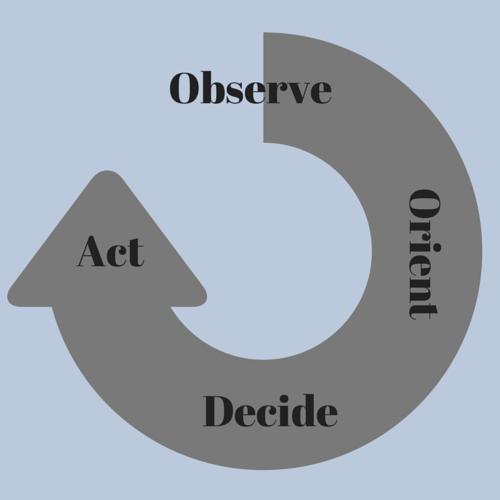
The OODA loop is one of my favourite strategic tools because it highlights the competitive advantage in speed and learning in a Responsive Organisation. I have also found OODA a useful mindset for my blogging and a way to ship posts consistently.

What is the OODA Loop?

Developed by a U.S. Airforce strategist Col. John Boyd the OODA Loop is the concept that strategic advantage goes to the party who can best navigate the decision loop through observing the situation, orienting themselves, deciding what to do next and translating that decision into action. Through transparency, autonomy and experimentation, a responsive organisation moves decisions to the edge of the organisation accelerating its OODA loop to deliver better business value.

How does OODA accelerate my blogging?

Observe: My blogging is built on a foundation of being constantly on the look out for insights. Every day as we work we are exposed to great ideas, wonderful learning and exciting conversations that challenge our thinking. The more I capture the more I learn and the more I have to share. Are you tuned to observe and capture these opportunities to share through a blog? Managing your attention to observe these moments and building a system to capture notes at the moment helps.

Orient: A blog is an expression of your cumulative knowledge and experience. Finding a way to orient a new observation against your current knowledge matters to building a consistent philosophy. You need to know how a new post fits into your blog. Once I have an insight I try to quickly connect it to other ideas on the blog and elsewhere that extend the thinking. Building this system of links helps reassure you of the value of a new post. Ultimately I would like these links to provide an ever evolving network structure to the ideas on my blog.

Decide: Struggled with a white screen? Found your 500 word post is 2000 words long? These are challenges of deciding what you are writing about. Decide to share one small simple idea. Keep it simple. Stop when it is done. If the idea gets complicated break it into a series. If you have oriented well then the decision on the role and scope of a post is a little easier.

Act: Write. Just start. The best way to solve a problem in a post is to write. You can always throw out and start again later. Only by writing and posting do you generate the interactions that create new insights. Embrace permanently beta. Ship the post and let others help you learn more. This focus on action in blogging is the power of working out loud.

Accelerating the OODA cycle on your blog reduces the risk of a writer’s block or a monster post that can be finished. Work out loud one idea at a time and invite others to share and accelerate your learning.

International Working Out Loud week is from 17-24 November 2014. For more on #wolweek check out wolweek.com. International Working Out Loud week is a great time to put OODA into action in your working out loud.

Standing In: The Future of Work

image

What are you doing to cut through the challenges of attention in the future of work?

Attention Discriminates

Yesterday a client found me in a busy activity-based workspace by my colourful socks. There were too many dark suited males sitting at desks but only one was wearing loud socks. A distinctive trademark cut through the challenges of attention.

Our attention discriminates. We deliberately focus to exclude distractions. When humans lived on the African savannah there was already too much information and attention was a way to economise.

When we enter the future of work that issue of attention explodes. Streams of updates, flat networks of relationships to follow and complex rapidly changing environments create a load on our attention. If you want to be recognised for your efforts in this environment you will need to stand out.

Wearing colourful socks won’t cut it. Socks don’t scale. The traditional response of the extroverts among us just adds to the noise. One pair of colourful socks is a discriminator. Many are noise. We see the same with the ‘look at me’ cries on social media.

The future of work might not be about standing out. Perhaps it is about standing in.

Standing in

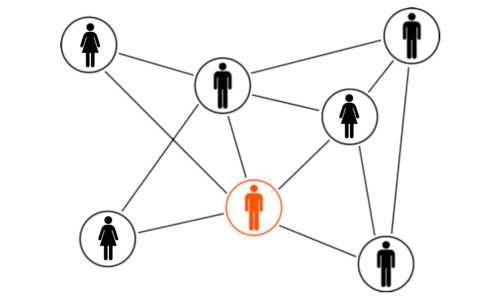
The way to get noticed in a network is to be a valuable node. Your goal is not to push yourself to isolation at the edges, it is to contribute to value creation at the core. In short, you need to stand in (networks).

How can we stand in more effectively? The Value Maturity Model offers us a guide:

  • Work for a purpose and gather those around you who share that purpose
  • Make connections between people to improve the efficiency of the network
  • Share relevant information, add new information to your networks and don’t pass on the dross. Working out loud is a great practice that helps others and John Stepper has described how working out loud works for introverts.
  • Help solve problems of others in your network
  • When you see an ability to make a unique difference, take that chance. Innovative opportunities don’t happen often. Take a risk and leverage your network to make something unique happen.

To fight the discrimination of attention in the future of work, focus on standing in (networks).

image

Why #responsivecoffee?

Yesterday was another great responsive coffee event in Sydney. The event began with my short talk about creating value with social business and working out loud. I shared some insights from the Enterprise Social Collaboration Value Maturity Model as a framework for developing a more responsive culture in an organisation. Then the group dived into a vibrant conversation sharing challenges and opportunities as people work to make their organisations more responsive.

One question I am often asked is ‘what is the value of a Responsivecoffee event?’ Here’s my response:

Connection matters:

People working in change can feel isolated. Simply meeting others doing similar work can make it feel more possible. Connection is the foundation of community. After the session yesterday there were all sorts of new connections established that will support people to do more work faster.

Connection is also important because of the diversity of Responsive Organisation challenges. People attending the event were considering the Responsive organisation approaches from the mindsets of consulting, communications, learning, knowledge management, technology, change, property management and many more functional areas. The connections cut across the boundaries of organisations, products, industries, roles, functions and ambitions of the organisations. All those diverse connects help expand the range of possibilities and enable clients to implement change faster.

Sharing Matters:

The conversation was a treasure trove of insights and shared experiences. That sharing encourages people and enables fast change. Many people are just starting out in the journey of being more responsive and more social. Hearing the stories others shared have them confidence to start and a sense of the possibilities and challenges ahead.

Problem Solving Matters:

Many people brought a practical problem to the table and over coffee leveraged the collective insights of the group to move forward and move faster.

Innovation Matters

Responsive coffee remains an agile experiment in value creation. The formats change to create value for those who are attending from session to session.

We are even seeing new intercompany collaborations and experiments being spun off these events. Participants are going away to work together to create new products and services to help accelerate change and address challenges shared. If you don’t bring people together to explore what might be possible you will never see the next horizon.

The Value of Responsive Coffee is Accelerated Maturity

The benefits of Responsive Coffee reflect that of the Value Maturity Model because a purposeful cup of coffee with other change agents is an act of social collaboration. We need more and richer connection to accelerate change in our organisations and the adoption of new ways of working for value. Value occurs in the rich conversations of social collaboration.

Long live #responsivecoffee.

Image credits: 

Coffee: http://pixabay.com/en/coffee-cup-time-meditation-talk-14662/

Photo of Responsive Coffee: Luke Grange

The Last Thing We Need is an Enterprise Social Network

Dear CEO

Re: The Last Thing We Need is an Enterprise Social Network

The purpose of this email is to explain why the last thing we need is an enterprise social network.

This email is in response to the conversation about enterprise social networking in the executive leadership meeting yesterday. We thought it best to summarise the position of the leadership team, because yesterday’s conversation got derailed by anecdotes about social media, technology terminology, fear of change and discussion of abstractions like collaboration, future of work and new organisational structures. Before you left the meeting, you remarked “Based on this discussion, I think an enterprise social network is the last thing we need”. We agree.

We don’t want faddish technology. We need execution of strategy.

As CEO, you’ve been rightly suspicious of all this discussion of social inside the organisation. It is bad enough that your teenage children never look up from using social media on their phones. Whatever that involves, it can’t be needed activity in our organisation. We are a place of work.

What made this country great was well-run organisations, hard work and increasing effectiveness in creating value for customers. That takes focused strategy, disciplined execution and a willingness to do the hard yards. Great organisations aren’t built by chasing technology whims. They come from executing strategy to create better value. When we need to create better execution on strategy, the latest fashionable technology is the last thing you need.

We need better strategic value creation

Times are tough. Industry is more competitive than ever and change keeps increasing. We know customer and shareholder value needs to go up and costs need to come down. We have a strategy that is about meeting these new customer & stakeholder expectations, improving the organisational efficiency and delivering the returns that shareholders demand. We all wonder from time to time whether everyone in the organisation gets the imperative of the new strategy and whether they are all working hard enough to find new ways to create value. We know that we perform better when we have better conversations to make sure that our employees are aligned to the strategy. What we don’t need are distractions when there’s doubt that people even understand the strategy.

When we need strategically aligned value creation, the last thing you need is an enterprise social network.

We need new more effective ways of working

To fulfil the strategy of the organisation, we know as a management team that we will have to start to work in new more effective ways. There has been too much wasteful duplication of work in the organisation. Too many of our processes & policies don’t line up across the silos, aren’t agile enough for the environment and don’t meet customer needs. Both our customers and our employees complain about how badly we do this. We need to start working in new and different ways to identify, solve and improve this on a continuing basis. We have to focus everyone on find and using better work approaches that help us to fulfil the strategy.

When we need working in new and more effective ways, the last thing we need is an enterprise social network.

We need to change management and leadership in every role

Working in more effective ways will likely require us to change the way management works. We are going to need to push decisions down to people closer to the customer and give our people the ability to fix problems. We will need our managers to move from command and control to a coaching and enabling role. We need to ensure that all our people are realising their potential and able to work to create new sources of value. Of course in this new role, middle management will need to be trimmed and the new flatter organisation will need to change more often as we respond to further changes driven by our customers. Employees will need to step up into a leadership role in these changes and with customers, the community and the organisation.

When we need to change the culture of management and asking every employee to play a bigger role in leadership, the last thing we need is an enterprise social network.

We need different conversations

Changing the culture of management is going to demand very different conversations in our organisation. We are going to have to find ways to make sure that conversations are efficient and effective. We need to leverage the contributions of more people from across the organisation. We won’t be able to rely on long meetings, workshops, speeches, video and emails. Did you see the budgets for communications, off sites & roadshows in the forecast for next year? We have to do something different. We will need to involve our people more in making decisions. If that’s going to happen our people will need to be better informed and better able to channel their contributions. Our people will need ways to inform themselves, learn by pulling what they need, share ideas of how to work better and collaborate to solve work problems. We are going to need to encourage our people to join conversations that use their capabilities to innovate, to create value for customers and create new forms of working.

When you need to change the conversations, collaboration and culture of an organisation, the last thing you need is an enterprise social network.

We need more from our people

We wrapped up the last executive leadership meeting reflecting on how big these demands will be on our people. We will be asking for a lot of change in them, their work and the way the organisation exists around them. We will be asking our people to play an increasing role in the success of the organisation. We will want them to lead new conversations to create the future for this organisation. We need our people to be more engaged because we will need much more from our people.

Conclusion: What we need

After you left the executive leadership meeting to catch up with the board, we realised that we are clear what we need as an organisation:

  1. we need to succeed by fulfilling our strategy to create greater value in a rapidly changing market; and to do that
  2. we need to be able to work in new & better ways that create a more effective, agile and responsive organisation; and to do that
  3. we need a new culture in management and more leadership from our people; and to do that
  4. we need new conversations that enable our people to discuss and act on creating better strategic value; and to do that 
  5. we need more engagement and a better ability to leverage the potential of our people to contribute to and lead this change; and to do that
  6. we need an enterprise social network to support the first 5 steps.

If you are surprised by point 6, think back through the needs again. After all you were the first to say that an enterprise social network is the last thing we need. We don’t want an enterprise social network because it is new technology or because it is good for some abstract goal. We need one to help our people to execute on the changes necessary to achieve the goals of our strategy. Enterprise technology only makes sense when it enables us to work in new ways that deliver strategic value. As your management team we can see that the value creation opportunity is compelling. We couldn’t see it when you made your remark, but we have come around to your perspective.

The paperwork required by our old process is already on your desk, but a number of our people have started experimenting with solutions to see what value we can create. (Interestingly, their first suggestion is a better procurement process.) When you get back from the board, your assistant will show you how to log-in and join us discussing how we implement in the new enterprise social network.

Thanks for challenging us to come up with a better way of working.

Please think of the environment and don’t print this email. We’d encourage you to discuss it on our new enterprise social network instead.

If this post sounds familiar or if you would like to create greater value in your enterprise social network or discuss how the Value Maturity Model applies to assist your organisation to create strategic value through enterprise social networking and collaboration, please get in contact. I am available through @simongterry or Linkedin or www.simonterry.com