Innovation: From Crisis to Critical

Yesterday for HISA’s series on Innovating Health, along with Vishaal Kishore, I facilitated a discussion of healthcare leaders on how to create a culture of systemic innovation. In the conversation we discussed the insight that participants in the healthcare system are great at innovation in a crisis. When the urgency and need are high, resources are made available, change leadership arises, collaboration comes forth and novel solutions are pushed through to solve challenges. We need to reflect on why the innovation and change that arises in a crisis is not more critical to our organisations.

Learning from Crisis Innovation

Many organisations and systems are capable of extraordinary things in a crisis. Inspired by crisis level performance, the response of leaders can be to seek to leverage and replicate this capability beyond the crisis. Many leaders try to recreate innovation and change through a manufactured crisis situation, either through a ‘burning platform‘ or simply a high pressure project environment.  These strategies result more often in crash than crash through. It is rare that sustainable change flows from a skunkworks or a pressure cooker because people and systems push back on embedding and adoption of change when the crisis subsides and practices return to normal. These interventions are transactional and not generative. In addition, the costs of a rolling crisis to employees and organisation involved can be extreme.

Other leaders take the view that innovation is only possible in special circumstances and therefore look to create space for those unique circumstances of shared purpose, collaboration, leadership and resourcing. With this mindset comes a focus on a special extra space for innovation. This space ranges from extra time, to special teams, to extra funding through to dedicated innovation labs. There is an important role for dedicated space for innovation. Critically these spaces can act as ‘wiggle room‘ to enable change agents to learn and demonstrate their potential and to enable organisations to test approaches and see proof the value of innovation. Extra space for innovation can be a key part of a transition to wider changes in the system to foster and support innovation across the organisation.

The inadvertent consequence of both of these approaches is a view that innovation is over and above work.  Innovation happens in a crisis, a project or a lab. It doesn’t happen at my workplace. Innovation is what others do when asked. Sustainable systemic innovation requires organisations to focus on how innovation can become critical to work and not a crisis. The best innovations are driven by the insights, interactions and lessons of the flow of everyday work.

Critical Innovation Leadership is Leadership

When we look at some of the human elements that align in a crisis situation to enable people to push through to realise new ideas, we can see that many of these circumstances are not that special at all. In fact they should be critical to the success of any work. Leaders should foster these in all work. Clarity of purpose supports all work. Focus on value for diverse stakeholders improves effectiveness of work everywhere. Great leadership and collaboration to work across silos and around barriers is essential to all work. Resourcing and risk appetite should be driven by value creation and the needs of work. A learning mindset is critical for all work in an era of continuous change and rising expectations.

We can and should address challenges in crises when they arise. We can all benefit for the extra reflective space, practices and resources for special areas devoted to innovation. However, the challenge for all work and all leaders is how to move innovation and change from crisis to a critical everyday part of every role. We need to focus on the capabilities, behaviours and systems that enable and act as barriers to innovation in everyday work. Aligning and improving these aspects of the system will benefit all work.  All work benefits when leaders set about creating the ideal circumstances for innovation and change.
Changing Work is Hard

cwv3irtuqaa4po4-jpg-large

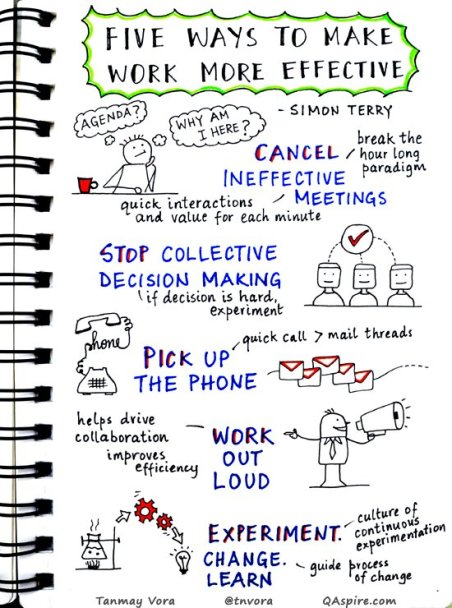
Some time ago I published a post on five small changes that we can each make to make work more effective. Tanmay Vora turned the post into the great sketch above that has been widely shared. On the weekend I wondered whether all this sharing actually helped anyone to change their work. Tanmay and others responded that they were using the sketch as a guide to their work. However, my question remains open. Do we have as much change as we should? Do we act on the small ways to improve work?

Changing Work is Hard

Changing work is hard.  We would all like work to be more effective, but we continue to cling to ineffective practices. We know there are better ways but we don’t always use them. Why is there a gap between our future of work intent and action.

Let’s look at some of the reasons why changing work is difficult.

Reactive not Reflective: We are busy.  Being busy often deprives us of the time to reflect on how best to do our work or how we could improve our work.  While time pressures should present an incentive to plan a better way, we often think it is better to just start.  Take the time each day, if only for 5 minutes to reflect on how your work could be improved.

Habit: There is comfort in habit. Habits provide patterns of certainty in an incredibly volatile and uncertain world. Habits can be behaviours or habitual mindsets. Together they create ingrained and unthinking behaviours. Sending an email or organising a meeting is a routine next step and others will share the habit making it harder to break.  Find triggers for new habits. Make a choice to think and go another way and lead people away from bad habits.

Social Capital: Dave loves his meeting. Dave has perfected his meeting to suit his needs and his project. How do I tell him that it is a complete waste of everyone else’s time? We aren’t always great at feedback and we hate to put our accumulated social capital in jeopardy, particularly if what we are asking is out of the usual. Explore better ways of working with your work colleagues through collaborative coaching conversations. Encourage them to reflect and to help you find better ways of working too.

Fear: Our workplaces are full of fear. Fear power, fear of ostracism, fear of loss of status or wealth or purpose. Our workplaces put the full neurological gamut of status, certainty, autonomy, relatedness and fairness under threat. Adding change to the mix risks upping the fear quotient. We need to make the benefits of change clear to ourselves first and then to others. We need to use these elements of our uncertainty to help us, not hinder us.

Conscious Incompetence: New skills are hard. They don’t work as well as our habits. We may have been unconsciously incompetent at our old approach, but as soon as we try something new we are conscious of the gap in our skills. Practice and experience is the only way to improve our skills. We need to do the work and get better.

Initiative: Nothing changes unless someone acts to influence change. We can wait for our boss or others to discover the change themselves.  However, to bring about change sooner we need to exercise individual leadership and take on the challenge of making change happen. We must be our own role models. We need to find our voice and lead with our actions to change the way we work.


Simon Terry provides consulting, advice, speaking and thought leadership to global clients through his own consulting practice, and as a Charter Member of Change Agents Worldwide, a network of progressive and passionate professionals, specializing in Future of Work technologies and practices.  The focus of Simon’s practice is assisting organizations to transform innovation, collaboration, learning and leadership. 

Getting Past The Obvious

One of the commonest forms of corporate sabotage of change is to raise a difficult issue as an obvious objection. The challenge is not raising them but working to resolve them through conversation. Don’t accept the obvious.

Present a new idea or try to make a change in a large organisation and at some point you will encounter the following behaviour. Somebody will to raise a complex and difficult issue as an obvious barrier to the success of your project. They will frame their naysaying in the name of straight talk, speaking on behalf of others, being a devil’s advocate or even helpfully raising an issue that others may be too supportive or politically correct to discuss.

These conversations appear everywhere:

  • “We need to make changes to adapt to digital” “But, let’s look at these digital competitors. They are tiny and none of them are making money. Why should we copy them? We will have to give up a lot of margin if we do.”
  • “We are planning to be more diverse in our hiring” “But, and I hate to say this, if we are honest we haven’t found the talent available for the roles we have and I’m not even sure they are interested.”
  • “We want the organisation to be more collaborative” “But, we need to be realists and recognise we have demanding targets, a headcount reduction and if we asked them our people would tell you they are already busy”
  • “We want to be more innovative” “But, isn’t innovation just the latest consulting buzzword? Our customers don’t want costly innovation. They want a lower price”

The objection is carefully designed to appeal to an ‘obvious’ point and to make the speaker appear intelligent for having considered a wider range of issues than you have presented. Many of these issues are valid challenges that your project needs to address.  Many are also overblown or illusions. The challenge is that the speaker expects the ‘obvious’ to be a definitive answer. Even if you can create a conversation about ways to move forward past this issue, the speaker won’t be contributing to the solution.

Getting Past the Obvious

Here are some suggestions to avoid this issue

Anticipate the Obvious: If it is going to be raised anyway, it is better that you raise the issue yourself. Challenge yourself and your team to engage stakeholders early and flush out the obvious and not so obvious objections that might be in your path. Understanding the likely objections and potential responses is an important part of handling this challenge.  Preparation will also give you the best chance to dispute a throway remark in the moment with facts and evidence.

Hold the Tension: The person raising the obvious issue expects the conversation and your project to end. Resolving difficult issues requires hard conversations. Plan for this hard conversation and allow yourself the time to keep your stakeholders in this hard conversation until progress is made. Create an environment where this challenging issue can be discussed and progress or new perspectives might be found.

Bring the System into the Room: The challenge comes from bringing a selective part of the system around your project into the room. You need to consider how you can involve a broader view of the project and its stakeholders. Can you bring out broader benefits that make persisting worthwhile? Can you bring other voices into the conversation to offset the obvious?

Reframe the Obvious: The obvious remark may also hold a clue as to the path to its solution. Look at the examples above. If margin is the issue, then what if profit is lost to unmet disruption. If a stock of talent is the issue, how do we redefine, find or create a flow of talent. If workload is the issue, how can collaboration help. If price is the issue, how can innovation drive value.

Ask to Do the Work: A lot of obvious issues turn out to be no issue at all in practice. They are built on untested assumptions, rumours and guesswork. Ask to do the work. Ask for a richer conversation with a wider group of stakeholders. Ask to put the issue to the test by doing an experiment, a pilot or gathering real data. Too many obvious barriers are only barriers around conference tables.

Don’t accept the obvious issue as a barrier to the progress of your project. Your stakeholder may not even care. They might just want to appear clever in the meeting. Do the preparation and the work and you will carry your project far beyond the obvious issues. The real challenges are the issues nobody anticipates.

#WOLWEEK Day 2: Make A Connection

Welcome to International Working Out Loud week which will run from 7-13 November 2016. The Theme of this Wolweek is “Working and Sharing Purposefully”. 

Each day this week this blog will share a discussion of the 7 Days of Working Out Loud post. Thoughout the week and in the coming weeks we will also be sharing blogposts, interviews, and other content to help practitioners of working out loud to lean and to spread the movement.

7-days-ofworking-out-loud

Day 2: Make a Connection

Working out loud exposes us to the networks of other people in our work. Understanding and leveraging those networks begins by making a connection.

generosity

Nobody Works Alone

Everybody works with others. Even remote lighthouse keepers, solo yachts people and shepherds have networks that support their work or depend on the outcomes of their work. We like to focus on our solo heroic efforts to achieve our goals, but we do so by excluding the view of the networks that support, collaborate in and benefit from our work. Working out loud is a way to bring those people back into our work.

Understand the Networks

Effectiveness at work in an era of global digital network connectivity depends on understand the networks in and around our work. We can now see and communicate with all the people in the networks of our work.  Ignorance or inaccessibility is no longer an excuse.

The networks in and around our work don’t respect boundaries. They don’t stop at the edge of your part of the hierarchy. They don’t stop at the edge of your process. They don’t respect the boundary of your organisations or geography. Those networks go where the work demands.  They are connected by the fulfilment of purpose. The better we understand these networks of people the more effectively we work.

See the People

These networks are not technology. They are a flow of human conversations and interactions. You are working to engage and benefit human beings. The new opportunity in working out loud is to connect personally at a real human level. To see, acknowledge and begin to understand that person an the relationship to your work.

Don’t look for stakeholders, managers, colleagues or customers. Look for the unique individuals who are a part of your work. Some will hold many roles. Share your work with them so that you can benefit from a better understanding of their unique needs, capabilities and dreams. Averages lie. The more individual and personal your connection with those around your work, the more effective you will be. Hidden insights, capabilities and help will only be revealed when you build a personal connection and a relationship of trust with each individual.

Make a New Connection

Consider the network of people around your work. Which people the greatest mystery? Where do you most rely on reports, averages, data and other myths rather than a human connection? Those people are where you need to deepen your network connections.

Take the purpose of your work to those people and make a new human connection. Share something. It doesn’t have to be big or finished or grand.  It just needs to start a conversation. Ask that person what they want or need or fear. Ask that person to share their life and their work. At some level, people love acknowledgement and the opportunity to talk about themselves. Connect at a personal level and you will begin to see the magic of working out loud as a practice.

When you look for the people around your work, you will likely see those who help and support you who you have not acknowledge adequately. Take the time to celebrate these people. Make a new personal connection with them by thanking them for their support of your work. Turn that thanks into the beginning of a new conversation.

Make a connection today. At a minimum you will enjoy the conversation.

Simon Terry

WOLWEEK Partner

Change Agents Worldwide is the Principal Partner of International Working Out Loud Week. Change Agents Worldwide helps organisations and individuals leverage the potential of working out loud to create more purposeful and effective work.

caww_logo_footer

Just Start: Working Out Loud in #WOLWEEK

What are you going to do today to share your work in progress in a purposeful way?

simongterry's avatar#wolweek

It is never too late to take advantage of International Working Out Loud week (7-13 November 2016).  All you need to do is start sharing your work purposefully.

The week before Working Out Loud week is always a busy one.  The most common topic of conversation is “is it too late to do something ?”  My answer is always the same “No, let’s do it.”  The theme this Wolweek is “Working and Sharing Purposefully”. That applies to how we promote working out loud during the week too.

People often want to overthink and overplan working out loud. They want to do it exactly right. They want to know they are doing it in the authorised way.  They want to know exactly what will happen when they share their work before they do so. They want to know what method of starting working out loud in their organisation will work best for…

View original post 266 more words

Word Gets Around – Reputation and Working Out Loud

People often worry about working out loud because they believe the practice poses a risk to their reputation. In the modern networked workplace, it can be a greater risk to have no reputation or one chosen only by others.

Working Out Loud involves purposefully sharing work in progress so that others can learn and contribute. Many people used to traditional ways of working where only final artefacts are shared see this as a risk to their reputation.  They are worried that experiments, errors, revisions or even the confusion of the development of work might reflect badly on their expertise. They worry that their reputation may suffer if they share their work before it is perfect.

Reputation is an important component of the networked workplace. As our work becomes more agile and dynamic we need to make decisions on who has authority, who we can trust and who influences our decisions. Reputation plays a key role in influencing these calls.

However the best reputations are based on stories of actual work. They aren’t based on a  marketing pitch. You get a reputation not just because of the output you produce but how you produce it. A good reputation is rarely one of how someone perfectly executes 100% of the time without drama. Those stories are too unreal and too boring to share. Great reputations are people who solve problems, engage others and demonstrate their abilities working through challenges and triumphing in the end.

Surprising your stakeholders by sharing some of your challenges may be risky but it is far riskier to pretend you have none. Pretence is the way reputations are destroyed.  Building a deeper relationship by purposefully sharing the work, seeking input and creating solutions to challenges together will make your stakeholders an engine of a positive reputation.

Many people who are worried about reputation actually create for themselves the opposite risk. They share nothing of their work. That silence is not filled by people saying good things about their work. With nothing specific to attract attention or to discuss, most people won’t say anything at all. In a sceptical world, the absence of a reputation is bad news.  The silence that is created is filled by people talking about other topics or worse talking from ignorance of what is going on and why.

Word of your work gets around. To build a strong and healthy relationship, you want discussion of your work. Shape the views and conversations about your work purposefully through working out loud.

International Working Out Loud week is from 7-13 November 2016.  See wolweek.com for more details.

Digital Workplace Masterclass

Really Looking forward to helping people set up their plans for 2017 with this Strategic Planning workshop for Enterprise Social Networks and Digital Workplace initiatives. Join us in Melbourne on 16 November and set yourself up for success.

Anne Bartlett-Bragg's avatarRipple Effect Group

digital-workplace-masterclass-banner

Melbourne – 16 November, 2016

Did you know that digitally mature workplaces are 26% more profitable than their competitors?

Digital technologies are fundamentally changing the way we work beyond purely operational efficiencies that lead to cost savings. Digital workplaces offer organisations and employees the opportunity to deliver real strategic benefits. To achieve the benefits and successfully transition there are 2 key elements: a clear vision and a well constructed implementation plan that also defines measures of success. How prepared is your organisation for the changing business landscape?

In this practical masterclass, Anne Bartlett-Bragg and Simon Terry will guide your development of a strategic plan for your digital workplace approach. Combining deep dives into practical use cases for your organisation with a workshop to develop your own personal strategic plan, this masterclass will put you in the position to lead and manage your workplace implementation to success.

This workshop is relevant to people…

View original post 344 more words