Collaboration Everywhere

My early business career was in business development, buying and selling businesses and pulling together joint ventures. One thing I learned through that experience is that no matter how conflicting someone’s position was to yours, there was always a way to work together. You just needed to understand how and where their interests aligned with your goals.  Work hard enough to understand what they want and eventually a path forward together will open up.

Collaborating with Enemies

Reading the book ‘Collaborating with the Enemy’ by Adam Kahane recently, I realised how this early business experience meant I came to the work of organisational collaboration with an uncommon mindset. Kahane highlights that much discussion of collaboration focuses on the idea of one cohesive team with an agreed view of the problem and the solution. Kahane contrasts this with his term ‘stretch collaboration’ where there are multiple groups in conflict, where the group needs to experiment a way forward to solve the issues and where maintaining engagement is a key challenge. My friend Harold Jarche makes a similar point with his distinction between collaboration and cooperation.

This distinction is a critical one in organisational contexts. In many corporate and client situations in which I have worked the value of in team collaboration is obvious to people. In a team, everyone shares a leader and there is clear alignment of goals. The value of collaboration outside that team is usually less clear to employees who have come to see other teams as competing for resources, success and even existence. The great challenge of organisations seeking to transform to digital ways of working is not moving faster in the inner loop of the team. Moving faster and more effectively in a team context is a problem whose dynamics are largely known and there is leadership to deliver that outcome. The challenge of digital success is engaging the complexities and misalignment of the wider organisation.

Creating Psychological Safety for Collaboration

I can see now that my early career experience meant that I didn’t always fully understand the reticence of people to engaging in this wider outer loop stretch collaboration. Much research has highlighted the need for leaders and teams to create psychological safety to enable effective collaboration. Employees aren’t going to take risks and experiment if the environment feels unsafe.

My previous career experience had given me an unusually high sense of safety in risky forms of collaboration.  Worse still, it was obvious to me that you could collaborate to mutual advantage with competitors and people who shared no interest in your success. That is not a point that is obvious to employees who don’t feel safe in their organisation.

Organisations have not made that point obvious to their employees and many poor leaders enhance the within team dynamic by excerbating competition with and fear of others in the organisation. One of the benefits of working out loud is to enable people to discover the value of connection with people beyond their day to day networks and also to discover through contributions how their interests might align to achieve goals.

Focus on Alignment

One of the key themes of the work that I have done with organisations, leaders and employees using the Collaboration value maturity model is to stress the value of alignment, a step usually skipped in people’s rush to deploy new technology and race to the good bits of collaboration, like innovation.

slide1

The Connection and Sharing phases of the Collaboration Value Maturity Model are opportunities for teams to understand and develop the rationales, behaviours and trust required for more effective collaboration. Activity in these two phases, led by leaders at all levels who are looking for alignment and are seeking connection to higher strategic goals, builds an environment of psychological safety and a strong imperative for employees to connect, share, solve and innovate together well beyond the boundaries of their immediate team. Working out loud reinforces the transition from sharing to solving as employees increasingly discover their interests are aligned with widely divergent teams across the organisation.

The value of the Collaboration Value Maturity Canvas is as a tool of alignment and one that reflects the fractal nature of collaboration in large organisations. The Canvas brings people together to see what they share and how their individual and team contributions to collaboration can achieve wider goals.  Like Kahane’s idea of stretch collaboration, the Canvas does not deliver a strict plan but shapes a series of experiments to tackle the challenges of collaboration in the wider outer loop.  The Canvas is not a process or a recipe. It becomes a map as people take the initial pathways and then build out their own.

We shouldn’t need everyone to go experience the challenges of business development in strange markets to build cultures of enterprise collaboration in the modern workplace. What we need is leaders and teams that are prepared to work out loud and focus on the opportunities of alignment in the broader domain of the organisation and its goals.

Simon Terry enables collaboration in organisations through Working Out Loud and using the Collaboration Value Maturity model approach. The Collaboration Value Maturity Canvas is a 2-hour workshop to enable organisations to discover the essential elements of alignment in their collaboration strategy. Get in touch to learn more.


Noticing Out Loud

A few weeks ago, I was struck by the idea that I was commuting to and from work and not paying much attention to the environment around me. Paying attention to little things has been a big source of inspiration for the posts on this blog. I didn’t want to miss opportunities. I chose to pay attention.

I began to reflect on what I was seeing as I walked, caught planes, trains and cars to work in my own and other cities. Some of those reflections caused me to research the history of particular aspects of our work culture like business attire. Other reflections left me with open questions or new topics of inquiry.

Because my habit is to work out loud, I shared the first of the insights on twitter and added the hashtag #morningcommute. That hashtag is a reasonably busy collection of messages of people sharing content about their morning commute. Like any effort at working out loud, I was sharing thinking in progress with a relevant community in my followers on twitter and that hashtag. Because I shared them in the moment, there was a good chance others would be in the same experience at the time too. I had started noticing more and now I was noticing out loud. Most importantly, I tried to frame each tweet as the start of a conversation. There was more I wanted to learn. Here was this morning’s effort:

What struck me immediately was the extraordinary conversations that began to happen each day triggered by the tweet. That tweet alone has generated discussion on digital tribes, trust and connection in under 30s and the future of work, the coaching of kids sport teams and how we teach people to collaborate, the value of talking to strangers and where to find the pack mentality.

I was surprised to get answers and insights from people around the world. Many correspondents were on their way home or even at the end of their day. Some topics went on for days. Others faded immediately.

With one simple step, my efforts to pay better attention were supported by a global community who helped me benefit in my work and presumably benefit in return. A few people became regular partners in conversation on my journey to work. It reconnected me to people with whom I had lost contact. Even better I learned a lot and the discussions pushed me to consider insights I had missed.

Each of these interactions encourages me to keep going, to pay more attention, to reflect more and continue to share. Sharing a simple moment out loud helped me find a community to support the work of paying attention.

No insight or action is too small or too insignificant for working out loud. The community will help you discover value you cannot yet see. The simple act of noticing might be enough to create a special moment of connection.

Agile, Learning & Random Walk of Performance

The pace of business continues to accelerate. Learning is more valuable than ever. We place a high priority on change. However, with this focus on pace and adaptation comes the danger of a random walk of performance.

The Random Walk of Performance

The random walk of performance occurs when the rate of change overwhelms the insights of the performance of that change. We begin to react before we know what we are learning from our changes to improve performance.

Here’s a common example:

  • A product owner wants to test a new product in market with the sales team
  • After the first few days the results are disappointing so they make a change to the communication materials
  • A few days later the results haven’t improved so there’s changes made to the sales approach
  • A few days later the product pricing is changed because the change in sales approach disrupts the sales team and sales decline
  • Later still some more product features are announced to address customer feedback from the first week
  • Eventually with no consistency & no baseline to measure from the team realises that while there may be positive signs now, they don’t know what they learned through this process of change. Would results have improved with time? What changes worked? What should they do now? Everyone is stressed & confused, catching up with the cascade of change, and the confusion isn’t helping performance. Was that the issue all along?

I used a product example but the same situation happens with the development of personal skills. Practising new skills takes time to develop confidence, involves discomfort and needs persistence.  Layer too many changes of approach on top of each other too quickly and it can be hard to develop the desired skills and understand what is driving changes. Far too many people give up on positive changes because they aren’t prepared to wait for outcomes or the change gets overwhelmed by the next new thing.

Avoiding the Random Walk

To avoid the random walk, changes need to be given time to embed into performance and they also need a clear baseline against which to measure performance.  The desire to test multiple changes at once is why many organisations now run complex comparison testing. Separating the changes into different cohorts helps keep clear the impact of each change. It also makes it easier for the system to adapt to each individual change and improves the pace of assessment.

Processes like scrum build in reflection at the end of a sprint cycle so that learnings can be built into the next sprint. Staging learning into the system in this way gives better assessment of the need for and impact of changes.

At an individual level we can manage the random walk by:

  • being clear on our measures of performance and the base performance level
  • persisting with a change until we can understand the impact on performance, often until after the period of conscious incompetence ends
  • resisting the temptation to change everything at once or in rapid succession
  • building in time for reflection

Rapid learning is more important than ever. However a random walk of performance tells us little. We need to plan our changes as part of a process of managing learning and adaptation.

The Narcissism of Employee Engagement

Much has been said about the crisis of employee engagement across organisations. Many organisations actively work to foster employee loyalty and discretionary effort. Little changes.  One driver is the narcissistic self-regard of many employee engagement efforts.

The Narcissistic Organisation

Narcissism is defined in psychology as an extreme selfishness, with a grandiose view of one’s own talents and a craving for admiration. When we examine employee engagement discussions in organisation, much of the discussion reflects this trait. Whether this characteristic is a trait of the leaders of these organisations or even a good thing has been widely debated elsewhere.

I have been a part of many discussions that follow these themes:

  • The organisation not the employee is central:  The discussion revolves around the organisation its purpose, roles, benefits and processes, not employee’s broader purposes, lives or circumstances
  • The discussion is unreal: The only facts in a discussion are the satisfaction survey results. Much of the rest of the discussion is belief, assertion and opinion with little to ground that in the real world employees experience.
  • Employees should admire the organisation: Support for an employee’s issue with the organisation is a signal of disloyalty by the supporter. Failure of employees to admire the organisation is not a cause for reflection. It is usually a communication issue. There is little discussion of reciprocity of admiration or engagement by the organisation.
  • The organisation knows the fix: An engagement survey might use employee feedback to identify issues. Minor communication, role, benefit or process changes might be required but these will be determined by management based on survey outcomes, often without discussion of why or how to address the issue.
  • Need for Change is minor and peripheral: Employees need to be fixed. If the issue is not failure of employees to understand, it is failure of their leaders to communicate the benefits of the organisation. The core ideas, beliefs and processes of the organisation are beyond reflection.

Narcissist have terrible relationships. The constant demands for admiration and the lack of consideration for others is wearing. Narcissists struggle to see these issues because of their self-absorption. If our organisations approach employee engagement in this spirit it is no surprise we have made little traction for change.

Engagement is A Human Relationship

Employee engagement is a characteristic of a relationship between the employee and their colleagues. That relationship occurs in a whole series of conversations, interactions and experiences across the community in the organisation. How the organisation is viewed is simply an outcome of these human relationships.

We cannot change employee engagement without bringing that entire community actively into the discussion of the problems, the rationales, the needs and the solutions. Changing the dynamic of employee engagement requires organisations to make some key changes to their process of considering engagement:

  • Start in the real world: Nothing changes if employees feel the organisation is an unreal place and discussions don’t connect to their reality of the work and their lives beyond the organisation. The whole real world impacts their view of the organisation.
  • Involve everyone:  There is no ‘organisation’ without its people. Bring everyone into the discussion. Make sure the goals and solutions you pursue make sense to everyone.
  • Give employees the loyalty and regard you desire: Don’t ask for what you can’t reciprocate. If there isn’t a relationship, don’t try to pretend. It won’t work.
  • Have a conversation in a relationship: Let both parties talk. Widen the discussion to cover the whole relationship and its impact on others.
  • Connect the conversation beyond the organisation: The power of discussions on purpose and the organisational connection to customers is that they help ground engagement in the meaningful work of employees to help others.  They make the organisation focus on real issues.  An outside-in focus also changes the frame and can u


Thoughtless Comfort

Now that I look back, I realize that a life predicated on being obedient and taking orders is a very comfortable life indeed. Living in such a way reduces to a minimum one’s own need to think. – Adolf Eichmann

I went looking for a quote about the need for thought and the dangers of comfortable life for a blog post inspired by a client conversation. I wanted to write about the challenge of discomfort and learning. I came across this shocking quote and it could not help but throw the issue into a starker relief that I will explore in this post. I will return tomorrow to the business story I wanted to tell but first let’s talk about the threat of thoughtless comfort.

Hannah Arendt in her book and essays ‘Eichmann in Jerusalem‘ gave us a memorable description of Adolf Eichmann’s role to execute the Holocaust during the Third Reich.  She described Eichman as an exemplar of

‘the fearsome, word-and-thought-defying banality of evil’.

The second half of that phrase is commonly quoted. Eichmann tried hard to present himself as following orders at his trial. Arendt focused a great deal on his compliant active participation in the evil of the Nazi system. The impression she created is that a compliant mind is particularly banal, even when engaged in the horrors of genocide.

On the Thoughtlessness and the Banality of Evil

The horrors of the Holocaust were real and clear. Eichmann played a significant role in the Nazi state’s plan for ‘the final solution to the Jewish question’. For some, Arendt’s phrase ‘the banality of evil’ has been controversial. Some commentators see Arendt as having fallen for Eichmann’s efforts to minimise his complicity. Other commentators feel the ‘banality of evil’ phrase downplays the horror experienced by the millions of victims, Eichmann’s own role in perpetrating evil, or distracts from the actions of other evildoers.

However, Roger Berkowitz argued that Arendt was making the point that those who participate willingly like Eichmann in these kinds of evil movements:

‘are thoughtless in the sense that they abandon their independence, their capacity to think for themselves, and instead commit themselves absolutely to the fictional truth of the movement.’

Whatever, your view of the controversy, we are left with a stark example of the need to discourage ‘thoughtlessly & dutifully’ participating, acquiescence to the comfortable paths of conformism and unwillingness to learn in the face of reality, especially the reality of evil.

Thoughtless Comfort

This context brings us back to the less often quoted first half of Arendt’s phrase, ‘word-and-thought defying’. A compliant mind brooks no independent thought and no other word. An compliant mind offers no chance for reflection, no time for learning and no chance for a change of course. When we chose to commit ourselves to a group, movement or a larger community at the price of compliance with fixed beliefs, we have become thoughtless.

That thoughtlessness can offer a form of comfort. The hard work of thinking and challenges of solving for reality is taken away. Without the need for any effort to challenge our views or change our actions we are in a perverse, reality-denying and self-denying form of comfort. Our biases are not disrupted. Our actions are secure. We need not engage with the world or learn anything new. Many of the uncomfortable demands of the modern world have been removed.

Worse still, this attitude in a community can be reinforcing. Vaclav Havel noted in his 1990 New Year’s address to the Czechoslovak nation, a nation coming out of totalitarianism, that a compliant mindset had created a ‘contaminated moral environment’ that sustained the previous system:

We had all become used to the totalitarian system and accepted it as an unchangeable fact and thus helped to perpetuate it.

Thankfully today, outside of the remaining totalitarian states on the planet, we do not need grapple with state enforced pressures to conform. We do not the need to sacrifice learning, thought and independent action for the comfort of fixed beliefs.

Yet, we experience smaller moments of thoughtless comfort every day. Our civil society is strained by media bubbles that tell us what we want to hear. Our politics deals less with reality and more with with comfortable messaging to match strongly held ideological positions. Many organisations place enforce the comfort of compliance, beliefs and a tight binding culture for their employees. Our social cliques can involve real peer pressure and shape how we interpret and act in the world. We form habits we repeat long after they remain relevant. Savvy marketers offer us pre-packaged solutions to implement without reflection. In a world of real threats, rapid and daunting change, these forms of comfort can be very appealing.

Thoughtful Discomfort

The real problems and opportunities in our world are not going to be solved by thoughtlessness or belief. Compliance is not a path forward no matter how large the movement or community. Worse still, compliant mindsets and thoughtlessness throws up at us the risk of evil and other dangers that the world faced through the systems of totalitarian states.

Each of us must value the opportunity to think, to learn and to act independently. We are going to have to lead the hard conversations and the difficult collaborative work of learning and change. With that thoughtfulness comes the embrace of an ongoing level of discomfort. That discomfort is not to be avoided, it is the price of learning together engaged in the reality of our shared situation.  Discomfort is the price of a civil society that is generating solutions together.

Leadership of the Inner Loop, Outer Loop and Transition

slide12

Leaders need to change their style of work to suit the different types of engagement in different domains.  Leaders should recognising that open collaboration in platforms like Yammer focuses more on leading by influence. They can also play a critical role in helping people see the opportunities to work in different ways through coaching and mentoring

One of the areas for further discussion I called out in the post on the role of Transition in Inner and Outer Loops was the area of leadership. It is important to note that leadership in this context includes hierarchical managers but is also wider, including the leadership actions of peers and other champions. Leadership, in the sense of inspiring action in others, might be a key expectation of managers but we know that not all managers are leaders. This post examines how leadership fosters collaboration in each domain and the role leaders play in tranitioning between domains of work. In the previous post, I said

People don’t need to know ‘what to do where’ so much as they need to know when their current mode of work is ineffective.

Leaders, whether hierarchical or peer leaders, help people see these opportunities to change.

Inner Loop – Leading Performance and Execution

Most managers are familiar with the approaches to achieve performance in teams focused on execution and continuous improvement. The challenge is usually the consistency of a manager’s leadership behaviours.

Inner Loop platforms can help increase the volume and velocity of communication of managers in these teams, addressing a key challenge for many managers in their performance and their leadership.  Better awareness across the team and its stakeholders of key issues and challenges will also enable managers to chose to lead in more relevant ways that drive better performance.

As teams embrace the potential of the Inner Loop, transparency, autonomy and rapid communication, also increases the potential for peers to play a leadership role. The Inner Loop should also enable greater sharing of customer feedback and voice to guide performance and shape the improvement opportunities pursued. Hierarchical leaders should be encouraging customer focus in decision making in this domain and encouraging other leaders to take action to drive improvements in performance.

Agile has seen rapid adoption as a work practice because of its potential to support autonomous teams reacting to new customer feedback where leadership can come from any role.  The Inner Loop of rapidly adapting teams, both hierarchical and cross-functional, is a great environment to develop the leaders of the future.

Transition – Leaders Create the Need to Change

We can get so focused in our execution challenges or so enthusiastic about our communication with a wide network that we don’t see the need to change our behaviours. In both the Inner and Outer Loops of collaborative work, coaches and mentors can play a key role in helping individuals to improve their performance.

Coaching is critical in encouraging individuals and teams with a focused pursuit on delivery to reflect, to consider alternatives and to ask for help. While many people in focused work feel that stopping to look around is a waste of precious time, the advantages of being able to reuse work, borrow capabilities or have new insights deliver an exponential return on the time invested.  Great coaching questions from leaders will foster this reflection and the opportunty to try another approach.

Mentoring is a way to spread learning across the network. Like coaches, mentors can prompt reflection in either domain that will help foster change. One of the reasons to underpin an organisation collaboration strategy with a ready team of champions is to create a force of mentors to help your users with issues, ideas and new ways of working.

Investing in coaching and mentoring programs in your organisation is a key part of a balanced focus on performance using the 70:20:10 model of learning. That investment in coaching and mentoring will help you leverage improvement in work across both the Inner and Outer Loop.

Outer Loop – Leading by Influence

All employees in your organisation benefit from better understanding the dynamics of influence in the networks of the outer loop. This is a realm where the writs of power run shorter than many hierarchically powerful leaders expect. Networks value contributions and contributions create value.  Insistence on decision making power or overreliance on orders weakens an individuals influence in networks because they have the ability to treat blockages as something to route around.

To gain influence in networks, leaders of all types need to practice some key fundamentals:

  • to stand for something – a vision, a purpose, some values, or a goal
  • how to win trust & respect – authenticity, credibility, showing alignment, showing capability and delivering for others
  • be known for your own action – set an example, demonstrate capabilities and values, put evidence behind your reputation, give generously of your time, capabilities and experience
  • create motivation – using a vision and narrative, shared goals and personal connection
  • foster action – highlighting gaps, making action safe, encouraging experimentation, encouraging reflection in others, fostering tensions and being provocative.

Working out loud by sharing a persons work can help foster these conditions of influence. The genius of John Stepper’s five elements of working out loud are that they are well aligned to creating the ideal elements for influence:

  • Focus on relationships
  • Generosity
  • Visible work
  • Purposeful discovery
  • Growth mindset

These characteristics can be rare or unusal to traditional managers brought up in the domain of hierarchy. To enable them to be effective leaders in outer loop context we need to build their capabilities to act in new ways.  We also need to foster and reward the champions and other leaders who demonstrate these approaches to encourage all employees to leverage the potential of the outer loop.

transition loops

Solving Work Problems Out Loud & Outside

Working out loud can sometimes seem quite abstract. The benefits can seem a little obscure. Here’s a little story of how purposefully sharing your work in progress can create a great experience that makes work easier and more effective.

A Story of Working Out Loud Outside

I interact a lot with the Customer Success Team for Microsoft Office. We are both trying to help clients to find the best ways to implement Office capability. These situations can vary from client to client because each one has a different strategy, a different culture and a different plan. There’s always something new to learn and a new problem to solve.

Today as I travelled to work, I got an external Yammer post from Avi Sujeeth, a Microsoft Customer Success Manager in the US. I’ve known Avi for a while through online interactions only.  Avi was in discussion with some of his colleagues around an issue about organisational structures for IT teams that he needed to solve for a client. Avi had previously seen a post I had written on the same topic in the Microsoft Tech Community.

By @mentioning me into that thread in Microsoft’s Yammer Community, I was able to join into that thread of conversation between the Microsoft team from around the world. The thread appeared as a notification in my inbox in my ChangeAgentsWorldwide Yammer. I answered the question to the best of my abilities.  Over the next 30 minutes, in and around other tasks I was doing, we had a quick back and forth to clarify some issues.  I went on with my day in Melbourne.

Breaking Down the Benefits

When I next checked Yammer, I saw a new notification of a follow-up message in the thread from Avi pointing out the power of what just happened.  Included in that post was the following quote (shared with permission)

I had no idea where this conversation was going to go. I don’t have Simon’s email. I did it all in about 30 minutes because of async communication. Work Out Loud rules.

There’s little reason to believe that I could have contributed to solving a problem for Avi if he hadn’t his work in progress, based on a mutual understanding from a history of sharing our work. I don’t have Avi’s email. I didn’t know he was based in Texas until I looked up his LinkedIn profile to include it above. I don’t have a clue what he is doing other than what he shared with me. He was on a deadline that I didn’t discover until the last post. The ease and the curiosity with which Avi could share that challenge with me made it incredibly easy for me to quickly understand the issue and reply to the best of my ability. The whole interaction took less than 10 minutes of my time.

Importantly, Avi wasn’t sure what he might get from his question to me. Avi took a risk putting the message out there. I could have been in a workshop or on a plane. I might not have had anything of value to say (I’m still not sure that I did). There’s some comfort that he probably got better answers to his question to me from his peers while I took my time responding. Having shared a work challenge out loud his colleagues could all jump in to the conversation too.

Would Avi have got the same answer asking me publicly or privately on Twitter or Linkedin? Maybe, but then he may not have got the participation of his colleagues and I wouldn’t have had the same sense of engaging in a team response to a problem. Being part of a purposeful team is highly engaging, even if it is just a single thread. Because this was one thread with many other people from organisation I know well, I knew I could trust the team and I felt safe to share my thoughts and get feedback – the dynamics of responding were better and a better solution resulted.

Working out loud is a powerful tool for solving work problems because when people share work in progress purposefully with relevant communities. Examples like these are what we need to achieve to move the conversation in collaboration from sharing to solving work problems. Once people work out loud consistently organisations and individuals see benefits quickly further driving collaboration internally and externally.

PS:A short comment on external collaboration features:

Many organisations turn off external messaging and external groups in Yammer because they don’t understand the experience or have fears of security or data sharing breaches. This example of an agile and fluid form of external collaboration is a what is lost in that decision. Avi could have got my email from a colleague and emailed me but it would have been the same information, just slower and less engaging. More and more organisations need to work not just across silos, but across organisational boundaries in rapid collaborative teams.

Fast or Slow – Accelerating the Value of Collaboration

slide1

This morning’s #esnchat led by my Change Agents Worldwide colleague and change management expert, Jennifer Frahm involved a vibrant discussion about how to launch an ESN quickly. A strong theme of the discussion was that collaboration takes time to build and you should take care not to rush that development. The Value Maturity Model above is founded in the growing sense-making and culture change in a community that surrounds that community’s embrace of new ways of working.

Launch Quickly. Succeed Slowly

In part the question is not the real issue. Launching a social collaboration solution of any kind is not the problem.  Launches can be put together in days or weeks depending on your passion for chaos. Send some communications, enable the network, have a fancy launch event and you are done. Launch is complete.

However, a successful launch, even with a high level of engagement, is not the point of collaboration in your organisation (this article was pre-reading for the #ESNChat discussion). Your organisation and your employees work to create business value. Until your collaboration platform is sustainably creating that level of business value your job is not done. The Value Maturity Model describes some of the key steps to that growing maturity over time.

What if you don’t have the time?

We don’t always have the stakeholder support to take time. Many organisations want or need to get going quickly. Launch dates become fixed in the calendar before organisations understand why they are seeking to launch a collaboration platform. The key issue in my experience is that the same organisations who want to go quickly are usually those who think that going fast will make their collaboration network cheaper to launch and run.

The value of a purposeful, strategic & vibrant collaboration community is that it becomes self-managing. The community begins to develop the value and the engagement that drives its own future success and growth. The community becomes the example to all new users as to ‘what we do here, how we do it and why’. Over time that self-managing, self-promoting and self-correcting characteristic of successful collaboration platforms is what reduces their cost to operate and accelerates their value creation.

Setting up a community to become purposeful, strategic and vibrant takes time and money. If you want to do that quickly, it will cost you more money up front in the planning, leadership and communication, not less.  You will also need to invest more money over the life of the community to manage the higher risks of failure and to sustain the community after launch until it becomes self-sustaining.

Community managers often bemoan the continued focus of business leaders on the costs of their work. Many organisations seek to continuously cut budgets and resources for community management over time. Let’s be clear that organisations decrease investment when they lose confidence in the returns from an activity. Community managers are the agents and architects of strategic value in collaboration. They need to embrace the challenge and justify their ongoing investment in their growing returns.

Given there are many platforms in the market that promise fast engagement (& with good evidence to support it), the issue is not how quickly you engage in use of the platform. The key challenge for any user and any organisation is how quickly their use of a platform becomes a self-sustaining contributor to the fulfilment of purpose and sustained value creation. When clients ask me why the investment in developing their community using the Value Maturity Model is required, my answer is that they can skip the work, but they risk skipping the value. The value of a clear strategy and an effective approach is that it accelerates the value of strategic collaboration.  If you want to go fast, you need to plan for more costs, now and later.

Failing Forward in Management Science

A new scientific truth does not triumph by convincing its opponents and making them see the light, but rather because its opponents eventually die, and a new generation grows up that is familiar with it – Max Planck

If science advances one funeral at a time, management ‘science’ advances more slowly. For management to advance, there must be a radical transformation in the nature of work and our organisations that makes old management practices extinct. That change is now underway as digital transformation changes our industries and our work.

Changing the Paradigm

The word ‘paradigm’ fits niceley into a buzzword bingo square for most in management. It is a fancy term that consultants like to throw around. However, paradigms are why science advances ‘one funeral at a time’. Prevailing theories in a scientific discipline create culture and power structures that are self-reinforcing. Thomas Kuhn referred to this as a paradigm – “the practices that define a scientific discipline at a certain point in time.”  Those practices shape who has seniority, what looks like a right answer, who gets to decide what is published and which research directions are acceptable. By shaping what is measured, what questions are asked and how answers are interpreted, a paradigm has a long reach shaping the continuation of that approach.  As long as the proponents of the current paradigm are in power, alternative approaches are often suppressed or at least confined to the periphery.

Management likes to see itself as a science of measurement and performance, but the reality is that it is far less scientific. Much of management is complicated resulting in difficult or remote or multi-factor connections between cause and effect.  Much of management is still run on intuition or prevailing opinions. These elements reinforce the prevailing paradigms.  If we look for dramatic changes in the theory of management, they are few and far between, many of the everyday principles we have today can be traced to the beginning of the industrial revolution or to Taylorism at the beginning of the mass manufacturing age.

How can these ideas be so enduring when in many cases there is strong evidence a management approach is ineffective. There is plenty of evidence that pay for performance remuneration and highly targeted performance environments can be ineffective, costly and even counter-productive. However, these approaches remain the default way that organisations manage, measure and reward performance. Dan Pink gives some examples in this short video.

Why does it takes a radical shake-up in the nature of industry and our organisations for managers to reflect on whether there is a fundamentally better way of fulfilling their roles? Management theorists like Gary Hamel have been calling for management innovation for some time but the progress has been weak. The few managers who have sought to lead change have been seen as mavericks with the adjective ‘dangerous’ held back for private conversations. Even successful examples of new management approaches such as those flowing from the Toyota Production System have been either isolated to a few organisations or been adapted to fit within the prevailing management paradigm for general consumption.

Here’s my hypothesis. Failing ideas in management survive because the measurement is weak so proving failure is less direct than in a university experiment and the social pressures to conform in management are so strong. Career progressing in management is entirely dependent on being a right thinking leader like other past successful leaders. Worse still the paradigm in management has become ingrained in processes and systems so that efforts to change require radical overthrow of the way businesses work. The outcome is that change is not a question of a generation of management dying off. Change in the paradigm can require a whole industry model to die off under the competitive assault of new models.  The first industrial businesses powered by water, steam and machines killed off the craftsman model of industry. The mass-manufacturing businesses and Taylorism killed off the first industrial models of work.

The Next Great Extinction of Management

The next great extinction of management has already begun with the digital transformation of business. With the rise of new digital competitors, we are seeing a new found energy in the innovation of management. This time around the innovators have management directly in their cross-hairs with new work management practices like Agile and approaches like increased use of analytics and prediction seeking to either remove traditional management roles or reshape them entirely.

Traditional organisations have begun to look at their practices afresh as they see traditional management role models struggle and fail. At the same time, they admire and seek to replicate the success of newer organisations, hiring their talent and seeking to bring new practices across at the same time. The change is not always driven by evidence or even success. In many cases, the shifting management paradigm is simply driven by a fear of being left behind and the need to create evidence of change that enables the next career opportunity.

With a great deal up for debate and much of the future paradigm in flux, the market for management is as confronted with much insightful and proven practice and a great deal showmanship & thought leadership. The lack of a clear path and the flailings of traditional managers to either defend old ways or jump on new approaches can be frustrating for change agents looking to consistently build new and better approaches to work. The better organisations are embracing their change agents and realising that they cannot import ‘best practices’ whole they must adapt new ways of working to their own circumstances and organisation.

Change Agents are critical for organisations navigating these changes.  Management is less a science and more about the creation and shaping of a culture of performance. That culture is inherently local to each organisation and influenced by the complexity of the environment, team, purpose and goals of that team. As the surrounding environment in organisations becomes more complex and the pace of business continues to drive change, businesses cannot rely any longer on importing best practices and copying them onto their organisation. They must be looking to develop adaptive cultures of perfomance within their organisation that are learning and continuously changing.  Platforms that enable change agents to sustain this change will be critical.

By the time you hear about the next great management book that everyone is reading, the paradigm will have changed. Focus instead on how your organisation can manage the process of learning and adaptation to deliver excellence in performance and the realisation of human potential. That’s the future of management

Inner & Outer Circles – Team of Teams

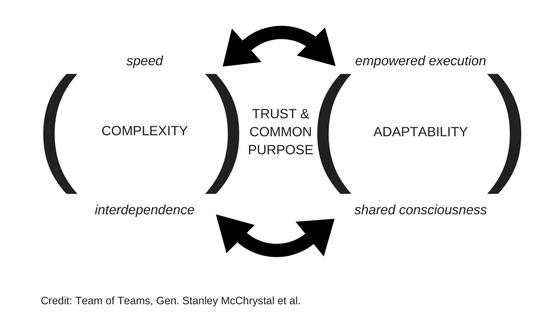
Last week I had a couple of long flights and I read ‘Team of Teams’ by Gen Stanley McChrystal et al. again to refresh my understanding of the authors’ insights into creating agility and responsiveness in an organisation tackling complex rapid change. At the conclusion of the book, the authors describe their model for an effective team of teams combining speed, empowered execution, interdependence and shared consciousness in an environment of high trust and common purpose.

‘Team of Teams’ highlights that traditional hierarchical environments struggle to adapt to the pace and complexity of change. The cost of information exchange across a hierarchy and the lack of autonomy prevents effective adaptation. Teams can ameliorate this at a local level if properly managed but a hierarchy of teams will have limitations on its ability to adapt. Structuring a more fluid structure that allows for constellations of teams working as a network is the key. This Team of Teams can adapt and reorganise itself while sharing information across the network in a rapid and responsive way through practices like working out loud.

McChrystal et al. note that complexity comes from the speed of change and the interdependence of parts of the organisational system and surrounding environment.  Adaptability depends on being able to manage individiual execution in a pervasive awareness of the system and the role that players are taking and the actions that they are undertaking.  Coordinating these elements requires a universal understanding of purpose and high levels of trust across all in the organisation.

1

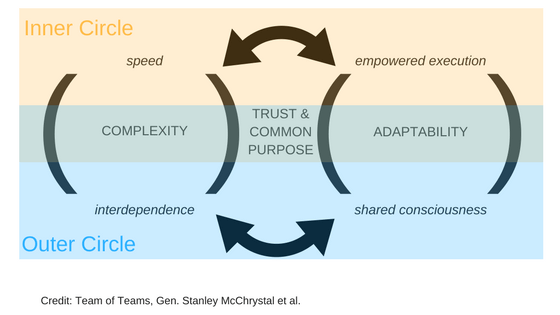
What struck me was the alignment to the Inner and Outer Circles of work that are at the heart of Microsoft’s Collaboration product strategy. The Inner Circle in the Microsoft version is the environment of speed and empowered execution. This is the environment that solutions like Microsoft Teams are designed to support. The Outer Circle is the work environment of organisational connection and discovery. In the Outer Circle teams have the opportunity to share the visibility of their work with others widely across the organisation and explore unexpected connections around their work.

2

There is overlap in both circles and as noted in my previous post, the shaded areas above only capture the core environment of each circle. You can push the circles and their associated products to cover the entire domain of a Team of Teams if required. However, each pattern of work is different and there is value in specialisation.

What is critical to note is that Trust and Common Purpose are issues in both an Inner Circle team and and Outer Circle community. Both depend on purpose for shared connection and a sense of direction and trust for effective collaboration. The work of community managers and leaders is to foster trust and shared purpose. This is the work of change and adoption and where the alignment to the value maturity model supports the development of community.

slide1