Standing In: The Future of Work

image

What are you doing to cut through the challenges of attention in the future of work?

Attention Discriminates

Yesterday a client found me in a busy activity-based workspace by my colourful socks. There were too many dark suited males sitting at desks but only one was wearing loud socks. A distinctive trademark cut through the challenges of attention.

Our attention discriminates. We deliberately focus to exclude distractions. When humans lived on the African savannah there was already too much information and attention was a way to economise.

When we enter the future of work that issue of attention explodes. Streams of updates, flat networks of relationships to follow and complex rapidly changing environments create a load on our attention. If you want to be recognised for your efforts in this environment you will need to stand out.

Wearing colourful socks won’t cut it. Socks don’t scale. The traditional response of the extroverts among us just adds to the noise. One pair of colourful socks is a discriminator. Many are noise. We see the same with the ‘look at me’ cries on social media.

The future of work might not be about standing out. Perhaps it is about standing in.

Standing in

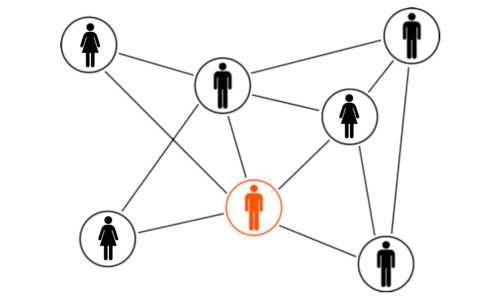
The way to get noticed in a network is to be a valuable node. Your goal is not to push yourself to isolation at the edges, it is to contribute to value creation at the core. In short, you need to stand in (networks).

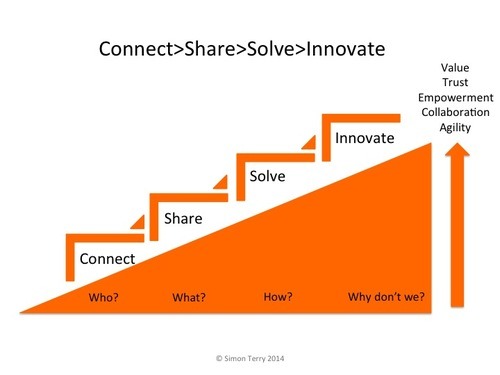
How can we stand in more effectively? The Value Maturity Model offers us a guide:

  • Work for a purpose and gather those around you who share that purpose
  • Make connections between people to improve the efficiency of the network
  • Share relevant information, add new information to your networks and don’t pass on the dross. Working out loud is a great practice that helps others and John Stepper has described how working out loud works for introverts.
  • Help solve problems of others in your network
  • When you see an ability to make a unique difference, take that chance. Innovative opportunities don’t happen often. Take a risk and leverage your network to make something unique happen.

To fight the discrimination of attention in the future of work, focus on standing in (networks).

image

Disruptive Purpose & Emotion – Experience Design

image

Disruption is often presented clinically as a rational economic & technological process. Often the only consideration of emotion referenced is the emotions in the reactions of those disrupted. Focusing only on the rational misses a lot. Remember Clayton Christensen, who did much to create disruptive innovation’s present focus, began trying to understand companies that seemed to the traditional participants they undermined as irrational entrants to markets.

We can open consideration of disruptive opportunities to a wider range of influences and inspirations. We must not forget the opportunity to design for emotion, passion and purpose. There is much disruptive potential in the design of new and better services and many opportunities to make work and life more human in the process. 

The Emotional Opportunity at Disrupt Sydney

At Disrupt Sydney 2014 in the anti-panel, an unusual theme rose from the synthesis of the morning’s insight into ongoing activities in digital disruption. A recurring theme was the power of emotion, experiences and purpose. We reflected that perhaps as discussion of disruption matures from a focus on technical wizardry, there is a rise in the elements that make disruptive forces more human.

Disrupt Sydney’s keynotes and short talks had laid a strong foundation for the rise of this theme of human emotion & purpose.  Maria Ogneva had spoken of building community and movements, stressing the pragmatic needs for common purpose and human interactions. As Maria noted community is a human activity. Community is not a use case or a feature. Paula Bray had shared insights in the use of digital in the Powerhouse Museum to create new open conversations and experiences. Ruben Martin had described the potential of sharing human intent and developing solutions to bring people together around intent. Equally the compelling Mya Dellow, aged 13, had described the potential of Minecraft to engage students in education because of its open, creative and addictive nature. Most dramatically, Marc Sagar had wowed the audience with a demonstration of Baby X, an intelligent toddler simulation. This latter talk reinforced the value of emotional interaction and the high bandwidth of personal human communication. 

With this wide range of inspirations, the anti-panel played a key role by empowering the audience.  Participants needed time to synthesise, connect and learn with others on their experience of the morning, to reflect on their own emotions and to connect what they had learned to their personal purpose. The anti-panel was a learning experience.

Experience = Purpose + Process + Emotion

As the focus of disruption shifts to the disruptive opportunities in services, it must increasingly account for emotion & purpose, two very human characteristics. The disruptive services will succeed or fail on their ability to unite a customer purpose with a process of interactions and associated emotions to create something unique, memorable and compelling. Creating community through new services requires an even deeper focus on the purpose, the interactions and the emotional journey.

Best practice is no longer to plan for optimum efficiency in a process or a product. Efficient solutions will always be outperformed eventually. Many providers of efficient services never give any thought to the purpose their customers are fulfilling. That is their loss. If their logic never moves beyond the purely rational drivers of efficiency, then real humans will move on to the next better solution to their purpose, a little dissatisfied that their human needs were met so narrowly and so blandly. 

Design for a Human Experience

Better practice is to design for a human experience that enables a purpose and shapes the emotional value of that experience. A diverse market of consumers will have differing purposes and experience differing emotions. There is an incredibly breadth of opportunity to engage them through emotion and purpose.

Some consumers will care about your values. Others will want to know that you have treated your employees or the environment well. You may not be able to satisfy them all. The way the design of your service or solution outperforms in this challenging but human domain of competition is the foundation for something truly disruptive. That radical disruption is to design for human experiences.

By adding human purpose and emotion to our normal focus on process, we start to make work and our lives more human. In addition to focusing on the opportunities at the bottom of markets, we should focus on that which lies in the bottom of our motivations and decision making. There is a much richer opportunity in making experience design more common in services.

Action Changes Culture

It’s easier to act your way into a new way of thinking than to think your way into a new way of acting – Millard Fuller. 

To many in management, culture seems like a soft topic best left to Human Resources or Communications . To this mindset, culture is a matter of getting the words right, saying the right things and having the right tools & programs to change culture. Culture change is a communications issue. Often this results in culture change programs dictated by senior management with a goal of uniformity of culture in the organisation. These approaches at best fail quickly and at worst are counterproductive, generating employee cynicism.

Culture doesn’t work this way. Culture arises in a group of people when there is an expected pattern to interactions. The expectation forms from a consistent and predictable pattern of actions. Rituals are a classic example of how culture is transmitted. Words may help us to notice a change and tools may enable new actions but only the actions done consistently create the new mindsets.

The focus on expectations and actions also highlights how unlikely uniformity is. With consistent behaviour to shape expectations groups may develop a commonality of expectation. However uniformity of expectations remains unlikely. There will always be local variations for good reason. A good reason may be that a different pattern of action is better at fulfilling the organisation’s purpose or customer needs in this context. The heart of embracing diversity as an organisation is understanding these variations and leveraging them too

Expectations cannot be imposed. Begin with discovery of the expectations and the actions that really exist. Be honest. Failure to accept reality won’t help. Creating change then becomes a matter of understanding how to change actions to consistently deliver new patterns and to shape different expectations.

I am often asked ‘how does an enterprise social network change culture?’ There is no universal answer to that question. There are no guaranteed changes in expectations and actions in an enterprise social network just as there is no universal culture. Enterprise social networks in the right circumstances enable transparency, leadership, learning, problem solving, innovation and enablement of people. Where the culture is hostile to these things they do not, without significant investment in changing the way people act and interact.

Better questions are ‘what actions and interactions in our culture will be facilitated by an enterprise social network? How can we encourage these actions to become more consistent? What would these actions do for the expectations of our people as to how we behave here?’ These questions focus attention on the hard work of creating consistency in a community of new and different actions.

The impact of culture on the actions and interactions in the organisation is ultimately why Peter Drucker famously said ‘Culture eats strategy for breakfast’. Strategy that hopes for action inconsistent with the culture’s expectations will fail.

Start new and different actions now. Start small. Build new habits. Experiment with new ways of working. Action matters

Action creates culture. Focus on the actions, not the words or the tools.

Leaders Aren’t Painkillers

No team wants to hear they need pain. We wish for less anxiety, pain and challenge at work from time to time. We can wish our leaders would take the pain away. However, leaders aren’t there to be painkillers. Nobody says:

‘Sounds like a problem. Take two leaders and call me in the morning.’

Leadership is the technology of realising human potential. Effort, challenges, pain and anxiety are a key part of that process. Leaders who remove all pain underperform.

– in a complex fast changing world obstacles are the work. There is no steady painless state. Relief is illusory and temporary.
– pain is feedback: the pain we want leaders to remove is a signal we need to change.
– the right challenge is productive: human potential is realised against a growing challenge and developed through effort. We learn by doing not by being led.
– tension and conflict is a reason to examine our thinking, create new approaches, explore the broader system and collaborate better
– painkilling creates dependence where the leader is expected to solve greater and greater levels of challenge and the team just rests until things are painless .

We tell ourselves we need pain in many polite ways when we talk about the importance of flow, tension, mastery, practice, learning, empowerment and effort. Nobody likes to endorse pain. No team wants to hear that they need it. Sugar coating just leaves teams unready for the effort and change involved.

Great leaders don’t remove all pain. They engage teams in solving their own challenges. They work with others to remove the unbearable but maintain the productive pain.

Separating Ownership, Decisions, and Returns?

Capital intensive industry united Ownership, Decisions and Returns 

At the beginning of the industrial era, establishing a corporation was a challenge of capital. Manufacturing plants demanded ever larger amounts of capital for plants, equipment, raw materials and to fund the costs of production and distribution. The providers of capital were the entrepreneurs and were rewarded with the returns of the venture and control of the decisions. This was reinforced with the adoption of hierarchical manage structures to manage assets and information and control decision making.

We have carried through to modern management practice the unity of ownership, decision making and return. We simply inherited these concepts from original corporations. One of the few adaptations is a necessity of scale that in many large organisations with diversified shareholding boards and senior management have taken the decision making (and in some notorious cases the returns) as agent of the shareholders. Even still the prevailing dialogue is the maximisation of shareholder returns.

The Future of Work Changes the game

Increasingly we work in networks as knowledge workers, often spanning the boundaries of organisations in our sharing and work in the process. Knowledge work is rising as a share of the work in the developed economies. 

Dan Pink popularised that purpose, mastery and autonomy are sources of motivation and engagement. Knowledge workers particularly benefit from a sense of ownership of the work and the ability to make decisions as to how work will be delivered. Freeing these enables the development of mastery of the craft of knowledge work.  Harold Jarche has highlighted that work gets better with freedom to share and connect as well.

Importantly in manage knowledge working roles, value creation is potentially exponential and directly related to the worker’s talents and outputs. An engaged knowledge worker is far more productive than one filling a role in a hierarchy and a process. 

Ownership, Decisions and Returns aren’t tied together

We need to move from a default position of uniting ownership, decision making and returns. The process and approach we use for each should be a unique decision in our organisations.

Own Purpose: Ownership of capital differs from ownership of the purpose of the organisation. Shareholders rarely provide the means to bring people together and give them the meaning to contribute their efforts.  This broader sense of ownership of purpose and a commitment to the community of the organisation is a far more important leadership challenge in the networked knowledge working organisation.

Free Decisions: We can separate decision making from shareholding. Modern management would not be possible without this. However we still allocate decision making to hierarchy as proxy for shareholders. With appropriate coordination, knowledge workers can have far greater autonomy to make their own decisions in line with the strategy of the organisation, to experiment and use networks to coordinate and resolve issues.

Reward Talent: Capital may still needs its return. Returns are needed to attract the people who fund the start-up, help with infrastructure and provide the working capital to enable a knowledge worker to be paid before a customer pays. Those returns may not always be financial. Importantly, this return will often be after the substantial returns to knowledge workers for their contributions. Again this concept is not new. Professional service firms, investment banks, movie studios and other businesses dependent on the value creation of knowledge workers have paid high shares of returns to their knowledge workers. 

Legal Structures Change All the Time

The corporation is just a legal structure. Legal structure change when needed. We have employee owned businesses, not-for-profit companies, B companies, social enterprises and many novel forms of organisation because people saw the need to work in a different approaches to ownership, decision making and returns. 

These changes apply to for-profit businesses too.  Look at any joint venture between two large corporates and it will have a complex series of agreements implementing different models of decision making, ownership and returns than that which flows from the traditional shareholding approach. Many global corporations already have different classes of shares to separate ownership, decision making and returns. Management can use the same approaches internally to separate and improve ownership, decision making and returns.

Responsive Organisations need to ask themselves the question:

What approaches to ownership, decision making and returns will help our people to better engage with our purpose and respond to our customers?

Change that leverages these answers will help make work more human

Status is Over

Don’t report status. Share ongoing work and let collaboration advance the work.

Most of the time in meetings is spent sharing and discussing status. A large portion of our emails are status updates. In organisations with social networks much of the information shared is in the form of a status update.

All of this information is better pulled as needed than pushed in a time consuming way to everyone. As we all know, listening to someone else’s status is rarely relevant or useful. What has happened is done. If you are impacted or involved, you already know. For everyone else, the value rarely justifies the time

Importantly, all that can happen from a status update is awareness. Many of those a status updates are made solely to make others aware of our performance. Often the consequence of that awareness may be identification of an error or problem after implementation.

When you work out loud on work that is ongoing, there are many more valuable conversations that can be had. People can:

  • help solve problems
  • suggest improvements
  • highlight risks or issues 
  • add information or ideas
  • offer assistance
  • avoid duplication
  • reuse your work practices or approach to improve their own

Reporting status is good for history books and the ego. Reporting on ongoing work is better for learning and collaboration.

The Extraordinary is the Ordinary Consistently Applied

image

Inconsistency is the norm. The extraordinary is the ordinary consistently applied.

I attribute all the success that I have had in my career comes down to one point.  My successes came about because I tried harder for longer at some simple thing.

  • I became a CEO because I tested myself with the little acts of change leadership every day for over a decade that built my skills and understanding of how to influence, to set a strategy and to lead a business
  • was invited to join Change Agents Worldwide because of my change advocacy and the thought leadership on this blog and I had been working on change every day for years and building my thoughts and writing daily for more than 4 years
  • my current consulting work in change leadership, collaboration and customer experience is not the outcome of any single insight. It is the consequence of learning more every day.

Whatever talents I might have were much less significant to my success than the willingness to put in the daily effort over a time span of years. After all, there are a mighty lot of talented people out there. It is far easier to outstay them than out perform them. If you put in the effort, you will discover, many extraordinarily talented people never start or give up at the first, second or tenth setback.

My actions aren’t extraordinary. I am a generalist, not a specialist. It is rare when I have the capabilities to make a unique difference. In our complex networked collaborative world, it is increasingly rare someone delivers on their unique capabilities alone. The generalist knows to leverage a network and is more likely to attend to all the disciplines needed for success.

When others are trying to achieve the extraordinary, often it is the small steps of change that are over looked. Consistently attending to these small efforts is much more likely to deliver the results. 

I have also discovered that luck is the outcome of effort, opportunity and preparation. Luck rewards those prepared and still trying. Working and learning consistently means when a new opportunity arises you have a better chance of success.

Just as talent rises from a community, extraordinary performance rises from consistency of effort. If you read biographies and history the theme recurs; Overnight success is an outcome of years of effort.

So don’t despair at the lack of an obvious way to be extraordinary.  Remember inconsistency is the norm. Your path to the extraordinary is the ordinary consistently applied.

So What Now?

Leadership is always a fallible hypothesis.

Leaders must be capable of being wrong to be engaged in leadership. If you are telling people what they want to hear, it isn’t leadership. If you are speaking in platitudes, then you aren’t leading anyone.

Leaders engage others in the hard work of change.

A testable hypothesis

The surest way to test the hypothesis of your leadership is to engage others and ask them to work with you. They will either follow or they won’t. Nobody can be forced to follow you. Your views aren’t always going to be right.

A leader must take a position that is specific enough to be potentially wrong and specific enough to be actionable in hard work. The change needs to be something detailed enough that others can fight for it or fight with it. Remember being proved wrong or working through opposition can be the critical learning experience in any change.

‘So What Now?’

Avoiding the risk of failure through management speak and motherhood statements only accelerates leadership failure. Any attempt to deceive or avoid simply delays the inevitable.

Too many leaders never discover the failure of their leadership. They leave the room confident but all that remains is question echoing in the minds of the audience:

“So what now?" 

Ideas at play. Are you playing too?

Ideas are always at play. In the great networks of the world they frolic. They bounce, transform, unite, evolve and disappear. When ideas are in play in these networks, it is always fun. There is the exhilarating sense of creation through collaboration through interaction.

Are you playing too? What playful conversations about ideas are going on in your networks? How are you letting ideas play in your own personal network of knowledge?

Nobody knows everything. No idea can’t be tested in play. Three are always surprises in fun.

There are always ideas at play. The only question is whether you are missing out on the fun.

Check your Mental Map

One night at a dinner party visiting friends in London, I had the group laughing at my tortuous path to dinner on the London Underground. As a tourist I had travelled the long way across multiple lines between two stations that are a short walk apart. My mental map of London was the tube map and I didn’t realise how much the geography differed. I am not alone – up to 30% of passengers on the tube take a longer than necessary journey by following the iconic map.

The human brain loves patterns. We absorb maps and make them our guides to daily action. In our work context these maps may not be as pretty as the underground map but we have familiar patterns that describe our inputs, our key relationships, our processes and our outputs. We carry these maps from job to job and organisation to organisation. Often we carry them long beyond their usefulness.

Usual our work maps don’t reflect the potential geography. They are a simplification of the complexity of the real world with real customers. They don’t adjust often enough to the shifting context of our organisation.

Check your mental map. Share your work with others doing similar work or your stakeholders. Working out loud is one way to let someone else’s better local knowledge guide us to a better way. Experiments in changing practices help us to keep our mental map of work updated.

Doing what you have always done, gets you where you always get. Change the map and you change your potential. Look for the opportunity to work in ways that are easier and more effective.