What is today’s experiment?

Today you are going to work, play, eat, create, watch, start, engage, walk, open, converse, complete and dream. The list of verbs that will fill your busy day is long and ever growing. How many of these will you do unthinkingly without considering another possible way?

Make sure you don’t miss an important verb in any day: experiment.

How are you going to experiment? What is the one small change you want to test today? What hunch do you have that things can be better?

Just the act of reflecting on the alternatives will improve your day. Going through your day learning as you measure your experiments will add even greater value.

If you are struggling for a hypothesis to test in an experiment, here are three universal examples to test today:

– you will learn more talking to more people: engage someone in conversation who is not part of your usual circle
– purpose matters: start a conversation about the reason for a piece of work to assess the energy and effectiveness of the discussion
– leadership exists in every role: enable someone to see the difference that they can make. Test your leadership and theirs.

Today is a busy day full of opportunities to experiment with the power of small change.

Look back at the sand behind you

Yesterday I asked a room of managers of Yammer networks in a Masterclass to work out loud. I asked them to share their biggest challenge and their biggest success. The challenges came out quickly. Successes were slower.

This experience is very common. Everyone has some form of success to report. However many need help to focus on what they have achieved.

We work so hard on shifting the sand in front of us. We know exactly how hard moving that sand will be. We know we lack the resources and time. Knowing our challenges is easy.

When we look back at the sand we have already shifted, we realise it is always this way. Work is tough but we get the job done. The obstacles are the work worth doing. Small wins accumulate. However we spend less time appreciating our achievements. We always gave forwards to the new sand.

Working out loud makes the work we are doing visible. It enables other to help us to appreciate what we have done. Importantly it gives us a record to review to appreciate our own achievements.

Take time each day to note one thing going well. Share that work. You will compile a better picture of the sand piling up behind you as you work

Yesterday is over

Yesterday is over. Your issues all ended Yesterday in one moment. You are free. Make today count.

Yesterday was the last day you felt your potential was constrained.
Yesterday was the last day you were unclear on your purpose & value.
Yesterday was the last day you felt you had to keep silent.
Yesterday was the last day that you walked past something that needed fixing.
Yesterday was the last day money, politics, power and process mattered more than people.
Yesterday was the last day of you had to wait for permission
Yesterday was the last day of frustration.

The problems all ended yesterday. The problems were a perception. You see the world more clearly today.

Make today count.

Pay better attention

I stood at the traffic lights this morning beside a toddler in a pram. As the gathered adults stared blankly ahead absorbed in their thoughts or their phones, the toddler intently studied the traffic passing. Every car and truck got intense focus. The toddler was trying to learn something about its strange loud and colourful new world. The adults were elsewhere.

If you want to start small and start now, you need to pay attention to the little things. Small problems, small opportunities, small conversations and small moods all need to be noticed and acted on.

Here’s a question: do you know the shoe colour of the five people nearest you? Shoe colour is not that important but the act of paying better attention is. Paying better attention leads to other insights. For example, if all five are wearing black shoes, perhaps you might want to move somewhere more diverse.

Attention is a sign of respect. Attention is the foundation of learning. Attention drives the opportunity to change.

What small things can you notice today that can lead to a small action of change?

In the spirit of paying better attention, RU OK Day is 11 September. Find out more about how a little attention and a little conversation can make a difference at https://www.ruok.org.au

Start small. Start now.

Each journey of a thousand miles, begins with a single step – Lao Tsu

If you have time to email, then you have time to work out loud. Find one email to reply out loud instead. Repeat.

If you have time to talk, then you have time to lead. Find one person to influence. Repeat.

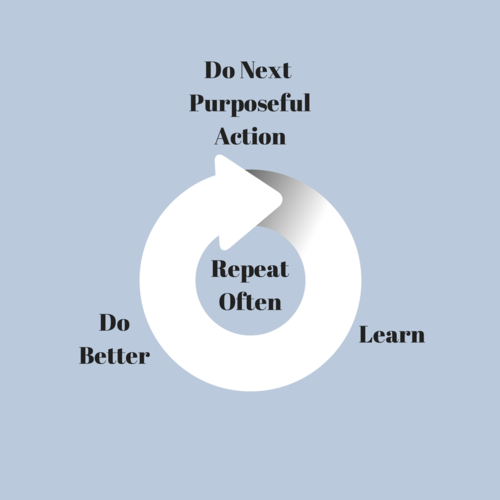
If you have time to do, then you have time to experiment. Find one hypothesis to test in action. Repeat.

If you have time for a meeting, then you have time to start a movement. Find a group to engage in a purpose and action. Repeat

If you have time for a coffee, then you have time to learn. Find one moment to reflect on how to do better. Repeat.

If you have time to fix, then you have time to make change. Find one way to make the system better. Repeat.

Small scale changes accumulate given the time. Small interactions reinforce change and build community.

You have the time and the work. Start now. Start small. Repeat.

The fine art of stress

Be stressed when it matters.

I’m late. Fog has closed in on my destination and the plane won’t take off for a few hours. I hate being late because I believe timeliness is a sign of respect. Timeliness contributes to better productivity of all.

I hate being late but now I am not stressed about the long delay.

Constructive stress

I feel stress about being late up until I begin my journey. That is constructive stress. Stress makes sure I am doing all I can to start on time. Good stress is a motivator to make change, to act and to get going.

Pointless stress

However, once I begin a journey I know it will take the time it takes, especially if it involves planes, trains or automobiles beyond my control. Sitting at an airport waiting for a flight, stress is not a constructive experience. Nothing I can do will change how soon I arrive. Once I mitigate the consequences of my lateness, I can rest in peace. For the next few hours I will get some work done instead of worrying about travel.

Take control

Bearing stress you can do nothing about is terrible for your health. It is deviating for motivation and performance too. If you experience this, change your circumstances, mindset or find a way to do something constructive.

Remember stress is a consequence of your own thoughts. You are anticipating future bad outcomes. Choose your stress wisely. Be stressed when it matters to your ability to act.

Interactions over Transactions

In working with organisations who are implementing enterprise social networking I often hear the same kind of complaint: ‘we wanted to use our network to [insert use case], but that has failed here. How do we fix it?’

One of the dangers of a use case approach is that it engenders a transactional mindset. There is a big difference in a human interaction that is framed to ‘get information’ vs one that is framed to ‘ask politely, learn and acknowledge help’. Often the failed use cases are where the network participant are taking a transactional mindset and not considering the needs of the other person involved. Without interactions that benefit all participants the community, the benefits of the use cases fall away.

A network has transactions. Communities have human interactions. Community creates greater business value. A community has interactions that build long term relationships of trust, learning and collaboration. That’s far more valuable and much more human.

Orderly Processions are Over

Hierarchy likes order. Networks manage complexity.
Hierarchy walks in an orderly procession. Networks hustle.
Hierarchy wants projects to go from a through to z. Networks experiment across the alphabet.
Hierarchy wants a clean status. Networks solve for problems & mess.
Hierarchy reinforces status. Networks value results
Hierarchy manages stocks. Networks manage flows.
Hierarchy likes secrets. Networks share.
Hierarchy approves, authorises and allocates. Networks learn, enable and do
You can wait for your spot in the orderly procession. However the orderly procession might never reach you or might pass you by blind to your talents to walk in lockstep.

Join the network of doers instead.