A Key Question for Working Out Loud

“What to Share Where” guides have become very popular given the breadth of collaboration tools available in an organisation and beyond. They have even generated a parody. Helping people make sense of the opportunities to work out loud is important. However, prescriptive solutions can work against the opportunities that come from sharing work. Not all work fits the formula. Not all tools support community. The bigger opportunity is to encourage people to reflect on the communities that best support the purpose of their work.

The Right Community for Working Out Loud

Concerns about the audience for working out loud dominate the discussion of the topic. Many people get concerned that out loud means total transparency. They worry that to work out loud they must share their work with everyone.  There is no one size fits all answer for working out loud.

The right community matters more than size or the tool used to share. Any form of sharing is making work more public. We need to recognise that there are lots of different channels for conversations and that each channel may have different participants using the tool in different ways. Just because a tool has a dominant pattern of use doesn’t mean everyone we may want to engage uses it in that way.  The tool matters less than the connections it creates and the connections matter less than the sense of community. The right community is one that values your work, has an ability to learn or assist your work and allows you to build deeper relationships.

A Key Question for Working Out Loud

We can start small and expand the community around our work over time as we grow in confidence and learn the value of working out loud. The networks we use to reach our community can be big or small. They can use technology or not.

The key question that we need to ask each time we want to share work is:

“Where is the best community to share this work?”

The answer to that question won’t be the same for every piece of work we do. We might share with one other person, a small group, a team, a business unit, an organisation, a community, a network or the world depending on the work. At times the answer is not to share. Often we won’t be able to predict the best answer and may have to experiment with different networks to learn a way that works for us, our community and the work. In these scenarios, a bias to openness helps us to learn more. Reflecting on the right community, brings our human collaborators to the centre of the question of where to share.

Better effectiveness of work and better relationships come from creating an ongoing reflection about the value of sharing work with others and the right communities in which to do so. This reflection puts the human opportunity of working out loud before the tool or the work. That is far more valuable than the outcome of following any prescriptive formula.
Three Levels of Co-Creation

As we begin to explore the collaborative potential of connection, co-creation is becoming increasingly important solution to problems. Organisations are increasingly looking to employees, partners and suppliers to be a part of efforts to co-create solutions to complex problems. Collaborative co-creation is a key part of the Solve phase of the Value Maturity Model. As we practice co-creation, we discover bigger opportunities to create value.

Co-Creating Ideas

Most co-creation begins with some kind of crowd-sourcing of ideas to solve problems. Diversifying the sources and inputs into the creation of a solution can enable big steps forward. Often new stakeholders have solutions to hand, see potential to reuse capabilities or bring opportunities to do things in new ways. Crowd-sourcing can be a fast and effective way to gather inputs from a large group of people towards a solution.

Efforts at crowd-sourcing solutions need to plan for two main challenges:

  • Lack of Connection: To contribute meaningful solutions, people need to feel connected to the problem and to each other.
  • The Volume of ideas overwhelms Execution: ideas are great but the exercise to sift and integrate diverse ideas can be a drain on execution. This is why many efforts at crowd-sourcing turn into a show of ‘engagement’ with no traction on the ideas submitted.

Co-Creating the Work

The next level of co-creation is when people come together to take a solution and execute it. The challenges of a problem don’t stop when you have an idea. People need to solve all the little issues and manage the idea until it is successfully implemented.

Make sure the expectation in you co-creation community is that work will be done to solve the problem.  Give the community the autonomy to follow their ideas. People will contribute better ideas if they think that they have to see them through.  Co-creation is more meaningful to a community that has been asked to work the problem together. Challenge them to take their ideas and see them through to implementation.

Co-Creating the Problem

The final level of co-creation goes back to the start and looks at the system from a higher view.  This level removes the constraint that the problem definition is externally imposed on the community. At this level of co-creation, the community has responsibility to find, create and implement its own solutions. To do this the community is going to need to start to ask questions about Purpose, the scope of the system and what goals they have for the system.  Bring a diverse group of stakeholders in to shape the problems and you may discover new problems and that some of your current problems aren’t such a big issue. The third level asks the community to own co-creation from Purpose, through Diagnosis, and then to the Design and Execution of any solutions.

The Good Fear

You feel it first as a nervous tension. Don’t turn from Good Fear.  It is here to help. Embrace the Good Fear. Working through Good Fear is what helps you grow.

We all encounter the Good Fear every day:

  • The fear when you don’t know.
  • The fear that comes when you leave your comfort zone behind.
  • The fear of being not quite ready.
  • The fear of an uncertain outcome or a new level of complexity.
  • The fear of being not quite perfect

Because the Good Fear is frightening, uncomfortable and a sign of danger, we might be tempted to back away, to wait or to prepare harder. Instead, the Good Fear is a sign that you are ready. You know where the challenges lie. You may not yet know what to do, but you know something new and better is required.

Good Fear is what puts you on alert, ready to learn and adapt. Good Fear guides you to where your stretch can be found. Good Fear challenges you to bring your strengths to the table. Good Fear shows you what you don’t know and what you know that happens to be false.

Find the Good Fear. Work it.

A Thousand Little Things

Complex change is not about the one big decision or the one big project. Complex change in uncertainty is an outcome of a thousand little things. Launch lots of little experiments.

Researching for a workshop on Agile Change and Culture last week, I revisited the work of Heifetz, Linsky & others on Adaptive Leadership. I was reminded of the concept of the Decision Conundrum. Brought up with models of leadership based on power, we expect leaders to make one big decision to make everything right. However, complex and uncertain change in systems often requires us to make a series of small decisions to prod the system and so that we can learn. Experimentation is a great way to prod a system

Experiment to Learn the Real Adaptive Problem

One challenge we may face is to understand the real problem.  Lois Kelly described a great example of this in a recent blog post. When cultural issues or complex systems aren’t delivering the right outcome we can spend a lot of time on the wrong problems. Too often we try to fit one big, often popular, solution to the poor outcome rather than ensure that we properly understand the problem.

Here are two more examples where the obvious answer to a complex challenge led to counter-productive results:

  • An organisation decides that its poor performance is due to a lack of accountability and following management theory implements an exacting performance regime. In their complex system, creating single point accountability is challenging and becomes subjective and arbitrary. The risk-averse culture is worsened by the uncertainty of the new system and collaboration collapses as people seek to look after themselves. The focus on accountability leads to further performance declines as fear increases and morale collapses. (For an extended discussion of this dynamic, see Roger Martin’s The Responsibility Virus)
  • An organisation wants better employee engagement and implements an expensive new collaboration system to enable new social conversations. However, all the new system does is display the poor leadership skills & mindsets of senior leaders more clearly to everyone. Employee engagement collapses and the system is rarely used. Management then start looking for a better collaboration system.

Experiment to Learn the Way Forward

In complex and rapidly changing scenarios, the ‘simple obvious’ solutions are often incorrect, unhelpful or downright dangerous. Much of management theory was developed for a simpler more predictable world.  Even if you are sure that your one big fix is right, before you commit fully, try a test.

The more complex the scenario the more likely it is you have to learn through a rapid series of agile experiments. Heifetz and Linsky describe the approach as Observe>Interpret>Intervene.  The Cynefin framework talks about Probe>Sense>Respond. Col. John Boyd’s OODA loop is Observe>Orient>Decide>Act. All of these approaches to complex scenarios shift the focus from one big decision to learning from experience and constantly adapting action. We need to use experiments to help us understand how to fix situations requiring complex change.

Experiment to Engage the Whole System

Adaptive problems are rarely solved around a board table. We need to bring the insights of all the system participants to bear on the problem. We will likely need their contributions to a solution too.

Moving away from a big decision mindset helps enable a wider engagement. When leaders stop looking for one big fix to decide they have a better chance of pushing the work out to the participants in the system and letting their voice be heard. Working Out Loud on experiments to drive change is a great way to start a new conversation about the way things are and should be.

Experiments to Gain Momentum

Momentum is your friend in driving change. Humans still have a herd mentality. Big decisions usually require big waterfall projects that are slow, expensive and risky. A thousand little experiments can create a much greater engagement and much better sense of the priority and momentum of change.

The busy humans in your workplace have fractured attention and are pretty forgetful. They aren’t likely to attribute much weight to your ‘one big thing’ until it is done. However, lots of experiments creates a pattern that might be more effective in holding their attention.

From Sharing to Solving

Sharing Out Loud

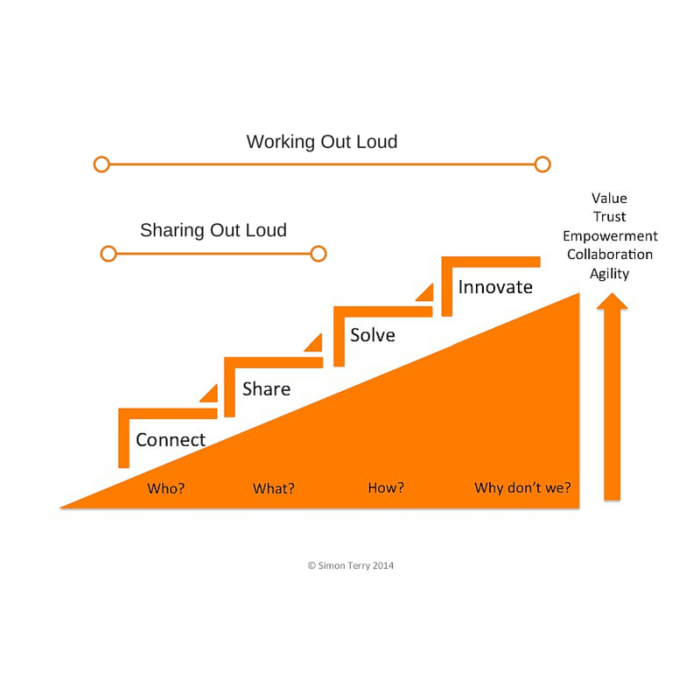
A recent conversation with Cai Kjaer and Laurence Lock Lee of Swoop Analytics about the Value Maturity Model highlighted a key point that is at the heart of many organisation’s struggles to get value from enterprise social collaboration. Too many organisations are stuck below the Share>Solve boundary. Once you connect enterprise social collaboration to work, the benefits for users and the organisation expand exponentially.

Sharing Out Loud

The first reaction in many organisations to an enterprise social network is to see it as a chance to share out loud. What people see first is the potential for status updates, sharing of articles, links and other stories of interest.  This is natural human behaviour and it will be heavily influenced by the culture of social media use in your employee base.

As we have discussed in previous posts, sharing adds value in helping provide transparency, shared context, reducing duplication and enabling better alignment. If Sharing Out Loud is as far as the Working Out Loud goes then it can add value. Sharing is the core concept behind the knowledge worker productivity case for benefits of enterprise social collaboration. Share information and it is findable. Findable information can be reused.

Any organisation that does not move beyond Sharing will face a number of key challenges.  Sharing is where there is a lot of noise. Filtering the sharing with groups and other approaches becomes important. Users get frustrated that there is so much information and so little value. Networks can alienate users because a few loud or extroverted voices dominate the traffic and shape perceptions of what an enterprise social network can contribute. Senior executives will quickly lose interest in a network that does not reflect their work and their strategic priorities. A network that is only sharing will need sustained energy from community management or passionate users to survive.

The Launch Point: The Sharing-Solving Boundary

When an enterprise social community crosses the boundary from Sharing to Solving, the dynamic changes. Bringing work into the community provides a momentum and new benefit cases for all users. The purpose of the community and the benefits it can provide begins to clarify and the distinction between an enterprise social and other forms of social media can clarify for people. The work itself begins to provide the energy, rhythm and momentum of the community.

We can help users to turn a Sharing Out Loud community into a Working Out Loud community through strategic community management. We can provide the right context and strategy for the use of collaboration. We can structure the opportunities for Connection, Solving, and Sharing around the key interactions and challenges of the work of the organisation. We can focus on the culture of collaboration and generosity in helping others. All of this helps users to sustain their activity in the Solving domain.

One other benefit of focusing on moving above this boundary is that you are building key foundations for innovation.  Employees who develop confidence in an enterprise social collaboration solution as a place to solve their problems will begin to explore how to fulfill their new ideas there. People move easily from How? to What if? Employees who learn to create agile teams to solve problems can apply those same teaming skills to new ideas. The growing wirearchy of work can be reused to provide an engine to innovation work in your organisations.

Creating an environment where employees (& others) can work out loud on real business problems and challenging customer opportunities is the work of strategic community management. The value created beyond the Sharing-Solving Boundary is exponentially greater than that before.  If you want the attention of the business stakeholders to support your community, you will need to Work Out Loud.

If you are interested in exploring further how to the Collaboration Value Canvas, enables organisations to conduct a two-hour workshop with business stakeholders to ensure that the business has an integrated plan for its community management and adoption work.  Contact Simon Terry to discuss how this could be applied in your organisation.

For suggestions on how Swoop Analytics can help you measure this transition see Cai Kjaer’s post on Linkedin.

Digital Transformation and IT Transformation: Beyond Automation

Digital Transformation presents a challenge for many traditional organisations because the nature of the change goes beyond our traditional focus on using technology to better automate the tasks of the organisation. The opportunity in digital transformation is to fundamentally reshape the business model of the organisation, its customer propositions, and structure. The ongoing transformation of IT reflects efforts to better leverage digital technology to reshape the nature of the organisation and its business models.

Digital Starts with the Customer. So Must IT Transformation

Digital businesses start with a narrow focus on meeting a customer need. This is at the core of the concept of a Minimum Viable Product. To do this, they must be clear on what customer they are serving and having a specific need in mind. That takes research and experimentation. Importantly, delivering a product is not enough, they need to test their solutions for fitness to the customer and see the customer through to success. Traditionally IT organisations were focus on design, build, and management of a technology solution. Now the challenge is design, build and delivery of an ongoing service to users to support the needs of a rapidly evolving digital business.

Digital Manages Whole Experiences. So Must IT Transformation

These days the demands of a Digital business go far beyond the interactions that occur over the internet. Achieving a seamless digital service to meet a customer need demands that a business rethink its entire system and connect that whole system in service of the customer proposition. The biggest transformation opportunities are when people are able to leverage digital technologies to transform the entire system in better service of the customer proposition. Traditional IT was able to be structure along the siloed and functional lines of a traditional business.  In a digital era, IT needs to be able to manage the entire system to manage the experience, change solutions as demanded by the system needs and each individual IT function needs to keep the experience goals front at centre.

Digital Learns. So Must IT Transformation

We no longer operate in stable markets with predictable competitive dynamics. Digital transformation is enabling organisations to learn faster and move with greater agility on the opportunities identified. Data analytics has opened transparency to new insights on our customers, our employees, our systems, and our processes. Experimentation offers new ways to make decisions and resolve ambiguity in the organisation. The IT organisation needs to transform itself and its teams into rapid learners. There is no one perfect and universal model. Different customer needs and value propositions will drive changing structure and technology solutions as the organisation learns best how to respond.

Digital drives Radical Strategic Change. So Must IT Transformation

At the core of these themes is that digital transformation is pushing businesses to seek radical strategic change. The opportunity is not incrementalism. Digital transformation offers opportunities to radically change cost, delivery models, develop new value creation and scale to global markets. IT Transformation must enable the IT Organisation to lead and support this radical shift in the business strategy driven by digital. This change won’t be easy and places new demands across the IT Organisation. No one strategy will solve the challenges placed on the IT Organisation. However, focusing the IT Organisation as change agents of a radical strategic change and supporting the teams with the business, relationship and change skills to lead this work is a place to start.

Work Out Loud When It is Easy Too

When we begin to incorporate the practice of working out loud into our work we can inadvertently fall into an unhelpful pattern of seeking help only when work is hard. Working out loud when it is easy is important to balance the risks of working out loud by building relationships of trust and collaboration.

We Work Out Loud When It is Hard

Working out loud when work is hard is obvious. If you are facing a big challenge, there can be real benefits of getting the insights, ideas, resources and support of others. Your network when aware of your challenges can make a big impact.  For many people sharing challenges is where they want to start their working out loud. Working on a big challenge together with others can bring many rewards, including the feeling of heroic leadership.

However, working out loud when work is hard is a time when we feel the risks of sharing can be greater. Bigger challenges bring their own sets of fears. Do we look incompetent? Are we creating an impression we need help a lot? Are we too demanding on our networks? What if nobody can help because the task is too hard?  Many of these fears can be managed through careful framing of our requests for help, choosing where we share and by considering the needs of others. However, it is also important that we don’t just share our big challenges. A consistent practice of working out loud helps.

Work Out Loud on the Easy Work Too

When work is easy, we often forget to work out loud. There are a number of reasons:

  • We want the exclusive credit for our easy successes.
  • We assume there is no better way
  • We can do them so quickly we forget to share or don’t reflect on our experience.
  • We don’t value the things that we do well.
  • We assume everyone else knows

Whatever the reason we are missing opportunities for shared value. What is easy to us is not always easy or obvious to others. Others can learn from our easy work. Sharing credit with your network can be a great way to give back to those who help us when times are tough. Importantly, showing people what you do that works well helps build a great profile and balances out the traditional risks of sharing when work is hard.

Building a relationship of trust and collaboration with your networks is far easier when you are consistent.

The Convoluted Paths of the Greater Good of Working Out Loud

Helping doubters to see the value of working out loud involves not just enabling them to experience others differently but helping them to see the value of the greater good. A challenge we face is that the value that flows from giving of ourselves travels along a convoluted path.

Reciprocal Benefits: Stories of the Paths of Referrals

Almost all my consulting work comes through referrals. Working out loud is a key foundation for that flow of referrals. However, there’s no linear process, no response rate to track and no measure that can capture the paths through which these come. I don’t work out loud for referrals.

I don’t work out loud for referrals. I work out loud to better understand lessons from the work I have each day and to benefit from the insights of others on that work. I also enjoy that others can share these lessons. However, generating business value is a lovely side benefit.

That benefit is not predictable because it is a function of reputation, relationships and work that’s ongoing, not a transactional exchange. Here are some examples:

  • I post on Linkedin about working out loud week and the post is shared widely. The post reminds a former colleague of mine about me and some work we did together. My friend refers me to a friend of their as a potential solution for an unrelated topic.
  • I agree to have coffee with a friend of a friend who is running a small business to discuss a business challenge. After a number of conversations where I offer some advice, things go quiet as we both return to our work. Months later, the small business owner refers me to another friend of theirs. Eventually, a colleague of that person retains me for some work.
  • I collaborate with a small group of partners and competitors over four years. We share insights, ideas, and approaches even when we occasionally come up head to head competing against each other for work. After a number of years, there’s a flow of great referral opportunities between members of the network. We like working with each other. We understand each other’s relative expertise. We know we can’t do everything.

I see each of those examples of referrals to my consulting practice as an indirect outcome of reputation, relationships and work done out loud over many years. I have faith that if I continue to work in this way the benefits will keep flowing. Try explaining it to a doubter and they will explain it away as a result of hidden strategy, luck, reputation, or expertise.

The Greater Benefit of Altruism

Even harder for the doubter to grasp is that I would still work out loud, if none of these or other examples had happened. I enjoy helping others. Seeing others succeed in their work because you were able to assist is amazing. Having the ability to help others is a privilege.

I knew the power of help and generosity. However, I had not seen the specific power of working out loud until I started blogging consistently at work.  Each day I shared a post on some lesson from my work and career. The posts were short and the audience was small as they were shared only inside the organisation. I realised the value to others one day when walking into the building a stranger enthusiastically rushed up to me and thanked me for a recent post. Speaking like a close friend, they explained that the post had enabled them to solve a problem and they now used that technique consistently. One person’s work had been made easier by my blogpost and they were extraordinarily grateful. Even more remarkable, a person I had never met felt they knew me well enough to forget to even introduce themselves.

Work today is hard, competitive, and it can be alienating for people. Creating just one moment of human connection founded in generosity can make a wonderful difference to others. It can also be a great reminder that those who give receive the greatest rewards, even if nothing ever comes back but thanks.

Belief in Working Out Loud is Belief in Others

Practitioners of Working Out Loud come from all faiths. They share a common belief system. They have faith in the value of transparency and generosity. They have faith in the potential of humanity to collaborate for greater benefit.

“Working Out Loud is like a religious experience. It can be hard to explain the value of working openly to others”.

I hear variants of this comment from advocates of working out loud often. If you have advocated for working out loud, you have had the experience. You believe passionately in the value that you have experienced in working out loud. You want to share this with others. Some people jump on board straight away. Many others don’t get it. No matter how much you try to explain they don’t believe you. They won’t even try.

A Simple Divide

This disconnect that working out loud advocates experience is driven by a simple divide. On one side are those who would meet the characteristics of the Givers of Adam Grant’s “Give and Take”.  Givers help others with no expectation of reciprocity because they can.  Givers believe in contributing to the greater good. On the other side of the equation are those who only act when there’s an advantage or at least a clear benefit to them. These people need short-term reciprocal benefits to act.

If you expect benefits for yourself from every action, then working out loud seems irrational. Why would you exert effort to help others with their work with no immediate reward? Why would you risk embarrassment or loss of credit for your work? There’s no return coming.

Adam Grant highlights that the real benefits to Givers are reputational. The benefits flow unevenly and over the long term. They are the result of network effects, not transactions. To be able to realise all of these benefits you need faith in others. You need to believe in the value of the greater good. In the next post, we will look at how this convoluted path plays out.

Trust is Not Rational

At the heart of the divide is a view of others: are they helpful or are they seeking advantage? This is a question of belief, not calculation.  The answer is founded in willingness to trust in others. Advocates of working out loud face a challenge that changing these kinds of belief is not a rational process.

When we advocate for working out loud, we love to stack up reasons why people should try working out loud. We describe the benefits. We map simple steps and build support processes to help people to get started. No matter how many reasons and how much proof we offer, actually doing working out loud takes someone to trust in others.

Trust is not driven by logic. Trust is driven by beliefs, emotions, and experience. The decision to trust in others and share something out loud that is imperfect is going to take a leap. This is the ‘trembling finger’ moment in all working out loud. Those who believe others are benign will find in their belief system the reasons, emotions, and experience to trust others. Those who are more suspicious are going to need to experience something better first. Their lack of trust means that the risks of sharing are all too evident and it may well violate strongly held beliefs of the need to behave cautiously.

If someone is resistant to working out loud, no amount of argument or proof is going to change their view. They won’t work out loud until they experience benefits and attribute them to working in a different way. If they continue to experience the benefit of working out loud, perhaps over time their beliefs will change.


Linkedin Marketing for Linkedin Marketers

linkedin-1084446_1920

A curious phenomenon can be found on Linkedin. Accumulate a few followers and publish some content and you will begin to receive a consistent flow of connection requests and offers of services from Linkedin Marketers. What’s curious about the phenomenon is how badly these Linkedin Marketers market their services on Linkedin.

I don’t have a problem with marketing or networking. I have worked as a marketer and done well marketing can drive rapid growth in relationships and real business value. There is value in getting consulting help to maximise the new opportunities and value of social relationships in business. That is one part of what I do for a living. I know some excellent consultants who deliver real value for people looking to get the most out of Linkedin. My friend Samantha Bell is excellent and she has written a very useful book on how to get the most out of your profile. Helen Blunden has provided great advice, coaching, and workshops for people looking to more effectively leverage Linkedin.

However, there are people roaming the platform whose approach is giving Linkedin and Linkedin Marketing a bad name. These Linkedin marketers do themselves a disservice with the laziness and the ineffectiveness of their approach. Before you hire anyone to help you with marketing in Linkedin, consider how well they market themselves on the same platform. The volume of poor approaches also impacts users view of the platform as well. Linkedin’s standard connection message even has its own meme as a generic New Yorker cartoon caption.

Improving Linkedin Marketing

Here are some suggestions for Linkedin Marketers who are looking to sell their services on the platform:

Research: The greatest value of Linkedin is as a platform for research. Great marketing begins with a depth of understanding of your target customer. Want to learn more about someone or some organisation? LinkedIn offers a fantastic way to explore people, roles, relationships and information relating to that individual and organisation. Have any of the Linkedin Marketers demonstrated their research in their approach to me? No. Not one. They are clearly not leveraging the research potential of their Premium memberships.

Relationships: Linkedin is a map of business relationships. The goal of Linked is to map the business graph of relationships. Start on the platform by using and building on relationships. I read my connection requests and I research them. However many with no prior relationship and no explanation, I simply ignore. Too many of the approaches from Linkedin marketers simply sent me the generic message. Not one of the Linkedin marketers has used a relationship referral to connect with me or sought to demonstrate the credibility of their offering by highlighting an endorsement by one of their relationships. Relationships are more than connections. Having a connection with similar people or being members of the same Linkedin group doesn’t count. Show me relationships with whom you have done business. Because I research approaches I receive, if our shared relationships are the people who accept every request, then it gives me a good clue that you don’t know them.

Relevance: Effective marketing depends on relevance. Relevance is the price of attention. “Connect with me so that I can help grow your business” is an improvement on the standard Linkedin connection message. However, you haven’t shown any specific relevance to my current needs. If you don’t even mention a recent action that triggered your interest, you are simply playing a numbers game. Research is the foundation of relevance. You need to go back and do the research.

Response: Linkedin is a low engagement platform. It is easy to passively consume on this platform. To get people to take action, you are going to have to engage them with a relevant message at the right time and with a compelling offer to act now. Adding numbers to your Linkedin connections may contribute to opportunities to hunt for clients, but it doesn’t drive the bottom line. Include a compelling call to action. Experiment and learn from different calls to action.

Resilience: New relationships don’t happen immediately. Cold calling new relationships takes time and resilience. How many of the Linkedin marketers have ever come back after their first offer was ignored? None. The only second approach I have received is from one Linkedin marketer to whom I explained that I was declining their offer of connection because of a lack of need. Of course, the follow-up was equally generic, made no reference to our previous conversation and learned nothing from it.

If you are not a Linkedin Marketer, these suggestions will help you be more effective on the platform too. And a word of advice to all the Linkedin Marketers who read this post and see it as an opportunity to send me a connection request: I will be using this post to judge the quality of your research.

This post first appeared on Linkedin.

Simon Terry provides consulting, advice, speaking and thought leadership to global clients through his own consulting practice, and as a Charter Member of Change Agents Worldwide, a network of progressive and passionate professionals, specializing in Future of Work technologies and practices.  The focus of Simon’s practice is assisting organizations to transform innovation, collaboration, learning and leadership.