Over the weekend, some feedback came back to me through networks of how I was perceived in a former workplace. That feedback was simple – ‘Simon was so nice’. While nice may not be the richest adjective, I came to understood that my kindness to others was appreciated. While I doubt that view was universally held, it was comforting to hear that my efforts in relationships were appreciated. Kindness, generosity, an interest in others and a willingness to help are rare enough in large organisations to be remarkable.
When you put yourself into the shoes of others and seek to understand their situation, it can be hard to engage with people in any other way. There are evil people and they are best avoided. However, so many poorly performing people are confused as to their goals or distorted by the systems in which they operate. In my experience kindness leads to reciprocity and trust and they are on the list of the few things that can help someone to better behaviours. Leaving a little kindness behind as you go about your day makes even unpleasant situations more bearable.
You catch more flies with honey than vinegar
Traditional Proverb
Collaboration is one of the few superpowers that we mere mortals can invoke. How else can we borrow the assistance of others – their knowledge, their efforts, their capabilities and more? Kindness oils the wheels of collaboration opening up to us access to a force magnifier of productivity as our networks lean in to return the favour. Don’t view kindness as a reciprocal transaction. I have received way more generosity than I have ever given. Even more extraordinarily, I have received it from strangers who know people in my network or simply saw my kindness to others.
we know the moment kindheartedness walks in. Each praise be echoes us back as the years uncount themselves, eating salt.
It takes no more effort to be kind and often it takes less when you remove all the scheming, shouting and unintended reactions to unkindness. Kindness need not be confused with being soft. The world yields to those who are purposeful, but kind in their relationships. Everything we do, we do in relationships with others. A little kindness goes a long way on those well networked paths.
PS By the way our productive network relationships don’t end at our social media relationships. They only begin there. As much as it can be tempting to be smarter or sharper or one-up in that medium, don’t. Keyboard warrior, troll, that guy on Linkedin and reply guy aren’t terms of endearment and aren’t titles that lead to greater or more productive things
“What you should learn when you make a mistake because you did not anticipate something is that the world is difficult to anticipate. That’s the correct lesson to learn from surprises: that the world is surprising.” Daniel Kahneman
When I hear words I have uttered to you and forgotten They are like birds
Sally Ann Kinsolving, Surprise
We have learned a lot about surprises in the last twelve months. Whether it was the shock of a global pandemic disrupting our work and our lives, how much we can get done working from home, the power of freak weather, how far some people will stray from rationality in the name of ideology or who was up to the challenges of supporting us through the year (and who wasn’t). We also were surprised by who was ready for the transitions and who wasn’t able to adapt enough or at all. The surprises of the last year have the potential to teach us a lot.
Humans evolved around the African savannah where surprise is rarely a good thing. We long for the safe, comfortable, stable and predictable. Our brains even tend to default to a linear projection of activity forward in steady ways. This longing can be so strong that we are willing to ignore or suppress the reality of the shocks and surprises that impact us everyday. We do so particularly when those surprises are calling for us to change or make change.
A system of necessity much elaborated becomes allowances very possibility
Most organisations spend far more time perfecting forecasts, approving business cases based on forecasts, managing performance to forecast and otherwise smoothing out the future than they do on the risk management of surprises. Yet surprises are inevitable. Most annual plan achievements are the outcome of getting to the numbers still after the surprises happened. We rarely reflect on what is lost or what are the costs in that process.
As Daniel Kahneman, notes above, the world is surprising. The world is even more surprising when we set out to make change, to improve things or to create new things. We never quite know in these scenarios what we are going to get. However, the inevitability of surprise is not an excuse for ignorance it is an imperative to plan for surprises, to build in agility and to adapt. Most surprises aren’t that surprising if you consider the risks and opportunities and plan for eventualities that are on the spectrum of possibility. Preparation helps mitigate the shock and panic of surprise on the African savannah and the modern organisation. Knowing whether to freeze, fight or take flight is essential preparation.
You will be surprised. Expect ‘mistakes’ to disrupt the certainty of performance expectations. Plan and prepare for it.
It was misfortune on that cold night falling on someone’s house, but not mine
Yammer is a tool that looks straight forward to many communicators. It is an employee communication tool so we can use it to broadcast to employees. This mindset is why so many communicators focus first on the number of employees on the platform and the communication features available. Employee engagement matters and so do the breadth of features available. However, highly valuable and strategically powerful use of Yammer is about more than numbers and buttons wrapped around broadcast messages. There is a critical opportunity that simple broadcasting to employees in Yammer misses. Yammer is both a communication tool and a collaboration tool for communities. This two-way potential opens up new opportunities for interactions and new power to your communication strategies.
Communication AND Collaboration
This two-way potential of Yammer is critical in this time because it highlights how we need to respond to the uncertainties and challenges facing our organisation. Rather than pretending they don’t exist or ironing out differences in the name of security, we have the opportunity to leverage our whole organisation’s talents and capabilities to navigate and adapt. That’s ultimately what we come together in organisations to achieve. Yammer magnifies the power of organisations to leverage talents and capabilities. The communicators in organisations play a critical role in supporting this process.
Organisations exist to change to meet the needs of customers and the environment
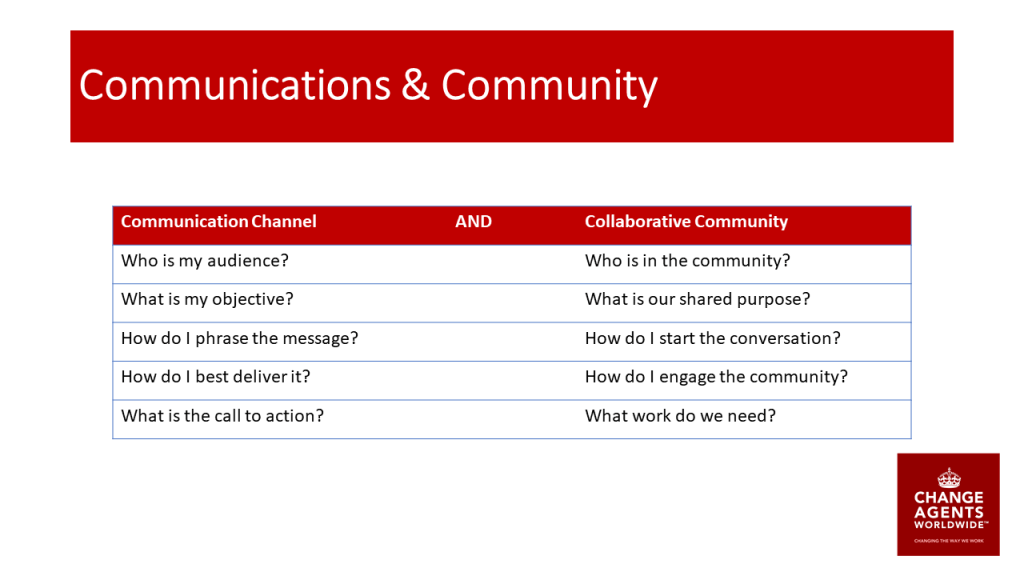
Communicators are very familiar with planning broadcast messaging in an organisation. We work from the audience, through objectives, to the message, delivery and call to action. In thinking about the power of the two-way communication opportunity, communicators can use similar questions. It begins with understanding who is in the community and what purposes they share. That planning develops by recognising the the process forward is a two-way interaction. Communicators need to think through how to start the conversation, how best to engage that community and ultimately the work that they want achieved together.
Planning out the engagement
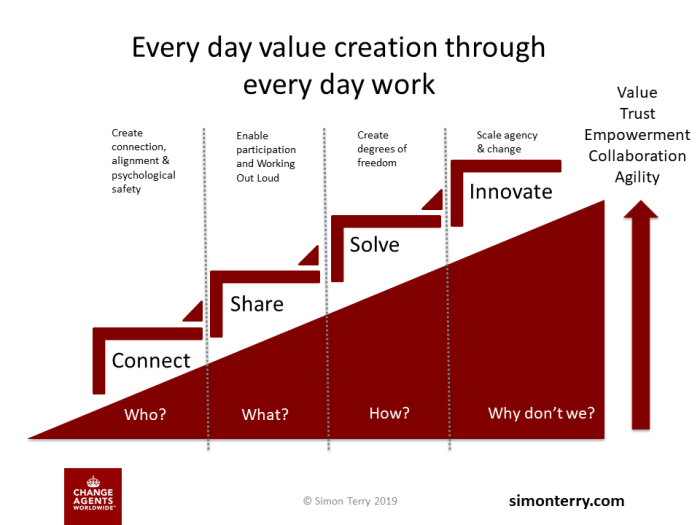
Planning for a successful collaboration must also leverage the understanding of communities in the Value Maturity Model of Collaboration. Communities are comprised of people who come together to share purpose and build trust. Organisations are comprised of many overlapping groups like this. If you want to engage these groups on Yammer or any other collaboration tool, you will need to work through how those people connect in purpose, share sufficient context to work together and begin to solve common problems with the capabilities of the organisation. Psychological safety, working out loud and the degrees of freedom to make change become critical accelerators of value on that journey and what ultimately powers the value of the work. The Value Maturity Model Canvas is a tool to enable anyone planning a collaboration to work through questions aligned to this model.
The Value Maturity Model of Collaboration
At a high level the role of the canvas is to map our the key questions aligned to the Value Maturity Model: who needs to connect, what do they need to know to solve what problem. Even these simple questions can guide a communicator in thinking about how they can better leverage Yammer for greater value in their organisation.
Do you understand the who, what, how and what if? for you? for your employees?
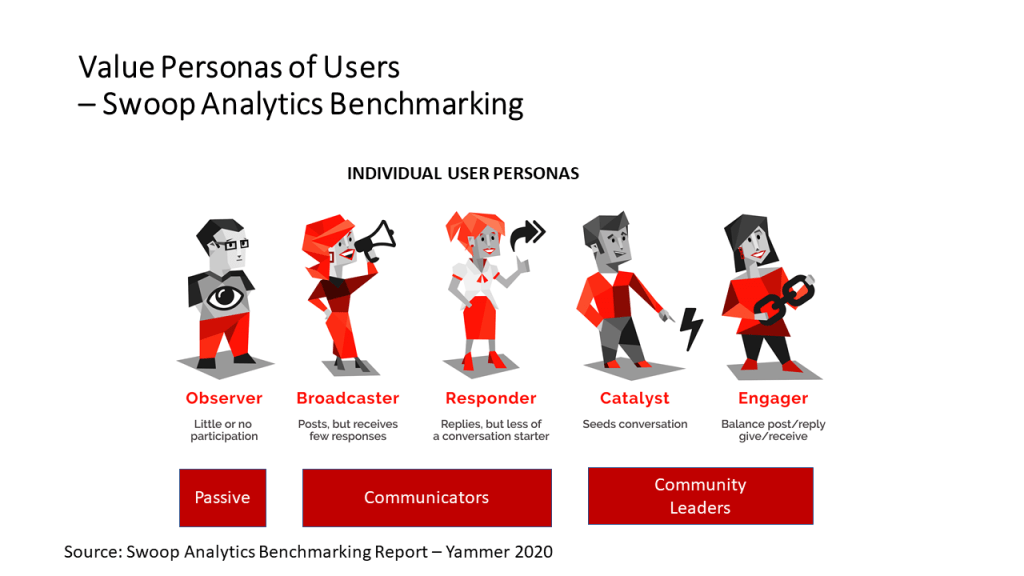
Planning in this way is important for communicators who want to leverage the benefits of Yammer because it will enable them to adopt more valuable use of the platform Yammer offers an organisation and also support other leaders that they advise to do the same. Swoop Analytics has mapped out a range of personas of user behaviours that reflect different value in the use of Yammer. You can see how these personas move from passive, to communication only and ultimately to two-way interaction that fosters the wider network.
The value of users differs – from communication to value creators and value multipliers
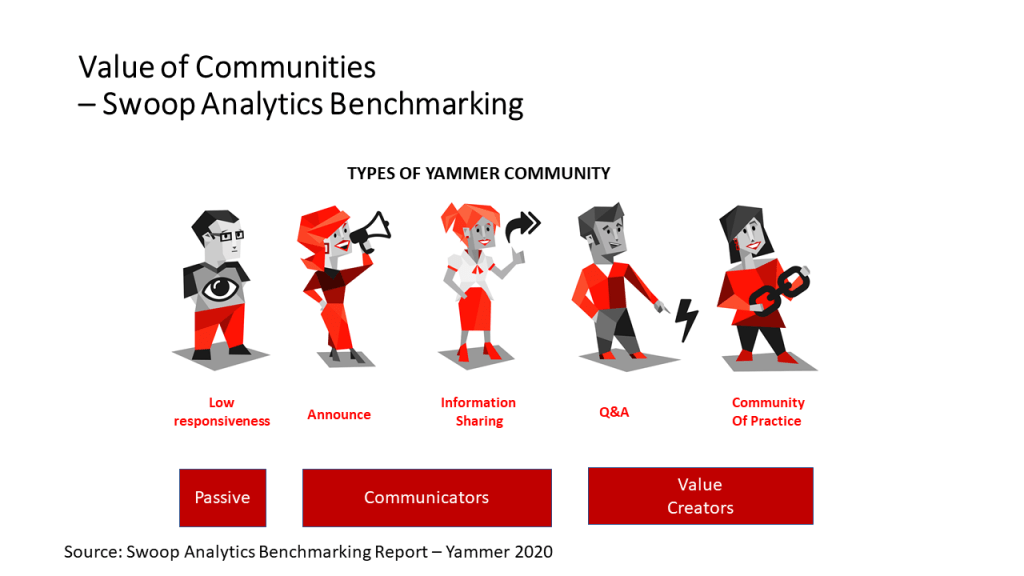
In its recent Yammer Benchmarking report for 2020, Swoop Analytics has also identified that groups in Yammer move through a very similar continuum. This reflects the fact that network collaboration is often fractal with patterns repeating at different level. The pattern is so similar that I have adapted their image for personas to reflect the different types of groups moving from inactive through to value multiplying. Communications professionals in organisations can play a key role in helping groups to interact in more valuable ways. If you are planning to leverage groups, remember announcements and sharing groups are useful but the real value comes from a deeper two-way interaction.
The value of groups differs from communication to value
No two organisations are the same. No two groups are the same. No two employees are the same. You will get the sense that there is no one pattern for success in Yammer for communicators. In fact the uses are extraordinarily diverse and reflect the growing value of two-way interactions through the maturity journey for individual users and also for the groups together. Whether you use text, images, video, GIFs, Q&A or something more to start your interaction, you are only just beginning a journey of change together with the employees of the organisation.
A myriad of valuable use cases. As many as you have employees and work challenges
As role models of communications best practice and as advisors to senior leaders, communicators can play a key role in enabling all employees in a Yammer network to understand how best to leverage the platform. While Yammer may support organisational top-down messaging, two-way means it is also powerful as a vehicle for peer-to-peer and bottom-up conversations, work and change initiatives. Fostering productive mindsets and behaviours across the employees, groups and organisation will help power this change. Those mindsets have been described on this blog before. Importantly, these mindset challenge traditional communications models of trying to get a message and its delivery perfect every time. Because you are planning for interaction and engagement, there is a chance to improve the messaging and its understanding over time. Thankfully there’s also the ability to edit typos in Yammer these days. Open, generous and purposeful listening and engagement from all employees whether senior leaders or frontline employees will be the foundation of the kind of trust that multiplies value and speeds organisational agility.
Changing mindsets around work and communication – not everything is about perfection
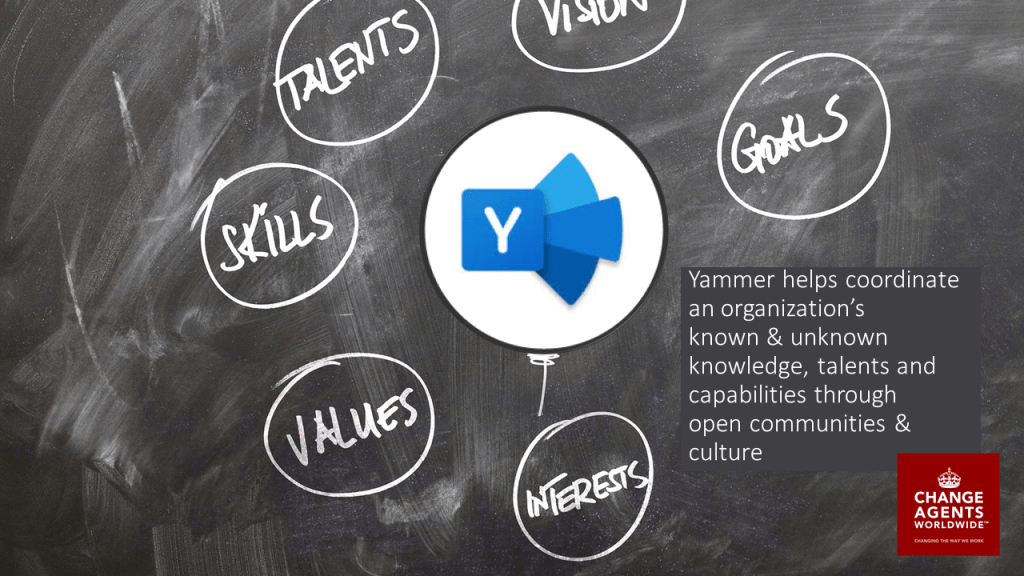
The two-way potential of Yammer as a platform for communication and for collaboration is what enables it to play a key role in helping organisations to adapt to change. Open communities, groups and a culture that enables employees to foster change will help lead that transformation. Ultimately an organisation’s success depends on how well it aligns its people and leverages their known and unknown talents and capabilities in performance and needed change. We can’t know everything all the time, but we can create a platform that enables people to share what they know, do what they can do to help and campaign for necessary change. The communicators in organisations have an important role to play in taking Yammer far beyond an employee communications platform to an open platform to leverage talents and capability for strategy and change.
In the fifth week of a customer experience nightmare over a fundamentally simple transaction, I am in the midst of a stark reminder of the difference between concern and care. Every agent I deal with in my customer experience disaster is deeply concerned at the incovenience, the delays, their failure to deliver over and over again and concerned that this be fixed. At least, the scripts they cite endeavour to convey that concern.
However, neither they nor their organisation have any care for me. The system is established to move me through a series of deeply concerned transactions with no interest in the overall care for the customer. Nobody has enough care that the process doesn’t work to change it. Everyone accepts their role in the broken process to pass the customer on to the next broken process. Achieving an outcome for the customer is lost in the concerned delivery of tasks that never end.
In a world without care, it is concern all the way down.
Enough Concerned Voices. We Need Care
Everywhere I look I hear deeply concerned voices. So many of our global challenges are roiling debates of earnest concerned voices. We have battles to demonstrate our great concern and the conflicts of our concerns. There’s so much concern that we lose sight of people, action and the specific outcomes of change.
In all this concern, we have lost sight of the obligations of care. Care is not talking. Care is action. Care is taking specific actions for specific people to achieve meaningful outcomes. Care is delivering an unique individual or a unique group a specific outcome that matters to them.
Care involves moving beyond transactions to change the system to deliver better outcomes for those specific people.
If you are concerned, you have started the journey to care. To complete that journey you will need:
Understanding of those affected by your concerns
Clarity of their goals and how they want them to be achieved
Compassion with their circumstances and the experience that you create
A passion for action to create change for those people
Willingness to care about those who share your concerns, find them and collaborate with them
Concern without care is simply theatre. Empty voices shouting into the wilderness will not enable the change we need. We need to partner our concern with care to deliver the meaningful action that will make change.
Care in community is the way forward. We can leverage our concerns to make the first steps to change.
There are other unfathomable things that speak to both moment and beyond.
Anne Coray, The Egyptians Had It All Wrong
We tend to think of success built in stone and steel. However, both of these substances can be brittle when it is time to flex. Long term success is about our ability to flex, to learn and to build new capability.
The last year has been a massive shock to the global economic system and our own personal experience of work and life. We are coping with a significant magnitude of adaptation in a compressed timeframe. The forces of those changes can reveal our capabilities and our organisations to be flexible or brittle.
Flexible enough?
If you have seen the cities of Asia, one of the extraordinary sites is the bamboo scaffolding around construction sites. That scaffolding of sections of bamboo tied together can reach many dozens of stories high. The material is cheap and plentiful. Tied together by expert teams it is also flexible enough to cover the needs of construction crews and survive moonsoons.
I live in a house that is over a hundred years old. It is a weatherboard. The foundations aren’t always great and much has been replaced over time. The walls shift and crack a little. However, while a house has been here for a hundred plus years it is not the same house. Over that time it has been renovated, renewed and changed in an ongoing way to suit the needs of its occupants and the wear and tear of use and weathering. The ability of the house to flex can be an advantage in storms, heatwaves and other sudden changes.
Our bodies too go through a process of renewal. I may not be as old as my house, but I know that every part of my body is adapting to changes, renewing itself, learning and growing. Luckily I haven’t broken bones but I know that it is a consequence of the body facing too much stress and being unable to flex. Something has to give.
I must renew my bones in your kingdom, I must still uncloud my earthly duties.
Careers and lives need to flex and be renewed, but that isn’t always part of our discussions. We can tend to see careers as monoliths built stone by stone, reinforced by steel. This discussion can bring a brittleness to our experience of careers. We assume that the stone and steel is the outcome of successes, when much of the advancement in our careers follows failure. Our flexibility and our growth comes from these moments. Failure helps us adapt because we can become too settled and cease to keep adapting to what comes next. Small shocks help us correct cause before bigger shocks arrive.
My name is Ozymandias, King of Kings; Look on my Works, ye Mighty, and despair! Nothing beside remains. Round the decay Of that colossal Wreck, boundless and bare The lone and level sands stretch far away
Percy Bysshe Shelley, Ozymandias
We have all met people who have risen quickly, one success on another. These careers like steep towers of stone can look impressive. Surprisingly many of these careers are not deeply planned. Success followed success and the stacking of stones inevitable. However, these people and their careers can be particularly brittle. Continuing that run of success can become central to a person’s identity. They chose to succeed, not the path. Pretence creeps in to cover gaps. Image overcomes the focus on listening, learning and adaptation. Fixed mindsets of the drivers of personal success don’t prepare people for the shocks that always come.
Success can also make our relationships brittle. Instead of a fluid two-way flow of information and authority, like in a wirearchy, we become increasingly fixed on power relationships and managing the flow of information. Building the capability of others which was once part of our success becomes a threat to our position. Without the flexibility and support of a network we are tied into a rigid structure of unforgiving relationships. Power increases the expectations and if not carefully managed can reduce our ability to flex and adapt.
All friendships of any length are based on a continued, mutual forgiveness
Long term success is built on the flexibility of renewal. Lifelong learning is a key attribute of the ability to anticipate, to build capability and to recover from shocks, breaks and loss. None of us are born predestined for a path, a career or a life. We make that life in the living and by how we adapt and change to the circumstances as they arise.
What got us to this point is much less important than how we adapt to this moment. Success in our last role or career can provide a foundation but the work is how we build something suited to the challenges of now. The heart of this flexibility is asking ourselves “what do I need to do to succeed in this moment now and to prepare for what might come next?”
but when the spill comes the brook will have another heap in its way, another shambles to get through or around; or over: how much time does a brook have: how much time a brook has!
We have a strange array of language to discuss confidence. People have and show it. We find it, whether ours or some generic stock. Some times confidence is given lightly or bestowed on others formally. It comes from within. For others, confidence is structure that crumbles, is rock-solid or builds.
The vagaries of this language reflect the fact that confidence is a feeling – a feeling of belief in or reliance on someone or thing. That status also highlights a limitation of some of the language above. Feelings are fragile and ephemeral. Feelings are contagious and transferable, but they aren’t simple gifts; what is received may not quite match the intent of the giver. Feelings surface and can be discovered but it is not a process of search. Feelings are influenced by thoughts, but they are part of being, not thinking. Feelings are human and that very human experience means that they don’t fit well into predictable business processes that seem to demand confidence in everything everywhere all the time.
Few people are confident about everything. Most people restrict their confidence to specific tasks and situations. Advice to ‘Be Confident’ doesn’t well meet the feelings of uncertainty that resolve around specific situations and tasks. Many of the people perceived to be confident are simply better at disguising their uncertainty and have learned techniques to paper over the cracks. Simply having techniques to give you more time to think, like paraphrasing the question back or a standard introductory patter that buys time, can make you feel more confident by avoiding the perceived pressure of silence and eager ears.
Confidence in your own performance
As hard as it may be, confidence in your own performance begins within. It is your own feelings that need to be sure about what you will achieve. We all have the ability to doubt. We especially doubt those who may seek to build our confidence when we don’t share the appraisal. That is why the gift of confidence is so fragile. However, remember you don’t need to establish universal confidence. You need only feel confident in this task for this time.
Confidence is a classic example of an area in which you need to act yourself to a new way of thinking. Nobody improved their confidence by focusing on the risks and the negatives. We need to concentrate on what we can believe in – the positives, what works and what can be done. Remember you just have to feel confident and hold that to the end. Some times it is preparation and effort. Other times it is dress and attitude that helps us feel confident. Whatever it is, put in the efforts sustain that feeling throughout. When things begin to crumble remain focused on the feeling of confidence and doing what you can do to get through your performance.
The Confidence of Others
Winning the confidence of others is often about performance – both delivery and the acting. Remember you are playing to a feeling, not a fact. People will be most convinced by your own feelings of confidence or the confidence others show in you. They will never be convinced by a hint of your doubts.
Remember that others need not love you universally. They need only have confidence in you for a specific task, a specific role or a specific challenge. Confidence in the relationship can grow over time. Again act yourself into their thinking (and your own).
The confidence of others is rarely transactional. Depth of relationships will drive relationships. Invest time in others and allow them to understand your specific skills and expertise. Invite others to provide feedback on what works and learn from their advice on what you do well. Encourage them to share their opinions with others.
Trees in a forest can work together to share resources and support each other. The universe is held together by the gravity of dark matter we can’t see. There’s a lot going on we can’t see and that includes the collaboration in our organisations.
We focus on the successes of individuals. We celebrate these highlights. What we tend not to see at all the little moments of support, encouragement and enablement that make success possible. The human equivalent of the ‘world wide wood’ or ‘dark matter’ holding our organisations together is everyday collaboration in everyday work.
We may set individual targets but our organisations run on collaborative efforts powered by trust and norms. Imagine if you had to negotiate each individual element of support or every step in an organisation process that supports your work. In functional organisations, this support adapts and changes as needed to just everyone performs. That change is powered by purposeful change agents making things better for everyone.
In a worldwide wood, the vehicle of sharing is fungi woven with the roots of trees. In our organisations, this collaboration and adaptation runs along the lines of communication from informal corridor conversations to formal strategy presentations. The give and take of the organisation flows from its interactions.
An engaged and agile workforce is one that is constantly communicating- customer needs, market changes, problems and opportunities. It is also communicating the less visible interpersonal elements of mutual understanding, shared context, alignment and trust. Little moments of give and take build powerful cultures of trust and support.
Success = (purpose x talent) raised to the power of culture.
As I have said before, the rewards to a collaborative, learning, and supportive culture are exponential. However, too many let this be the hidden and unmanaged part of their organisation.
We invest a massive amount of time development and resources to support individual achievement. We run the risk of missing the networks of support and learning that make that achievement possible. Spend as much time and money on the hidden collaboration that powers performance and you will be rewarded.
The internet is full of exhortations to be brave. Thoughtleaders love to tell us to be brave, rock boats and take risks. It’s one of those simple exhortations that’s heroic and nonspecific enough to sound motivational and yet inoffensive.
Most change agents understand bravery differently. They didn’t set out to be brave. Usually they wanted to make things better in a small way. Many expected it to be easy or straightforward. Over time they were drawn to make purposeful, meaningful change.
People who invite you to rock the boat do so from the shore.
Bravery comes when the push back hits. Change always faces opposition. The bravery is a response to the need to continue and to do more when there’s resistance. Whether the risks are deliberate or entirely accidental, risk is secondary to the outcome of the change.
Successful change agents are rarely foolhardy. Their risk tolerances may be greater than others. However, the risk appetite is combined with a calculated consideration of the challenge and the strategy to make change acceptable. Foolhardy enthusiasm is admirable but rarely effective. It’s often frightening short lived.
So if you feel you need to be more brave in work, life or other domain, don’t go looking for risk. Risk will always find you wherever you are. If you want to be more brave, go looking for those people or things that matter enough to you to keep going, especially when it would be easier to stop.
Bravery is an output of relationships or purpose. That’s why it’s so often correlated with success.
…instead of asking “What should I do?”…ask, “What is the work asking me to do?” —Michael Jones, The Soul of Place
If your organisation is only talking about working at home or working in the office, then you are missing the potential productivity and other benefits of flexible working. However, to realise these benefits you will need to move beyond binary thinking and lean into the tension and choices for employees, teams and the organisation.
Flexible working is about…flexibility. The choice for organisations is not a binary one between working at home and working in an office. There are multiple dimensions of work arrangements and patterns that can be leveraged to meet the needs of the work involved, the people and the strategy of the organisation. Escaping the binary of in the office versus at home is essential to an effective strategy.
Before You Begin
Before you even consider the choices for flexible working, there are a few foundations that you and the team need to understand in your organisation. These elements are what shape your approach to flexible working:
What is the purpose of the organisation?
What culture do you wish to practice?
What are your performance management & career development models?
What kinds of work does each team and role do to fulfil the organisational strategy?
What constraints do you have from a time, security, technical or legal perspective?
You may look at the list and see a lot of work to do to be ready for flexible working. However, this work isn’t preamble. These questions shape what you want work to achieve and how you expect it to happen. The outcome of these questions is a major part of your chosen employee value proposition. If your flexible working strategy does not align to that will fail. A flexibile working strategy fulfils your work and your strategy. It cannot be independently determined.
Any attempt to impose a working model that doesn’t reflect these factors will fail or cause ongoing major issues for employees and the organisation. The better you understand the questions above, the better you can work with leaders and teams to change their work.
A Menu, Not a Compliance Process
Flexible working is flexible. You are designing a menu of choices for individuals and teams. The teams are going to use the menu to fit their work to their needs, the organisations needs, and the outcomes that they need to achieve. If you are designing a watertight step-by-step compliance process, stop you are going the wrong way. Employee and team choices are fundamental.
Choice means tensions. There won’t be a one size fits all. You also won’t make 100% of people happy 100% of the time. Because the flexibility options need to meet so many conditions and also suit both the needs of individuals and teams there will be some need for compromise. Teams and individuals will have to discuss and agree how they balance the work and personal tensions using the choices from the menu.
Your sales director may want to work from the hiking paths of Nepal, but if a major part of that work is engaging clients in Australia, wifi is spotty in Nepalese mountains, and the role involves working with other teams in the organisation, that ambition will likely have to be compromised. Otherwise your sales director needs to find a role that better fits their lifestyle. However, working from home or a regional location for work, client or family reasons might be a better option for all involved.
The Minimum Menu Options
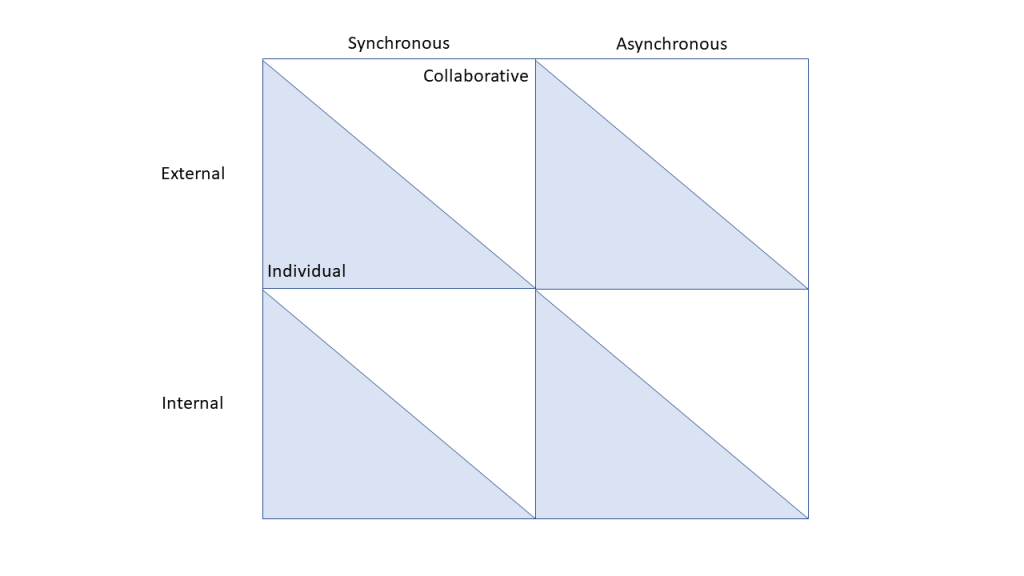
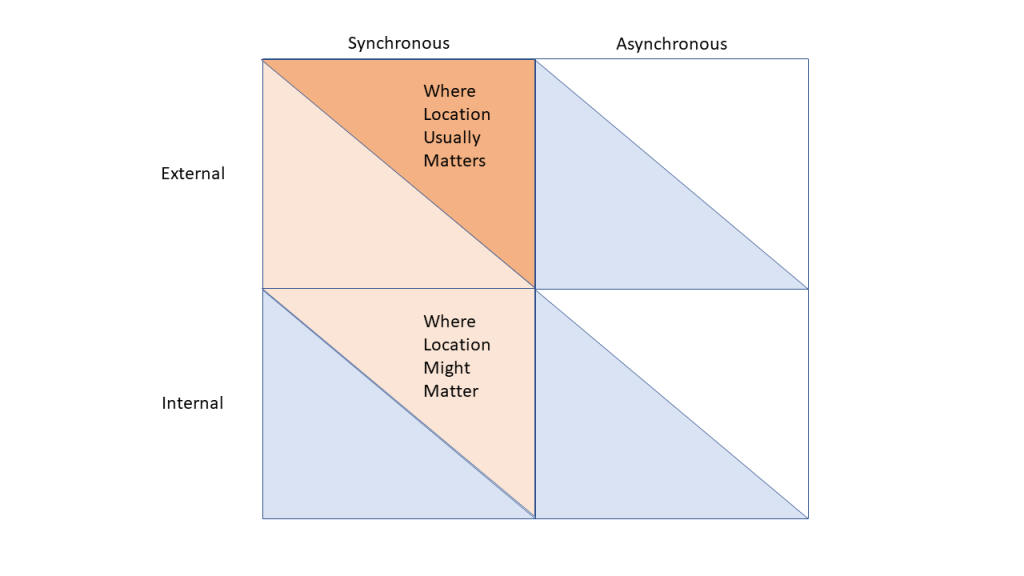
Some work is timebound and must happen at particular times. Let’s call this synchronous work. Other work is able to be done at any time. Let’s call this asynchronous work. Organisations need also to realise that their work is both internal and with external partners. Your flexible working menu should include options to cover the following patterns of work at anywhere and in the office:
Synchronous, External Partner Work
Asynchronous, External Partner Work
Synchronous, Internal Work
Asynchronous, Internal Work
All four modes above can be delivered anywhere. There is no location built into those options by design. Much of the asynchronous work can be done anywhere by definition. However, the menu and the choice of your teams will shape where those patterns of work occur.
There are another two dimensions that need to be factored into this menu to cater to the needs of focused individual effort and collaborative creation and problem solving:
Individual work
Collaborative work
Mixing these together gives us a menu like this:
It is important to recognise that location is only a small part of the menu choices. We obsess over our offices, office design and meeting spaces but they aren’t all of our work choices. Much more important is the infrastructure and tools to support the breadth of work arrangements required. After all only 3 of the 8 triangles might require physical co-location. Even in these 3 we have seen through our recent experiences of lockdown work can go on without physical location.
Requiring physical location is an unnecessary strict standard and one that it is very hard to meet. The hard part about flexibile working is that there are no binding rules, just choices and tensions. Employees, teams and the organisation may choose physical location when not strictly required for social, cultural or other reasons. There is a lot of informal interaction and context sharing in a workplace that is critical for relationship building, alignment and productivity but hard to capture when separated. I’ve long been an advocate for the kinds of tools that we have used in recent months to work remotely. They have for too long been underleveraged by organisations to their detriment. However, every utopia has its underlying dystopia. I also understand that being forced to work remotely is suboptimal for much work and for many many people. The social stresses of recent times highlight that clearly.
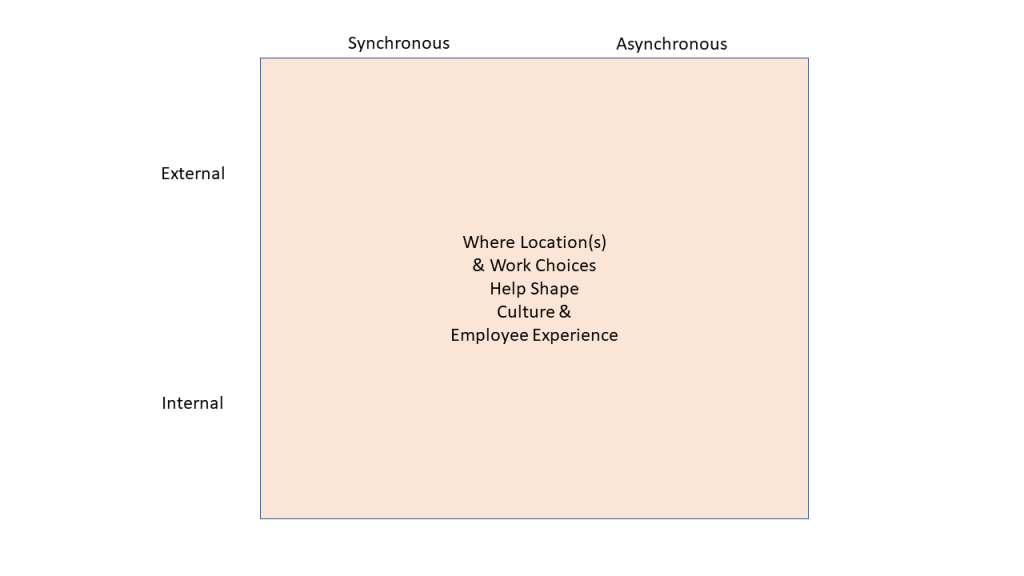
Every organisation needs to remember that the entire menu of choices contribute to culture and engagement. Engaging individuals and teams across the organisation in developing a menu and thinking in a detailed way about where to work and for what tasks will help drive new levels of organisational productivity and engagement. Because there are choices and tensions, the best way to make decisions in your organisation will be to involve the employees and teams involved in a detailed consideration of how best to manage the work. That process alone will contribute new productivity ideas and new levels of engagement.
meant its name, as if the edge of continent contented us with boundary. Draw a line from A to B. Live there.
Bin Ramke, Curve of Pursuit
2020 was going to be my year of better managing boundaries. Instead all the boundaries came down as we all battled to #WFHIADGP (‘working from home in a deadly global pandemic’). Soon we found that all of life was a digital melange of work mixed with family and friends with voluntary responsibilities and other commitments. Calls blended with chat, texts flew, communities proliferated and emails just kept coming. Overlayed over the top was a mild case of existential dread. We had realised the long sought future of work digital working nirvana overnight, but like any good utopia it was secretly dystopian.
So what did I learn from this experience for the way we work flexibily in organisations going forward:
Boundaries Matter
If boundaries aren’t there because of the need for physical movement to different spaces or because of clear transitions between different time periods, we need to create them. Work days need to end. Time blocks are useful for productivity. Breaks in work matter. Projects and even relationships end. There is a time to switch off, to stop and we don’t have to be always on to work or to live.
Planning for ‘digital commutes’, scheduling a morning and evening walk, finishing a day or a week with social activities are all important parts of signalling transition. It is also important to manage the interruptions that cross boundaries. We don’t have to answer work calls out of hours or in the middle of other tasks and commitments. Email doesn’t have to be read and managed 24×7
It is also important to ensure that in a flexible working environment that projects have begining and ends. It is easy for project tasks to drift on after a project is complete and become a new level of support and work with little reward of achievement and much less return.
Understanding Context Matters More than Knowing with Certainty
For much of 2020 and even into 2021, we didn’t know exactly what was going on. We may never again manage with our usual false senses of certainty, confidence and security. However, we learned that knowing everything was much less important than understanding the context in the bounds of what we had to do.
I could have spent the last year in the many twists and turns of epidemiology, US Politics or any other controversy, especially as a distraction from the here and now of a lockdown, but gradually I turned my attention to understanding my own context more deeply. Drawing clear boundaries within which I need to understand context and letting other things go, helped me manage the complexity a great deal. The goal was not always to achieve perfect certainty on an ever shifting environment within my own narrow bounds, but to pay greater attention to what was going on and how it influenced me. That was a big win and that presence is ongoing work.
In the trees on the other bank a solitary startled wood pigeon flies towards me
I have long known the power of saying no but it became much clearer to me since we started grappling with WFHIADGP. I have a very strong bias to say yes, to do things, to make things work and to stretch for more. I am an enthusiast and I hate missing out.
At the beginning of last year there was a flurry of interest in working from home. I had a lot of interest in my expertise and ideas. I had to work very hard last year to resist that temptation, choosing only the opportunities that I could do and also those to which I added unique value. I also had to accept that this meant ceding the space to others.
I turned down roles and opportunities. I didn’t pursue client engagements. I wound back my social media and social activity. I chose not to do more. I even put my long planned book project on hold as I worked to make all the pieces of my life hang together. No was my boundary enforcer.
It’s a Small World After All
One of the hardest lessons to learn in life is that the narrower our focus the bigger our impact. Small things done well make big changes possible. Instead of dreaming for the biggest changes possible in one step we can benefit from leveraging small changes in nearby adjacencies. We achieve more if we go step-by-step after a clear and narrow goal. We need to manage boundaries to make the most of our impact. Boundaries provider constraints that help focus, make us creative and help us find those evolutionary changes.
I achieved far more last year in a fully flexible environment than I had thought possible. Productivity was increased and importantly my colleagues and contacts adapted well to the need to redesigning work and projects to an asynchronous, virtual flow. There were undoubtedly new work, social and emotional pressures of lockdowns and a pandemic but the one binding boundary constraint of social distance was not a barrier to engaging with people effectively within an organisation, within a city or across the world. All that was required was to explore the small evolutionary steps to improve performance and to evolve the work outcomes towards success. We did that well.
Let’s not talk about rampages, disasters, conflicts or coupes that never ruined a perfectly good year during which the sun shined on the moon, the earth, and six billion who, for once, got everything right and not a single thing wrong.