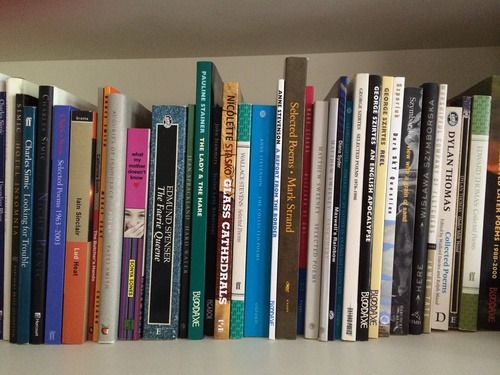
Read poetry every day of your life. Poetry is good because it flexes muscles you don’t use often enough. Poetry expands the senses and keeps them in prime condition. It keeps you aware of your nose, your eye, your ear, your tongue, your hand. And, above all, poetry is compacted metaphor or simile. Such metaphors, like Japanese paper flowers, may expand outward into gigantic shapes. Ideas lie everywhere through the poetry books, yet how rarely have I heard short story teachers recommending them for browsing.

What poetry? Any poetry that makes your hair stand up along your arms. Don’t force yourself too hard. Take it easy. Over the years you may catch up to, move even with, and pass T. S. Eliot on your way to other pastures. You say you don’t understand Dylan Thomas? Yes, but your ganglion does, and your secret wits, and all your unborn children. Read him, as you can read a horse with your eyes, set free and charging over an endless green meadow on a windy day.

Ray Bradbury, Zen in the Art of Writing (via hislivingpoetry)

On Poetry

Don’t blame the Leadership. Lead.

Unconnected & unresponsive organisations often find themselves in a trap.

Disengaged employees look up to a Chief Executive Officer and blame them for the lack of a better workplace. At the same time the CEO often wants a more engaged workforce but has no idea how to make the change in an effective way.

The longer this goes on the greater the risk that in this circumstance the CEO pulls the lever on the traditional response and announces a top-down transformation program. With the CEO and the transformation team having accepted the responsibility to drive change, everyone sits back and waits to see how the CEO’s pet project goes.

Many will have seen that moment when the arms start crossing defensively in the auditorium as the CEO announces the change. If the organisation started with disengagement now it has disengagement, along with a healthy dose of apathy & cynicism.

Change from the top

There are few models of change that don’t emphasise the importance of senior management support for change. It has become a litmus test of change in many organisations to inquire about the level and seniority of executive support. Senior management are powerful stakeholders in any change and change takes both collaboration and power.

However none of the change models that work, place all responsibility for change on senior leadership. Senior leadership should support and align change in the organisation to the desired direction.  Nobody said they, or their proxies, had to do it all.

Looking up is disengaging

We have our jobs and our place in the hierarchy. We have power, capability and influence to drive change. Waiting for senior leaders to get the changes required is the most disengaging experience for capable leaders across the organisation.

Looking up can take many forms. Some times it is a simple as feeling the need to have some indication of the ability to proceed. Other times it is created by approval processes on the resources or people required to make change happen. Some times we don’t even know we have referred something up for approval until we challenge why we aren’t acting now.

Creating an environment where people look up for authority will only worsen any engagement issues. Lack of engagement will worsen the problems in the workplace. Instead, give people the authority, trust and confidence in direction to act on their own.

Follow & Act

Take guidance from senior leaders. Support the change they seek to drive. Be a good follower.

Yes, necessary, but not sufficient for real & effective change.

Take it as your responsibility to respond to what you see needs work. Connect with others to encourage them to join you in this important work. Start new conversations that help everyone to understand the changes needed and push change forward.  These simple steps make you a networked change agent.

Understand the strategy and align the changes that you are pushing to where senior leaders are heading.  If you don’t understand ask for clarification, not approval.

Ask for forgiveness, not approval. You will learn and grow as you act. If you are doing the needful to bring about change your organisation and colleagues will not mind.  

Mostly you will get thanks from a grateful CEO.

From CMeO to CUsO

A lot of magic is ascribed to CXO titles. Often there is more real influence in other parts of the network, like middle management.

No matter what you think of the CXO roles, one CXO role is critical: The Chief Me Officer.

The functions of a Chief Me Officer are as follows:

  • Discover your personal purpose
  • Understand your own strengths and opportunities (others will be happy to volunteer your weaknesses and threats)
  • Set some longer term strategic goals for yourself and a few immediate short term experiments
  • Engage your personal networks to align to your own plans
  • Build your own capabilities by developing your own personal knowledge management approaches
  • Lead the work to deliver on your personal plan

A successful Chief Me Officer recognises the ‘buck stops with the CMeO’ on all matters relating to you, your life and your career. Like a good organisation leader they don’t just focus on one part of their business, you need a whole of life and community view of the impacts of you.  With this kind of accountability, this is not a role you can outsource. Family, friends, mentors, organisations, colleagues and people leaders can all help, but they won’t deliver on the plans you need to be successful.

Once you build your plan to become a successful Chief Me Officer, you will be well placed to lead others, engaging in collaboration in the new networked ways of working. The future of networked working needs capable leaders in every role.  How can you start your leadership journey better than by leading yourself?

Once you know how to become a CMeO, you can graduate to being a Chief Us Officer. That’s when the leadership journey gets really interesting…

The Network Navigator

image

The power of a networked world is shifting the emphasis of work from expertise to navigation. Are you ready to move from expert to network navigator?

From Expert to Navigator – a financial services example

Research into perceptions of an advice relationships in financial services consistently often comes up with a common theme. Usually, the financial services organisation is keen to build a trusted relationship with the client as an advisor and to demonstrate its depth of expertise in the advice process. 

However, these goals are rarely what the client is looking to achieve. The client is often more interested in building a relationship with someone who is responsive to their needs and who can to help them navigate the complexity to find their own answers. The complexity the client needs to navigate is not just the financial decisions; it includes the organisations own advice and service processes. In times of complexity, uncertainty & change, clients are reluctant to be dependant on someone else’s expertise. They want control. They want to be guided across the map of choices and find an easier way through the process.

The Network Navigator

Networks and the increasing pace of change that they bring about are having a similar disruption for the traditional model of expertise-based advice.

Relying on a proprietary stock of knowledge is no longer enough to justify an advice proposition. Knowledge is increasingly a flow. Stocks of knowledge are out of date too quickly as the network learns more faster by sharing.  If clients want access to stocks of knowledge, they can find the information themselves (& access a greater diversity of insight and experience) if they are prepared to put in the time and effort.  Doing that work for them on an outsourcing basis is a low value task.

The challenge of a networked era is no longer gathering a stock of knowledge. The challenge is leverage rapid flights of knowledge and guiding others through networked knowledge creation. The skills that rise to the fore are no those of hoarding a stock of knowledge. The skills are those of being able to connect people, share capability and create new knowledge together.

The 8 Skills of a Network Navigator

A network navigator does not need to know the answer. They do not even need to know the whole way to the solution. They need to be able to lead others, to leverage the knowledge of the network and to find a way forward in collaboration to create new value: 

  • Setting a course: In a complex world often the purposes, goals and questions are as unclear as the answers. Helping people clarify their objectives and questions before and during their engagement with the network is a critical role that the network navigator can play.
  • Seeing the big picture map: Navigators are people who can hold the network system in view and manage the micro detail to guide people forward.  A navigator creates new value with an understanding the broader map and new & better paths that others may not have considered.
  • Make new connections: Increasing the density of networks can be critical to creating new knowledge and value from network interactions.  Bridging weakly connected groups is another role that navigators can play to realise new insights and value.
  • Recruiting a crew and local pilots:  Building community matters in new network ways of working.  Community takes connection to a deeper and more trusted level and begins to accelerate learning and change.  Network navigators know how to recruit crew to their travelling community and add local pilots as they need to learn faster in new parts of the network.
  • Translating strange cultures: Connecting diverse groups often means that there are differences of context, language and culture to be bridged before conversations can create new knowledge. Network navigators have the skills to understand and share diverse inputs.
  • Logging the journey: A network navigator works out loud to record their journey and let others contribute and benefit from the record.  A network navigator nows there are many others seeking the same answers or looking for better paths forward and makes that possible by sharing their work and inviting others to contribute.
  • Weathering storms & avoid shoals: Journeys through networks are not linear and often unpredictable.  The navigator has the experience and the confidence to see others through the storms and to sustain others in their journeys. Most importantly, when the storm is darkest, they have the passion to keep pushing and keep experimenting.
  • Navigating where there is no map: Network navigators need to be able to embrace uncertainty and ambiguity.  They need to be able to lead others forward to learning even if it is dark and there be monsters.

Acknowledgements:  This post is in large part inspired by conversations with a wide range of participants that occurred during John Hagel’s recent visit to Melbourne for the Doing Something Good dinner and Centre for the Edge workshops that I attended.  It is also informed by ongoing conversations about new networked ways of working among all members of Change Agents Worldwide.  

Purpose is a network of potential

Purpose is exponential.

In a critical way purpose expands your horizons and returns from work. Purpose is a network of potential and brings out the potential of your network.

A network of potential

Purpose is not the answer to an introspective question. Purpose is the expression of your intent in action. The best way to discover your personal purpose is to look back over what you have chosen to do with your life. 

More than ten years ago I was doodling on a pad trying to find a focus to my diverse career history. I decided to draw a network diagram of my personal and work interests, the work that I enjoyed most and always chose to repeat. I drew lines where there were connections between these activities and interests. I began to build a map of my past life experience.

In a short while hubs began to appear where connections were densest. These were the major themes of my life, core activities that I found most rewarding and repeated often. Those hubs were a major insights towards purpose.

It was a short step to make the hubs an engine of potential. If these activities were rewarding and I did them most, then I should do them more and focus my learning in these areas. I began to use those challenges as criteria to choose the roles I would play and to guide my personal learning.

Asking why these activities were the hubs of my life experience took the process further towards an understanding of my personal purpose.

The potential of your network

A second insight came with this exercise. Every one of those activities in my prior life involved people. Around each of the activities in my purpose network was a network of relationships. The network hub activities gave me criteria to consider in my efforts to deepen relationships and choosing the new relationships that I needed to build. 

Purpose highlights the potential of your network to help you to do what you want to do most. 

Understanding purpose enables you to shape the new relationships that you build as well. We meet people every day through a range of activities. When you have a better understanding of your personal purpose, it enables you to more easily recognise a serendipitous new relationship. A strong connection over purpose can deepen relationships quickly.

We are shaped by the work we do and the people with whom we do it. Choosing relationships & organisations to further your personal purpose helps your network deliver exponential returns in impact. There is nothing more powerful than to work with a team that shares purpose. Finding an overlap of purpose accelerates the work and the impact.

Purpose is exponential and that power is in your network. 

PS: Imagine the opportunity to use network analysis to apply this same purpose exercise to an organisation and build purpose using the networks within and around the organisation.

Cold Hard Clarity and the Passion to Act

Business culture can be quite reductionist, favouring simple stereotypes. Anything that removes complexity and makes the modern large organisation easier to manage is embraced.

Stereotyping people is a common way to simplify the organisation for managers. For example we often see the use of a simple pair of stereotypes to influence debate around any issue. Someone in an effort to win an argument will type the participants in any debate into two camps:

  1. Managers: The sharp, rational, level-headed, pragmatic, outcome-focused, action-oriented realists
  2. Daydreamers: The fluffy, optimistic, utopian, enthusiastic, do-gooding, people-focused, passionate daydreamers

There is little surprise that in most businesses team 1 is the ‘right team’. These are the people who are trusted to ‘get the job done’ and ‘speak good sense’. These people have the interests of the corporation at heart and are management material. Labelling your opponent as part of team 2 can usually get you a long way towards winning any argument.

If you are an organisation change agent, you are going to find yourself lumped into team 2 often. To expand their influence in organisation, change agents need to learn to unpick these stereotypes. 

These stereotypes play on the fact that many people believe that the passion and optimism of those advocating change are inconsistent with being disciplined and realistic. This does not have to be the case:

  • Realism is now: Seeing things as they are is a challenge for today. Many organisations full of managers who fit the criteria in team 1 struggle to do this. Sometimes the sources of information, stakeholders and impacts considered are too narrow. Often they are beholden to management ideologies that distort perceptions. Risk aversion and other forms of conservatism may force them to resist or ignore the signals of required change. All managers, change agent or not, should aim to have a cold hard grip on the widest possible set of present facts. 
  • Optimism is tomorrow: Optimism is not inconsistent with realism because it does not describe today. Optimism is a hope for a better future. We can’t be realistic about the future, only optimistic or pessimistic. All managers should embrace hope because it is the only way to validate their potential to be the actor that brings about improvement. If you don’t have hope for your own influence, why are you there?
  • Passion is the vehicle for action: Passion is what drives action. Passion is what builds trust and wins support of others. Passion should be the impetus for action and sustain it through all the challenges of making change happen. When balanced with realism, passion is an enormous force for connection and change. 

Let’s help those seeking to bring about change to shift the debate from one between the fluffy no-hopers and the model managers. All parties in the debate needs to be realistic, optimistic and passionate. Only then will it be a fairer fight between the forces of change and the forces of conservatism.

The best change agents convince others because they demonstrate cold hard clarity as to the challenges and issues of today. They make change happen because of their passion and optimism for the future and because of their willingness to act. They do so because making change happen realises their potential and is the impact that they choose to have on the world

Tell me why that is not what every great manager does.

Change Agents Worldwide E-Book Released

The Change Agents Worldwide e-book: Changing the World of Work One Human at a Time is now available. Get yours now:

CAWW e-Book

The book is a series of essays that answer the question “what step should organisations take to make the most of the future of work?” The answers reflect the diverse and insightful perspectives of the members of Change Agents Worldwide on leveraging social collaboration, networks and trust.

My essay in the book is entitled “Do You Trust the Talented People You Went to Great Care to Hire?”