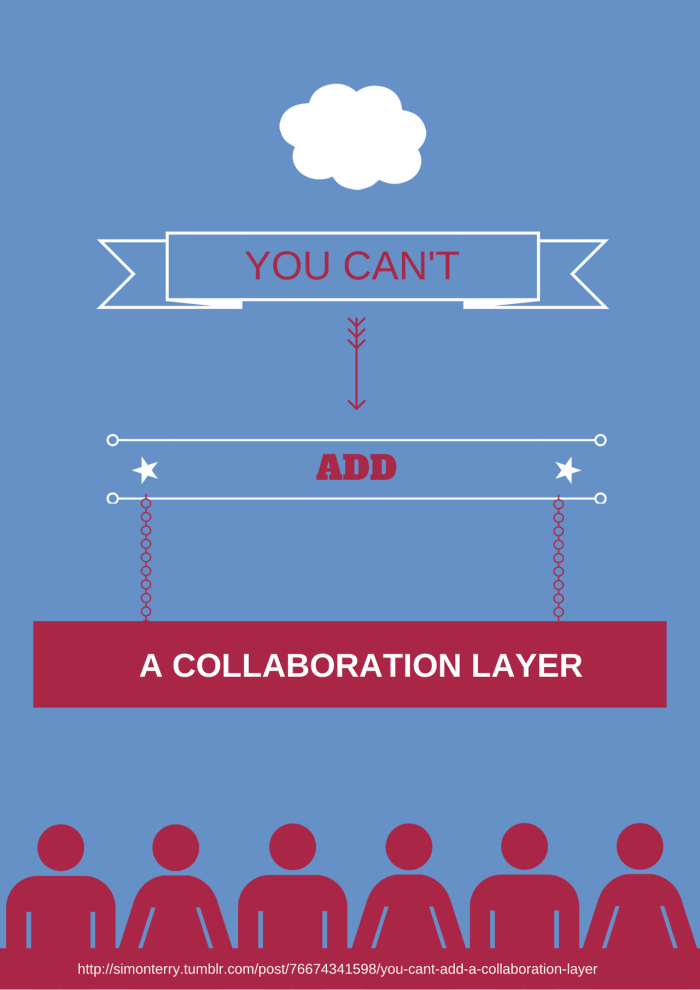
You Can’t Add a Collaboration Layer

Collaboration is human-to-human interaction. We are rich, creative and diverse, given the chance. You can’t add a collaboration layer to your existing processes.

Collaboration is not something that helps with the work. Collaboration is not something you integrate into your existing systems. Collaboration requires a fundamental rethink of the way work gets done. Collaboration is not a layer because it changes the whole system. Great collaboration goes the whole way through.

The phrase ‘collaboration layer’ is common. The idea of a collaboration layer most likely has its origins in information technology architecture. Collaboration systems are often represented as a different layer of the system stack, similarly to the user interface. As a result vendors and others talking to an IT audience will often promote the need to add a collaboration layer to existing processes. After all adding a collaboration layer sounds relatively painless – all the benefits of collaboration without the change.

As the application of the phrase shifts from systems architecture to the business conversation on how work gets done, something gets lots in translation. Success in the application of social collaboration systems does not come from integrating one more piece of technology into the stack. Collaboration is not an integration challenge. Collaboration is not about machine-to-machine or even machine-to-human interaction. Collaboration is human-to-human.

Collaboration can’t just be layered in on top of everything else. Collaboration requires a rethink of the entire process to foster the best of human interactions. Networks are required for collaboration. However, great communication requires more than a network. Great collaboration requires a community. The highest value collaboration goes beyond a community and builds a change movement.

To bring community to life you need to do more than add a layer of machine-to-human and human-to-human communication over the top of your Taylorist processes. The goal of social collaboration is not to make dumb workers better informed. The goal is to leverage their collective knowledge, intelligence and creativity. Allowing workers to share purpose, connect and create new and better ways of working together comes from giving them the opportunity to connect deeply and to rethink the processes and entire systems that they use to do their work. The best innovations in social collaboration are when entire traditional processes disappear because a newly engaged workforce finds a better way.

People will not stay long in a conversation where machines send them status updates. There is much less value in collaboration, little community and no change if the process is the process and can’t be rethought. This is one of the reasons so many enterprise social networks struggle. Without the prospect of creating a sense of community and the ability to change things, what is the point of participating?

If you want the benefits of rich collaboration, growing community and powerful change driven by your people, then you will need to move beyond a collaboration layer on existing processes. Letting your people use collaboration to change the whole system for the better has to be possible. Collaborative humans will demand it.

Re-Dream Often

Dream big. Conventional business and life advice. Hardly worth sharing. Would anyone listen if you told them to dream small?

But a big dream can become a weight on your progress. It can become stale. Eventually you may look at it and wonder why you every dreamt of it at all.

Redream your amazing future often. The dream is not what matters. What matters is the dreaming. Bring your dream up to date. Make it reflect the now. A continuous process of re-dreaming the dream will make it more relevant and more vibrant. It will make it more powerful. The re-dream will help you find new ways to action and new ways to bring it to lfe.

Day-dreaming is a great process to refresh and update dreams. Day-dreaming is when you get to change a dream as it is visualised.

If you are collaborating with others it is even more important to re-dream the dream. People change, circumstances change and people change again. Nobody likes delivering someone else’s dream. Dreams are not inherited or imposed. The process of re-dreaming that future together enables everyone to own the dream and stay engaged.

Dream big. Sure.

Re-dream often.

Leaders don’t know

Every leader faces a challenge. People expect them to know the answer.

Knowing as a leadership challenge

Every day in each leadership interaction whether with one person or thousands of people the same moment occurs. People look at their leader and hope that the leader has the answer. The question is irrelevant. The leader is expected to supply the answer. The leader is expected to make things easier by taking the problem away. In this moment, a leader’s authority is tied to their capability to perform as an answer delivery machine.

Leadership doesn’t work that way. Often supplying any answer is exactly the wrong response. Supplying an answer can disengage, foster work avoidance or leave the leader holding all responsibility going forward. It can be a lonely and challenging place to be trapped in a question against the weight of expectation of the team. 

The pressure to supply the answer and be a source of all expertise is a common factor in the imposter syndrome many leaders experience. Not knowing enough to answer all the questions makes people doubt their capabilities. The feeling that they are an imposter is more than a thing. Imposter syndrome is almost an epidemic.

Why leaders don’t know

If you don’t feel some doubt at leading in a time of great change and complexity then you are extraordinarily talented and well informed. Just take care that you are not one of the leaders who are either delusional or pathological There are some reasons why knowing is a challenge: 

  • Leaders shouldn’t know – role: A leader’s role is not to be an answer person. Their role is to create conversations that engage, deepening understanding, set context and shape direction. Leaders need to hold others in tension so that they do the work necessary to move towards answers.  If you are providing answers all you can expect is compliance or at best agreement. You won’t get engagement or creativity.
  • Leaders can’t know – context: No matter how well they measure their business, no matter how deep their expertise, a leader can’t have all the context required to make a good decision. They should be focused on other things most of the time. They will have a different context to the person on the spot with a problem.
  • Leaders shouldn’t know – waste: Every time you stop to ask a leader everything comes to a halt. The process of asking takes time. That time could be better spent solving and building the team’s capability in the process. Even if the leader does know the answer, that time and the process required to extract information is a waste.  You can’t create agility with a bottleneck of a leader.
  • Leaders can’t know – uncertainty: Often the answer is not clear and will only be revealed in action. Requiring a leader to declare a certain position or outcome in this case is pointless and only serves to undermine the leader.
  • Leaders shouldn’t know – capability: Giving answers rarely teaches people how to find their own. Leaders need to build their people’s capability to answer, learn & lead themselves

Knowledge is a flow

Leaders don’t need to know a particular stock of knowledge. Leaders need to know how to help others to share and develop knowledge as an ongoing flow. Then leaders need to help people translate knowledge to action.

  • Teams know some: In a majority of cases when asking a leader what to do, the person asking has a well-formed view of what to do. They have the context. They understand the challenge well. With a sense of authority, they would have acted by now. If the team doesn’t know the answer itself, they likely know where to start.
  • Stakeholders know more: Leaders who help their teams engage externally with the system & stakeholders around the business, enrich the team’s understanding of what to do next.  What a team is missing, the system around will be able to add. In the conflict between the answer of the team and the broader stakeholders is exactly where the problem and the insight lies.
  • Knowledge is evolving: Knowledge needs to be constantly tested and updated in action. Leaders can make sure that teams understand to track and learn from the experiments that they make applying knowledge. The lessons from those experiments move everyone’s insight forward. 

Next time people expect you as a leader to supply all the answers, lead them & their stakeholders to engagement with better questions instead.

What’s your experiment?

Yesterday a conversation about experimentation, inspired by the Responsive Organisation, prompted this reflection:

To grow in life and work we experiment

We like the comfort of plans, order and progress. We hope that our lives will deliver a straight-line path to our goals. We feel the pressure to be able to lay our actions to others in a plan with a high degree of certainty. This pressure is magnified in a work context where the expectation of  managers is often to demonstrate confidence, certainty and control.

Life is chaotic, uncertain, creative and constantly changing. Just like us.

The only way to manage that volatility is to experiment, to grow and to change a little bit at a time. If we don’t become more responsive, we wither:

  • Some people let the uncertainty overwhelm them. Paralysed by fear they stop and wait for some clarity. Success moves by them.  
  • Some people let the scale of the challenge overwhelm them. They are concerned that they they won’t finish. If you don’t start, you can’t grow the ability to solve for the scale.
  • Some people fear their own goals, worrying that they might be too daunting or not bold enough. Without confidence in a direction to start, they don’t start and miss the chance to shift to better goals as they learn more about the world and themselves.
  • Some people worry about being changed. They experience change is their external environment forces them to change and that’s rarely a path to success.

In every case, the alternative is to do something small one thing at a time, to experiment, to learn and to grow. My experience is that success follows those times that I took a chance.  I grow when I put myself in a place where I have to learn more to get the job done. I may not have known how it would end, often it ended up somewhere new and better, but the lessons of the experience will showed me what I needed to know & do next. You don’t need to be reckless, but take small actions to experiment with the water in the deep end.

It won’t be easy. Success never is. Success is rare and precious. Success is the reward for risk, learning and effort. Success comes when you respond better to the opportunities before you.

Start today

What experiment will you try today that takes you one step closer to your goals?

What questions build your community?

image

Why do we focus on Push communication?

Push communication is deeply ingrained in our way of thinking. We live surrounded by push messages. The triumph of push is so great in business that push functions, like marketing or PR, are simply called communications. We are used to models that tell us to “Always be closing”, “Get your message out”, “Build awareness” and ‘Be proactive’.  Networking has a bad name for many people because it is seen as the equivalent of cold-call sales.

Social tools are sold as media, driven by advertising revenues and promoted as a new method of advertising yourself. We obsess about follower size or measures of influence like Klout and Kred that are heavily influenced by the ability to push. The ‘Number One Mistake Everybody Makes on Twitter‘ is not to turn a reply into an message to their whole follower base. Do we need more messages when we are living in a period of ‘information obesity’?

Organizations worry about compliance in their employee base in the use of social communication because non-compliance might adversely impact the desired push media & reputation effects. The assumption that push messages must be preserved leads many organisations to ban their employees from sharing or tightly restrict their engagement. Even where social is encouraged many employees struggle with pushing their views forward. A reluctance to push and a reticence about the quality of their messages holds back adoption & use.

John Hagel, among others, has argued eloquently that it is time to move from Push to Pull.  We need to move from communication to community to get full value of the networks that we have built.

What’s your most valuable communication?

Ask any business which conversations are the most valuable and the answers are usually consistent.  The best conversations are where they get a chance to sit around the table with customers or key stakeholders, to let them talk to each other, to listen, to question and to learn. From these conversations come new product ideas, insights into customer drivers and customers taking on the challenge of explaining and even selling your business to others. The insights can be revelatory and the business value outweighs any speech, status update or advertisement.

For conversations to have this value, they must be authentic, reciprocal, valuable to all involved and intensely personal. The conversations aren’t driven by a message the business wants to share. They are driven by questions that bring out what customers want to share. The questions don’t always come from one source. They come from anyone in the conversation.  For that to occur it needs to be underpinned by the relationships, personal connections and trust.

What question is your push communication trying to answer?

When you unpick the next message you want to share as push communication, you will find at its heart a question. Your communication is trying to close off a question that belongs to the customer, an employee or another stakeholder. You are trying to supply an answer to your guess of a question that your push communication won’t let them ask.

Why won’t you let your stakeholder ask their question?  

Closing off a question may seem safe, but control is a false & costly form of safety. Control does not build trust, connection or value. It doesn’t stop the customer forming their own view by thinking of other questions. It simply denies them a way to share any connection with you.

How do you build your community with questions?

Community is the ultimate pull. Community is when your stakeholder choose to connect deeply with you, to work together to create value and to share of themselves for a common goal. Community is a layer of trust and connection that enriches the value of networks.

Community is built by questions, not statements. Asking someone’s name is the first step. Then we ask how they are going. We ask why they are here and what they are trying to achieve. We ask about their hopes and their concerns. We ask what they know and believe. In time, having learned enough, we ask if we can help.

What would happen if everyone asked a question?

Everyone in your business is connected. They have connections at work and in the rich world outside. Hopefully those networks grow each day. They won’t grow more valuable if they are just names and contact details. They grow richer with deep interaction and growing community.

It is hard work getting everyone in your business to master push communication. Many don’t want to use push communication and aren’t confident in their skills to do it well. This challenge of push affects the senior manager as much as the frontline employee. That’s why there are specialists in communication and convoluted communication policies.

Everyone in your business can ask a question. Practised consistently, that questioning develops into an ability to seek and make sense of their environment. Every stakeholder can answer that question if the connection is strong enough. Great questions get shared as people in the network become interested in the discussing the answers generating new questions and learning together.

Use your networks to share questions and you will find every part of your network is contributing to building a rich and valuable community for your business.

What great questions build your community?

Please share your answers.

Leaders Create Paths not Stone Walls

image

The most enduring & strongest form of leadership is the ability to constantly change yourself and change with your team.

Leaders as stone walls

In the western districts of Victoria, historical stone walls can be found.  These stone walls built by convicts and early settlers are carefully assembled piles of the volcanic rock that can be found in those soils.  These walls were built with are no foundations and no mortar. The walls stand where they stand, but they are lost when they fall down or must be moved. We lack the patience or skills to work replace them. Their strength comes only from the careful effort to lock all the pieces together under the force of gravity.

Some managers see demonstrating strength as the critical component of leadership.  These managers come across as carefully constructed and as immovable as one of these old stone walls. With strongly fixed views on the way things should be, they work hard to hold all the pieces of their world just so. They demonstrate a formidable power to resist and to hold their position. However, when they reach this point of strength, these leaders find they are no longer able to move without crumbling.

Managers like this confuse leadership with control and power. They focus on their own strength and consistency because they think it is necessary to maintain their power. Threatened by uncertainty and change they demonstrate consistency to deliver certainty to their teams. The burden of consistency falls on the manager alone.

But this view is self-fulfilling only on the downside, if you define strength by your inability to be changed, like a stone wall you will fall apart irreparably, if you need to change. There is no upside from this kind of consistency. It takes you nowhere in a world of rapid change. You will find yourself and your team irrelevant as you remain fiercely rooted to the spot.  Eventually someone needs to knocks you down to create a new path. The strength of consistency becomes fragility to external change.

Leadership as a path

Leadership is not about control, certainty and stasis. Leadership is work. Leadership is about influence and movement. More specifically it is about engaging others in change and encouraging them to work at the challenges and opportunities in front of them. Leaders create leadership in others, they don’t bear the burden alone.

You can’t lead as an immovable wall, however carefully constructed that wall may be. The work of leadership requires constant adaptation to change and that change will change the leader in the process. Leader and team evolve as they respond to new challenges and develop new approaches of working together.

The real strength of leadership is the inner purpose, self-awareness and connection to others that holds you and your team together as you all face into major change. It is that confidence, that enables leaders to empower their team to demonstrate their own potential to lead and to make change happen. 

Leaders help people to travel new and better paths. This means that they must embrace the change needed to move their teams forward.

Lead all the way through

The Maltese Falcon is one of my favourite films. The plot involves the classic example of a MacGuffin, a device that propels the characters’ actions, often with little explanation or rationale. In the Maltese Falcon it is a lead statue of a bird that the characters suspect has hidden riches.

Many organisations run on exactly this kind of MacGuffin. People are executing tasks to orders in pursuit of a little understood goal. Often there are vague promises of wealth and riches if the tasks are successful. Far too often at the end of their work the employees discover the MacGuffin is meaningless. ‘Exceeding market expectations’, ‘winning share’, ‘leading cost efficiency’, ‘achieving series A funding’ are all MacGuffins. Like the Maltese Falcon they prove to be lead all the way through.

Instead of a MacGuffin like an arbitrary and meaningless goal, have a conversation about purpose with the team. Discover the why that you share. Why your team does what it does matters, especially to the team. Be clear as a team on the impact you aim to have on others in the world. When the thrilling ride of work is over that purpose is far more valuable than any Macguffin.

You get to keep your purpose. A Macguffin just goes back in the prop drawer.

image

(Image source: Wikipedia)

Now!

image

When it comes for you digital disruption is quick and dramatic. Have a look at these charts:

Each of these charts demonstrate the phenomenon that Seth Godin described well as “gradually, then suddenly”. When the years of steady growth slowed, collapse was imminent.

In a world where organisations seek to deliver consistent revenue and profit growth, the extent of the decline is devastating. Each of these industries was left apologising while there were collapses in confidence, stability, strategy and ultimately dramatic reductions in the capital and other resources available to respond. 

Disruption will happen

In Silicon Valley alone multiple billions are invested each quarter in venture capital deals focused on disrupting traditional business economics and business models. Around the world and around the desks of your competitors and potential competitors people are considering how your industry can be rebuilt with digital means.

Disruption is not just an issue for digital media or technology businesses. It reaches the information intensive economics of distribution models, pricing, data exchange and knowledge work.  It offers new agility and new ways to rebuild the value chain in other industries. Collaborative consumption is looking at how we buy and use capital intensive items.  The internet of things, connecting devices to the internet so that they can exchange data offers even traditional industries new potential.  Just look at Google’s acquisition of Nest, a digital connected thermostat, for the extraordinary price of $3.2B, a signal of new opportunities.

Impacts will be widespread across the Australian and global economies. It is just the timing and scale of the impacts that are in issue.

Start Responding Now

Every business should start now to consider the scenarios of what digital disruption might mean for their business, their customers and their industry. Every business should be considering how it can make itself more responsive to the changing digital marketplace.

Here are three steps you can start today:

  • Design your future competitor: Ask a team from your business to design the disruptive competitor. Take a group of people from your business (include others from your networks if you need additional perspectives). Give them the challenge of designing a disruptive competitor from the ground up. Let them break the rules. Give them different constraints. Let them imagine product choices, margins, budgets, processes and technology free from your usual practices. Tell them not to come back until they can scare you. This is not daydreaming. Knowing what your future competitor might look like is a good clue to what you need to start doing and where you might need to invest to reduce their advantages.
  • Think digital capabilities: There’s a good chance that the team you assigned thought differently about the capabilities that underpin your business. They looked for people with different skills and experiences. They went looking for data to capture, to analyse and to use to create value. They connected customers, suppliers, people and stakeholders in new networks & new channels. They assumed a personalised, streamlined, connected, always on, always aware, algorithm-driven process. They assumed everything that could be digital was digital, everything was mobile, everything was social and almost all of it was free to roam the internet. If that list of capabilities seems fanciful, expensive or impossible, it is exactly where your new digital competitor begins.
  • Start becoming a more Responsive Organisation: Let purpose focus your organisation. Let experiments drive your decisions. Let customers drive your product strategy. Let employees drive your creativity. Let community drive your impact on the world. Read more about the Responsive Organisation and begin to experiment in your organisation.

If you are wondering what digital disruption means for your organisation, there’s a good chance someone else is already working on it.

Start working on your future now.