Author: simongterry
Governance is a Leadership Conversation

Governance best practice requires a vibrant conversation that shares the diverse insights & experience of directors so that organisations can make better decisions. We need to focus as much on the quality of the conversations and the networks of the directors as we do their experience and expertise.
Directors are chosen for their experience, insights and expertise. The role of a director participating in a governance process is to bring their personal capabilities to bear helping the management of the organisation to make better decisions. However, experience, insights and expertise will go to waste if the directors are not part of an effective conversation and if their networks are not keeping them up to date.
Focus on the conversation at board level
A vibrant conversation is one with rich and relevant contributions from all parties. A vibrant conversation is engaging because it is an exercise in joint learning. Directors and management working together to understand how best to proceed leveraging their collective insights and experience. Both the chair and management need to help facilitate this process of learning and encourage an engaging and effective conversation.
If a board conversation is predictable, agenda driven, runs to only the papers or dominated by a few voices, particularly those of management or a chair, then there is a good chance that the governance process is failing. Disrupting a comfortable board to improve its function takes leadership, tact and courage.
Questions matter as much as expertise. Questions are also a powerful source of disruption to patterned thinking. While a director brings expertise, that capability is more engagingly used to frame provocative questions for the board and management to consider. Great questions prompt reflection, draw out new perspectives and can change the understanding of all involved in the conversation. Well framed questions respect others ability to contribute and to learn.
Questions also highlight the potential of conflict to frame and define an issue. If everyone is in agreement all the time, then nobody is required around the table. The role of a governance process is to interrupt this experience with relevant pushback. One of the benefits of a diversity in a governance process is it is more likely to surface other relevant questions and perspectives to be considered.
The learning nature of any governance conversation should extend to the effectiveness of the conversation. Double-loop learning that looks at the process as well as the content accelerates effectiveness. The best question to finish any discussion at board level should be “How can we have a better conversation next time?”
Broaden the Conversation with Networks
The second way to improve the governance process is to broaden the inputs to the conversation at board level. The networks of the directors and other stakeholders around the organisation can be a critical source of other views and considerations.
If a board is considering a highly technical issue, they may well reach out to engage experts, peers or friends who has deeper expertise in that area. Board processes should encourage this leverage of the networks around directors and the organisation as a regular exercise. In our rapidly changing networked era, the networks from which directors may gather insights can stretch globally mediated by technology. Leveraging and improving this flow of knowledge will help directors and organisations stay current on latest thinking and also diversify their thinking. Being well networked as a director is an antidote to disruption.
Stakeholders around an organisation are also an important network for directors to consider in the governance process. How often do directors engage with customers, suppliers, communities and other key stakeholders of the organisation? Do directors have access to critical information from these conversation? For example, reading verbatim customer complaints can be a rich source of insight for a board that is not captured in metrics of customer satisfaction. Stakeholder engagement also creates new awareness of accountabilities that can be critical to improving performance in an organisation.
Governance is a Leadership Conversation
Playing a governance role should not be easy or risk free. All participants in a governance process need to be helping make conversations more effective for the organisation. Governance is a leadership role and as leaders boards need to consider the effectiveness of their conversations and the value of their networks.
Change the Conversation

A large part of the history of our technology has been the effort to use technology to control human behaviour. Technology transformation is often sold on the potential to better make humans do things that they should be doing. The failure of so many transformational technology programs is proof that human behavioural changes are a subtler and more elusive challenge. Changing the conversation is as important as changing the process.
The Business Case for Technology Transformation
Leadership mindsets from the industrial era often lead to the management question:
“What can we do to make people do the right thing?’.
Technology transformation is sold on a promise of offering the answer. Too commonly management will choose a new technology system or process as delivering a way to make people ‘do better’. For example:
- Customer Relationship Management systems will deliver better conversations with customers and better sales force productivity
- Human resources systems will deliver better talent, engagement and performance conversations and better compliance with required processes
- Business Process Management systems will enable better and more granular control of the processes that people use to do the work
- Enterprise collaboration tools will make an organisation more collaborative
- Knowledge management tools will make organisations better informed
- Better analytical tools using big data will deliver better decisions in organisations
However, these technologies are usually only an infrastructure to support new behaviours and new conversations. Their capabilities underpin human behaviour. New processes will encourage change. New data capture and reporting may help measure activity. Without a willingness to change to new behaviours from users, the systems alone cannot make change without risk of major disruption or disengagement.
Technology rarely can require a new behaviour or a new conversation. Human creativity enables remarkable ways to cling to old ways in the face of new technology. Even to the extent that these technologies deliver better measurement of human activity, organisations are often frustrated to discover that the ability to measure and target activity simply generates activities to solely meet the measures, not behavioural change. Quantities are achieved as the cost of both productivity and quality.
Change the Conversation
Changing the leadership question can have a dramatic impact on how an organisation makes decisions. Here’s a different question for management to ask about a transformation of technology:
‘What do our people need to better deliver our goals?’
There are a number of advantages that flow from changing the conversation around change and transformation in this way:
- Engaging your users: Instead of assuming management or a technology vendor has the answers, the question opens up a conversations for people who do the work to contribute and learn. Treat your employees as skilled knowledge workers and respect their creativity and opinions. These people will have the best context on what is causing the issues and what support they need. Engaging their input will be the most powerful element of change in performance. At the end of the day, the behaviours that need to change are theirs.
- Change the leadership conversation: Shifting from a control mindset to one that is about realising the potential of the team is a powerful change in an organisational conversation. A transformation can be a key way to help accelerate this change in mindset. If employees feel trusted and are free to share, many people will highlight the way that the leaders themselves may need to change as part of that transformation too. The best change begins with those seeking to drive change.
- You may not need new tools or a new process: How many systems have been implemented to solve issues which were simply a lack of clarity of purpose or objectives of work? Do people need new skills or capabilities instead of new systems? Do people need new freedoms, approaches & leadership support to respond in an agile way to market needs? Consider alternatives and additional elements to enable the behaviour changes that arise.
- Inconsistent demands on people: Engaging your people in change will highlight areas where you are being inconsistent. In a siloed organisation systems often work at cross purposes. Are you sure that all the other elements of your systems & culture reinforce the right goals? For example, it is common for people in sales and service roles to experience that their time is used up with low value compliance tasks. As a result high value customer tasks will get pushed from the system. Forcing additional compliance will only make that worse. If performance management systems and the real leadership conversations in your organisation work against your new system, it is dead before it is even deployed.
- Engaging outside the organisation: Do your customers want to give you the data that you need for your new CRM or analytics system? Does the change in sales approach or work process improve their experience as well? Will great talent be rewarded by working in your performance management system? Are you sure you can articulate the value of these changes to external stakeholders? Your people will need to do so. Your people’s reluctance to do your view of ‘the right thing’ might be saving you from broader issues with customers or other stakeholders.
- Pace of change: Changing systems takes time. When will the system need to change again to adapt to a rapidly changing market? Are your people holding back because they can see the next change coming? Are you better to focus on your ability to change behaviours in more agile ways than through changing technology systems?
Technology transformation can be a powerful enabler of organisational change. However, it is merely an enabler. Changing the leadership conversation is often the critical element to ensuring the success of a transformational change.
Image source: http://pixabay.com/en/ravens-black-birds-conversation-236333/
The Future of Leadership – Reading

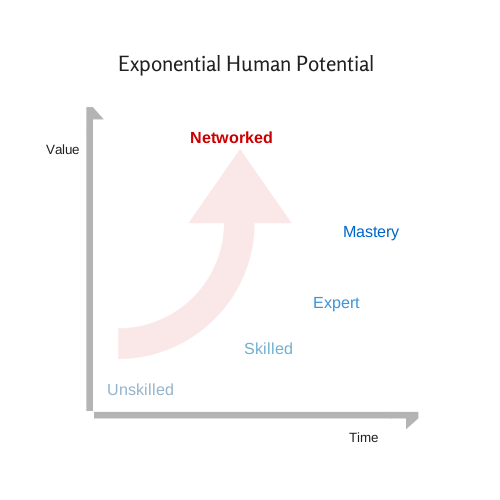
Leadership is the technology of human potential. We know that leadership needs new concepts to adapt to a network era. Without the right new leadership concepts, we won’t realise the human potential of the future of work.
Change Agents Worldwide is offering solutions and development opportunities for change leaders looking to make the transition to network era. I am excited to work with an extraordinary team of change agents to bring that about. Leadership can come from any role, so building capabilities matters for all individuals and for all teams. The opportunities are tailored to people’s personal goals, needs and position in the organisation.
Getting Here
Creating the future of leadership in a network era takes a diverse series of influences. The list below is the set of books, articles and blogs that have most influenced my personal learning. Like all such lists it is partial and personal. There are too many great thinkers and leaders whose work I have not had the time to read or the space to include here. I have included a long list under categories to enable people to dip into sources that they may not have seen before.
If you are looking for some great places to start, here my list:
General Leadership Agenda:
- The Leadership Challenge – Kouzes & Posner
- On Becoming a Leader – Warren Bennis
- Leading Out Loud – Terry Pearce
Leadership Stories
- Delivering Happiness – Tony Hsieh
- Maverick & The Seven Day Weekend – Ricardo Semler
- The Contrarian’s Guide to Leadership – Steven B Sample
- Small Giants – Bo Burlingham
The Rationale For Change
- Future of Management – Gary Hamel
- Moonshots for Management or What Matters Now – Gary Hamel
- The Responsive Organization Manifesto
- The Manifesto for a New Way of Work – Stowe Boyd *
Adaptive Leadership Techniques:
- The Work of Leadership – Ron Heifetz & Donald Laurie
- The Practice of Adaptive Leadership – Heifetz, Grashow & Linsky
- The Australian Leadership Paradox – Liz Skelton and Geoff Aigner
- Solving Tough Problems & Power and Love – Adam Kahane
Discovering Purpose & Authenticity:
- Purpose posts from this blog
- Purpose – Nikos Mourkogiannis
- True North – Bill George
Personal and Organisational Learning:
- Seek>Sense>Share – Harold Jarche
- Teaching Smart People to Learn – Chris Argyris
- The Living Company – Arie De Geus
Working Out Loud:
Network Leadership:
- Wirearchy blog – Jon Husband
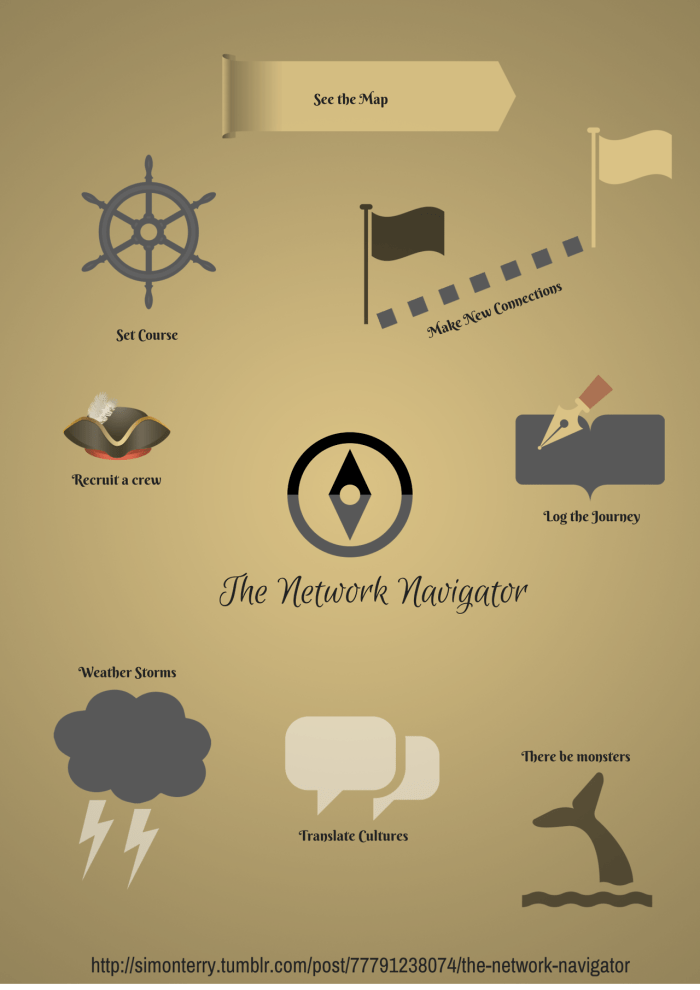
- The Network Navigator
- 6 Social Media Skills Every Leader Needs – McKinsey
- The Power of Pull – Hagel, Seely-Brown & Davidson
- Multipliers – Liz Wiseman & Greg McKeown
- Leadership that Gets Results – Daniel Goleman
Systems & Design Thinking
- Fifth Discipline – Peter Senge
- The Opposable Mind & The Design of Business – Roger L Martin
- The Laws of Simplicity – John Maeda
- Change by Design – Tim Brown
Communication:
- The Communication Catalyst – Mickey Connolly & Richard Rianoshek
- Fierce Conversations – Susan Scott
Community Building
- Cultivating Communities of Practice – Wenger, McDermott & Snyder
- Rules for Radicals – Saul Alinski
- WISP at Sanofi Pasteur – Celine Schillinger
- The First Follower – Derek Sivers
Any list like this is partial. These are the works on leadership that I go back to again and again as inspirations. This list clearly could be far more diverse and far longer.
Whose leadership inspires you? Who has been left out of this list? What materials should people read or engage with to design the future of leadership in the future of work?
I look forward to seeing your additional ideas and suggestions in the comments.
Notes
Change Agents Worldwide has a free e-book with essays on steps companies can take to be ready for the future of work.
* In an earlier version of this post Stowe Boyd’s Manisfesto was incorrectly referred to as The Manifesto for the New World of Work. The post has now been amended.

Why else would you work? http://www.csrwire.com/blog/posts/1239-etsy-s-recipe-for-purpose-creating-a-culture-around-mindfulness
The Future of Work is The Future of Leadership
An insight about the future of work dropped this morning as I discussed leadership in the network era with Harold Jarche and Jon Husband, colleagues from Change Agents Worldwide.

The Future of Work is the Future of Leadership
The future belongs not to the leadership of technology. The future belongs to the technology of leadership.
Our opportunity is not incremental improvement in the leadership of change to implement network technologies. Our opportunity is a much more important transformation of the critical human technology of leadership for the network era. Only new leadership capabilities & concepts will enable us to realise the potential of the future of work
Realising Human Potential is What Matters
If you are one of the thought leaders, consultants or vendors working to bring about the adoption of social collaboration technology, you know there is a raging debate about what changes in social and network technology means for organisations. However, there is much that is unclear in the debate about the future of work. Social Business is dead, not dead or even not enough. The biggest challenge is adoption, lack of executive buy-in, return on investment or even organisation’s success. You need a collaboration layer, you need purposeful collaboration or you need cooperation instead.
If you are a manager in an organisation trying to achieve outcomes in a rapidly changing business climate, you most likely missed this entire conversation. The debate about the impact of social collaboration technology is not even on your radar (unless a consultant or vendor has caused you to reflect on it for a moment before you returned to the daily challenge of running your business).
What matters most to managers is more effective human collaboration – collaboration that improves the performance of your business for your customers and delivering better work experience for your people. Managers everywhere wish there were better ways to tap the talents, innovation and engagement of their people to help deliver better outcomes. That is at the heart of the discussion of employee engagement in our organisations.
The technology that engages people and realises potential is called leadership. That’s why so many investments are made by organisations in leadership development and in a push for leadership in every role. Leadership is the most effective technology to solve for the management wish.
Network Era Leadership Realises Human Potential
Work is a human task. Leadership is the work of mobilising others to action. Leadership is how we help people to realise their human potential. Much of our network and collaboration technology is just an infrastructure for the work and leadership required. The network can magnify the culture of the organisation, but we need the right leadership models for managers to realise the potential of a network era of work.
Traditional management & leadership approaches inherit many of their concepts from process models borrowed from the industrial era. In this mindset human potential is measured in productivity terms. The command and control culture focuses on using the right processes to drive human productivity and align that productivity with the right tasks. The engines of human potential (engagement, knowledge creation, experimentation, innovation & enablement) are driven out as sources of volatility & waste. What many call leadership is better described as a process of command of people with an efficiency mindset. That is not leadership at all.
These traditional management concepts also get baked into organisational systems. We have built much technology to explicitly or implicitly reflect these industrial models of management and work. Look inside any organisation and you will find plenty of systems designed from the top-down that reinforce hierarchical command and control. Pull out your system process maps and look for your employee’s ability to do exception handling. In many cases there is no exception process. Exceptions are handled in hacks.
Transparency, responsiveness, the ability to work across silos and effectiveness are often surrendered to tight control of process, narrow measurement of process outcomes, compliance and efficiency. Critical systems in customer management and human resources systems offer some of the most striking examples of these constraints and are widely copied from organisation to organisation. To the frustration of everyone, managers and people must work around these systems to collaborate and cooperate effectively while managing waves of top down change management to bring them back to compliance with process.
The disruption of the networked era is evidence of the scale of change that networks are bringing to our lives. ‘Kodak Moment’ has an entirely new meaning today. This pace of change focuses our attention on a need for change in the concepts of leadership & organisation to support a changing world of work.
We need not focus much on the threats of this era. The opportunities of new models of work and leadership are greater. New network technologies give a glimpse of the potential for leaders to better leverage the people of organisations for work and innovation. However, realising the potential of human collaborative and cooperative knowledge work in networks demands new leadership models.
We Know How to Start Leading in the Network Era
Each new era brings social changes and requires new more effective concepts. We updated the concepts of leadership and management at the birth of the industrial era, leveraging existing concepts from the military and other spheres of human life. Now people need to work to develop new models to leverage the infrastructure delivered by networks and collaboration technology.
The good news is that many of these concepts are already clear and have been developed by practitioners to the point where they are capable of application in everyday work. These practices now work highly effectively and can be taught. Managers now need to pick these up and build the capability in their people to lead in new ways, using:
- Deeper self-awareness and understanding of human behaviour and drivers of high performance
- A greater focus on systems and a wider view of outcomes and stakeholders
- Purpose & Trust to enable leadership & followership in every role
- Experimentation & Adaptation
- Collaboration & Cooperation
- Network models of work organisation like Wirearchy, Pods and Swarms
- Social work and learning, such as personal knowledge management, working out loud.
However, we cannot expect managers do to all the work alone. We will need to support them with learning, coaching and the opportunity to practice the new skills and mindsets. We need to change the organisational systems and processes that hold back this opportunity to better leverage human potential.
Making these changes is the great challenge of leadership is in the new network era. It is the work I will be focused on with my colleagues in Change Agents Worldwide as we help others to navigate these changes.
The future of work is the future of leadership for everyone in organisations. Building a better more effective model of leadership will help realise the human potential of this future. Join the effort in your organisation to build a new technology of leadership to make this possible.
The Dread Pirate Roberts Problem
Man in Black: I can’t afford to make exceptions. Once word leaks out that a pirate has gone soft, people begin to disobey you, and then it’s nothing but work, work, work all the time.
– From the film ‘The Princess Bride’
Many middle managers have the Dread Pirate Roberts Problem. Changing our organisations will require them to break from moulds of leadership that they have inherited with their roles. Middle managers need to invent the new path forward to more responsive organisations or disappear in the disruption of digital networks.
The Dread Pirate Roberts Problem of Middle Management
Man in Black: The name was the important thing for inspiring the necessary fear. No one would surrender to the Dread Pirate Wesley.
In the film ‘The Princess Bride” we discover that the Dread Pirate Roberts that has been terrorising the seas for 20 years is not a person, it is a role. The title Dread Pirate Roberts has been handed down from one player of that role to the next. Each player carries on the traditions and techniques of the role to maintain their effectiveness. When they tire of the role, they retire passing it on to the next person to play Dread Pirate Roberts with terror, ruthless efficiency and no exceptions.
Middle managers can experience the same challenge as the successors of the Dread Pirate Roberts. The role that they take on as managers in a hierarchy comes with cultural expectations that have been built up over years by their predecessors. Culture is an expectation as to patterns of interactions between people. The culture creates expectations of how managers will act, use their power and demonstrate leadership. In many cases those expectations can be no less fearsome than those of the Dread Pirate Roberts.
Many middle managers have not seen or been trained in any other models of management and leadership than those that have prevailed in the role or organisation. Asking or expecting these managers to break from these deep cultural expectations on their own is a vain hope. Even if they are given the skills to act differently, they will find their teams and stakeholders are disappointed that they no longer behave as the Dread Pirate Roberts should.
The system pressure to return to type in this situation can be strong. Performance management & talent systems reward ‘strong leadership’, usually defined culturally by the existing role of manager. The risk of adopting another model is that any volatility of performance will be seen as failure of the new practice. Personal influence in the networks of ‘strong leaders’ can erode. Struggling to come to grips with new practices managers find management and leadership becomes ‘work, work, work all the time’. It hard not to see why many choose to just continue the traditions, enjoy the rewards and hang out for their chance to retire and pass on the role.
Why does Middle Management Need to Change its Approach?
Digital disruption and networked ways of working are threatening organisations and putting pressure on the traditional function of middle management roles. The role of middle managers as creators and filters of knowledge disappears as knowledge becomes a flow in networks and technology automates the functions.
Middle managers are increasingly facing a need to realise people’s potential in collaboration and create more responsive organisations. More and more organisations are focused on the fact that the poor engagement of people in traditional command and control models is a massive waste of human potential. Every disengaged employee is someone not helping to push the organising forward. More knowledge work demands better use of people’s purpose, passion, creativity and intelligence. Organisations increasingly want leadership in every role, a direct threat to command and control models. Managers need to leverage new mindsets, new questions and gather new knowledge & expertise from networks.
Embedding a New Model
However, when these changes require new management and leadership models, the Dread Pirate Roberts problem arises. A middle manager who is expected to manage by control and power will find a shift to the role of an engaging leader, let alone a network navigator, challenging and confronting. They are going to need to give up their traditional models of influence, perceptions of how they create value and ‘work, work, work’ to influence teams and stakeholders that a new approach works.
Middle managers need to accept the work & the risks. Leadership is work. In the new era of network disruption, leadership can’t be safe. Managers need to accept that they are the change management. Influence is critical and middle level managers need to use their networks and authority to lead that change collectively.
Senior organisational leaders can authorise and support these changes. Senior leaders can help reduce the work and risk of change. However, they cannot make change easier for middle managers. Senior leaders can’t order a change in culture. It will take a new shared story of leadership in the organisation, new capabilities & practices, new systems, and consistent role modelling for a new model of leadership to embed. Social collaboration inside organisations can help managers to accelerate this cultural change by acting as infrastructure of culture magnifying the change in culture and role modelling effective behaviours.
Middle managers need to embrace the opportunities to be leaders, culture change agents and to explore the network navigator role, particularly in networks in and around their organisation. These roles may well be the only functions of a middle manager in a future organisation. By experimenting and working collaboratively with their teams and leaders in this way they will discover the right path forward for their organisation & build critical capabilities for the years ahead.
Perhaps then all the managers playing the role of Dread Pirate Roberts in organisations can happily retire and hang up their boots.
On Collaboration & Innovation
A recent presentation for a corporate client on the role social collaboration plays to power a strategic agenda of innovation. In particular it features the innovation maturity process in an ESN community as it develops from Building Connection through to Collaborative Innovation
More Poetry at Work

The magic of social collaboration is when you become part of a conversation, then others bring their insights. After the last two posts, this has become poetry week (or so it seems).
Two Quick Reads
My last two posts discovered two further good reads on the power of poetry:
- A delightful post by Neil Usher (@workessence on Twitter) on the 10 reasons to use poetry in business
- Richard Martin (@indalogenesis) wrote a post An artist by any other name – a dissection of knowledge work, The Waste Land and its influences
Deeper Reading
For anyone who wants to dive deeper into this topic, I can recommend:
- the classic work by David Whyte ‘The Heart Aroused: Poetry and the Preservation of the Soul in Corporate America’
- another masterpiece on creative work written with poets in mind, The Gift by Lewis Hyde
- for practical inspiration (& great mindsets for any business person) The Artist’s Way by Julia Cameron
- An argument for a wider impact of poetry: Can Poetry Matter? by Danny Gioia. Also available in a great book of essays
Action
Lastly, go to your favourite bookstore and buy a book of poetry. There is no better way to realise the power than to dip into the inspiration of a collection of great poems.
One book can make a difference. My journey into the power of poetry began when a good friend, Geoff Higgins, gave me a copy of Seamus Heaney’s The Haw Lantern. Geoff did me an enormous favour because great poetry is a passion that can sustain a life of creative work.
You could do worse than to decide to follow this practice by the wise Lois Kelly:
@simongterry I read a poem first thing every morning. My version of morning prayer.
— Lois Kelly (@LoisKelly)

A Poem as Knowledge Work
A poet’s work is to name the unnameable, to point at frauds, to take sides, start arguments, shape the world, and stop it going to sleep. – Salman Rushdie
The moment of change is the only poem – Adrienne Rich
Genuine poetry can communicate before it is understood – TS Eliot
Poetry is pure knowledge work. Poets take their art, sensibilities, training and deep domain expertise to create a work of pure knowledge, a piece of literature.
We accept that a poet might use elements of the following processes to create their work:
- Engaging with the world
- Taking time for reflection & seeking inspiration
- Working drafts, experimenting, throwing away failures, restarting often and trialling different approaches and ideas
- Building on patterns, influences, themes and ideas shared by others
- Collaborating with others, seeking the guidance of colleagues, peers, editors and audiences to improve the work
- Creating new forms, practices, breaking rules and pushing the discipline of the domain
- Questing after perfection and never quite realising it. Paul Valery famously said “Poems are never finished, just abandoned”
Poetry in this way is an example of knowledge work’s pursuit of effectiveness, over efficiency. The best poems are the result of distilling human experience, creating a leap forward in capability and dazzling in their rich human value.
As much as we may joke about a roomful of monkeys with typewriters writing Shakespeare, we know it cannot happen. Yet many organisations seek to manage knowledge work as a monkey business, concerned solely with the efficiency of the process of knowledge production. This mindset rejects the potential of the elements above and seeks to apply industrial process management to knowledge work. An example is the concern that collaboration in organisations might be wasteful or time consuming. That concern misses the engaging and creative potential of collaboration.
There is much knowledge work that can be improved. Even poets quest for better more impactful creation. However, they focus of their improvement is increasing the value of the output and not reducing waste in the process.
We can minimise down time. We can reduce errors and waste in the process. We can turn the process of knowledge creation into an algorithm. But like poetry created by monkeys, we must acknowledge that the great human potential for connection, emotion, creativity and innovation has been lost in that process.
Poetry is nearer to vital truth than history – Plato
Poetry is the art of uniting pleasure with truth – Samuel Johnson
Always be a poet, even in prose – Charles Baudelaire