You don’t need to be first
You don’t need to be best
You don’t need to be richest, loudest or most powerful
You don’t need to be more connected, more famous or smarter
You need to be more engaging, more empowering and more effective
The network does the rest.
Author: simongterry
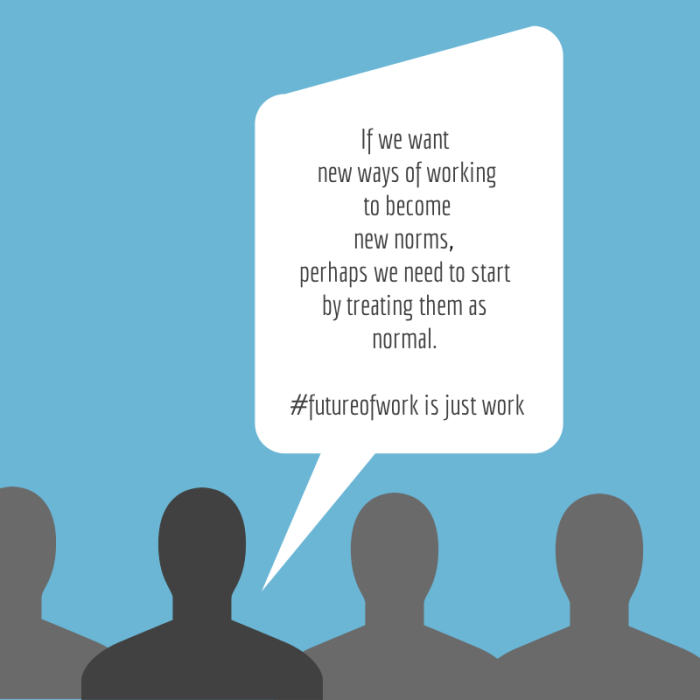

The One Success Secret to Social Collaboration in the Future of Work
There is a lot of advice out there for organisations trying to achieve success in social collaboration and new ways of working. The future of work is very popular now so there is a lot of effort to sell the newness, the complexity and its special nature. Much of that advice makes efforts at social collaboration sound difficult to achieve or alien, if you are working today in a traditional organisation.
Despite all that discussion, there is one practice that helps make initiatives in social collaboration successful and increases the value that is created in the future of work. That practice is simply:
Treat it as just work
We work collaboratively every day
Every day people collaborate at work. Mostly they don’t call it collaboration. Instead, it is seen as having a conversation, sending an email, persuading someone, getting advice, getting help or working together on a task or project.
Social collaboration extends the opportunities of who can engage in this collaboration. Social collaboration tools enable this kind of work to be done with more people, faster and with better ability to leverage the knowledge created. If social collaboration tools don’t make it easier or better to do this kind of work, then users won’t and shouldn’t use them.
Treating social collaboration as a special activity distinct from work confuses people. They debate when they should use this special collaboration. They question the value of collaboration. They can’t see the point. And each time they go back to their work and start collaborating with others again.
Work is why we share information
Many people can immediately see the value of social collaboration as a way to share information. Your enterprise social network looks like Facebook. Your corporate blogs look like the ones in the public domain. Your wikis and knowledge management systems may even be familiar too.
However, this familiarity makes people uncomfortable at work. Clearly we don’t usually share the same information at work as we do in Facebook. Many people ask: What should I share? What do I have that is worthwhile to share? What will happen if I share the wrong thing?
However in any organisation the best reason to share information is to work. People share information to do work together and to create value. Connecting with work colleagues, working out loud, solving work problems collaboratively and innovating with others are the reasons we share information at work.
Work isn’t special
Treating social collaboration as work addresses other issues that organisations face as they move into the future of work.
You have the policies, processes or campaigns to do your work. You don’t need special approaches to start social collaboration. Your normal work rules and processes should cover your social collaboration too, including rules on privacy & confidentiality, behaviours and performance processes. If these approaches break, constrain or prevent new forms of social collaboration, there is a good chance they don’t work for other forms of collaborative work and should be changed. Don’t create special rules.
Do you gamify your daily work processes? If you don’t gamify everyday work, don’t gamify engagement with a social platform. Remember it is the work that creates the value, not the adoption. Don’t confuse the tool with the result.
Don’t start with special things. Start by helping your people to do their work better. If your organisation has never ever sought any input to its product development processes, doing a special product ideation session can be valuable, but it is a terrible way to start a social collaboration journey (especially if you fail to follow through on the ideas). You don’t want people building an idea that a social collaboration tool as something for special, rare & unique events. You want people realising its potential to do work and solve work problems each day.
Treating social collaboration as work also addresses why senior executives and other leaders should participate. This is not a special domain. This is where the work gets done. If you want to lead, lead here too.
Work Creates Value
Most importantly, considering social collaboration as work drives our attention to the question of the value that the work adds. When we work, we know we need to work more efficiently and find ways to make our work add value. That is part of the deal with work.
Focusing on social collaboration as work also reminds us that we should work to realise our strategy as an organisation. The collaboration must realise the organisation’s goals and the goals of the individuals who need to work. Collaboration for its own sake is a waste.
Start Working to Work Better.
Social collaboration is the same. We shouldn’t focus on the tools. We should focus on the value of the work we do and how we can do better.
If you want to create value from social collaboration and new ways of working, start by treating it as work. Then ask people to improve their work. Experiment and make changes to make work more productive and effective each day. You will need to change processes, policies and organisational structures over time, but you will be guided by the collaboration of your people. That is the way to realise the human potential in your organisation.
The journey won’t be easy. There will be setbacks and lessons to be learned. People will need to learn new ways and adapt to change but an engaged group of people working together will create greater value for your organisation over time.
That sounds just like work too.
—-
The Connect>Share>Solve>Innovate maturity model assists organisations to accelerate the value of the work their people do in social collaboration tools in practical ways. Accelerating the progress of collaborative work from Connection to Innovation significantly increases the returns to individuals and the organisation from new ways of work. Importantly it also engages people in shaping the future of work in their organisation. If you would like to learn more, please get in touch.
The Learning Potential of Discomfort

When you become a leader, success is all about growing others – Jack Welch
Leadership is how we realise human potential. To realise potential great leaders help people to step out of their comfort zone. As a leader, you will need to get used to being out of your own comfort zone.
The friction of capabilities against a bigger challenge
A match doesn’t realise its potential until you strike it against a surface. The friction brings out the flame.
Developing the potential of people takes learning. We need to learn the limits of their capabilities. We need to learn how far their capabilities will stretch. This learning only occurs when people are out of their zone of comfort.
Great leaders excel at getting people acting outside of their comfort zone. Getting outside our comfort zones is where we can feel the friction of their capabilities against bigger challenges. That action to stretch ourselves is how we learn.
Leaders don’t make action safe. Leaders give people the confidence, purpose and support to do unsafe things to learn, to improve or to make change happen. This means guiding people into action, shaping the feedback and reflection to grow learning and helping people back up when they fall short to try again.
Leaders enable people to realise a potential that they might not fully accept or understand. These leaders never confuse competency with capability. They look for the upside. Great leaders help create the achievements that people describe later as “i never thought I could do that but I just did.”
Leadership can’t play safe
Before people take a risk for you, they want to know you are taking a risk too. If you build in too many failsafes, fallbacks and protections, then you will take the stretch, the risk and the learning away from the team. If you believe in others and take a risk on their capabilities the results & gratitude can be extraordinary.
Great leaders know they are realising the potential of their teams outside the comfort zone because they feel that friction in their leadership too. They push themselves to improve and realise their potential as well. Great leaders know they need to learn new approaches, build capability and improve to make things better.
Leaders can’t play safe to realise the potential of others.
In three words I can sum up everything I’ve learned about life: it goes on.
Robert Frost (via gentlemen-always-know)
Leaders and their Tools

Leadership is the technology of realising human potential. In practice, leaders need to use different tools in different contexts. The use of a new tool does not change who they are.
Many leaders use the same approaches to leadership in every context. They either call it a best practice or their best style. They define themselves by their leadership tools. These leaders repeat phrases to themselves like ‘I am collaborative’, “I create accountability’, ‘I am powerful’, or ‘I am inspiring’. These phrases become constraints on their freedom of action. When the situation demands a different style of leadership, they find it hard to work against their self-created identity. These leaders have confused the tool with the result.
Leadership depends on context. The needs of others are different in every situation. Leaders need to adapt their styles to the needs of their situation and their people if they are to realise the potential of others. That means leaders need to choose different tools and have different conversations. If it is time to demonstrate power, then a leader must demonstrate power regardless of their natural style. Importantly, they still choose the values that they show in their use of power.
The best leaders have a dynamic toolkit of styles that they apply as the situation demands. They don’t define themselves by anyone one tool. What matters to the best leaders is the purpose they are seeking to achieve and the values that shape how they use a leadership tool.
Don’t define your leadership by a tool. Define your leadership by your purpose, your values and your impact.
Why I am excited by Do Lectures Australia
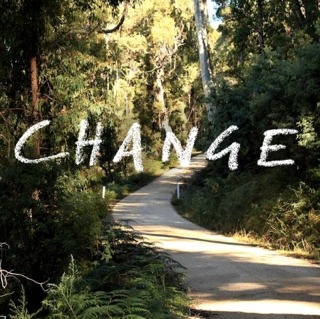
Photo: Do Lectures Australia – Write change across anything and it looks good to me.
Do Lectures Australia is almost here
When I first heard about Do Lectures Australia. I went and looked at the Do Lectures website and found stories that resonated deeply. I found:
- The idea which is put simply this way:
The idea is a simple one. That people who Do things, can inspire the rest of us to go and Do things too. So each year, we invite a set of people to come and tell us what they Do.
- The founder of Do Lectures David Hieatt has a great personal story of doing and that he was writing a book about Purpose, a topic dear to my heart.
- The talks are simply amazing – this talk by Tina Ross-Eisenberg (aka swissmiss) that Trust breeds Magic has become a personal favourite and great guidance to my personal work as an independent change agent.
I immediately wanted to be a part of the event. I am so excited that after some luck and a great deal of generosity from Yammer. I am going to be a part of the experience later this month.
Why Do I Want to Do?
There are 3 things that are at the heart of why I am excited about the first Do Lectures in Australia
- The Community: Do Lectures is not a huge conference. The scale is human. The goal is connection, interaction, learning and inspiration in a community atmosphere. The speakers which you can find on the blog are diverse and have achieved great things. However, the list of attendees is just as remarkable. This is a community that I want to join.
- The Purpose: In a world that can feel disconnected, apathetic and alien at times, we need people setting out to share their personal purpose, connect with others over purpose and bring great things to life to further purpose. From what I have seen and know, there is a rare depth of purpose among the attendees at this event. I have already heard some extraordinary stories of what people have done, want to do and why. I want to hear, learn and engage to help more of these purposes come to action.
- The Do: Conferences that are full of beautiful talking about talking are everywhere. Twitter was invented so that you don’t have to attend them, just read along or watch the videos later. I want to do, not talk. I want to be inspired to do extraordinary things. I want to meet people doing extraordinary things. I want to help others do. Purpose is in the work.
I look forward to sharing more on my return from this extraordinary event. I have had enough luck to date to tell this is going to be a great learning experience. I will share more of my adventures and insights after I return from Payne’s Hut. I am sure I will be raving even about the ‘Purpose is the Work’ and the ‘Community is the How’. I might even slip in the odd mumbling about leadership in communities, networks and the future of work.
Special Thanks: I would like to thank the Do Lectures team for keeping the pressure on for me to attend the event. There is nothing like an idea and the support of a community to produce results.
Most of all I would like to thank Yammer for the partnering with Do Lectures Australia to help bring this extraordinary event to life and for giving me the opportunity to attend as their guest, competition winner & Do-er. If any organisation has shown me the power of a community to reinforce purpose, to inspire and to do more, it is Yammer. Thanks for one more proof point.
Collaboration Fast & Slow
I admit I’m starting to struggle with the conflict been rapid change and extensive collaboration. Any help? #2014FOW
— Christoph Hewett (@ChristophHewett)
//platform.twitter.com/widgets.js
Christoph Hewett asked this great question attending the #2014FOW conference. The question set off a huge discussion as people debated the need to move faster in a disruptive economy with an increasing emphasis on collaboration because of the networked nature of that economy.
Much of the discussion was about whether collaboration is really slower. The slowness of collaboration is the common perception. In traditional management terms of clear decision makers and control of resources, collaboration is often perceived as slower and more difficult.
I recognise the concerns raised. I have heard it often. My experience differs in that I have seen collaboration deliver accelerated results. I attribute that concern to the view that collaboration is a ‘softer way’ of management.
Separate Collaboration from Consensus
Collaboration and consensus are often used as synonyms. They are not. The involvement in other people in collaborative work does not mean that there need be large numbers, everyone has to have universal agreement or that the work is directionless.
Successful collaborative projects have strong leadership and direction at their core. This leadership helps them to find and leverage the common direction of the competing agendas of those involved. For example, Linus Torvalds remains the ultimate authority on what gets included in Linux despite its open source collaborative model.
Slow Collaboration – Collaboration as the What
We need to start to distinguish between slow collaboration and fast collaboration. When people see the slowness of collaboration, they often are looking at abstract exercises of stakeholder engagement or consensus. Talk oriented, this approach is the practice of engaging a rolling group of people seeking consensus for its own sake (or in the absence of any other plan). These forms of activity are rarely satisfying for anyone. The stakeholders engaged usually end up frustrated at the lack of action and the unwillingness to make a decision.
In this meaning of slow collaboration, collaboration is the point of the exercise (what). Consensus or other collaborative activities that have this approach are where traditional management develops the sense that collaboration is soft and ineffective.
Fast Collaboration – Collaboration as the How
“Collaboration – the action of working with someone to produce something” – Oxford English dictionary
We collaborate every day with other people to do our work. We just don’t call it collaboration. We call it getting help or using expertise or completing a project together. These small acts of collaboration are not seen as difficult because we understand the work, we understand the goals and who gets to make decisions.
Fast collaboration, at any scale, focuses on collaboration as a means (the how) to achieve a goal (the why) with clear roles for the participants which include decision rights (the who).
Collaboration is not the point of the exercise. The point of fast collaboration is getting work done better. If things drift, everyone can be reminded that there is a goal to be achieved and one or many leaders responsible for ensuring that the exercise gets to the goal.
The benefits of fast collaboration can be huge:
- Reduced search time for information and resources.
- Faster and more flexible access to the collective skills, capabilities and experience of other people.
- Increased passion and engagement leading to more discretionary effort, more creativity and better influence.
- Reduced time learning, selling change or educating stakeholders because they are part of the journey
With increasing leverage of networks and increasing complexity in our goals, how we do our work and how we structure our organisations, collaboration is increasingly unavoidable. The challenge for organisations is not how to avoid collaboration but how to effectively leverage it to gain the benefits of the network era. Those who don’t leverage collaboration will be at a significant disadvantage to those who can reap the benefits above.
Fast Collaboration is Hard
Reaping the benefits of collaboration is not easy. For traditional management focused on power, control and ownership, it can be a radical challenge.
Fast and effective collaboration is hard precise because the investment upfront and ongoing to align people. Alignment takes tough conversations traditional management often ignores in commands and one-way communication. In larger groups, these conversations challenge leaders to demonstrate adaptive leadership skills and focus not on their agenda but what realises the potential of the group.
Having hard alignment conversations upfront and ongoing around purpose and decision rights flushes out the real issues that are otherwise ignored and avoids learning, rework, duplication, conflict and waste later. To move fast, this kind of collaboration must manage the conflict in people’s agendas early and it must have ongoing mechanisms to drive accountability and resolve conflicts.