Chair and Non-Executive Director, Advisor, and CEO helping healthcare, finance, and educational organisations drive growth, leverage technology innovation, and realise the strategic value of transformation
A great source of productivity and happiness is choosing carefully the unnecessary in your life. Removing the painful and unnecessary leads to both happiness and success. The unnecessary is everywhere.
I wrote a post in the pandemic in an effort to strip things back to basics. The post was called the Needful. The Needful addresses both that which we need to do to succeed and that which we must prioritise to get by. The Needful had a strong ‘cut wood, carry water’ vibe.
Reflecting this week on needful, what came to mind was its antithesis – the unnecessary. Our modern lives are so full of the unnecessary:
The text that tells you a call is coming about the meeting to discuss the email that was sent last week
The third LinkedIn connection request from a growth marketing consultant who doesn’t understand how to grow their own business
The outrage in the political sphere about matters that don’t contribute to the betterment of the world or those in it
The anger that arises day to day as people expect more and give less, understand more and know less, or demand more and do less
The packaging that wraps the packaging that covers the packaging to protect the item
The bureaucratic processes that satisfy a systemic demand for bureaucratic processes and little else
The relentless cascade of things you should be, do or own with scant regard for what you might need to be, do or own.
And so on…
The Unnecessary is everywhere in our lives. You could say that a defining characteristic of late stage capitalism is the creation and commercialisation of the unnecessary.
Removing the unnecessary from your day, week and life is the greatest source of immediate happiness and productivity. Something simply vanishes and you can do more and feel better. Unchecked the unnecessary proliferates and its demands become all consuming bringing more unnecessary to remedy the last.
The only unnecessary you need is those things we do for pure moments of living, joy and beauty. We should choose the unnecessary we experience for happinesses sake or for an occasional escape from the demands of the needful.
Living life with a focus on the needful, eliminating the unnecessary as much as possible is a path to productivity and happiness. It also opens the space to enjoy a much more fun form of the unnecessary as the art of living well.
We live in a time of transition. That transition makes the world feel unusual and brings forth many strange moods. We need new rituals to appease the strange gods of these times.
Maybe this could be a gift of our turbulent times, reconnecting to the power of ritual that ancient cultures knew so well.
Sonja Blignaut
Strange gods
We ask people all the time “how are you?” or “how are you going?”. Once the answer was always “fine” or “good”. Now the response usually involves some variant of “things are a bit strange”.
Some of this reflects that we are still grappling with the same Monsters at the Gates from early 2020 that demand our agency and our attention – climate change, race, gender equality, pandemic, changing work and more. We have recently added war and new fronts in the landscape of political and cultural conflict. A bigger issue is that our personal responses to the demands on our agency, our work and our lives has been changed by the distruption of the pandemic. Lockdowns left us with lots of time to reflect. For many, the conclusions of those reflections lead directly to change as Sonja notes in her piece – changes in relationships, work, lives and more.
In the burned house I am eating breakfast. You understand: there is no house, there is no breakfast, yet here I am.
Similar periods of transition at the beginning of the modern era have led to intense explosion of religious revival. The experience in the ‘burned over’ districts in New York state of a significant religious revival was broadly contemporaneous with the beginnings of modern factory production, transportation and communication and the rapid westward expansion of the United States. There was a great deal of change in society and new power structures as society transformed from an agricultural to an industrial one.
In our time, the beneficiaries of this transition are less likely to be religious leaders, but there has been a return to those capable of manipulating modern digital communications: populist political leaders, disinformation specialists, influencers and thought leaders. Our reflexive daily doomscrolling ritual plays to their expertise, provides a channel to our attention, and has enabled many to build rich livelihoods, large movements and even considerable power.
New Rituals For Strange Gods
For it is important that awake people be awake, or a breaking line may discourage them back to sleep; the signals we give — yes or no, or maybe — should be clear: the darkness around us is deep.
I have found over the last two years that there are a need for new rituals to reflect the changing world. Here are some examples:
The Digital Commute: Walking from the kitchen to the study is a matter of minutes and doesn’t allow the planning or reflection time of a traditional suburban commute. I have found the need to find the time to stop and drink a coffee before the day begins. This is also my time to consider a blogpost or a new project. Gym time is another important ritual in this context.
Morning Digital Greetings: We don’t walk into the office as much and in lockdown we never left the house. We lost our morning greetings and social chats. I found myself adopting the practice of a morning greeting to a regular correspondents. Adding a tiny social interaction helps start the day in a more engaged way and often resulted in the day being underpinned with a more social vibe. Some went on so long, they became evening farewells.
Validation Checks: In a face paced digital world, it is easy to take messages at face value and equally easy to get oneself in a mess whether through misinformation, phishing or some other malicious act. I now check information more often and more widely. I ask myself why I am clicking through and what I want from the experience more often.
The Digital Disconnect: We need to turn off our work and our digital bombardment. Baking in time in the day that digital is off is important. More recently, I have begun to insist on a fixed time of reading books to stretch and relax the mind. Taking concentration away from the intensity of work and social media is important. I find this time powerful for engaging curiosity, imagination and escaping the drive of the algorithmic bubble.
The Spontaneous Coffee/Walk/Lunch: With less interaction in the office and busy social lives, there is more need to plan social interactions. Fighting that with a call to others for a spontaneous coffee, lunch, walk around the block or walk in the park.
it seems they were all cheated of some marvelous experience which is not going to go wasted on me which is why I’m telling you about it
Something for Yourself: A ritual of finding time for yourself is important when the digital, work, family and social pressures can be relentless.
The Creative Outlet: Engaging a different part of your life through creative work or engagement with the arts is as important as the daily grind. Finding consistent time and practice for this has become important. I have spoken about my enjoyment of poetry and have been continuing my baking in this regard.
The Evening Walk: Ending the day in the dark and the quiet with time to clear the mind and calm the nerves
Just like moons and like suns, With the certainty of tides, Just like hopes springing high, Still I’ll rise.
Collaboration is a natural human practice. Yet we tie ourselves in knots on how best to train people to collaborate. If we didn’t make work complicated with concepts that interfere with natural human collaboration like hierarchy, ownership, scorecards, practices, and more, we might find the outcome easier. There’s much we can learn from the simpler world of toddlers.
Once small children move beyond parallel play and want to play together any parent will tell you that there are a few simple rules to be reinforced to help a child understand how best to play with others. Most of these rules relate to taming the nascent toddler narcissism:
You can’t make someone else play with you
Do something you both want to do
You need to share – If there is a scarce resource, make sure you both get a go
Talk about your goals, problems and frustrations – they don’t know what you know
Be nice to each other
A lot of collaboration problems could be solved if we just asked everyone in our organisations to put aside their fancy ideas and complicated systems and followed the collaboration rules for toddlers.
The ancient Romans celebrate Janus, a king of Latium for his piety and elevated him to the gatekeeper of the Gods, making him god of doorways, thresholds, beginning and endings. Janus gave his name to January, the first month of the year that we have inherited from a Roman calendar. Janus is represented as looking both forward and backward observing both sides of a boundary, understanding that each threshold is both an end and a new beginning.
The wheat leans back toward its own darkness, And I lean toward mine.
We rush through many boundaries in our daily lives without Janus’ careful reflection. Everyday, we awake to a new day and a new range of possibilities, but often we head straight back into the routines and the challenges that we have become accustomed to managing. It takes reflection to stop on a daily level and to look for what can or might need to change. The most productive people build these small moments of review into their everyday life.
Doesn’t everything die at last, and too soon? Tell me, what is it you plan to do With your one wild and precious life?
For many of us, such reflection is only an exercise that flows from a major boundary, perhaps the end of a weekend, a holiday, or the start of a new job, or a change of team, city or office. We need to treasure these times to reflect and to choose what we want the new day to be. Our agency will shape how the boundary is crossed and what becomes of the future.
These major transitions can be times where much becomes uncertain and unknown. We have the same degree of uncertainty each day as to what exactly will happen and what might change but we rarely perceive it so intently we pursue our habitual lives. However, at the bigger junctures our stomachs can fill with nerves as we pursue the might bes and the threats of all that is new across the boundary.
In these moments, we need to retain our hope. We need to take comfort in our agency and our capacity to lead the changes that are needed to whatever circumstances come our way. Fear will not help us. We need to combine a passionate optimism for our capabilities and the potential of others, with the frank certainty of pragmatism and realism. That’s the path to make each doorway a winner. That is also the path to validating our own unique potential to contribute and be productive.
You remind me of the necessity of having more hope than fear, and of sounding out terrible names.
What goals should you set for your organisation? There are so many it can become a blizzard of goals: grow customers, grow revenue, grow profitability, improve returns, cut costs, improve productivity, deliver a balanced scorecard, achieve sustainable growth and so many more. So many of these goals can even come at the expense of the purpose of your organisation and the people who make it up.
What if there was a simpler shared and meaningful goal that grew the value and sustainability of your organisation?
Grow the potential of your people to deliver your organisational purpose
The focus on purpose means this applies for not-for-profits, for-purpose organisations and for profit organisations. If you aren’t doing better by growing your capacity to deliver your purpose then you have a fundamental business model problem. Purpose should be the reason for every action and the measure by which all organisation activity is judged. Remember purpose is a benefit to people outside the organisation and that external focus helps capture the social, environmental and stakeholder benefits lost in a pure accounting calculation.
In the short term the people in your organisation is largely fixed. In a tight labour market, it can be hard to add people and the expense and time of the process might be challenging. You don’t want to lose people either. Developing your people’s potential, capabilities and capacities to deliver on purpose is the best way to gain leverage on your expensive and talented employees. You worked so hard to hire them, why wouldn’t you want to see them grow into the rewards of better delivering purpose?
For the engineers worried I am focused on the human here, growing human potential in this way demands a focus on the whole set of systems around the humans. For the accountants worried that this sounds like expense, we are investing in improved productivity and improved value. For managers worried that talented people will leave, we can assure you people in unrewarding work leave faster. For learning and development, this measure brings focus to the panoply of things that could be developed and forces a winnowing of all the showy learning that adds little value to performance.
Some times the simplest goals are the most far reaching in their effects. Some times the measures you choose become a catalytic mechanism for organisational and social transformation. Focusing on the potential of employees to deliver your organisation purpose will challenge you and your organisation every day to grow, to add meaningful value and to do more.
Collaboration software won the world and lost. How can it be we are here now? The answers reveal much about what business wants, how vendors sabotaged themselves and why collaboration still hasn’t delivered the promise.
A recent post by Carrie Basham Marshall, a leading future of work practitioner and founder of both a technology platform and a leading consultancy, announcing her move into ranching highlighted a frustration widely shared in collaboration practitioners:
But digital transformation in its current state no longer feels innovative – it’s a bit of a Groundhog Day industry right now, still offering the identical community and collaboration-related promises that we made more than a decade ago. It’s also too vendor-centric, which makes employee behavior change even harder. I’m still a huge believer in transparency, the digital workplace, and the employee experience. I’m also in search of something new and deeply meaningful.
Carrie Basham Marshall
I quote Carrie at length because her words hit home. In recent years, I have heard similar sentiments from clients, consultants and vendors alike. I recently found myself answering questions with a talk I delivered in 2011 and a post I wrote in 2013. We can talk about new features but mostly the vendors are in a cycle of copying each others features or copying the features of consumer social in an effort for relevance. Some vendors have given up discussing collaboration and social networking and focus almost entirely on employee communications. Hybrid work may mean everyone now has the technology likely through a major vendor stack or in opposition to it. Few are getting more than entry level value.
The technology is hardly new. We’ve been going around this technology block for a while. Jive was founded in 2001 and now have vanished into private equity hell. Yammer was founded in 2008. Slack was founded in 2009. Workplace from Meta the once new kid on the block was announced in 2015. Microsoft Teams was launched November 2016. Over the last 20 something years, a raft of other collaboration solutions have lit up the sky and either burnt out or scaled back to a niche. I’m sure there’s yet another Google product coming.
If you take nothing else away from this post, remember this:
Work is a wicked problem — a snarl of dilemmas, not a list of initiatives — and the whole world and all its actors are fighting to control it, bend it, contain it: in short, to own it.
Stowe Boyd in his typical incisive fashion nails the first issue with much of the last decade of collaboration. The consultants and change agents were focused on the potential to create a new way of working based in agility, transparency, freedom and creativity. Organisations and their managers right down to the frontline were focused on extending models of power and leveraging the technology to improve employee engagement without real change. Employees wanted some improvement in their work, better information and better help, but they weren’t seeking the revolution of the advocates, mostly they wanted work to be rewarding, productive and safe.
The second issue flows from the first. With so many diverse interests at play, we could never nail a consistent metaphor for the activity that these tools were helping to improve. Were we focused on social networking, collaboration, employee communications, employee engagement, community, employee experience, innovation, or something else? The answer of all of the above doesn’t fit in the reductive simplistic management model in place around the world. No wonder people had so much trouble with ‘what to use when.’ Kai Riemer nailed this issue back at the beginning of this technology when he highlighted that it was an infrastructure that’s use was open to its users and demanded sense-making. That we are still grappling with that sense over a decade later is a major issue.
Infrastructures don’t have a well-defined purpose. Infrastructures are largely undefined, general purpose, but they open up a realm of new possibilities. They are unpredictable!
With all the above in play, it became easier for vendors to focus on the technology and its features. Many embraced the sense-making and the adoption support required to help employees to understand and leverage the work. Other vendors made the lack of a need for such support marketing features even though it was an illusion. Over time, it became clear that one needed to invest in adoption at launch. Fewer clients lined up to support their investment in new technology with ongoing support. The benchmark of adoption became employees on a tool with some level of activity, not the potential to work better or more valuably. In a confusion of goals, the simplest metric dominates.
Last and perhaps most devastating of all, too much of the adoption work became about what to do to employees to encourage use of the tool – what to take away, what to force into the platform, how to create incentives from cupcakes to competitions to regular video updates from the boss. This top-down focus on doing-to-others meant so many organisations missed the peer-based bottom up doing-with-others that represented the exponential potential of value. Community which is hard and long-term was swapped for the short fix of launches, gamification and measurement. Employees arrived on the new tool without any sense it was for them to get value and asked “do I have to use this too?”. Managers invested significantly to get all their employees on the platform and went “is that all there is?” No wonder the next platform launch always looked tempting.
Please note, there’s no new revelation in these three issues. They have been discussed individually and collectively for a long while. What has changed as adoption of the platforms become universal post-Covid is that the answer to these was not going to magically appear when we had adoption or the tool to beat all tools was launched. Those who have been saying for a decade that we need to do better now have the evidence to back it up.
Where Now?
The challenges of the last decade highlight a few paths to a better future:
Focus on strategic value. Don’t focus on some universal use case, metric or goal. Focus on the value you need in your circumstances whether you are an employee, a manager, a team, or a whole organisation. Leverage these platforms to meet your work goals and create better ways to work.
Focus on people, not technology. There is no feature that will solve any problem. There is no feature that holds you back from creating the value of your people working together in better ways. There will be annoyances but there are always workarounds and people are ultimately forgiving if you create the value in 1
Scaffold the work. There are so many different kinds of community, so many different patterns of work in an organisation and so many employee goals and benefits. Put in place the scaffolding on which people can build their collaborations and their communities. That scaffolding includes purpose, goals, strategic alignment, context and relevance. Hint: It might also involve fostering connection, sharing, problem solving and innovation. Don’t try to prescribe who, how or where. Vibrant communities will always surprise you.
Back your employees: Your employees are better, more committed and more capable than you think. Give them a chance to show you what they can do. Manage exceptions as exceptions not the foundation of new policies and constraints. Trust flows from trust and one of the critical elements to success in collaboration is mutual trust.
Begin and end with everyday work. Video is exciting. Events are exciting. Campaigns, features, incentives and more can help educate employees but begin and end your work by improving everyday work. Make that better and your efforts have ongoing value to the grassroots in the organisation.
The challenge of this approach is that each client situation is different, each team has a different set of goals, needs and value. Projects can’t be rolled out following a standard pattern and to a fixed timetable. Simple measures of success fall away for customised outcomes. Most importantly of all vendors can’t promise the easy and the shiny and hope that it is enough. The work from vendors of scaffolding diverse patterns of work and supporting a cacophany of sense-making is hard, but the value creation is extraordinary. The first vendors who chose and support this path for their clients will see outsized returns and win the ongoing support of the tired collaboration advocates.
P.S. If you have got this far and magically believe that better community management tools, better integrations, DAOs, the metaverse, or some other next generation technology solution is about to solve all the above issues, please read again carefully from the start.
Meetings are deeply ingrained in our organisations. Many organisations run on them despite all the frustrations they cause and the productivity lost in these group gatherings. We know we can do better but we don’t. Here are some reasons why we can’t break the meeting habit.
The word thing has its etymology in the middle English word for an assembly or gathering. Our desire to get together as a species and talk, trade and decide saw that evolve to describe things we can’t name in the 1600s and eventually that word spread into everything.
Meetings are a place for the social aspects of work for good and bad to surface. The banter before a meeting starts helps build connection and rapport. Meetings reinforce power and status through the roles people play and who gets to shape discussion and decisions. The more digital and distributed we are the more significant meetings are in connecting people in a high bandwidth environment. Hence our years of lockdown became defined by Zoom and Microsoft Teams.
Social connection is valuable and key way to build and reinforce teams. However, no team needs a whole week of meetings to connect and engage.
Remedy: Plan the social connection of your teams and leverage other ways for people to connect and engage. Community activities and platforms can be a great alternative for social engagement and connection.
The Power Thing
Demanding people turn up to your meetings, is a sign of power. Chairing meetings is a way to exercise power. Making decisions in meetings or shaping their outcomes is a demonstration of your power. Many people without power in organisations find that they can only raise issues or questions in the formal context of meetings.
Humans rarely gather together without power surfacing in a small or large group. Silos in your organisation become power bases and generate their own meetings both within the silo to coordinate the exercise in power and and across silos to coordinate the power bases.
Remedy: Have clear responsibilities and formats for decision making that mean the performance of power in meetings is less required for decisions. Create other channels for issues to be raised, for discussions to occur or for questions. Build a culture of collaboration to offset silo based exercises of power.
The Performance Thing
If accountabilities are unclear in an organisation, people often correctly form the view that their performance will be determined by activity in front of leaders in the organisation, rather than in front of customers in the market. People will set out to perform in meetings attracting attention to their work, their intelligence and their worth ethic. Even though the presentations have been circulated in advance and the decisions are clear, people will still want time to present their work and receive the attention and accolades of others.
Remedy: Clarify performance outcomes and measures of performance. Ensure that market and customer outcomes is how employee performance is measured. Widen the assessment of behaviours from just senior leader perspectives.
Passive Work Thing
We need to understand why other people turn up to meetings. Another attraction of meetings is that for many participants they look like work and their participation is largely passive. Attending meetings is an easy way to appear busy. Make a few comments in your meetings across the whole week makes it look like you are busy and contributing.
People can be seen to be ‘working’ in meetings all day when much of that work is passive or reactive. When progress in knowledge work can be uneven or difficult to measure attendance at meetings is for many businesses a misleading sign of productivity. Meetings can also grow to absorb all the available supply of people. Consulting firms, in particular, understand that meetings are great for professional service team utilisation.
Remedy: Make sure there are no rewards in your organisation for busyness. Focus on outcomes and clarify accountabilities.
The Trust Thing
If you don’t trust your people, then you need to watch them work. If your people don’t trust each other, then the organisation will be full of watchers. If all work is done in meetings and all interactions happen through meetings then everything can be observed and nobody need trust an individual to work on their own. How many meetings have you seen where people turn up simply to observe that there is no issue of consequence to them, their work or their boss?
Remedy: If you have gone to elaborate lengths to hire employees you don’t trust, you have a bigger issue. Focus on building trust in the organisation both giving and receiving trust. Replace meetings with other forms of information sharing, measurement and transparency to reduce the risks of your new trust.
Meetings are often the outcome of an unplanned approach to work. With confusion and alignment problems, untrammeled power, lack of transparency, unclear accountabilities and no trust, putting everyone in a room or a call is the only way to solve the issues. This is neither productive nor effective work in most circumstances. We need to tackle the root causes of our meetings to ensure that the meetings that remain are more productive and valuable contributors to our work.
Lost with too many maps. Photo by Andrew Neel on Pexels.com
Context is king. Without the right information about context to connect with others and orient our work then we will fail to be effective. We can be as equally lost with too little information or too much. A digitally connected world was meant to be one with better experiences, information and connection. We need to take care that digital systems are not breaking or overwhelming the context that is essential to effective work.
Context-Free
We need the right contextual information to be able to work effectively. Knowing a task is not always enough. Better performance means we need to understand the rationale for that task, what success looks like and any incidental information required to make sure that we have the capabilities required to succeed and learn to do better. We also need to share enough context with others to be able to communicate effectively and coordinate our work.
As systems become more digital there is a risk that shared context may be breaking down. Lean digital communications don’t always supply the context. Not everything fits in a chat, an API or a field in a system. We don’t just need to move the critical information around in our digital world, we need to move enough context to enable work to be effective.
I’ve had two deliveries to my home in the last week that went awry due to lack of shared context. One was meant to be an installation, but the team that arrived had the goods but had been told only to deliver. In the other a driver arrived with no idea what he was delivering, no idea why or what was meant to happen, or even the right equipment or resources to get it off his truck.
Both of the conversations were frustrating for the delivery team and for me as we had to share missing context, negotiate the misunderstandings and try to solve puzzling issues of misalignment. In each of these cases, the delivery team who arrived at my house with boxes in a truck was at the end of a long digital logistic chain, but their only information was a sparse delivery slip. Neither of these teams worked for the organisation that had arranged their services or promised me something. I suspect both teams don’t even work as employees of the logistic company. The context that these two deliveries needed to meet the experience that had been promised by others had been lost somewhere along the chain.
We can also have situations of too much context confusing people. For example, pilots of the F-35 jets have complained about the complexity of the heads-up displays and the amount of information that is displayed in a narrow field of view. Task and tool switching brings its own challenges of new contexts, performance impacts and fatigue. This excess of context can be critical to performance in high-stress high-performance environments. We don’t want people in a digital workplace sifting through lots of emails to find the right employee communication for a context.
Create a Shared Context
We can design better logistic chains to share more context on delivery but this is symptomatic of how in many contexts our digital systems and the overload of other information is actually cutting down shared context. In the interests of efficiency many digital systems restrict information flows to only the essential information. What is essential may not always be enough. In other contexts, the overflow of information may mean everyone has a partial view of what is going on.
This experience of lack of shared context is surprisingly common in and around our digital workplace today:
what drove the last argument you had? There’s a pretty good chance it was a misunderstanding because people didn’t share the same context you had of an issue. In a world where there are lots of information sources and algorithms tailor what we see, we can’t always expect people know the same things or see them in the same light.
why did your last project fail to deliver as expected? most likely due lack of a shared context between the team doing the work, the stakeholders of the project and those who would use it
why did your product underperformexpectations? lack of shared understanding in the product, marketing and sales teams of the customer need and variations in design to suit other contexts
why is a team disengaged? usually it starts with they don’t understand the context of the work they are doing and aren’t able to connect with leaders operating in very different contexts
why is distributed working challenging? without activity to specifically share context between distributed teams, there are lots of misalignments, miscommunications and misunderstandings.
We need to consider what context is required to make work effective and to share more context than the minimum as we do so. One of the advantages of community platforms and collaboration platforms is the ability to connect people and share context on their work, their goals and their information. This is particularly powerful when these platforms allow people to pull the extra context that they need to be effective as required, rather than have it pushed to them. Embracing the potential of communities in Yammer can help people to connect, share context and solve the day to day issues that a lean digital context creates.
One part of the change fatigue that we experience is when people must grapple with multiple liminal states simultaneously. We can cope with many things changing but the burdens increase and change happens across multiple boundaries at once. A critical thing for organisations to understand in this pandemic is that the challenges are always a degree higher.
Layering Liminality
This blog is founded in personal reflection and personal experience. This morning, I realised that a large number of the domains of my work are in flux. The organisations with which I am working with are crossing boundaries in many different dimensions and tackling major transitions all at the same time. The outcome is that I have liminal states layered on top of liminal states. In the background of these changes remains the questions of what it means to live and work in an evert changing pandemic world.
In my darkest night, and I roamed through wreckage, a nimbus-clouded voice directed me: “Live in the layers, not on the litter.”
Remember being a teenager. Teenage life is another period of layered liminal changes. We navigate from childhood to adulthood. We must navigate changing bodies and our new found sexuality. We form new relationships. We move from school and out into the world. Ultimately, these years are our transition into our sense of self and who we will carry forward in the world. Being a teenager can be a time of extraordinary empowerment and a flowering of who we are. However, with so many layered transitions it is also a time with lots of stress, anxiety and pain. It also takes years to get from A to B.
I’ll say it here, right now, one more time, with feeling: it was the only moment in this wretched life a god was on my side.
The more transitions we face at the same time the deeper and longer this unsettling phase will be. Some of our frustrations are that the transitions won’t end and keep raising new uncertainties. We need to steel ourselves for this uncertainty and also be prepared to invest time to help and support others through changes. Importantly, we cannot assume that our change is the only or even the most important change that others are experiencing.
Finding a Path Through
When everything is changing, it is more important to found our path forward in our own purpose and identity. We will rely on our agency to find ways across the transitions required. So much is changing that we cannot rely on others to pick us up and carry us over. The liminality we experience is not always external to us.
We need to husband our strength, our commitment and energy to ensure we exercise our agency to greatest effect. These layered changes will not be once and done. We cannot seek to crash through. We need to plan for and prepare for a longer march.
It can be tempting when a lot is changing to turn your back on the world. However, the better path is a re-engagement. The community of people with whom we work will be critical supports and enablers in the transition. We will need to support them in their changes as much as we are supported in turn. We will all travel across together.
Even when I find myself at a point where my mind and heart are struggling to process a series of experiences into things that can be made sense of, there will always be a poet who my soul can trust to articulate me perfectly. It makes me feel so good to know that being a poet means that one can give so much of themselves — can create so much feeling in others without losing any part of what makes them special. The gift is endlessly multiplied in the sharing.
Digital Health has embraced customer experiences and practitioners as it widens its focus from clinical applications of digital technologies. There is a deepening recognition that holistic approaches and co-design is essential to the success and adoption of digital health programs. Yet how we change models of payment for care and how services are paid remains a gap in the focus of the digital health agenda.
The Missing Role of the Payer in Digital Health
I spent yesterday at the Digital Health Institute Summit in Melbourne. The event was a fantastic example of the exciting projects across Digital Health in Australia and beyond. Strong progress is now being made to leverage digital technologies into fundamental transformation of the delivery, management and monitoring of care.
The explosion of telehealth in the last two years of the pandemic was repeatedly celebrated as a highlight of the evolution of digital health. The technology, vendors, practitioners willing to use digital means and demand for telehealth were already in place at the start of this period. A key factor in accelerating the adoption and telehealth activity was the openness of Medicare and other payers to fund telehealth to ensure the continuity of care in times of strain on the health system.
Radically rethinking operating models, patient experience, clinician experience and system efficiency and better outcomes – digital transformation needs to deliver sustainability in healthcare – Damien Green #DHIS2022pic.twitter.com/sZ8FiOu1fT
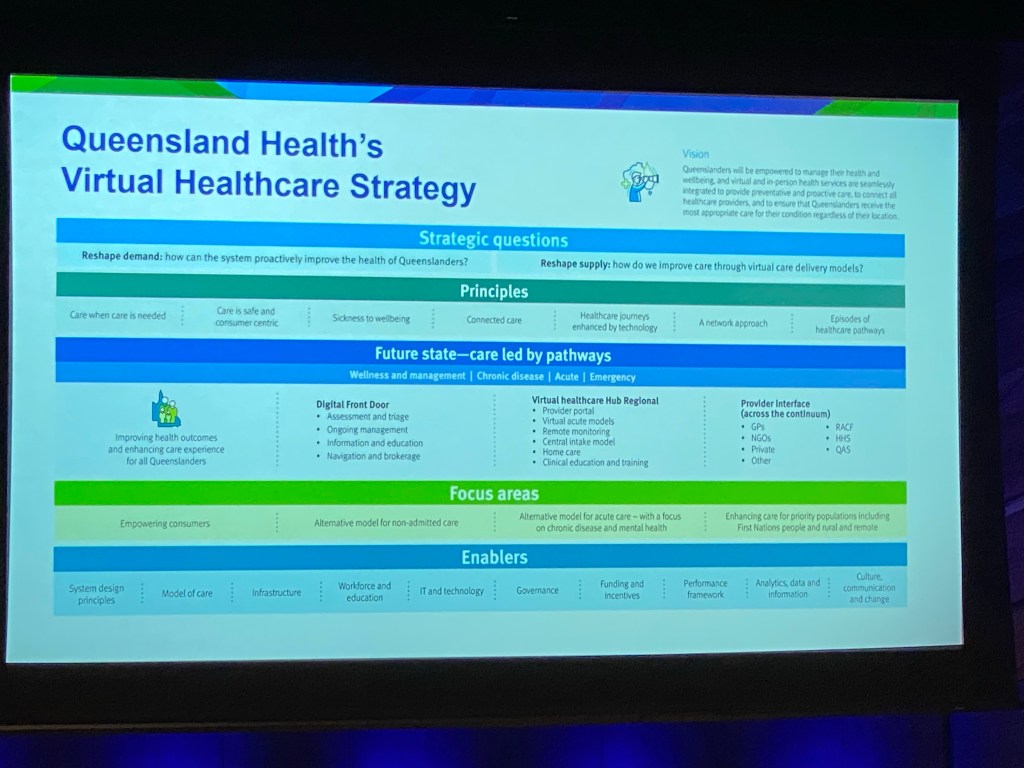
Digital health transformation requires us to rethink our approaches radically with a focus on sustainability, We cannot leave how healthcare is funded and paid out of that equation. Multiple speakers across the event referenced the challenges of investment, funding and being paid for service delivery under new models of digital care. However, in many cases the payments were left in a section of presentations as blockers or omitted entirely. Damian Green of Deputy Director General for eHealth, Queensland Health, called out changing models of care and payments as an enabler for the Virtual Healthcare strategy in the state. In the same presentation, Damian highlighted that virtual healthcare is a key part of Queensland Health’s efforts to make healthcare delivery sustainable in the state.
Payments listed as an enabler
Sustainability will mean looking at the value of care and how it is delivered. There are real opportunities to deliver better care for all system participants improving outcomes for patients, payers and providers.
30% of care is low value, 10% is harmful. Alison Trainer from @MonashPartners THIS is what we mean when we say real world evidence is valuable, not because we can sell data to others, but because we can use it to change 40% of what we do, and that is incredibly powerful. pic.twitter.com/xjQ2nymKCd
We have realised that digital health solutions can’t be designed without consumers and practitioners in the room and explicitly considered within the solution design. Today, most digital health solutions take payments as a given and sometimes even an issue for later resolution. We cannot move forward throwing the challenge of payments over the fence to finance and operations to manage with payers. Failing to bring payers into the room to support and drive the future of digital health will constrain the next level of transformation.
Payers are not as monolithic as many expect. I work with payers across the digital health landscape every week. The Payers, whether multiple levels of government, government agencies, private health insurers, other insurers, or private individuals are intensely interested in better modes of care delivery and sustainability. Many of these people are creating their own solutions or partnering at the edges with those vendors who will invite them into the room. Through our work at LanternPay, we have seen consistent interest from payers at all levels to drive new digital solutions and to support the payment changes required to make different models of care available.
Fundamental changes in payment structures, process are required to ensure that payments do not become a burden for practitioners or consumers as digital health evolves. Payers want to ensure that these changes contribute to better outcomes, efficiency and sustainability. We need to ensure payments is seen as essential to any digital health project and does not limit the potential breadth of digital transformation in healthcare with a goal of enhancing both outcomes and sustainability.
Payments can be a potential source of complexity for practitioners and consumers, particularly when models begin to change. Bringing Payers into the room to develop solutions that work for all parties, are supported by digital solutions and can contribute to sustainability is key to the next phase of digital health.
Simon Terry is the Chief Growth Officer of LanternPay, a healthcare, disability and aged care digital payments platform. LanternPay delivers health providers and payers innovative simple solutions for the complexity of care delivery across Medicare, government claiming and private health insurance.