Writing

Start with Connection

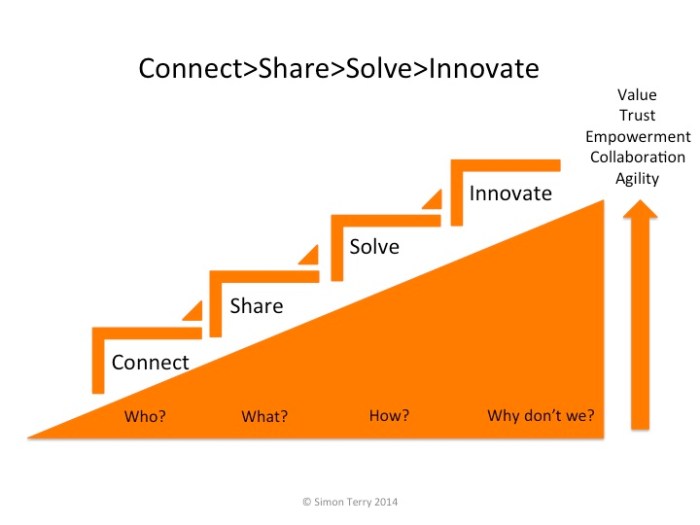
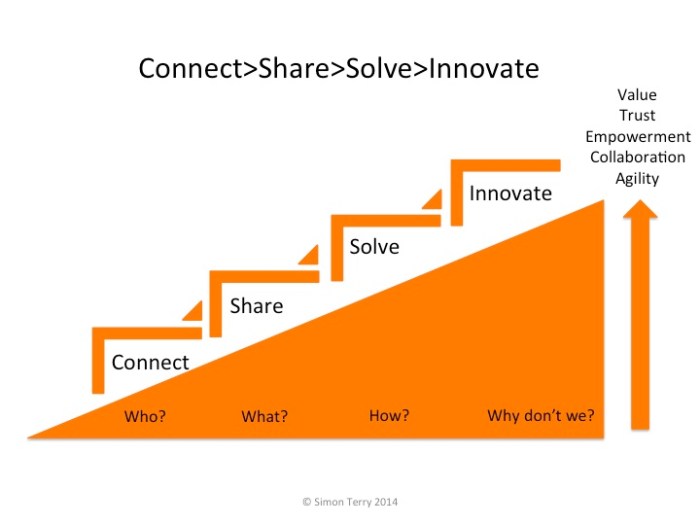
Are your employees really connected through your Collaboration platform? Many who are members of your platform aren’t actually connected in human relationships. Perhaps it is time to check that your organisation is ready to begin the journey of adoption to realise strategic business value.slide1

A Missed Connection

When I explain the Value Maturity Model, many listeners skip over the first stage of the model and want to rush into the heady territory of sharing, solving and innovating. “Connection. OK. We have our employees on our network,” they say, “We are connected already. What’s next?” I am not alone in this experience. In a recent conversation with James Tyer of Togetherwise, a collaboration & learning consultant in the UK and Canada, James explained that he often has to take people back to the beginning to pick up missed connections and build a solid foundation for the work of realising business value.

Cai Kjaer of Swoop Analytics has also pointed out in a recent Linkedin post that having a network solution and employees being able to access that solution are precursors to realising value from social collaboration.  However, those steps on their own aren’t enough to create the human relationships that are necessary to work more effectively in organisations.

Experts in collaboration have been stressing for some time that a platform is not enough to deliver the benefits of collaboration. We can’t rely on “Build it and they will come”.  Most vendors now stress the need for adoption but what they often mean is “people on a platform” to ensure their revenues. ‘People on a platform’ is not enough to generate meaningful work and business value. Random crowds roaming your enterprise social network will get you nowhere you want to go. The potential wisdom of crowds of employees must first be shaped by strategic community management. We need to help employees to connect new relationships to be able to benefit from new opportunities for social collaboration.

Connecting Human Relationships

Community managers are the agents of strategic value in social collaboration. Their work translates human connection into the specific business value that realises an organisation’s strategy. The first role of community management in an enterprise social network is to connect new human relationships. Those relationships, not the platform, are the foundation of new value.

Think for a minute about the best work relationships that you have. What are the characteristics of those relationships? Features of great working relationships include a shared understanding, context and goals, reciprocal value, trust, mutual support, and learning. The first work of community managers in organisations that are using a social collaboration solution is to put in place the conditions that will foster these kinds of connections.

The Work of Connection

Let’s look at some critical elements that deliver connection for business value in a social collaboration network:

  • Connecting Understanding: For many of your employees, the use of social collaboration tools at work is new. Kai Riemer of the University of Sydney has demonstrated in his research into ESNs that sense-making is a critical early phase of network development. We need to help employees to make sense of the use and benefits tools in the work context.
  • Connecting Purpose: Work is busy. There’s already too much to do. People need reasons to use a new platform. Real people love their tasks to have meaning. Connecting those reasons to shared purpose in the organisation is an important benefit to users and a benefit in communicating and reinforcing purpose.
  • Connecting Strategic Value: Your organisation’s strategy outlines the most important work that needs to be done and the value that the organisation is seeking to achieve. Ensure that this value is clear to your community and that they can help drive what the organisation needs to be done.
  • Connecting Work: Not every employee and business will be able to find the connection between their own work and the broader business strategy. Help individuals and teams to make the connections of their work into broader businesses, processes, and projects.
  • Connecting Groups: Groups (or the related concept of Channels) are the home of work in any effective social collaboration solution. Make sure you have the groups you need to start the right work. Make the groups findable for new employees. Help these groups form, storm and norm on their way to performing. You don’t want names in a group. You are aiming for a team built on real human relationships.
  • Connecting Capability: Human capability is variable. Not everyone will have the capabilities they need to understand how to use the platform, to work or to lead in these new complex relationships. Make connections for people to ways to build their capability to be more effective.
  • Connecting over Barriers: Every organisation has legacy rules, mindsets, processes and approaches to work that will get in the way of effective collaboration. Help your teams to fix, avoid or work around these barriers.
  • Connecting Leaders and Champions: Real people are influenced by the behaviour of others. Leaders and champions will help shape the work, the norms and the value created in your network.
  • Connecting Governance: Budgets come with expectations and organisations come with norms. Connect a governance team that can help the community managers to drive the right strategic outcomes in ways that best suit your organisation.
  • Connecting Data: Value realisation requires measurement. Put in place a plan to measure the data you need and gather the tools that you will need to do the measurement.
  • Connecting Resources: Nothing is free. Great work needs the right level of resources. Make sure your community management team and platform has a sustainable level of resourcing for the strategic value that you want to create.

If you skipped the Connection stage in your collaboration solution, some of these elements might have been missed. Even if you picked up these steps, are these elements integrated to ensure that the foundations for future business value are in place?

Realising the strategic value of social collaboration requires a focus on the human relationships in work. Any good relationship begins with a strong connection.

If you are interested in exploring further how to the Collaboration Value Canvas, enables organisations to conduct a two-hour workshop with business stakeholders to ensure that the business has an integrated plan for its community management and adoption work.  Contact Simon Terry to discuss how this could be applied in your organisation.

Addendum

In a discussion on Facebook around this post, Mark LeBusque added this insightful comment:

Another reason why BEING comes before the DOING. I often come across coaching clients who have been frustrated when projects hit a hurdle and it’s always because they haven’t created a meaningful connection with their cohort before the project begins. Instead of sitting in a room on Day 1 of the project talking about what they need to DO they should spend time in a less sterile environment talking about how they need to BE. The key element there is how to really be connected.

Mark’s comment highlighted to me the one missing connection:

Connecting Self: Busy people tied up in work, status, fears, dreams and other mindsets can struggle to connect to their feelings, fears and sense of self. Any relationship must be based on a strong sense of who you are and want to be. We need to help people connect with and leverage their authentic self as part of their work.

Working Out Loud: Chat, Conversation & Collaboration


Working Out Loud can generate a lot of confusion for people who are new to the term. Being clear on whether your goals are best advanced by a Chat, a Conversation, or a Collaboration will help the effectiveness of your working out loud.

The Many Interactions of Working Out Loud

Working Out Loud involves sharing work purposefully with communities that can help your work or can learn from it. The concept is deliberately a broad one. The concept covers a lot of different kinds of interactions.

There is no one right way to work out loud. John Stepper has written a fabulous book on one approach to working out loud to achieve personal and career goals. Jane Bozarth has an equally great book full of examples of people showing their work in many and varied ways and for many reasons. The WOLWeek website has a range of interviews with Working Out Loud practitioners and many practices are described. There are more approaches.

Working Out Loud is inherently adaptive. There is no one perfect way because nobody else has exactly your situation, your needs, and your network.  Learning how to navigate networks through generosity, transparency, and collaboration is a big part of the challenge and the source of the benefits of working out loud.

Chats, Conversations, and Collaborations as Working Out Loud

One way to reduce the confusion around working out loud and to improve the effectiveness of your practice is to be clear on what it is that you are looking for when you work out loud.  Are you looking for a Chat (shared information), a Conversation (shared understanding), or a Collaboration (shared work)? Each of these kinds of interactions involves a different level of engagement and add a different amount of value to your work. Each of these will require you to have a different relationship with and deliver different value to the other people involved in the interactions.

Understanding which interaction will best support your goals will help you choose the community and the approach. Many people get disappointed when they work out loud on twitter and they don’t get an immediate response that advances their work. Others get frustrated that people working out loud use twitter and appear to be engaging in self-promotion. In both cases, we are seeing a misalignment between the individual and the expectations of their networks.

More Effective Interactions

Reflecting on the desired interactions and the best communities to support them can help you improve your working out loud. After alll omproving the effectiveness of your Working Out Loud is an ongoing adaptive exercise:

Look for Shared Goals: If someone doesn’t share your goals then even a Chat is a distraction. Both Conversations and Collaborations require strong goal alignment. Look for individuals and communities who share your goals.

Invest in Relationships First: People are more likely to give if they see you as equally generous. People are more likely to care if they think you care. People are more likely to notice if you have noticed them. Use Chats, Conversations, and Collaborations to build relationships in your networks. Remember that in transparent networks people see not just your interactions with them but with others as well. You will have a reputation that is the sum of your interactions.

Choose Networks that Suit the Interaction You Want: Communities each have a dominant mode of interaction. Is it chatty? Do people help each other or engage in long debates? Pick communities that are suited to the interaction that will best suit your work. If you are looking for a richer interaction, such as a collaboration to solve a difficult work challenge, then choose networks where the relationships will support that interaction or where people share common approaches to interaction.  No community is 100% one mode but aligning to the dominant approach first will help you be most effective and allow you to branch out later.

Be Clear on the Purpose of Your Working Out Loud: Ask for the help you need. Be clear on the kind of responses that will advance your work. Help others to best help you and also reduce the likelihood of misunderstanding or embarrassment.

Start Small and Experiment: The adaptive nature of Working Out Loud means that it will take some experimentation for you to develop your own approach, develop relationships and to find the networks and interactions that best foster your work. Start small and experiment to learn how best to leverage working out loud in your work.

Digital Communication: The Practice of Poetry

Digital communications can benefit from the lessons and practice of poetry.

In May 1991, Dana Gioia wrote an essay in the Atlantic Monthly called ‘Can Poetry Matter?’  The article was a major contribution to a long-running debate on the relevance of poetry in a modern world that appears to run on prose. Gioia’s conclusion to this long running debate on the cultural significance of poetry and its practice was clear in his summary:

If poets venture outside their confined world, they can work to make it essential once more*

In 1991, digital had only just begun its progress to its current pervasive state. Gioia does not even reference digital journals and blogs which now reinforce his point on the niche audience for much modern poetry. We have learned a great deal since then on the practices of digital business and digital communication. Two decades of lessons in digital communication is still a small fraction of the lessons learned across the centuries of history of poetry.

Why Learn from Poetry? Isn’t it Dead?

Modern digital communication can benefit from a deeper understanding of the practices and art of poetry. In many ways, poetry has been practising to refine approaches that align to current challenges facing digital communication.

Capturing The Essence: Gioia gives a strong clue to one rationale when he defines his first rationale for poetry in his essay:

Poetry is the art of using words charged with their utmost meaning.

Digital communication always faces a poverty of attention. Extracting the highest value from expression and conveying as much meaning as attention will allow is essential.

Expressing the Experience: The mobility of digital communication means that messages no longer sit apart from any experience. Digital communications must help express, support and enrich the experience. Poetry has long battled with this same challenge of capturing, enhancing and enriching the human experience.  There are lessons to be drawn in the relationship between poetry and the experiences that it captures and supports.

Poetry is an orphan of silence. The words never quite equal the experience behind them – Charles Simic

The use of poetry in ritual in human history is a sign to its power in experiences.

Leveraging Reflection: The practice of writing poetry requires observation of the experiences of life and reflection. Wordsworth described poetry as:

Poetry is the spontaneous overflow of powerful feelings: it takes its origin from emotion recollected in tranquility.

Similarly, Robert Frost wrote:

Poetry is when an emotion has found a thought and the thought has found words

Digital communicators can provide an important outlet from the busy pace of work. They can write from and help provoke a deeper reflection on the daily experience of work and life.

Engaging through Rythm & Rhyme: The first poets had no written poetry. Jorge Luis Borges once said

Poetry remembers that it was an oral art before it was a written art.

Homer was a bard who told his tales from memory and they were passed on in memory. Many of our literary techniques are echoes of ideas that go back beyond the Ancient Greeks to master poetry and rhetoric. Sections of Shakespeare’s plays on the page can be a struggle for a modern reader but put them in the hands of an actor who can work the structure and they sing with new meaning. Read poetry and you realise the power of the rhythm of words and rhyme structures to engage others and to support your own efforts to share the work. When much digital communication struggles to hold attention, leveraging rhythm and rhyme for engagement remains relevant.

Memorable & Memetic: Great poems and great lines of poetry are memorable. This memorability is often based in universality of the ideas. Keats said

Poetry should… should strike the reader as a wording of his own highest thoughts, and appear almost a remembrance.

The English language is filled with phrases from the iambic pentameter of Shakespeare or the poetry of the King James Bible. They are so common now we barely can trace their origins. The potential of digital communication is to find that central, shared, memorable idea, phrase or aphorism that can live beyond one reading and spread through your networks as its own meme.

Open to Experimentation: Since the beginning of human history, poetry has experimented with forms, rhythms, rhymes, assonance, visual and verbal representations of messages. The most successful forms like the sonnet, the haiku, rap or the spoken word jam were tested and refined before spreading around the languages of the world. Digital communicators have learned to measure their effectiveness using the new tools available. A breadth of experimentation will help ensure that digital communication does not become trapped in local maximums of performance like the listicle.

Bringing in the Whole Human: Communication is not just a process of the human brain. Poetry shows the ways we can communicate beyond recitation of facts and logic. We have already seen digital communicators begin to leverage visual imagery in new ways to reinforce messages. Poetry also earns its attention by reaching for a deeper meaning in what is often a brief form:

Poetry may make us from time to time a little more aware of the deeper, unnamed feelings which form the substratum of our being, to which we rarely penetrate; for our lives are mostly a constant evasion of ourselves. – TS Eliot

Emotion, experience, spirituality, beauty and more are opportunities for experimentation for effective digital communicators as well. Finding richer ways to connect with human meaning is always an effective approach to communication.

Change: In the Defense of Poetry, Percy Bysse Shelley called poets “the unacknowledged legislators of the world.’ His point was that poetry is a way in which communities share and develop norms. Digital communication must play the same role in networks reinforcing the values and creating shared connection as new communities come together. Poetry has exploited its marginal place to push boundaries as Thomas Hardy pointed out:

If Galileo had said in verse that the world moved, the inquisition might have let him alone.

Equally importantly, Salman Rushdie laid out the challenge for the poet as follows:

A poet’s work is to name the unnameable, to point at frauds, to take sides, start arguments, shape the world, and stop it going to sleep

No challenge is more relevant to digital communicators when the virality of a message now outweighs its accuracy or usefulness.

Adapting: Paul Valery once said ‘a poem is never finished only abandoned’. The same holds true of digital communications. The work should be adapted continuously based on feedback, performance and changing circumstances. The goal is enhanced effectiveness and continued relevance.  Communication that is static is dead and abandoned.

The lessons above are but a few of thousands of years of the practice of poetry to engage the human mind and soul. Any digital communicator can learn from that collective experience. If applying poetry in digital communications seems unlikely, you can at least consider what poetry can do to improve your prose:

Yet, it is true, poetry is delicious; the best prose is that which is most full of poetry. Virginia Woolf

Always be a poet, even in prose – Charles Baudelaire

Notes:

* This insight has an echo in Steve Blank’s startup maxim ‘there are no facts inside the building so get the heck outside’

The Jigsaw 

You start with a jumbled pile of pieces and an image of the ideal outcome. 

People offer contradictory advice: sort them by colour or shape or build landmarks first. Some sounds like meaningless work and some sounds useful. You decide to start anyway with your keen eye as a guide. 

You build a few towers. You find some pieces are edges and start to mark out the boundaries of your current endeavours. Some times you get the boundaries wrong but don’t find out until later. 

At first there are lots of landmarks and things come together easily. Pieces go in a rush. You experience the satisfaction as steps to the goal resolve out of mess. You smile as a piece slips in just perfectly. 

Some times the detail of a piece is unclear and you stare at it, rotating it looking for a clue as to where it fits in your ideal. Trial and error works some times. Then there is the piece that seems like it fits but won’t go. Other pieces have to be put aside for later. Once or twice you walk away from the board to do something else for a new perspective. 

You find other people can see things that you have missed and add pieces to the puzzles. Some hang around to help as capitivated as you are by the challenge. 

The greenery you thought was a challenge succumbs to careful attention. There were clues hidden in there to guide your work. 

Things start to get serious. You clean loose pieces off the board and sort them carefully.  You find the pieces you think you’ve lost. Some you had all along. Others slipped out of sight and required a search. One isn’t from this puzzle. At least one was hidden deliberately. 

Slowly your goal rises from the mess. Your goal gets richer and more complete piece by piece. The smallest details are the hardest to finish. Your head hurts and you wonder why you started, but the end is in sight. 

You can see almost the whole landscape. It’s been hours of painstaking collaborative work. Now you just have to tackle that expanse of blue sky. 

What’s Your Knowledge Proficiency?

Many people are constrained by a binary view of knowledge. They focus on whether they know something or not. In a network era, it can be more useful to ask what level of knowledge will enable a working proficiency to learn more from professional networks. You don’t need to be a master in each area of knowledge but a functional proficiency will enable you to access the knowledge required from your networks.

We are familiar in learning languages with explicitly describing different levels of proficiency. The US State Department has a 6 level scale for proficiency of language ability. Understanding proficiency in language in this way helps them to separate functional levels of performance in a language in ways that are important to their work as diplomats.

  • Level 0 – No Practical Proficiency: No practical speaking proficiency. No practical reading proficiency.
  • Level 1 – Elementary Proficiency: Able to satisfy routine travel needs and minimum courtesy requirements. Able to read some personal and place names, street signs, office and shop designations, numbers and isolated words and phrases
  • Level 2 – Limited Working Proficiency Able to satisfy routine social demands and limited work requirements. Able to read simple prose, in a form equivalent to typescript or printing, on subjects within a familiar context
  • Level 3 – Minimum Professional Proficiency Able to speak the language with sufficient structural accuracy and vocabulary to participate effectively in most formal and informal conversations on practical, social, and professional topics. Able to read standard newspaper items addressed to the general reader, routine correspondence, reports, and technical materials in the individual’s special field.
  • Level 4 – Full Professional Proficiency Able to use the language fluently and accurately on all levels pertinent to professional needs. Able to read all styles and forms of the language pertinent to professional needs.
  • Level 5 – Native or Bilingual Proficiency Equivalent to that of an educated native speaker. Equivalent to that of an educated native.

We don’t see language proficiency as a binary. We learn language through using it in interactions with others. We understand it is a complex skill and an ongoing challenge of mastery of increasingly complex interpersonal interactions. We understand that there is not a stock of language to know. We recognize that there is an ongoing flow of learning to develop and that with enough skill to participate in the work we can accelerate our journey to mastery through interactions.

The digital network economy has made it more evident that knowledge can be accessed from others when we have sufficient proficiency. When we apply a similar logic to learning in new areas of knowledge in a network economy, we can see that we can draw parallels to a proficiency structure for knowledge:

  • Novice (Levels 0 & 1 above): Not enough knowledge to do more than make personal connections with knowledge experts. Struggle to sustain a conversation in a new knowledge area.
  • Working Proficiency (Levels 2 & 3): Enough knowledge to engage in increasingly complex discussions in the knowledge area and put some of the knowledge to use. A working proficiency of the jargon and structure of the main body of knowledge in the area. However, regularly experiences the limits of their understanding, can identify those who know more and can use this skill as a guide to learn more from masters in the field.
  • Mastery (Levels 4 & 5): Mastery is not an endpoint. It is a state of ongoing improvement in conjunction with peers.  An individual at this level has enough knowledge to lead the development of the discipline or knowledge area and to help others to enhance their knowledge. There is no mastery without practice.

The goal of learning in the modern workplace should be to use a broad range of learning solutions to first achieve a working proficiency. From that point an individual can participate in work and continue to access support to advance towards mastery. With a working proficiency, personal knowledge mastery and other forms of social learning are increasingly accessible to guide an individual’s practice to mastery. An individual with a working proficiency is better enabled to manage their own learning in networks.

It’s Not the Year: Attitude and Action

OMG! We’ve made it out of 2016. We snuck through with our lives, our livelihoods and our sanity intact (We might have a few doubts about all three that we won’t share publicly). 

Except,

2017 is just another year. 365 days organised sequentially and filled with external events from the random to the planned, from the heart warming to the shockingly tragic. It is not the year that does the work for good or bad. The days themselves are innocent. 

We do the work. Our attitudes and our actions shape every single day. We make a difference to our year one day at a time, one action at a time and one thought at a time. 

To make 2017 the year you want to remember, begin with the attitudes and the actions. Make each day count. 

Happy New Year! Now show us what you can do with this one. 

ICYMI: Top 10 Posts of 2016

Halfway through this year, I swapped from my Tumblr blog to this new WordPress powered site. My recap of the top 10 posts for the year will be 5 from each six months.

Here are the Top 5 Posts by views for the second half of 2016

Here are the Top 5 Posts by views for the first half of 2016 from simonterry.tumblr.com. Two of these are prior year favourites that I regularly reuse and recommend.  All these historical posts are now included in the archive on this site.

One older post missed the top 5 in each but had enough traffic to be in the top 10 across both sites.  The message still holds true: The Future of Work is the Future of Leadership.

My personal bonus: The most fun post to write this year was The Life Crushing Magic of Hierarchy.

Empathy

In my reflections on 2016, I included the insight that “there is always more context”. At the heart of this insight is a need for greater empathy. In 2017, I want to do more to foster empathy through my work. Greater empathy is transformational in an organisation’s culture and effectiveness.  It is also a big step to making work more human.

Empathy

After years of making work more mechanistic and more clinical, we are starting to see the return of the practice of empathy. Better service experiences, more effective leadership, and realising the potential of people all require greater empathy than traditional management practiceEmpathy is deeply embedded in the social nature of humanity.

Empathy is deeply embedded in the social nature of humanity.  Our brains have mirror neurons to help us to react to emotions expressed by others and experience them.  We need to use them more. Empathy is a key contributor to human social connection and a foundation for generosity. As organisations start to see the alignment of more human ways of working fostering to their strategic goals, efforts to return empathy to our organisations will continue to rise.

Practices of Empathy

Reflect: Until our minds are calm enough to reflect on and make sense of our own experience we will struggle to be empathetic to others. We need to put aside the time for reflection and for consideration of others.

Humility: The more wrapped up we are in ourselves and our importance the lesson able we are to be empathetic to others. A little humility helps our empathy. Working out loud can help expose the less perfect and more humbling side to others.

Be Purposeful: Purpose is the effect we have on others. Purpose pushes out into the world to understand others and the effects we have from their perspective. Challenging ourselves to be more purposeful will makes us more empathetic and more effective.

Listen: We don’t listen enough to others. We listen to confirm our perspectives. We are too quick to share our own.  We need to listen longer, more actively and more deeply to truly understand.

Design: Empathy is the first step of a design thinking approach. Until a designer or design team understands the user’s needs and challenges from their perspective then they cannot generate the insights or develop an effective solution. Prototyping and experimentation reinforce the lesson that it is the experience of others, not our egos that determine success.

Collaborate: As we connect, share, solve and innovate together we are drawn out of our shell. Our understanding of others, their contexts, and their concerns increases. Shared work reminds us of the value and the need for empathy.

Give: People in our organisations were never as mechanistic or as self-interested as management theory wished. We always have had human generosity in the wirearchy to make the hierarchy work. The practice of generosity develops understanding, trust, and community.

The Gift

When we say this time of year brings a gift of peace and joy, we should also include a reminder that some assembly is required and no batteries are included. It’s up to us to make the gift and keep it working.