
Cai Kjaer of Swoop Analytics interviewed me recently to discuss how community managers can use the Collaboration Value Maturity model
Innovation, Collaboration, Learning & Leadership
Cai Kjaer of Swoop Analytics interviewed me recently to discuss how community managers can use the Collaboration Value Maturity model
Our organisations learn how to manage human behaviour to productive ends from many aspects of society. The history of management shows many examples where it has borrowed from coercive human relationships, such as the organisational structures of military, the practices of slavery or the corrections system, because of the shared themes of control and coping with the complexities of human relationships at scale. If we are to create workplaces that have the necessary degrees of freedom to enable people to address the complex challenges of digital networks and realise their human potential, we need to be aware of these influences and to challenge control for its own sake.
This post examines an example of how the influence runs in both directions. The tide in business press is running against the supposed productivity of open plan offices. At the same time we welcome an open plan prison.
Your Cubicle For Life
If anyone doubted the parallels between the modern office environment and a security state, the NSW Government just opened a new high security prison in Cessnock in the Hunter Valley. The facility has 400 beds in dormitory pods. The radical innovation of the new facility, which has been borrowed from Jeremy Bentham’s Panopticon, is that it has done away with cell walls and with privacy. Anyone will recognise the formats of those pods as cubicle arrays in an open plan office.

Photo Credit: ABC News
As with any open plan office, the facility has no privacy and a focus on monitoring of behaviour.
Correctional officers monitor inmates around the clock from first-floor corridors overlooking the pods and with infra-red cameras for night monitoring; and Immediate Action Team officers are stationed within the facility to provide a 24/7 response to critical incidents. – Cessnock Advertiser
A key focus of the new facility is to use the new openness and flexible spaces to foster interaction and relationships between inmates. From sensory deprivation, the inmates will now need deal with an excess of human interaction
“For many that is culture change. The previous thinking has been minimal interaction with inmates.” – Newcastle Herald
The pitch is not that different from co-working giant, WeWork’s own residential facilities, WeLive. Of course, WeLive facilities have a colour scheme that includes colours other than grey.
From mailrooms and laundry rooms that double as bars and event spaces to communal kitchens, roof decks, and hot tubs, WeLive challenges traditional apartment living through physical spaces that foster meaningful relationships. Life is better when we are part of something greater than ourselves. Whether short term or long term, WeLive has flexible options designed to meet your needs.
Employee Engagement is the focus of the new office. Productive use of time will be carefully managed in this new open plan environment. Employees will be guaranteed 5 hours of productive work, which is more than most open plan environments:
The inmates’ days have been carefully structured in a way that focuses on intense participation and access to education, employment, programs and activities. – Cessnock Advertiser
Recruitment processes for this new office will also be intensive to ensure an appropriate cultural fit and to sustain the desired levels of engagement in a vibrant collaborative culture. Like any good employee fit process, those who fail the test are subject to exile but we won’t discuss where.
Mr Severin said inmates will be carefully screened – and if they don’t fit the profile, will be placed elsewhere. – Cessnock Advertiser
The real rationale for the new office appears to be its low cost and rapid construction. Never let real human relationships interfere with a low cost property strategy.
It is only a matter of time before the innovations in Cessnock cross back into our living and working. Expect to see technology giants leading the way removing flexible working, requiring their employees to use their working for greater productivity and to restore human relationships. Is it such a distant step to living facilities in a subtle elegant shade of metallic grey? or to WeWork’s laundry room bars? We will just need to remember that privacy terms and conditions apply and this lifestyle will be available to only approved applicants.
Simon Terry will be speaking at Disrupt Sydney 2018 to elaborate on these themes in his talk “If your company was a country, would you live there?”
A key issue for most digital workplace projects is a lack of connection between the goals of the project and the business needs of the organisation. Without specific goals and specific steps to realise them there is a temptation for professionals running these projects to rely on capitalised nouns like productivity, innovation, engagement, adoption and collaboration. Capitalised nouns do not make a strategy.
Why are we doing this again?
Whatever tool, platform or process you want employees to use in your digital workplace, they have the right and obligation to ask why. Employees lives are busy. They don’t need to do something for an abstract goal. They want to understand the specific benefits to the organisation and to them personally.
A capitalised noun won’t cut it to win discretionary employee effort or senior executive time. The best goals of any digital workplace are fulfilment of the business strategy of the organisation. Usually this can be measured on the simple dimensions of win customers, grow revenue, reduce cost, manage assets and reduce risk. Even those goals are so generic as to lack force. Every organisation should be able to describe what employers working better together will do. That’s what a strategy is.
From Business Needs to Specific Actions
The role of the team leading adoption of the digital workplace is to convert that goal to specific actions that employees should do using the workplace. These are the actions that become your use cases and are core to the communication and role modelling you need.
Beware of capitalised nouns creeping in to your use cases. Nobody ‘engages’ on a platform. You should be able to specify exactly what you want to see. That way you can measure the actions and the benefits.
The use case should be some combination of the key verbs in the model above. Ideally, more than one verb for bigger benefits. Ask yourself the following questions:
When you can answer these questions to the satisfaction of a disinterested executive you have the beginnings of a plan. Your engagement activities will then be based in how you create the scaffolding for people to learn to use the platform to deliver the goals that fulfil business strategy.
Slow down to ensure your productivity. There is such a thing as being too fast to be effective. There is also a danger that speed will mean you miss more important relationship signals.
Unsafe at Speed
I started a conversation on twitter this week with a reflection on how productivity is being sapped by a culture of continuous activity and the relentless pace of business.
As Harold Jarche points out reflection and learning are the first things to go as we get busy. I also find many people don’t have the time to do their jobs, engage with others or move projects forward because they are so tied to a daily schedule of meetings and activities.
The power of working in more agile ways is that it forces us to understand what done means for a piece of work. There are lots of meetings, documents and other busy activities that don’t advance a piece of work towards done. Going faster and doing more of these things is just destroying productivity.
Unsafe at Any Speed
Working without time for learning and reflection, is dangerous because it threatens our relationships, our productivity and the effectiveness of others. We don’t work alone. Lack of learning and reflection impacts those around us.
After that twitter post, I received a call in the middle of a busy day. I dove into discussing the presumed topic of the call. I was enthusiastic, keen to get the call done and talking quickly. After about 5 minutes of chatter, I paused for breath and that pause helped me to realise that the other person wasn’t particularly engaged. My enthusiasm seemed to be draining them. Worse still, I realised their tone of voice suggested something else was on their mind. I had been prattling on when clearly they had called to discuss a more difficult topic.
Reflection is one thing. The next step is also making the time to do something different with that insight. If we are too busy, we can put off implementing the insight until later, if ever.
When I stopped prattling, I asked then and there if they were OK. That simple question led to a much more meaningful and valuable conversation. We ended up discussing the challenges of modern work life, career struggles, motivation and the need to talk to others when you are struggling with symptoms of depression. If I hadn’t stopped my self-absorbed activity and reflected on the other participant in the conversation, then a valuable opportunity for us to help each other would have been missed.
Make the time in every interaction to check that others are OK
We need time for reflection and learning because we don’t work in networks of transactions with widgets. We work in networks of relationships with real complex and highly adaptive human beings. Being alert and allowing space for those relationships to develop enables our productivity and collective success.
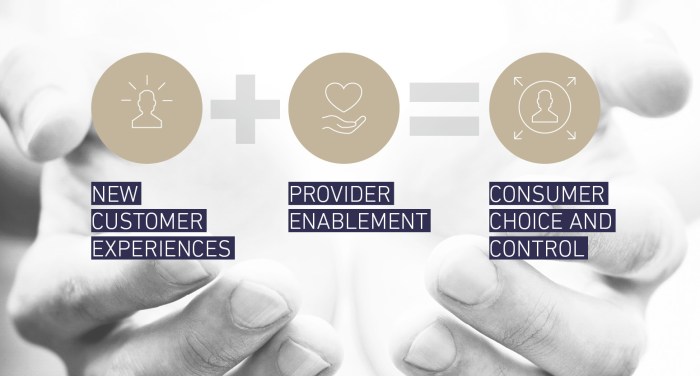
Digital transformation in health, care and disability is delivering new customer and provider experiences. A focus on design of customer experiences is important, but equally important is leveraging the digital potential of provider platforms. Government and private schemes need to consider both portals and platforms in designing their claim and payment approach for providers.
Designing Experiences for all Stakeholders
Design thinking is now a standard part of any digital transformation project, especially in health and care. We now understand the value of taking the stakeholder’s perspective as we shape new digital interactions. These insights can deliver significant benefits from new, more flexible processes and interactions.
Choice and control requires three parties to collaborate. While schemes are focused on delivering choice and control to consumers by designing new customer experiences, enabling providers to support choice and control in health and care is equally important to achieve the policy outcomes. A design that does not cater to providers by delivering easy and certain claim and payment, will fail to deliver its goals.
Choice and control for consumers = Creating new customer experiences + Enabling providers
Many payers use portals for consumers and providers to manage transparency of their funding and payment of their claims. Portals force everyone through a dedicated app, website or digital channels. The payer has full control of the experience and can design it to suit its needs and preferred experiences, but they have lost the flexibility consumers and providers need.
At LanternPay we see an open multi-scheme platform is a better way to deliver choice and control in health and care. A multi-scheme platform like LanternPay offers simplicity that reduces costs for all participants and integration with the wider ecosystem of health and care solutions.

A platform approach also means providers and consumers can interact in the ways that best suit them. LanternPay does not dictate a single channel and seeks to integrate with a range of customer and provider solutions. This way the choice extends to where each party prefers to transact. For example, there is a rich and vibrant market of consumer search and booking applications, a scheme that is looking to bring transparency and choice to the market can launch its own to compete and gain a share of the market or it can leverage a platform to deliver an experience to its customers wherever they are.
Bringing Provider Focus to Consumer Experience
Design thinking challenges us to put ourselves in the shoes of each stakeholder and that means making choices to suit the breadth of consumer and provider needs. The best digital experience is not always the one that fits in a single channel. This is particularly the case for providers, whose needs are often given less attention.
When we put ourselves in the shoes of a consumer or a provider, we see the hidden costs of portals. Consider a physiotherapist starting their day by delivering care to a Transport Accident Commission of Victoria client at 9am. Their appointments that include a mix of private patients, worker’s compensation patients and several other government schemes. Given a typical health or care provider can deal with many schemes in a single day, adapting invoicing to each scheme’s unique payment approach can be costly, complex and filled with uncertainty. In addition, providers often must bear the challenge of explaining the payment processes to the consumer, which can mean they bear the brunt of customer frustrations.
The scheme controls its interactions to suit its needs. Consumers and providers need to go to the portal and manage the process for that scheme. This results in inconvenience and cost. Also, winning adoption for new processes can be challenging. Scheme portals need to invest in marketing and communication activities to win provider adoption. Given the many demands on provider system vendors for integration, scheme portals often fail to deliver integrated solutions that fit into providers’ standard business processes.
Providers are in the business of providing care, not adapting to multiple claiming portals. If the complexity or cost to the provider is too great, providers will either stop providing services to that scheme or increase charges to cover the extra costs. Many government schemes already see the costs of small pools of providers and high service costs. Consumer choice and control is meant to help address these issues. Imposing costs and complexity on providers in the claiming process will directly impact the benefits of consumer choice and control.
Platforms bring a diversity and volume of ready-to-transact providers to a scheme. Providers are familiar with the standard claiming processes and integrations in place make that an easier part of their business. At LanternPay, we have been able to work with schemes to deliver rapid provider claiming pilots with schemes. These pilots easily demonstrate the value of bringing providers to payers and enabling consumers to take control of their care in new ways.
The market for health and care is complex. No one solution is likely to meet the needs of all consumers, providers and payers. At LanternPay, we believe a focus on design thinking requires payers to consider the value of both portals and platforms. In the next post, I will look at the added value that platforms can bring in enabling access for payers to an ecosystem of innovation.
Simon Terry is the Head of Markets of LanternPay. LanternPay is an open cloud-based claim payment platform designed to standardise claim payments across the health, care, disability, insurance and ageing sectors.
Startups operate effectively with less data and more uncertainty because they plan to learn and adapt.
When you work at the juncture of startups and large corporates, one difference is stark. Large corporates need much greater certainty to make decisions. Startups make decisions at much lower confidence levels.
A large part of the slow response of large organisations is the demand for certainty in decision making. Large corporates always need more information. For example, you don’t need to demonstrate the potential for a positive return, you need to calculate that return exactly and defend every assumption and element of the plan to win support.
Startups realise that businesses are made in the market, not in ever greater piles of data and better spreadsheets. Startups deliberately make decisions with less information because they know the best information comes from experimenting, doing and adapting. Wait too long and your beautiful data will be wasted as the opportunity closes or the data is out of date.
Corporates make decisions on the basis it is a one and only chance to decide. It has to be perfect. Most decisions aren’t actually irreversible or final.
Startups know the decision is imperfect. It always will be. The point of the decision is to start the process to learn and adapt based on the lessons from doing. Nobody learns anything new around a board table.
Making decisions with less than perfect information is a big challenge when you are used to the model of decision making in large corporates. However, just like the transition from perfect messages to working out loud, the change to less certainty and adaptation is a liberating one.
We can all benefit from being a little less certain and more open to learn.
Fintech startups are experiencing rapid growth and increasingly playing a role as enabling new capability and innovation for traditional financial services players. I recently spoke with Macquarie about the need for fintechs to understand their social purpose. This article expands on those comments.
The Social Licence of Finance
All forms of finance depend on a social licence. There are strict regulatory regimes in place for banking, wealth management, superannuation and pensions, insurance and other forms of finance. Importantly these regimes are just one part of supporting a social licence and the support of wider stakeholders. In many cases the regulation exists to enable wider community support or has been created to rectify loss of community trust in the finance industry. The finance industry complains about the burden of regulation but much of this regulation has been created in crisis or because of the danger of a rapid loss of trust in the industry. As the old quote goes
When community support and trust falls, all forms of finance quickly experience business risk, operational and existential issues. We only need look at our recent experience of the Global Financial Crisis or the stories of the Australian Banking Royal Commission to understand the degree to which community frustration and real business issues can arise when financial services players do not live up to social expectations.
The social licence exist because finance fulfils social purposes. Finance is an enabler of other business, personal and social activity. The benefit of finance in enabling or reducing the risk of that activity is key. When the finance industry’s attention shifts to money alone, it is losing its social purpose and that social licence is in jeopardy.
The Social Licence for Fintechs
Fintechs are the newer players in the finance industry. In some sectors of the wide range of fintech innovation, like crowd funding and blockchain, regulatory regimes are only now being created to catch up with the change they have created. In other parts of the fintech landscape, like attacker banks or new intermediaries, the goals of fintechs are to actively disrupt the approaches and practices of existing finance industry players. With a large, global addressable market, the daily challenges of innovation and a goal of disruption, social licences to operate may not always be a startup’s first consideration.
However, all fintechs must remember that the social licence that applies to finance applies equally to them. The nature of the finance industry is such that even the most disruptive of fintechs will depend on the community’s trust and confidence in the sector. More importantly, most fintechs depend on collaboration and partnerships across an ecosystem of innovation that includes other fintech startups but also includes partnerships with large financial services players. Some of the greatest and quickest value fintechs can bring is helping large financial services players to reach new markets or transform themselves with new ways of working or interacting with stakeholders.
The Role of Social Purpose for Fintechs
A social licence exists because a business fulfils a social purpose. Every fintech should challenge itself to understand how its business enables a social benefit to others beyond the organisation. Like the finance industry as a whole, fintech exist enable others. Their ongoing social licence depends on being able to clearly express a social purpose. Clever rent seeking, speculation or technology is not enough to enable a fintech to survive, let alone succeed.
At LanternPay, we have a clear social purpose and it is at the heart of our claim and payment platform – we enable consumer choice and control in healthcare, aged care and disability. We believe that giving consumer’s choice and control will improve their experiences of healthcare, agedcare and disability and create platforms for the sustainability of those important industries. Our platform can help hardworking providers of care to focus on care provision and remove the administrative paperwork of multiple different payment processes for different schemes. We can deliver efficiency This purpose guides how we develop our platform, how we price our service and how we operate. This purpose has been key to winning the support of consumers, providers, government payers and a range of other partners as we grow. Importantly, our social purpose engages all our employees, many of whom have direct personal or family experience of the benefits of choice and control in care. Growing a new two-sided platform in a rapidly changing health, aged care and disability industries is not easy work, our social purpose is an important ongoing part of our growth.
Fintech startups are a critical part of the future evolution of the finance industry and realising new capabilities for society as a whole. Fintechs need to understand their social licence to operate and support it with a clear social purpose.
I was interviewed recently by Macquarie Group on fintech innovation, LanternPay and the need for a fintech startups to have a social purpose. Fintech’s are maturing into key collaboration partners for players in the finance ecosystem. It is important that finch’s understand that finance is about more than money and play a social role.
Defining Management as Control
Henri Fayol published his influential book on management, Administration Industrielle and Générale, over a century ago in 1916 based on his management experience that stretched back to 1860 when the workplace looked quite unlike ours. Despite the time that has elapsed, Fayol’s definition of management would be familiar to many today, because it is still used in management textbooks:
to manage is to forecast and to plan, to organise, to command, to co-ordinate and to control
We read this definition of management and it shrieks of hierarchical power. We see this model of management in light of our experience and the prevailing management ethos controlling power of those who run our organisations. In over a century, these verbs have become expressions of power and constraints on human behaviour. Forecasting and planning are the decision making processes that understand the environment and set the direction for the organisation and its people. Organise, command, co-ordinate and control are the exercises of power by a manager to set the structure of a team, to direct people, to manage delegations and activity between teams and to adjust to the performance of that team and business over time.
The combination of these focuses with the process-centric and efficiency oriented legacy of Frederick W Taylor’s Scientific Management leave many employees with little freedom to use initiative, to share their unique capabilities and to pursue intrinsic rewards. Since Fayol’s time, we have come to view management as an exercise in building the perfect system or machine to constrain human variation and to drive human performance extrinsically. In our quest to make widgets better, we have made people a widget.
The prevailing system of management and the beliefs and cultures required to sustain it are a major cause of employee dissatisfaction with work, waste and loss of human potential. Worse still a managerial system dependent on the decision making powers of a few remote partially informed managers is incapable of adapting to meet the needs of a globally connected marketplace.
Not Quite As It Seems
Intriguingly one of the reasons Fayol wrote his treatise of management was that unlike Taylor he believed that elements of these managerial roles were inherent in every job. He even includes a table in his book highlighting that frontline employees had at least 5% of their time on managerial tasks. (In comparison, he attributed no more than 60% of the time to senior management). Fayol saw education of all employees in the skills of management and better communication as a key way to improve performance and reduce dysfunction in organisations.
Fayol was an experienced practical manager setting out to describe a theory of management when there was none to guide management education. His management experience meant he was all too well acquainted with the limits and the abuses of power. A few select quotes from his book highlights these highly modern themes:
‘Management thus understood is neither an exclusive privilege not a particular responsibility of the head or senior members of the business; it is an activity spread, like all other activities between the head and members of the body corporate’
‘A good leader should possess and infuse into those around him courage to accept responsibility’
‘…Conventions cannot force everything, they need to be interpreted or the inadequacy supplemented.’
‘In dealing with a business matter or giving an order which requires explanation to complete it, usually it is simpler and quicker to do so verbally than in writing’
‘The best plans cannot anticipate all the unexpected occurrences which may arise, but it does include a place for these events and prepare the weapons which may be needed at the moment of being surprised’
‘The administrative gearing – ie every intermediate executive – can and must be a generator of power and of ideas’
‘The tendency to encroach on the part of control is fairly common in large scale affairs especially and may have the most serious consequences. To offset it, powers of control must be defined at the outset as precisely as possible with indications of limits not to be exceeded…’
As you can gather from the quotes above what Fayol meant by ‘to forecast and to plan, to organise, to command, to co-ordinate and to control’ is not quite as rooted in absolute hierarchical power as we may interpret from our modern experience. Undoubtedly, the book has many examples of hierarchies and at times reflects a 19th century worldview, but it also includes many situations that reflect the need for local initiative, employee trust, responsibility, adaptation and change. These situations even include an example of the need for employees in two silos to have direct conversation to resolve issues because going up and down the hierarchy is too difficult.
When we read Fayol, one thing we can easily forget is that he was writing in an era before modern communication and transportation technologies. Imperfect information, poor communication and autonomy of distant individuals was part of the every day management experience. These constraints were so much a part of his environment that Fayol hardly need refer to them and much of the work of management that he describes is addressing these constraints directly or by enabling employees. The only clues are that he only refers to a distinction solely between written instructions and face to face conversations. In an early twentieth century business there was only the telegram and the train. No way to coordinate the large amounts of information or activity necessary to control a business from the top in real time.
We have adapted to increased information and communication in many cases by increasing the scope of the power to control. In light of this increased flow of information and communication, Fayol’s definition of management takes on echoes of a totalitarian state. We have followed the lead of Frederick W Taylor and his suspicion of employee’s individual contributions to work, other than as sources of waste.
Another Path: Enabling Human Capability
Our organisations are not entities in their own right. They are vehicles of shared human achievement. Our definition of management has to reflect more than the power exercised within organisations. It should reflect the potential realised within organisations as people come together to create new ways to fulfil a shared purpose.
The changing nature of a connected global market means that we need to move beyond the initial frame we placed on management of controlling uncertainty and maximising performance from a given stock of human talent. Now the challenges of management are to develop creative and adaptive paths leveraging the collective talents of those in the organisation, their access to information and partners beyond the boundaries of the organisation. This exercise is inherently a challenge of building human capability – scalable learning at speed. This challenge is going to require new management mindsets and new practices.

To reinforce the mindset change required and to break the connection to the language of command and control, here’s a new working definition of management to explore in the next post. Like any good definition of management, it’s focus is on value creation. This time that focus is through capability development and not control.
to manage is to enable an organisation to better connect, to share, to solve and to innovate
We connect in global networks to realise individual and shared purposes. We share to understand, gain insight and to learn faster. We solve the daily challenges to better adapt our organisations to its work and the world. We innovate to continue to create new value for stakeholders by collectively working in new and better ways. Each of these activities can be expressed in the action of each individual employee in the organisation and in their collective collaborations.
Importantly this definition brings to the fore the collective nature of the work of management. We have tended to see management as a solo task of the manager or one concerned with the direction and performance of one employee at a time. The value of management is its facilitation of collective work, collective learning and collective value creation.
The job of management is to build the capabilities in their teams, their colleagues and their networks to connect, share, solve and innovate. Everything else is just accounting for value.
Our world offers many opportunities for a great rant. The magic of the internet and social media is that your rant can find its audience no matter what your topic or preferences. Look around great rants are everywhere. Sadly, rants don’t create change. Only working together with others matter.
Ranting can be extremely satisfying. There is an emotional reward in getting something off your chest. Ranting is working out loud on steroids. The key difference is there is much less rigour about choosing a relevant audience. Rants find their audience. Even if they disagree, people appreciate the emotion and eloquence of a well phrased rant.
Unfortunately, a rant is an exercise in extremism. A good rant highlights divisions and differences. It portrays a stark difference between the engaged voice of reason and the Other. Rants foster engagement at the edges. They don’t build the engagement of a civil society. They don’t drive change.
Rants don’t lead to change because they release tension. Our reaction to a rant if we agree is ‘Yes. Glad Somebody said it.’ Rich with emotional satiation we don’t feel the tension to act. The reaction to a rant of we disagree is a heightening of tensions, increasing alienation and loss of shared ground.
Ranting is fine as an emotional outlet. Just don’t expect it to create change. Swap your rant for a conversation and find a way to work with others instead.