Why Collaboration Value is Understated

image

Applying mechanical process productivity to collaboration provides us with an efficiency benefit case for collaboration. Understanding the true benefits of collaboration requires us to understand the knowledge work systems in place and the broader effectiveness of the organisation at creating value.

Value of Collaboration is Not Easy

We always facing the challenge of valuing the benefits of collaboration.  Collaborative technology is part of the infrastructure of the organisation. It’s use is open to many applications that will be co-created by the employees and shaped by the organisation. Many of the outcomes are not direct; collaboration facilitates a more effective organisation.

The temptation is to play it safe. We can use the same process efficiency mindset that applies to any other system to automate processes.  The question usually asked is “How much more efficient will our people be when they use a collaboration system?’  A number of studies have looked at the impact of collaboration systems on in process efficiency of knowledge workers. One of the most widely quoted statistics is the McKinsey survey that identified 20-25% of the time of knowledge workers could be saved with better ways to search for and interact on information. This mindset often drives an adoption focus to collaboration projects that misses a bigger opportunity to create value.

25% Better Off?

If you are processing iron ore into steel and you find a way to do it 25% better, then you will have 25% more steel or need 25% less inputs. That is a mechanical process saving. Inputs became outputs at a cost. This is how our traditional efficiency mindset has focused us on measuring value.

However, knowledge work isn’t like steel manufacture. At the end of a knowledge work process, we still have the inputs and the outputs. Both the inputs and the outputs can be shared widely at very low cost because they are easily reproducible. Most importantly, neither the inputs nor the outputs are fixed. 

Let’s consider a practical example. As a knowledge worker, you are asked to create a new process to improve the efficiency of steel production. Is the goal to do this 25% faster? No, the goal is to create the most efficient way of producing steel.  There are four elements that measure effectiveness of your work:

  • Reduce waste: If there is no better way currently possible or someone has already done the work, then don’t work on creating a new process. Do something else.
  • Reuse existing knowledge: If someone has developed a process that is more efficient, use that process as a basis. Don’t start with a blank page.
  • Create new knowledge: If you can bring together people who have never been connected, if you can share information that has not been shared you may be able to solve new problems or create an entirely more effective process for steel manufacture. This is likely to impact a much larger value opportunity than knowledge work in your organisation.
  • Create new value with existing or new knowledge: Your new process for steel manufacture will be able to be shared across your organisation and may even become a product in its own right.

The economic value of these four elements aren’t productivity measures of knowledge work.  The economic value is the impact on the production of steel and the greater value created in the organisation by collaboration to improve steel production. In my experience the benefits from simply stopping wasteful projects without any value add, is an order of magnitude larger than the productivity benefit from reduced search by knowledge workers.

Thinking more broadly about the economic impacts of collaboration can create a dramatic step change in the benefits for an organisation.  Rather than looking at efficiency in the cost base of knowledge work, collaboration impacts value creation organisation-wide. This new view has a critical role to play in shaping leaders support for collaboration and the level of investment an organisation should make in fostering collaboration in the organisation.
Reflections on Facebook at Work (& Promises of Universal Adoption)

image

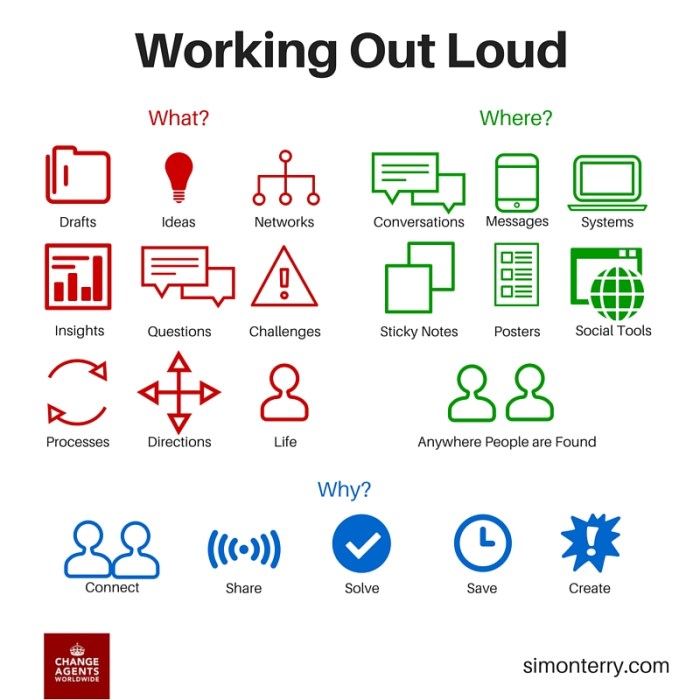
One core reasons collaboration tools have an adoption problem is a lack of benefits to users. That problem is not solved by a new tool. The benefit problem is solved by working out loud purposefully – creating an environment to learn, solve problems and create new solutions together.

The reviews of Facebook at Work are starting to come in. The claims from Facebook are intriguing: no community management required, no need to worry about adoption (after all its Facebook – your users are using it already) and so on. Does a new solution like this solve all the issues with collaboration at work?

Universal Adoption Isn’t Enough

We have had similar promises before of universal adoption before. Many existing IT systems providers were convinced that collaboration was a layer or feature that they could add to their applications. After all, they had adoption and use of their system, so the collaboration would naturally work in their system, particularly if they forced it into the existing processes. These systems have largely failed to deliver on expectations because the basics of value are not met. People don’t expect to connect with others or to share their work while working on processes in ERPs or other IT systems. Usually people collaborate to avoid the restrictions of these process driven systems or to achieve better outcomes than they can get from the system. Forcing in additional messages and conversations brought greater burden and more noise than user benefit.

Facebook begins as a dominant personal social tool so it starts in a much stronger position for adoption. For Facebook users, it is already platform to connect and share with others. Many sophisticated users already work there, marketing themselves and their businesses and engaging communities through Facebook pages and groups. Carrie Basham-Young has reviewed how easy Facebook has made it in Facebook at Work for people to Connect and to Share. We might wonder how the separate Facebook at Work profile will compete with the personal profiles for time and attention. Many users will already be connected and sharing social updates with work colleagues through a personal profile. Even so, Facebook will undoubtedly be able to capture a large share of the corporate graph and its watercooler conversations.

Sharing Isn’t Enough

Velux recently shared some insight into their adoption of social collaboration. A key insight of that case study was that sharing social status updates alone is not enough to create value. They needed to solve problems and create new value together. They need to move beyond what they saw as the pattern of ‘working out loud in Twitter’ to a more purposeful form of work asking questions to solve problems and connecting around key projects and activities. Like all social collaboration tools, Facebook at Work will need to help organisations navigate this transition and its history may be its disadvantage in this regard.

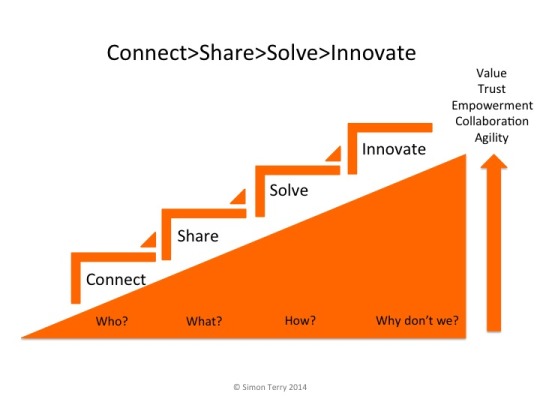
The Solve and Innovate steps of the Value Maturity Model of Collaboration will be where users see novel benefit and what keeps ensuring that they devote time and effort to using the new tool. Facebook at Work has clearly taken this into account with its focus on categorising groups into Teams and Projects, Open Discussions, Announcements and Social. However, if the traditional Facebook patterns of behaviours of social announcements and other forms of social sharing dominate, Facebook at Work will have not advanced the collaboration in the organisation, they will have simply extended Facebook use deeper into office hours. What if the patterns of Facebook use prove harder to change than our work email practices?

 Purposeful Working Out Loud Required

Working out loud requires people to consider the purpose & effect of their sharing. John Stepper’s discussion of the 5 elements of working out loud makes this explicit. Working out loud only makes sense when it makes work better for you and for others through learning, winning or giving help, making a new connection or other ways of solving every day work challenges. 

All forms of social collaboration, no matter how smart the technology, require individual users and the organisations involved to solve the challenge of creating connections based on purposeful working out loud. Slack another adoption success story is now being queried for the value of the conversations it creates. Slack’s solution is often suggested to be in its integrations but these can be complex to navigate and even discover for a new user dealing with a high volume chat channel.

Creating value for users and organisations is what will ensure that we change the long entrenched practices in way we work and we will consistently value new approaches to collaboration. Organisations need to invest in change support and community management to achieve an ongoing uplift in the value of collaboration. Facebook at Work is unlikely to magic this away any time soon because the context of value creation in each organisation and for each employee is different. The organisation needs to use new methods of working and collaborating to create its own approach to success. This is why customer success processes at other collaboration vendors have been notoriously resistant to being reduced to an algorithm. 

What Kind of Community Do You Have?

image

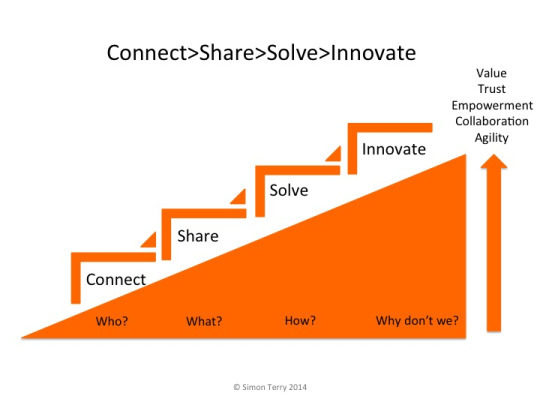
Enterprise Social Networks reflect the organisation’s culture and the maturity of collaboration in that organisation. As collaboration matures, different modes of engagement arise.  Higher levels of engagement aligned to the strategic objectives of the organisation are fundamental to the growing value of collaboration for any organisation.

Connect: The Directory

Many organisations don’t create much community in their networks. Networks or collaboration features imposed without thought or support will often languish. Without clear strategic rationale for collaboration in the organisation, their efforts create a new directory of employees (In many cases, a directory of only those who adopt). The collaboration features are used to create a social profile for individuals and to help people find others using the knowledge of those in the network.

Share: The Salon

When people are freely sharing ideas & their work, the level of engagement in the network rises. The community begins to resemble a salon. A salon can be an inspiring place filled with insightful knowledge and witty repartee. However, it can also be dominated by personalities, expertise and narrow schools of thought. Sharing knowledge is an important step on the journey of collaboration and a foundation for greater connection but posts with links is only an entry level for the human potential of social collaboration.

Solve: The Universal Genius Bar

When trust and engagement is high enough, people will see a community as a place to solve their work and personal challenges.  Like a Genius Bar, the community brings now just expertise and ideas, but solutions in the form of resources, processes and other ways to help drive change in the organisation. Well managed communities will be universal in their ability to reflecting the strategic intent of the organisation and the breadth of its people’s interests and purposes.

Innovate: The Platform

Successful cultures of innovation are those where people have a platform to which they can take ideas for development and trial. They also leverage the value of that platform as a way to track, understand and refine new ideas and those in development. When you have an innovation platform built on a rich level of engagement of all your employees, then the value and pace of change,  innovation and continuous improvement is accelerated.

Questions to consider:

  • Where does your organisation sit today in terms of the nature of the activity in your enterprise social network or other collaboration platforms?
  • What level of collaboration fits the culture of your organisation and its strategic goals?
  • What are the modes of collaboration that will help your organisation best achieve the value it seeks from bringing its employees together?
  • How have you authorised and enabled people to drive change and to collaborate in your community?
  • How can you move your organisations network from a Directory or a Salon into more valuable levels of engagement?
  • Do you have the leadership, community management and the change agents necessary to build trust, role model change and develop engagement?

The Value Maturity Model and its supporting tools are ways to help organisations plan and execute the development of strategic value in collaboration through enterprise social networks and other communities. For more information on the Value Maturity Model and how it can help you develop collaboration, please contact Simon Terry.

The little gesture #wol #vmm

Your gifts don’t need to be big. They just need to be gifts. 

I saw a neighbour driving in the street this morning. Being Australian males, we both raised a hand of acknowledgement. Two little waves made a gesture of greeting and respect. In regional Australia, the gesture is refined down until only a finger is raised from the steering wheel, but it is usually raised to greet each vehicle. 

Little gestures matter precisely because they are small and easy to ignore. Taking the time to recognise others specifically, is part of building community. Anyone can drift anonymously through a large city or organisation. Recognition reminds you that you have peers. 

The genius of John Stepper’s Working Out Loud is his focus on making small contributions to one’s network. All networks are built on these little moments – gifts of recognition, support or respect. Working out loud refines the giving in your networks and build a generous atmosphere of community. 

When I work with clients on enterprise social collaboration, my focus is to bring the conversation down from big set piece projects to these little gestures of community. The first three verbs of the Value Maturity Model, Connect>Share>Solve>Innovate, are foundations created by these small gifts of time, attention or value. Multiply small gifts and you multiply the power of collaboration. Most importantly of all, like a hand wave between neighbours, these gifts can be given everyday. 

Build your community with little gifts. 

May you enjoy the season of giving. Merry Christmas and a happy new year all. I look forward to further conversations with you in 2016 about the role of learning, leadership & collaboration in the future of work.

The Four Capabilities of a Social leader

Senior executives need new mindsets and new capabilities to be effective in the networked work of the future. Four capabilities will help e executives make the most of their networks:

Personal Knowledge Management: Personal Knowledge Management gives executives the personal learning skills to manage the flow of information and to deepen their personal networks. As executives personally learn to Seek>Sense>Share they develop critical digital skills for network leadership.

Working Out Loud: Working out loud is a practice that helps surface the value of work and learning in networks. Leaders are already the focus of attention. Making their work in progress visible to others is a highly valuable step because it accelerates trust and learning.

Leading in Networks: Network leadership requires leaders to surface shared purpose, build trust and influence and enable collaboration. Expertise, rank and orders are replaced with adaptive leadership techniques that manage learning, tension & alignment.

Creating Value in Networks: Leaders need to be able to set a strategy for their and their team’s engagement with networks. They need to be able to accelerate the maturity of value creation in those networks as they develop through Connect>Share>Solve>Innovate.

Developing leader’s practice of these key capabilities will enhance their effectiveness in enterprise social networks and the future of work.

Sharing is not Enough

All over social networks people share links and opinions. Meet ups are held to enable more sharing face to face. Networks share information every day.

Sharing is happening more than ever but it is not enough. Sharing information is a critical part of the value maturity model. Sharing builds trust, deepens understanding and fosters connection. Sharing should be a sign the network is taking off.

You only take off if you have somewhere new to go. A lot of the networks sharing information never mature beyond a flurry of content marketing. Their links and messages are the same as every other network.

Shared Purpose and Collaborative Work

Any reason will bring you together to share information. Before people can work collaboratively they need some overlap of their personal purposes. They need to have some commonality of the change they want to make. Shared purpose takes the conversation deeper and creates incentives for action.

As obvious as it sounds, people won’t do collaborative work unless there is work to be done. In dispersed networks, don’t assume everyone can see the work opportunities. Mostly people will see the barriers to work.

The role of Change Agents in a network is to connect people around shared purpose and to help everyone to see the work to be done. The generative leadership of change agents will help lead people to new ways of interacting by solving real problems. If you don’t yet have change agents, community managers and other leaders will need to show the way.

Links, pictures, jokes and opinions are a good start but not enough. The purpose is in the work.