You Don’t Have A Strategy if You Don’t Have the Work

slide1


The commonest error in plans to develop social collaboration in an organisation is the most obvious error. Too many plans aren’t focused on the work. You don’t have a strategy for realising the value of collaboration in your organisation if it doesn’t focus on the work of your organisation.

Early Friday morning last week was the #ESNChat tweet chat. Rita Zonius and Dion Hinchcliffe were discussing a question about the plans for developing ESNs. Dion reiterated an important point – adoption or other abstract goals don’t matter.  Your business is in business and needs your employees doing something meaningful.

One Success Measure

The only measure of success that really matters to your business is the value that you create in your social collaboration.  Value doesn’t have to be measured wholly in monetary terms but for a great majority of businesses value will have clear measures and commonly direct financial elements. Value creation, broadly defined, is what separates successful businesses from the pack.

Your organisation exists to fulfil some purpose. The strategy that is in place in your organisation sets out how you will maximise the value of the work to realise that purpose. If social collaboration in your organisation is not directly connected to this strategy and the value to be created for purpose, then everyone in your organisation has the right, and the obligation, to (a) question why it matters and (b) ignore it.

Measuring value in collaboration is hard. This challenge is greater when organisations are often sceptical of new ways or working or chains of benefits. Usually the benefit realisation happens away from the platform and is measurable only in other systems. Many proponents of social collaboration choose to ignore the hard to measure benefits and focus on easier to track goals, like adoption, satisfaction, sentiment, engagement or measures created specifically for the organisation’s collaboration plan. The danger of failing to align the measures of social collaboration to the measures of the meaningful work of the organisation is the danger of irrelevance.

Parallel Paths

The most damning criticism of many social collaboration networks showing high degrees of adoption and engagement is that they are a “parallel universe” to the real organisation and its interactions.  In this parallel universe, the hierarchy is levelled, leaders are proactively engaging people in conversation, employees are empowered to speak up and discuss their whole lives and great strides are being made in engaging employees and advocating for social issues. In the office, not so much.

In this scenario, the lack of accountability for real work outcomes has allowed the collaboration network to drift into play-acting an ideal organisation. Without real work there are no hard decisions and no ugly compromises. Without real work, it is easier for everyone to get along. You only need a little bit of fantasy to undermine the interactions of an entire network.

When a collaboration network is focused on supporting the real work interactions that network is bound to what goes on across the organisation.  There is a greater chance that the discussions in the network will reflect the issues, the challenges and the interactions that happen in the corridors of the conversation, for good and for bad. Getting tough work challenges into a collaboration network, as ugly as they may be, enables the network to help address and improve them.

Many organisations like the idea of a utopian network that shows them their better side. Role modelling is a valuable purpose. However, role modelling only works when the interactions are real.  The network can only contribute to making those interactions better, if the work is being done in some way across the network. Without the work, there can be no greater value.

A better network for social collaboration does the hard work to fulfil the organisation’s strategy. You don’t have a strategy for your social collaboration if you don’t have that work and aren’t measuring its value.
The Practitioner Benefits of Working Out Loud

slide1

Convincing an employee to take on the new practice of working out loud depends on being able to make a credible case for their personal benefits. Working Out Loud sounds new, different and risky at first.

Preconditions: Culture

Amy Edmondsen has done extensive research on team collaboration and demonstrated that a key component of participation in collaboration in teams is a sense of psychological safety for individuals. People need to feel it is safe to take interpersonal risk to learn, collaborate and experiment together. It is challenging asking people to Work Out Loud if the leadership, performance or other aspects of the culture make that personally difficult or disadvantageous.

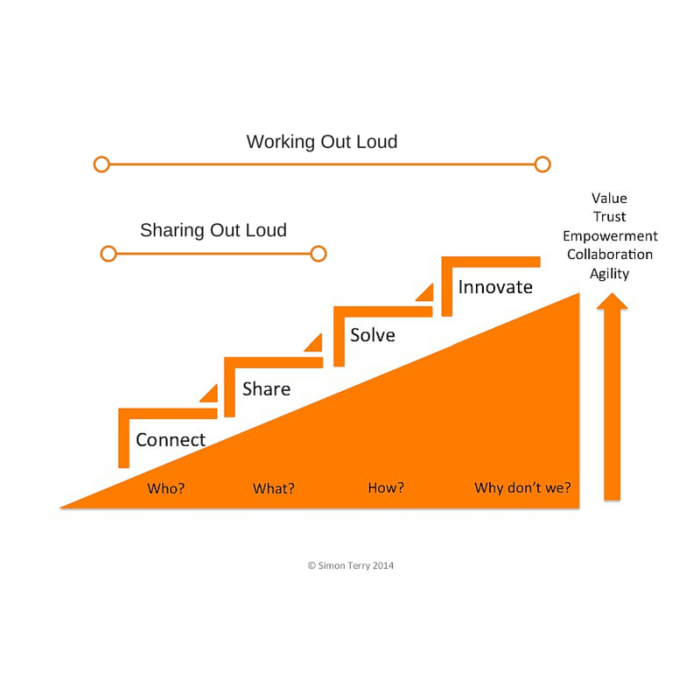
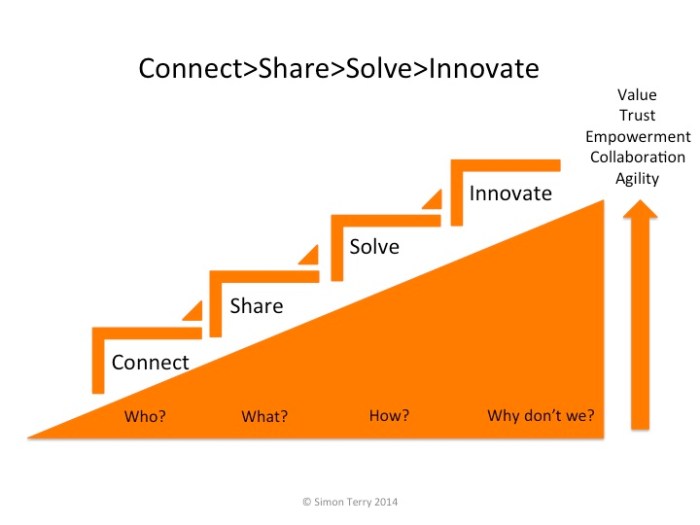
One of the reasons that the Value Maturity Model above works to build collaboration and working out loud up from connection and sharing is that it is a way to build trust and develop the culture of collaboration from safer foundations. Focusing sharing and solving around work needs and goals through working out loud can make it easier to change the culture leveraging work needs and key strategic priorities.

Working Out Loud can contribute to changing an unsafe culture, but that will take the work of Change Agents to role model the way and to run the risks of pushback. The kind of Change Agent who will take on a harsh culture to drive change is rarer than we would like.

The Practitioner’s Hard Benefits

A lot has been written about the human benefits of working out loud. Deeper connection to others, richer learning, personal purpose and fulfilment, the personal rewards of generosity and collaboration are all real and lasting benefits of working out loud. However, business is business and some users are looking for ‘hard’ financial benefits as their sole focus for change. The more demanding and siloed the performance environment, the more likely you will need to build your story on financial returns.

There are few sectors more focused on hard measurement of value than financial services. When I worked in banking we used to say there were four things you could do to create value for a customer. Our customer propositions were focused on the bank’s ability to:

  • save time,
  • save money,
  • enable people to make money, or
  • protect money or other assets (from risk)’.

A variant of these four holds for the personal financial benefits of working out loud to a practitioner:

  • Save time: avoid search, avoid learning time, avoid wasted work & prevent duplicate work
  • Save money: prevent duplicate work, improve alignment, avoid coordination costs, avoid expensive learning, avoid errors & rework, improve personal productivity & effectiveness
  • Make money: better align to needs, leverage diversity of ideas and solutions, leverage broad contributions & agility of teams, reuse intellectual property, make experience a transferable product
  • Protect: benefit from experience & learning of others, manage experiments easily, reduce risks, improve quality, etc

Each practitioner’s potential benefit equation will be unique. Work with their needs and circumstances to identify a suite of hard and soft benefits that engages their attention and provides an incentive for them to start the journey of working out loud.

Every Day Work Creates Every Day Trust.

slide1


Effective collaboration in your organisation depends on trust. The best way to build trust in your organisation is through collaborative work.

Trust is a consistent theme of this blog because it is fundamental to effective performance in organisations and social relationships. However, we mostly take it for granted and organisations often go out of their way to remind employees that they are not trusted and should not place their trust in the organisation.

Trust in the Work

One commenter on my recent post on collaboration and every day work suggested I was missing the need for trust to support collaboration. My response was that trust comes through actions and interactions.  Organisations often talk about trust as an abstract and something that can be worked on itself.

The reality of most trust building activities is that they create no trust unless they are connected to the fundamental interactions of the organisation. Trust is a manifestation of the expectations of interactions in the organisation, i.e. culture. Trust is human. All the fancy trust building exercises will fail if people believe the real interactions that support the work will occur differently.

Founding trust in and around the work to be done is important. Collaboration can deliver this new foundation for trust.  Transparency helps employees better understand what is going on in the organisation.  Networks leverage that transparency to deliver new accountability to help people have confidence in the work of others. Collaboration networks better enable employees to judge the intentions and capability of others based on the past performance in public interactions with others. Each of these interactions fosters a better level of understanding of the potential for trust.

Most importantly of all, collaboration networks can increase the interactions and the experience of generosity between employees. We all find it hard to trust strangers. Sharing a social network enables people to develop a deeper understanding of all of their peers not just those in their own teams.

Organisations that want to increase the level of trust between employees can benefit from focus on encouraging employees to work out loud and seeking opportunities for collaboration in their everyday work.

Get Out of the Way

Organisations also need to take care that they send signals that reinforce the value of collaboration and trust in every day work. Treat collaboration as inherently risky and you will discourage your employees from participating, trusting their colleagues and trusting the organisation.

When collaboration technology enables new interactions in an organisation, it can be easy to identify all the new risks that can be created. The traditional corporate approach to risk is risk elimination. Why not turn off the solution or the feature that creates the risk so that there’s no exposure to one poor decision by an employee. However, to avoid a rare event, this approach either excludes collaboration opportunities from the organisation or signals to employees that they cannot be trusted.

A better management of those risks is to place accountability on employees to manage the risks, both for themselves and others. That is a signal of trust in your employees and your willingness to make them responsible for a better workplace. That’s usually how you manage those risks outside collaboration technology where you have less control over what employees say and do anyway. Treating collaboration technology as specially unsafe is a bad signal for trust and ignores the opportunity to teach employees to the benefit of all the work.

This last point is significant. Trust, collaboration, agency and agility that you grow in your collaboration platform doesn’t stay there. Each of these capabilities are based in our human characteristics and follow wherever your employees go. They spread through the whole organisation. Manage trust well in the collaboration of every day work and the whole organisation will benefit.

Ain’t Nothing Special


slide1

Yesterday I saw a list of all the reasons why people don’t use social technology to collaborate in their work. You know the kind of list: fears, habits, lack of understanding, lack of leadership, etc.  I have to admit I sometimes tire of the focus on the negatives, especially as a sales pitch for consulting work. My response was to point out to the author that at the heart of almost all the points that were raised was a lack of an understanding that collaboration is how work gets done. When we are clear that collaboration is an important part of work then we get over our objections and make it happen.  It also opens us up to consider the most effective ways to connect, share, solve and innovate together.

Ain’t Nothing Special

We can easily fall into the trap of selling collaboration technology as special. We’re adding new technology. Magical things will happen. You can have new conversations. You can do new work here. We will achieve all the abstract goals that you have always wanted like engagement, innovation, customer loyalty, productivity, and much much more. As much as we talk about them, these abstract capitalised nouns remain abstract because they aren’t the work most people are doing.

Positioning collaboration technology as different and special runs straight into a priority problem. Where do I get the time to do this new and different thing? How do I even find the time to learn how to do it?  With new and different also comes risk. What if I aren’t any good at this new magical and different thing?

Positioning collaboration technology as wondrously different also runs into the problem it is not new. This technology has been in use for nearly a decade and stretches back to models of technology that have been around far longer. Why are we talking as if it is special?

What is the Work?

Ask a different question instead. What work in your organisation requires people to collaborate? Focus on the work and not on the technology. Go find all the instances in each of your work processes today where people have to find coworkers to help, share information, share documents, solve problems together and meet and interact around business challenges.  That work is going on right now all around you. Start with the collaboration and bring the technology.

When you start with the collaborative work, you are having a different conversation.  The work is going on. You don’t need anyone to prioritise their time different. You only need them to consider which way will make their work more effective. How could that collaboration be different if they worked out loud? How might it be easier, faster, better quality or otherwise more effective?

Put the collaborative work of your organisation at the heart of your collaboration technology. Your users probably don’t want anything else there.

Talk is Talk. Work is Value

Because collaboration technology is often owned by support areas, we can see it as a communication technology. We can focus far too much on the new conversations that will come along as the community builds. You do not want to position collaboration technology as a place for chat or social interactions.

The purpose of your organisation is the work that you do. That work involves connecting, sharing, solving problems and making change. Do that work in your collaboration technology. Focus obsessively on creating strategic value by connecting to the collaborative work across the organisation. When you do so, you will surprise the organisation with the value that can be created by working differently. You will also find that most of the barriers disappear as people race to be involved.

Three Levels of Co-Creation

As we begin to explore the collaborative potential of connection, co-creation is becoming increasingly important solution to problems. Organisations are increasingly looking to employees, partners and suppliers to be a part of efforts to co-create solutions to complex problems. Collaborative co-creation is a key part of the Solve phase of the Value Maturity Model. As we practice co-creation, we discover bigger opportunities to create value.

Co-Creating Ideas

Most co-creation begins with some kind of crowd-sourcing of ideas to solve problems. Diversifying the sources and inputs into the creation of a solution can enable big steps forward. Often new stakeholders have solutions to hand, see potential to reuse capabilities or bring opportunities to do things in new ways. Crowd-sourcing can be a fast and effective way to gather inputs from a large group of people towards a solution.

Efforts at crowd-sourcing solutions need to plan for two main challenges:

  • Lack of Connection: To contribute meaningful solutions, people need to feel connected to the problem and to each other.
  • The Volume of ideas overwhelms Execution: ideas are great but the exercise to sift and integrate diverse ideas can be a drain on execution. This is why many efforts at crowd-sourcing turn into a show of ‘engagement’ with no traction on the ideas submitted.

Co-Creating the Work

The next level of co-creation is when people come together to take a solution and execute it. The challenges of a problem don’t stop when you have an idea. People need to solve all the little issues and manage the idea until it is successfully implemented.

Make sure the expectation in you co-creation community is that work will be done to solve the problem.  Give the community the autonomy to follow their ideas. People will contribute better ideas if they think that they have to see them through.  Co-creation is more meaningful to a community that has been asked to work the problem together. Challenge them to take their ideas and see them through to implementation.

Co-Creating the Problem

The final level of co-creation goes back to the start and looks at the system from a higher view.  This level removes the constraint that the problem definition is externally imposed on the community. At this level of co-creation, the community has responsibility to find, create and implement its own solutions. To do this the community is going to need to start to ask questions about Purpose, the scope of the system and what goals they have for the system.  Bring a diverse group of stakeholders in to shape the problems and you may discover new problems and that some of your current problems aren’t such a big issue. The third level asks the community to own co-creation from Purpose, through Diagnosis, and then to the Design and Execution of any solutions.

From Sharing to Solving

Sharing Out Loud

A recent conversation with Cai Kjaer and Laurence Lock Lee of Swoop Analytics about the Value Maturity Model highlighted a key point that is at the heart of many organisation’s struggles to get value from enterprise social collaboration. Too many organisations are stuck below the Share>Solve boundary. Once you connect enterprise social collaboration to work, the benefits for users and the organisation expand exponentially.

Sharing Out Loud

The first reaction in many organisations to an enterprise social network is to see it as a chance to share out loud. What people see first is the potential for status updates, sharing of articles, links and other stories of interest.  This is natural human behaviour and it will be heavily influenced by the culture of social media use in your employee base.

As we have discussed in previous posts, sharing adds value in helping provide transparency, shared context, reducing duplication and enabling better alignment. If Sharing Out Loud is as far as the Working Out Loud goes then it can add value. Sharing is the core concept behind the knowledge worker productivity case for benefits of enterprise social collaboration. Share information and it is findable. Findable information can be reused.

Any organisation that does not move beyond Sharing will face a number of key challenges.  Sharing is where there is a lot of noise. Filtering the sharing with groups and other approaches becomes important. Users get frustrated that there is so much information and so little value. Networks can alienate users because a few loud or extroverted voices dominate the traffic and shape perceptions of what an enterprise social network can contribute. Senior executives will quickly lose interest in a network that does not reflect their work and their strategic priorities. A network that is only sharing will need sustained energy from community management or passionate users to survive.

The Launch Point: The Sharing-Solving Boundary

When an enterprise social community crosses the boundary from Sharing to Solving, the dynamic changes. Bringing work into the community provides a momentum and new benefit cases for all users. The purpose of the community and the benefits it can provide begins to clarify and the distinction between an enterprise social and other forms of social media can clarify for people. The work itself begins to provide the energy, rhythm and momentum of the community.

We can help users to turn a Sharing Out Loud community into a Working Out Loud community through strategic community management. We can provide the right context and strategy for the use of collaboration. We can structure the opportunities for Connection, Solving, and Sharing around the key interactions and challenges of the work of the organisation. We can focus on the culture of collaboration and generosity in helping others. All of this helps users to sustain their activity in the Solving domain.

One other benefit of focusing on moving above this boundary is that you are building key foundations for innovation.  Employees who develop confidence in an enterprise social collaboration solution as a place to solve their problems will begin to explore how to fulfill their new ideas there. People move easily from How? to What if? Employees who learn to create agile teams to solve problems can apply those same teaming skills to new ideas. The growing wirearchy of work can be reused to provide an engine to innovation work in your organisations.

Creating an environment where employees (& others) can work out loud on real business problems and challenging customer opportunities is the work of strategic community management. The value created beyond the Sharing-Solving Boundary is exponentially greater than that before.  If you want the attention of the business stakeholders to support your community, you will need to Work Out Loud.

If you are interested in exploring further how to the Collaboration Value Canvas, enables organisations to conduct a two-hour workshop with business stakeholders to ensure that the business has an integrated plan for its community management and adoption work.  Contact Simon Terry to discuss how this could be applied in your organisation.

For suggestions on how Swoop Analytics can help you measure this transition see Cai Kjaer’s post on Linkedin.

Keep Reconnecting: The Value of Strategic Community Management

Organisations need to invest in strategic community management for the life of collaboration. The process of reconnecting keeps relationships relevant as the organisation changes. Maintaining the connection of human relationships is the foundation of strategic value in collaboration.

slide1

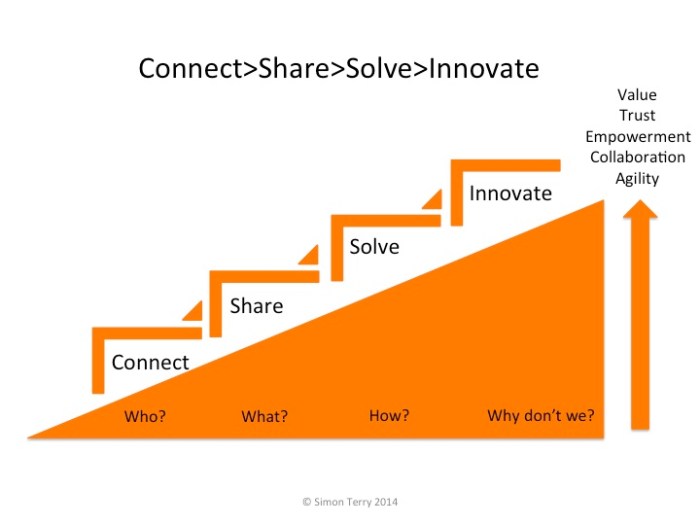
One of the consequences of representing a maturity model as a stepped process is that people interpret the steps as linear process – do connection then move on to do sharing.  The reality of collaboration in any organisation is that all four processes are going on at the same time. Even the most immature networks can have spots of sharing, solving and innovation. The model helps organisations develop the conditions to make those spots consistent, sustainable and predictable.

Keep Connecting

Connecting continues throughout the four phases. Perhaps a better representation would have horizontal bars or waves to show a continuity of each step in the model. The model reflects an ongoing development of capabilities and the main emphasis of each phase of development, not a series of linear exclusive activities. It also means that failing to maintain investment in any step can lead to the collaboration across the organisation slipping backwards in maturity. Let the relevance and effectiveness of relationships fail in your network and you will soon see a decline in the value created.

A corollary of this is that the most mature networks are also those that are most sophisticated at connection. In these networks, the process of connection is a task embraced by most users, is inherently a part of work and reaches well beyond the organisations boundaries to leverage all the relationships needed to make work better. Innovative organisations leverage relationships effectively, look beyond a role to leverage organisational capabilities and look outward to their networks to execute on innovation opportunities. Enabling this takes sustained effort and the development of new mindsets, capabilities and work practices in your teams.

Don’t Forget Reconnecting

Reconnecting is as important as the initial phase of establishment. Why? Connections get broken over time. Things change every day in your organisation. People join and leave. Businesses are reorganised. New strategies are developed. Projects form and close. Policies change. Technologies change. Without continued adaptation to all this change and without the creation of new relationships, the network will begin to wither and die.  A lack of ongoing connection and relevance to work is the reason most big bang marketing launches of collaboration fade away. Maintaining connection to support better ways of work is an ongoing exercise in any organisation.

The elements that I outlined on my last post on Connection need to be maintained, repeated and periodically refreshed. That is a role of strategic community managers. Organisations need to maintain an investment in community management long beyond launch to shape this ongoing adaptation of the networks of relationships across the organisation. Remember the relationships create the value, not the technology.

If you are interested in exploring further how to reconnect your organisation, the Collaboration Value Canvas can map an an integrated plan for the community management and adoption work required in a two-hour workshop with business stakeholders.  Contact Simon Terry to discuss how this could be applied in your organisation.

Start with Connection

Are your employees really connected through your Collaboration platform? Many who are members of your platform aren’t actually connected in human relationships. Perhaps it is time to check that your organisation is ready to begin the journey of adoption to realise strategic business value.slide1

A Missed Connection

When I explain the Value Maturity Model, many listeners skip over the first stage of the model and want to rush into the heady territory of sharing, solving and innovating. “Connection. OK. We have our employees on our network,” they say, “We are connected already. What’s next?” I am not alone in this experience. In a recent conversation with James Tyer of Togetherwise, a collaboration & learning consultant in the UK and Canada, James explained that he often has to take people back to the beginning to pick up missed connections and build a solid foundation for the work of realising business value.

Cai Kjaer of Swoop Analytics has also pointed out in a recent Linkedin post that having a network solution and employees being able to access that solution are precursors to realising value from social collaboration.  However, those steps on their own aren’t enough to create the human relationships that are necessary to work more effectively in organisations.

Experts in collaboration have been stressing for some time that a platform is not enough to deliver the benefits of collaboration. We can’t rely on “Build it and they will come”.  Most vendors now stress the need for adoption but what they often mean is “people on a platform” to ensure their revenues. ‘People on a platform’ is not enough to generate meaningful work and business value. Random crowds roaming your enterprise social network will get you nowhere you want to go. The potential wisdom of crowds of employees must first be shaped by strategic community management. We need to help employees to connect new relationships to be able to benefit from new opportunities for social collaboration.

Connecting Human Relationships

Community managers are the agents of strategic value in social collaboration. Their work translates human connection into the specific business value that realises an organisation’s strategy. The first role of community management in an enterprise social network is to connect new human relationships. Those relationships, not the platform, are the foundation of new value.

Think for a minute about the best work relationships that you have. What are the characteristics of those relationships? Features of great working relationships include a shared understanding, context and goals, reciprocal value, trust, mutual support, and learning. The first work of community managers in organisations that are using a social collaboration solution is to put in place the conditions that will foster these kinds of connections.

The Work of Connection

Let’s look at some critical elements that deliver connection for business value in a social collaboration network:

  • Connecting Understanding: For many of your employees, the use of social collaboration tools at work is new. Kai Riemer of the University of Sydney has demonstrated in his research into ESNs that sense-making is a critical early phase of network development. We need to help employees to make sense of the use and benefits tools in the work context.
  • Connecting Purpose: Work is busy. There’s already too much to do. People need reasons to use a new platform. Real people love their tasks to have meaning. Connecting those reasons to shared purpose in the organisation is an important benefit to users and a benefit in communicating and reinforcing purpose.
  • Connecting Strategic Value: Your organisation’s strategy outlines the most important work that needs to be done and the value that the organisation is seeking to achieve. Ensure that this value is clear to your community and that they can help drive what the organisation needs to be done.
  • Connecting Work: Not every employee and business will be able to find the connection between their own work and the broader business strategy. Help individuals and teams to make the connections of their work into broader businesses, processes, and projects.
  • Connecting Groups: Groups (or the related concept of Channels) are the home of work in any effective social collaboration solution. Make sure you have the groups you need to start the right work. Make the groups findable for new employees. Help these groups form, storm and norm on their way to performing. You don’t want names in a group. You are aiming for a team built on real human relationships.
  • Connecting Capability: Human capability is variable. Not everyone will have the capabilities they need to understand how to use the platform, to work or to lead in these new complex relationships. Make connections for people to ways to build their capability to be more effective.
  • Connecting over Barriers: Every organisation has legacy rules, mindsets, processes and approaches to work that will get in the way of effective collaboration. Help your teams to fix, avoid or work around these barriers.
  • Connecting Leaders and Champions: Real people are influenced by the behaviour of others. Leaders and champions will help shape the work, the norms and the value created in your network.
  • Connecting Governance: Budgets come with expectations and organisations come with norms. Connect a governance team that can help the community managers to drive the right strategic outcomes in ways that best suit your organisation.
  • Connecting Data: Value realisation requires measurement. Put in place a plan to measure the data you need and gather the tools that you will need to do the measurement.
  • Connecting Resources: Nothing is free. Great work needs the right level of resources. Make sure your community management team and platform has a sustainable level of resourcing for the strategic value that you want to create.

If you skipped the Connection stage in your collaboration solution, some of these elements might have been missed. Even if you picked up these steps, are these elements integrated to ensure that the foundations for future business value are in place?

Realising the strategic value of social collaboration requires a focus on the human relationships in work. Any good relationship begins with a strong connection.

If you are interested in exploring further how to the Collaboration Value Canvas, enables organisations to conduct a two-hour workshop with business stakeholders to ensure that the business has an integrated plan for its community management and adoption work.  Contact Simon Terry to discuss how this could be applied in your organisation.

Addendum

In a discussion on Facebook around this post, Mark LeBusque added this insightful comment:

Another reason why BEING comes before the DOING. I often come across coaching clients who have been frustrated when projects hit a hurdle and it’s always because they haven’t created a meaningful connection with their cohort before the project begins. Instead of sitting in a room on Day 1 of the project talking about what they need to DO they should spend time in a less sterile environment talking about how they need to BE. The key element there is how to really be connected.

Mark’s comment highlighted to me the one missing connection:

Connecting Self: Busy people tied up in work, status, fears, dreams and other mindsets can struggle to connect to their feelings, fears and sense of self. Any relationship must be based on a strong sense of who you are and want to be. We need to help people connect with and leverage their authentic self as part of their work.