Breaking Down the Value Creation Opportunities in A Yammer Post

image

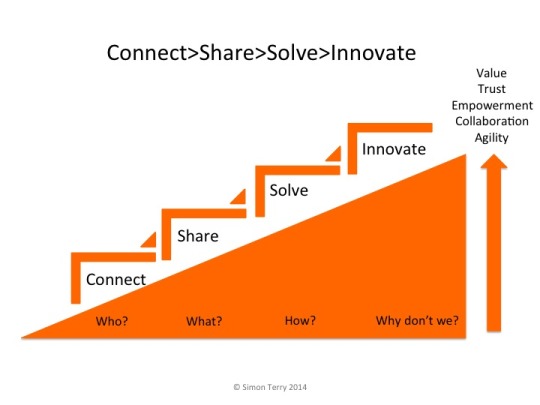
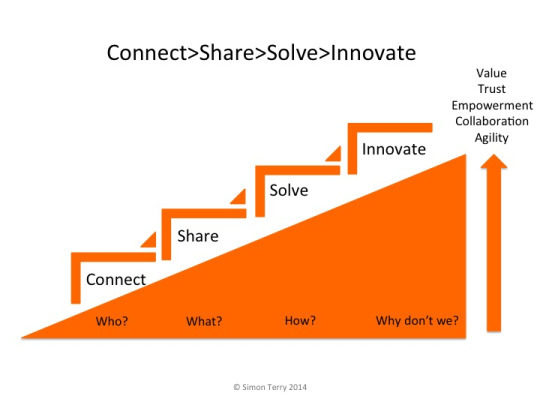
Value is created in enterprise social networks as people connect, share, solve and innovate together. That value creation is an outcome of the work people choose to do together. Measuring the activity in the technology isn’t a measure of the value created, it is simply a measure of adoption. The value of the adoption comes from the organisations strategy and the work of its teams.

However, the features in a typical Yammer post, or any enterprise social network, can give us a guide as to how people come together in networks to work in new ways.  Let’s break down a Yammer post using the Value Maturity Model so see how new organisational value gets created.

image

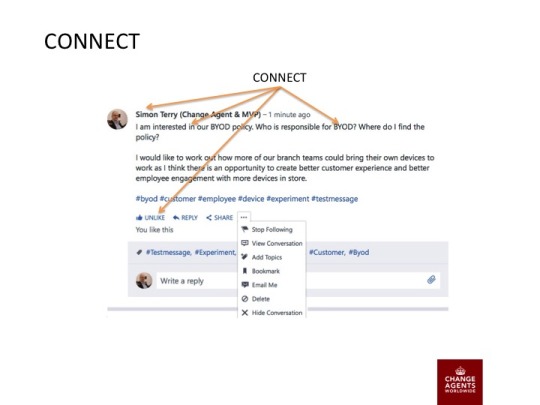
Connection brings people in the organisation together often for the first time.  That connection can be a simple as the feeling of belonging or recognition when a post gets a like. It might be bringing people together around a topic of current need or ongoing mutual interest like a community of interest or a community of practice.  Most directly, connection can be a way in large, distributed or siloed organisations to find the people responsible and get in touch to move work forward. 

image

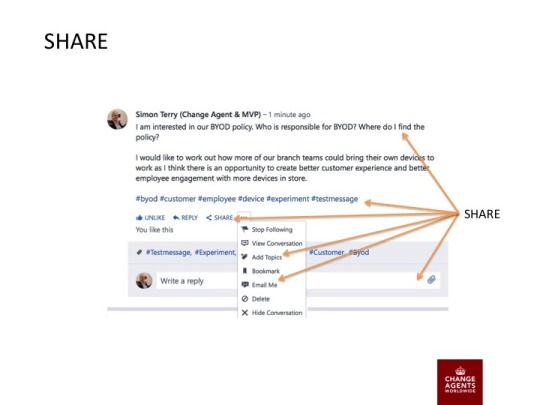
Sharing lifts information out of its hiding places, makes it findable and directs it to people who need to know. That can happen in the enterprise network through replies that answer common questions for everyone’s benefit, provide links to information or provide documents meeting a present need and saving future time and searches.  Shares make sure information reaches the right people whether a group, an individual through a private message or even by taking a message out to email to those who don’t regularly use the network. All sharing is silo-busting. Adding topics, either in a message or later, provides people new ways to navigate information and helps make information searchable. Sharing creates a rich domain for social learning and helps the new employee seeking to learn more. A culture of sharing fosters working out loud to help people achieve personal purposes, bring work to the surface and further increase these benefits. Most importantly of all, this activity helps build a shared and discoverable context for the work of the organisation reducing errors, duplication and improving problem solving and efficiency.

image

Value creation accelerates when an enterprise social network becomes a way for people to come together to work on solving problems. People can ideate, offer solutions and work together in the thread or in groups to discuss ways to solve work problems with existing or new solutions. Having a way to discuss and work through problems in products, policy or process, either through fixes or hacks, helps the organisation continue to flow for those doing the work. The problems raised in this way are able to be solved not just for one user but for everyone in the organisation. The value of these solutions will increase as the problems that teams tackle increase in value. Leaders, experts and creative individuals can help enable the organisation to move past its daily obstacles and create better experiences for customers, employees and other stakeholders. The benefits here are in work in the network and out in the organisation that continuously and responsively improves organisational effectiveness.

image

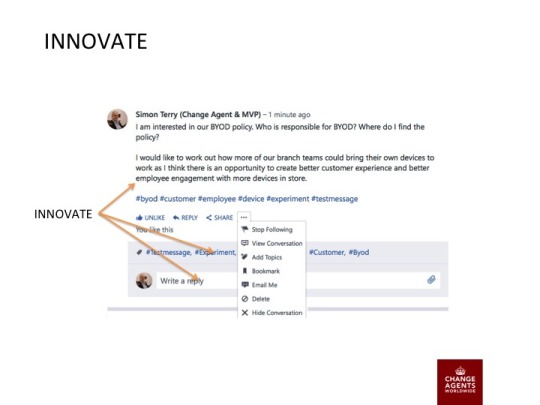
Innovation adds value to the organisation when employees feel enabled and encouraged to put forward possibilities, to seek ways to make them happen and to recruit capabilities and coalitions to experiment and execute on opportunities.  Vibrant communities will work well beyond a single post out into the broader organisation to make their ideas a reality and help the organisation to respond to its opportunities. Innovation allows employees to explore ways to better fulfil the purpose of the firm, to radically reshape the processes of their work and to deliver new forms of value.

image

Building the Goodwill of Networks

Networks give people access to more people than ever before. However, they can also create new inconveniences by allowing people to free ride. Networks are fostered when people are encouraged others to making contributions to others first and to consider in their approaches the value created for others in their requests. These actions, like purposeful and generous working out loud, rebuild the goodwill that free riders consume.

The Network Externality of Free Riders

In economics, an externality is a cost imposed on other people who did not choose to incur it. Free riding is where a person consumes more than their share of a common resource. Every network depends on common resource of goodwill in continuing connection. A common barrier to the development of collaboration in networks is the network externality of thoughtlessness and free riding.

Great networks build up goodwill among the members which facilitates collaboration through trust, shared connection and a sense of reciprocal benefits. Free riders are members of those networks who don’t contribute to the general goodwill. 

The Externality of Thoughtlessnesss

Thoughtless activities in networks consume goodwill because they impose costs on others in the network without any return:

  • Noise: It takes time and effort to filter out noise. Creating noise in networks is costly to everyone. Noise can include repetitive posts, broadcast messages, long rambling messages, diversions from purpose, spam and other forms of low value messages.
  • Laziness: Failing to check that the question you ask has not been answered already or that the answer is not readily available. Let me Google That For You is a great example of a solution to this common occurrence.
  • Confusion: Making a unclear request of the network. In many cases questions are far easier to ask than to answer well. Many people do not think through what others need to be able to answer their query. It takes time and effort to clarify what the issue is and what answers or assistance will be helpful.
  • Selfishness: Making request of others for effort without giving anything back. We have all been asked to help others in our networks. The better requests are respectful of the individual and the network. Most of the requests that come through Linkedin have a clear benefit to the other person but much less consideration on how I might be interested in helping. Responding to these requests takes time and effort which lowers the value of the network and the priority of responding at all.
  • Lack of Follow-through: Making requests that are ambit claims, have unnecessary urgency or where you are not prepared to invest in follow through on the responses others will make. A common issue is when people ask for urgent help and then disappear again without responding to even acknowledge the answers given to their query. 
  • Unclear Benefit: Making unclear offers of benefits. If you suggest something offers ‘exposure’, ‘mutual benefit’, ‘rewards’, ‘an opportunity’ or similar it helps to quantify this in your request. Leaving it for others to discover the meaning of your obscurity imposes costs on others and on you.

There are many more examples. While it may be easy to decline all poorly framed requests, some times opportunity lurks under the thoughtlessness.  The challenge is that the time and effort to respond, to clarify, to negotiate mutual benefit and to help can unduly burden network participants. Suddenly people withdraw from helping others in the network because the collective experience is burdensome. 

Sidenote: Recognise Your Own Value In Networks

Under an avalanche of requests for free time, free help, free speaking engagements, free advice, offers of ‘exposure’ and general lack of consideration, it can be tempting to decide that you have to acquiesce because the whole system works this way. This is even more the case when you are told ‘everyone else’ seems to be doing things on this basis. We are still learning how to manage relationships at scales, timeliness and distances that have never been possible before in human history. Remember always you have choices. The best way to make choices is to respect the value you bring, set your own strategy and set your own rules for the value exchange. That way you take and miss the opportunities you choose, not others. Ask people you trust to help you assess the value you create, if you can’t do it yourself. Grace, humble respect for the value you create and a focus on reciprocity can make magic happen.

Replenishing Goodwill with Purpose, Contributions and Serendipity

One of the reasons that I am a advocate of John Stepper’s work in promoting the value of working out loud is that John has made explicit the value of making contributions to others. Making purposeful contributions to people in your network builds goodwill. It is a great way to start a relationship. People are more likely to assist you if they have seen you making contributions to others. Most importantly of all to make a contribution to another person you need to take the time to think of that other person and their needs.

Goodwill erodes if it is not actively restored by reciprocal benefits in a network. Creating goodwill through consistent contributions to others and serendipitous benefits helps the networks deliver net benefits to participants overcoming the costs imposed by the thoughtless and the deliberate free riders. The more people make purposeful contributions to others the more likely the balance will be a net positive one. For this reason many early online forums excluded lurkers in an effort to foster purposeful participation and reciprocity. The champions, change agents and connectors at the heart of your network will be some of the most purposeful, considerate and generous individuals that you know.

Fostering a culture of working out loud that is purposeful and generous will help any network overcome the challenges of occasional free-riding.

Who is that exactly?

One of the most important questions to ask in any leadership conversation is “Who is that exactly?” Getting beneath the opaque references to people is important to bring real human impacts to the foreground in decision making. Human behaviour is richer and more complex than segmentation and averages can show. Importantly, a specific conversation about people can also surface other impacts, alternative approaches and bias hidden in decisions. 

The Opaque Other

Politicians love opaque phrases to refer to their opponents: ‘the 1%’, ‘big business’, ‘immigrants’, ‘refugees’, ‘special interests’, ‘leaners’, ‘those people’, and so on.  The value of an opaque phrase is that avoids the risk of conflict with the current audience and builds a sense of conflict with an Other that they use to unite that audience. Demagogues have been threatening audiences with an Other since politics began. In an age when sexism, racism and overt discrimination have become less acceptable, the Other needs to take on a more opaque form. Usually when confronted with specific examples or challenged to name who exactly they mean, politicians duck and weave to avoid being more specific. Who they actually mean can be quite surprising to the audience. 

The Opaque Other at Work

The same opaque conversations have drifted into business and social conversations too. It is not unusual to hear that a particular decision will have an adverse impact on ‘retention’, ‘a small segment of customers’, ‘stakeholders’, ‘some performance indicators’, ‘poor performers’ or even just ‘employees’. Behind each of those opaque phrases are real human impacts often on a scale that is far larger and far more important than the phrase indicates.

Asking “who is that exactly?” lifts the curtain on that obscurity and enables a better quality decision. Understanding specific individuals impacted can reveal unintended consequences beneath the averages. Percentages and other statistics are driven by real human decisions by specific customers. I have seen examples where organisations have approved decisions like changes to customer loyalty programs that have a forecast of a minor uptick in customer churn, only to discover later that it adverse impacted the most loyal and most profitable customers. The business impact was far worse than expected. 

Equally changes to organisational structures, processes, performance management, leave, flexible working and other HR policies rarely impact employees equally. While they may looks so in the data used for business decisions, real human employees are rarely fungible. To consider one example, a decision to ‘spill and fill’ a management role in a restructure had a devastating consequence on the business because of the experience that was lost as employees took their talents to market and the market lacked of talent to fill a sudden large demand for lost experience. Had people considered individuals in both the roles and the market first a better decision could have been made.

If you want greater collaboration and innovation at work then you need to get beneath consideration of the opaque bucket called ‘our employees’. Innovation and collaboration are different for specific employee.  They have different meanings, benefits and costs to different people. A successful strategy focuses on real individual employee needs to achieve the organisational outcome.

Turning your conversation to consider the specific people impacted and ensuring that you understand them well before making a decision is important in any conversation. Importantly this is also a key step to make sure the decision is inclusive and not divisive. The consideration may not change the decision but it will make everyone more aware of the risks and impacts. The consideration will also improve the quality of any engagement you have with impacted people as discussions move into implementation.

Asking the simple question “who is that exactly?” will help you to consider the complexity of real people.

Design the Work

Don’t design workflow for the product features. Design work for the people. Let them improve the process from there.

Features Change

Microsoft MVP Melanie Hohertz, Online Communications Lead of Cargill recently remarked in conversation ‘People need to stop designing workflow in Yammer around product features’. This comment is needs to be more widely understood as it is a key source of frustration for many community managers and their organisations. I am not surprised Melanie would so simply distill the issues vexing community managers with Yammer. Melanie is always insightful about Yammer, based in both her excellent command of the product capabilities but also her expertise in community management.

Cloud software solutions have brought powerful new capability into our organisations. However they have also created havoc with traditional ways of working due to their agile product development methodology.

Processes Don’t Change

The process-centric history of management means we try to turn much of our work into a tightly defined process. Many organisation take agile cloud solutions like Yammer and build their features into tightly structured workflow. This process centric approach doesn’t work.

Yammer’s product development is highly agile. Product features change to a loose roadmap but also as a result of a continuous program of A/B testing. We might wish for greater certainty and transparency, but the agile approach isn’t going to change.

The testing enables Yammer’s product managers to learn from the use of the solution by all their users. Your unique use case of a tightly defined custom workflow won’t fit in this approach. That one workflow is a blip among the way millions of users engage with the tool. Melanie’s insight means that we need to step outside our traditional process-centric view and embrace a people-centric approach.

Collaboration takes Community

The opportunity with collaboration in the future of work is for people to be able to reshape their work. Collaboration is not just a layer over the process. Don’t design a process for the features of the tool. Design around the people, those who do the work. Give them the capability to shape their work. Help them to become more agile and adaptable. Let the people take their work forward from there. People will learn in time to navigate the changing features, adapting them to their needs. The product roadmap matters far less than the creativity and agility of community.

Supported in the right ways, people will improve their work through creating new network connections, sharing information, solving challenges and continuously creating new ways of working. The results will be more agile, more collaborative and more effective.

From Life-crushing to Life-affirming Work

image

My parody post on the Life-crushing Magic of Hierarchy, rightly prompted the reaction: “Yes, but what do you recommend we do about it?”. This entire blog is an extended essay on what to do to help make work more human. I believe the critical challenge for organisations as we move into the future of work is how to use learning, leadership and collaboration to create more life-affirming workplaces and work. For those who are looking for quick clarity, I thought I would distill a few basic responses to the challenge.

Call The Life-crushing Management & Discuss it

Frighteningly several people have taken the post at face value as a recommendation of management practices. This highlights our need to discuss the excesses and abuses of management practices more widely. Transparency & debate is a first step, because many of the practices will be stopped or adapted when challenged or discussed openly. Importantly, transparency alone is not enough.  We need people to act on change too.

Calling hierarchical leaders to explain their actions is not a step taken lightly. Like it or not, the call will challenge some leaders and not all challenges are welcome. Simple steps can be taken to make it easier to call bad practice and start a discussion:

  • Don’t do it alone: Build a coalition or at least check your perspectives with others before you call a bad practice. Ensure that there is a crowd of supporters for your view point.
  • Seek to understand: Begin by seeking to understand the management perspective. Don’t presume malevolence or incompetence. Most bad decisions come from a lack of shared context.
  • Based your questions in higher purpose, values or strategy: Appealing to and clarifying the higher order can give you more basis for a challenge.
  • Add external perspectives: Closed systems atrophy. Some times lack of diversity can be the problem. Add external ideas, data and perspectives to add weight to your call.
  • Offer help: If you call something, be prepared to work to create a better way. There’s a lot of critics. There are fewer collaborators.

Discuss People, Outcomes & Purpose

The practices “recommended” share a common goal of valuing management power over the effects of work. Creating a vibrant discussion of purpose, the importance of meeting people’s needs and the impacts of work beyond the organisation is critical to moving to more meaningful work. Starting with a strong sense of why work is to be done and the goals it is to achieve for the organisation, the individual and other stakeholders is a key part of a better more engaging work environment.

Importantly, this begins to foster and “outside-in” perspective that pushes hierarchical managers to look to new data and perspectives in their decision making.  Being clearer on goals and purpose is also a fundamental underpinning to allowing new forms of autonomy for employees to react and make change.

Grow Accountability, Autonomy and Change

As we add human accountability to the networks in our organisations, we enable people to begin to grow trust and influence. Think of the definition of wirearchy and focus on increasing ‘the dynamic two-way flow of power and authority, based on knowledge, trust, credibility and a focus on results”. Many simple issues in our organisations can be addressed by allowing people to share more information and begin to exercise autonomy to make decisions that need to be made beyond roles, mere compliance and process constraints. The exercise of that autonomy rises as accountability & trust rises. At the same time, we start to accelerate the pace of change in our organisations enabled by the distributed talents of our people. Increased accountability is one of the goals of traditional management, but common practices tend to disempower. We need instead to increase accountability and empowerment at the same time.

Build Capability

The appeal of traditional management practice is that managers need not be very effective at coordinating people and the employee’s roles are kept rote and simple. Working in more human ways will require organisations to build new capability to lead and to influence and also to make more complex decisions in every role in the organisation. We can’t manage and work in different ways if we have not helped people to develop the required capabilities. Enabling people throughout the organisation to gather information, to learn, to make change and to influence others becomes very important.

Continue the Collaboration & Change

There are no quick fixes, no gurus and no systems to buy to make a more life-affirming workplace. The steps above need to be led by management and by the entire team in the organisation over an extended period of change.  We don’t necessarily need to start by throwing out hierarchy or managers.  In most cases, they come back in another form anyway. What we need to do is to learn to work in new and much more effective ways that value human potential inside and outside the organisation.

Capabilities aren’t learned overnight and new ways of working take time to embed and be secure from the next round of management changes and new hires. The best way to carry this journey forward is to embed it in a collaborative change program that the entire team embraces.  Making life-affirming work part of the cultural fabric of the organisation must be the ultimate goal.  After all, there is no destination, just an endless journey of improvement and change.

Why Collaboration Value is Understated

image

Applying mechanical process productivity to collaboration provides us with an efficiency benefit case for collaboration. Understanding the true benefits of collaboration requires us to understand the knowledge work systems in place and the broader effectiveness of the organisation at creating value.

Value of Collaboration is Not Easy

We always facing the challenge of valuing the benefits of collaboration.  Collaborative technology is part of the infrastructure of the organisation. It’s use is open to many applications that will be co-created by the employees and shaped by the organisation. Many of the outcomes are not direct; collaboration facilitates a more effective organisation.

The temptation is to play it safe. We can use the same process efficiency mindset that applies to any other system to automate processes.  The question usually asked is “How much more efficient will our people be when they use a collaboration system?’  A number of studies have looked at the impact of collaboration systems on in process efficiency of knowledge workers. One of the most widely quoted statistics is the McKinsey survey that identified 20-25% of the time of knowledge workers could be saved with better ways to search for and interact on information. This mindset often drives an adoption focus to collaboration projects that misses a bigger opportunity to create value.

25% Better Off?

If you are processing iron ore into steel and you find a way to do it 25% better, then you will have 25% more steel or need 25% less inputs. That is a mechanical process saving. Inputs became outputs at a cost. This is how our traditional efficiency mindset has focused us on measuring value.

However, knowledge work isn’t like steel manufacture. At the end of a knowledge work process, we still have the inputs and the outputs. Both the inputs and the outputs can be shared widely at very low cost because they are easily reproducible. Most importantly, neither the inputs nor the outputs are fixed. 

Let’s consider a practical example. As a knowledge worker, you are asked to create a new process to improve the efficiency of steel production. Is the goal to do this 25% faster? No, the goal is to create the most efficient way of producing steel.  There are four elements that measure effectiveness of your work:

  • Reduce waste: If there is no better way currently possible or someone has already done the work, then don’t work on creating a new process. Do something else.
  • Reuse existing knowledge: If someone has developed a process that is more efficient, use that process as a basis. Don’t start with a blank page.
  • Create new knowledge: If you can bring together people who have never been connected, if you can share information that has not been shared you may be able to solve new problems or create an entirely more effective process for steel manufacture. This is likely to impact a much larger value opportunity than knowledge work in your organisation.
  • Create new value with existing or new knowledge: Your new process for steel manufacture will be able to be shared across your organisation and may even become a product in its own right.

The economic value of these four elements aren’t productivity measures of knowledge work.  The economic value is the impact on the production of steel and the greater value created in the organisation by collaboration to improve steel production. In my experience the benefits from simply stopping wasteful projects without any value add, is an order of magnitude larger than the productivity benefit from reduced search by knowledge workers.

Thinking more broadly about the economic impacts of collaboration can create a dramatic step change in the benefits for an organisation.  Rather than looking at efficiency in the cost base of knowledge work, collaboration impacts value creation organisation-wide. This new view has a critical role to play in shaping leaders support for collaboration and the level of investment an organisation should make in fostering collaboration in the organisation.

The Internet of Humanity

An extraordinary technological opportunity confronts your business. Global communication networks have unprecedented reach and mobility. These networks can connect highly capable autonomous intelligent agents called humans. The potential of this technology could change your business, and even human society, in disruptive ways. 

Even more incredible the capabilities of these intelligent agents are not fixed. Equipped with a full range of sensors, motion and agile communication capabilities they are highly adaptive. They have been known to survive all environments on this planet and even near space. They learn from each other and can even collaborate without APIs to decide novel approaches to the challenges & opportunities in their environment. These agents are self-powering, purpose driven, upgrade automatically and operate entirely autonomously. 

Imagine the ability to discover, to explore and to make sense of the entire globe. Imagine the opportunities in global advocacy, creativity and collaboration. Imagine what your business could do if it connected humans. Just think of the novel products, the extraordinary experiences and the economic and social value you could create with the Internet of humans. 

We have the ability to leverage an Internet of humanity. We just need to better understand how they work.

Reflections on Facebook at Work (& Promises of Universal Adoption)

image

One core reasons collaboration tools have an adoption problem is a lack of benefits to users. That problem is not solved by a new tool. The benefit problem is solved by working out loud purposefully – creating an environment to learn, solve problems and create new solutions together.

The reviews of Facebook at Work are starting to come in. The claims from Facebook are intriguing: no community management required, no need to worry about adoption (after all its Facebook – your users are using it already) and so on. Does a new solution like this solve all the issues with collaboration at work?

Universal Adoption Isn’t Enough

We have had similar promises before of universal adoption before. Many existing IT systems providers were convinced that collaboration was a layer or feature that they could add to their applications. After all, they had adoption and use of their system, so the collaboration would naturally work in their system, particularly if they forced it into the existing processes. These systems have largely failed to deliver on expectations because the basics of value are not met. People don’t expect to connect with others or to share their work while working on processes in ERPs or other IT systems. Usually people collaborate to avoid the restrictions of these process driven systems or to achieve better outcomes than they can get from the system. Forcing in additional messages and conversations brought greater burden and more noise than user benefit.

Facebook begins as a dominant personal social tool so it starts in a much stronger position for adoption. For Facebook users, it is already platform to connect and share with others. Many sophisticated users already work there, marketing themselves and their businesses and engaging communities through Facebook pages and groups. Carrie Basham-Young has reviewed how easy Facebook has made it in Facebook at Work for people to Connect and to Share. We might wonder how the separate Facebook at Work profile will compete with the personal profiles for time and attention. Many users will already be connected and sharing social updates with work colleagues through a personal profile. Even so, Facebook will undoubtedly be able to capture a large share of the corporate graph and its watercooler conversations.

Sharing Isn’t Enough

Velux recently shared some insight into their adoption of social collaboration. A key insight of that case study was that sharing social status updates alone is not enough to create value. They needed to solve problems and create new value together. They need to move beyond what they saw as the pattern of ‘working out loud in Twitter’ to a more purposeful form of work asking questions to solve problems and connecting around key projects and activities. Like all social collaboration tools, Facebook at Work will need to help organisations navigate this transition and its history may be its disadvantage in this regard.

The Solve and Innovate steps of the Value Maturity Model of Collaboration will be where users see novel benefit and what keeps ensuring that they devote time and effort to using the new tool. Facebook at Work has clearly taken this into account with its focus on categorising groups into Teams and Projects, Open Discussions, Announcements and Social. However, if the traditional Facebook patterns of behaviours of social announcements and other forms of social sharing dominate, Facebook at Work will have not advanced the collaboration in the organisation, they will have simply extended Facebook use deeper into office hours. What if the patterns of Facebook use prove harder to change than our work email practices?

 Purposeful Working Out Loud Required

Working out loud requires people to consider the purpose & effect of their sharing. John Stepper’s discussion of the 5 elements of working out loud makes this explicit. Working out loud only makes sense when it makes work better for you and for others through learning, winning or giving help, making a new connection or other ways of solving every day work challenges. 

All forms of social collaboration, no matter how smart the technology, require individual users and the organisations involved to solve the challenge of creating connections based on purposeful working out loud. Slack another adoption success story is now being queried for the value of the conversations it creates. Slack’s solution is often suggested to be in its integrations but these can be complex to navigate and even discover for a new user dealing with a high volume chat channel.

Creating value for users and organisations is what will ensure that we change the long entrenched practices in way we work and we will consistently value new approaches to collaboration. Organisations need to invest in change support and community management to achieve an ongoing uplift in the value of collaboration. Facebook at Work is unlikely to magic this away any time soon because the context of value creation in each organisation and for each employee is different. The organisation needs to use new methods of working and collaborating to create its own approach to success. This is why customer success processes at other collaboration vendors have been notoriously resistant to being reduced to an algorithm. 

Working out loud on Career Transition

I throw a spear into the darkness. That is intuition. Then I must send an army into the darkness to find the spear. That is intellect. – Ingmar Bergman

Working out loud on your intuitions is critical to success of career transition. So is bringing your network to bear as an army of hunters and collaborators to help make the new role a success.

A bunch of friends, collaborators, and inspirational leaders were made redundant yesterday. At the end of a day of reaching out to offer help, I came across the quote above from Ingmar Bergman and it reminded me of each of my past career transitions. Enforced change is daunting and can be a time of doubts and confusion. We can be deeply unsure of what comes next.

When career change takes us by surprise we usually never quite know what we want next. We are deep in the realm of doubts and hopes. We need to trust our intuition as a signal of personal purpose. We need to throw some experimental spears. Working out loud is a great way to test the waters, refine your hopes and draw opportunities. Throw a few spears and see what happens.

However working out loud is just the beginning. The next challenge is to send out an army to help you find the next role, project or help you start the next business. There’s too much for one individual to do alone. Networks are the most powerful way to search for, find or even create the new role. Combinations of strong and weak ties will make things happen that you could never expect. Working out loud can make the network aware. You will need to work the network ongoing with all your intellect to turn ideas into opportunities to fulfil your purpose.

My friends are well placed for success in this game. They are highly talented and know how to work like a network. They have global networks. They have authority on the difficult challenges in change and adoption in the future of work. They are trusted experts and partners. They are ideally placed to leverage the wirearchy to their next success. The opportunity now is to work out loud and connect, share, solve and innovate with those who admire them.

For all of us who are pondering our next move, how are you leveraging working out loud and calling on the power of your networks? How are you helping others find their next horizon?

Manage Your Performance (in A Network)

“Keep away from people who try to belittle your ambitions. Small people always do that, but the really great make you feel that you, too, can become great.” – Mark Twain

Organisations are moving away from traditional performance management. Expensive managers are being removed from organisations as they explore ways to be flatter and more responsive. More people are working freelance. 

Managing your own performance is more important than ever. However, managing your own performance involves real challenges both in terms of personal and network value.

A Story of Doubt

Late in 2015 I lost my way. 2015 was a good year measured on my set of measures and most objective measures. I was busy on work that mattered to me and my clients. The work was purposeful, rewarding and recognised so by clients and others. However as the year came to an end after a few needed weeks of rest, I found myself doubting my performance and my momentum into 2016. With distance from my work, I wasn’t sure how well I was actually going to do in the new year.

Quite late in December I found out I was being considered for a Microsoft Most Valuable Professional award to be announced on 1 January. Until this occurred, I wasn’t even aware the award existed. In a matter of days, winning an award had become an important external benchmark to how I saw my performance. This need was an emotional, not a rational process. I slept terribly on the night of the 1 of January (due to timezones the award was announced early 2 January in Australia) and awoke to find no email from Microsoft. I was disappointed and resigned to the outcome as confirmation of my doubts. Dejected, I began reading the comments of winners on social media and congratulating those I know who had won. An hour later discovered an email in my junk mail and I realised a great insight into my personal limits of performance management.

Performance is Personal

Performance management is a personal process that happens between our ears, not on paper. We have already made the personal investment of our time and our efforts when the evaluation begins. We pretend it is rational and objective but we know that we are human with doubts, ego & emotions to manage. The SCARF model from David Rock highlights many ways that performance management can go wrong, by violating our sense of status, certainty, autonomy, relatedness or fairness. Anyone who has been through a corporate performance management process knows that an external opaque process of evaluation of feedback can trigger all sorts of reactions. What looks simple on paper rarely works that way in real human conversations.

Moving from performance management once a year by others to continuous self-management makes the process no easier and far more personal. The movement from an external accountability to a personal responsibility improves autonomy and can reduce relationship stress but it still leaves challenges and removes many external benchmarks. It also creates hard new responsibilities to fairly assess ourselves relative to others. We still have the same doubts and challenges but in many cases we can now struggle to accurately and consistently measure the true value of our work.

Valuing Yourself Accurately

In the era of self-management, workers need the capability to accurately value their work and their performance. From pricing your work, to negotiating your responsibilities, to managing the performance and reward process are all founded on the ability to accurately value your work and be able to communicate this value to others. New ways of working give us new processes to manage performance but fundamentally these processes still rely on our ability to accurately assess our own value and to negotiate that with others. 

When I lost confidence in my own measures of success, I found myself outsourcing these to a partial external event of benchmarking. That made little sense as a process of evaluation. There was only some overlap between the award criteria and how I deliver value to my clients and what I value. The most valuable part of the process was it was a partial measure of reputation in one community (see below). The process was more akin to grasping for a lifeline than genuinely seeking to understand how much value I had created.

This demand for accuracy in valuation challenges us all to tackle the reality of our performance in new ways. Traditionally we both under and over estimate different elements of our performance. Many traditional self-assessment process take advantage of this using benchmarks to knock off our over assessments but leaving our undervaluations. Just like my experience, they work as partial measures of the value we create, over reliant on benchmarks and competitive assessment on narrow criteria. 

Managing our responsibility to be accurate demands we test our self-perceptions continuously, focus on creating greater value and shake those crises of self-confidence that hold us back. We need to genuinely learn from failures and not reposition or hide them. We need to overcome our triggers to hold a true growth mindset. We need to become our own performance leaders, helping ourselves to become as great as we can be.

We also need to start to value ourselves far more as players in a complex system rather than a widget in a mechanistic process. 

Your Value in a Network

The most underutilized resource still waiting for discovery may be our ability to cooperate much more deeply than the systems of work have so far envisioned. – Esko Kilpi

All the value that we create is delivered for others and negotiated with others. We cannot escape the networks in our work. We are not an island widget producing output in a process. We are humans tackling increasingly complicated problems in webs of relationships that stretch through our organisations and out to the networks where our purposes have their effects.

Creating this network value is the key challenge and as Esko Kilpi highlights in the article above this depends more on cooperation and collaboration than competitive mindsets. Most performance management is competitive, dividing a scarce pool as an incentive. Network performance management is abundant, encouraging collaboration and cooperation to create new innovative value for individuals and for the stakeholders who benefit from the organisations purpose. Network performance management starts to bring us back to elements very similar to those of the SCARF model directly:

  • How we gain status (in the form of authority, reputation & influence) in our networks
  • How we react to and embrace uncertainty as a source of value creation through learning and experimentation
  • How we manage our autonomy and translate our opportunities for personal agency into value creation and fulfil our purpose
  • The breadth and depth of our relationships through our ability to broker connection, coordinate activity and access necessary information and capabilities
  • The fairness of our network exchanges in terms of reciprocity and mutual value creation.

Leadership in networks is a critical capability for all of us in the future of work. As Harold Jarche has noted, this kind of leadership is less controllable than traditional management, which presents its own issues for the management of collaboration. Leadership matters because it is the critical element to creating and sustaining value creation in networks as Dion Hinchcliffe has eloquently explained.

Managing performance in networks requires us to focus on both the need for new accuracy in our personal assessments and leadership of collective aspects of the abundant opportunities for greater performance through collaboration & cooperation. Individually and collectively we will need new measures, new confidence and to learn as we go on better ways to work.