#wolweek Day 2: Volunteers

International Working Out Loud week is from 17-24 Novemember. To learn more see wolweek.com

I have a Melbourne Chamber Orchestra board meeting tonight so I will close my reflections of my experience day 2 of #wolweek a little early today. I remain blown away by the generosity of those involved in #wolweek.

Volunteers

The future of work demands volunteers. Quality knowledge work, effective leverage of personal relationships and discretionary effort are not things that can be demanded.

Working out loud is a voluntary task. Nobody had to work out loud this week. The vast majority of people won’t. People participate when they can and because they want to be involved. We have had people apologising that they can’t contribute more which speaks to their personal desire much more than our request.

International working out loud week comes together based of the voluntary efforts of people all around the world. There is no coordination and no leverage to get anything done other than a shared sense of purpose. At best there are a few polite invitations and casual conversations around people being involved in some task.  Everything is optional and yet we have people adding to the activities and adventures all the time.

Here’s an example of how we work. The founders were discussing a tweet chat as part of #wolweek. We thought it would be a great way to get everyone in one conversation. We mentioned it to people and kept discussing ways.  I suspect we were waiting for someone to volunteer to do it. As we started to think about logistics, the team who run #ESNChat let us know they are devoting their tweet chat Thursday US time at 2-3pm ET to #wolweek. They are much better at tweet chats than us and have an existing audience interested in the idea.  Perfect solution to the tweet chat dilemma. All it took was a volunteer.

We cannot and we should not make people work out loud. It won’t work and it is counterproductive. Working out loud is part of the process of work growing up. We are no longer children who speak when spoken to. We are adults who share what we want to share of our work, our challenges and our lessons.

What other tasks in your work could you move to a voluntary model?

Give

Volunteers give of their time, their effort and themselves. They do so to help others. 

What are you going to give?

#Wolweek Day 1: Lessons

image

Every International Working Out Loud Week is an experiment. We have ideas. We share most of those ideas. We endeavour to engage others. However community means you never quite know what is going to happen. The day before I always wonder “What if there was a working out loud week and nobody shares?” Thankfully I don’t need to deal with the answer to that question just yet.

#wolweek is off to a great start. There’s more energy, more participants and more openness this time than ever before.

Today was a day of chatting with others, working on client work alone and of administration for me so I didn’t have the most exotic lessons from the day. However, I spent a part of the day curating #wolweek material so I had a wonderful overview of the experience.  Here’s what I learned:

Be Bolder

I am still at times timid sharer. There’s lots of “should I or shouldn’t I?”. With every experience I learn to share more. Every time I do share more I get greater value.

I am inspired by the boldness of others. The biggest reactions to people sharing today were to people who stepped well outside what they would normally share. Helen Blunden, Jodi Brown and Jeff Merrill were three examples of how to share work in a way that opens it to others to engage. Jennifer Frahm has an amazingly bold example of working out loud within a corporate context that I hope she gets to share some day.

You can always connect more

When a face to face meeting had been arranged by 9am as a result of a #wolweek post, you saw the potential of openness to connect people. We were also flooded with insightful blog posts. There were lots of comments and conversations triggered by posts that would not have happened without #wolweek. Let’s hope the rest of the week brings more people together in valuable conversation

I spent the morning with a consultant in a completely different field exchanging expertise. Jane is brilliant at helping to make accounting easier, to make it more valuable and putting her clients in control of their finances.  Her expertise to help my business and I shared a little of my expertise in exchange. I’ve saved hours of pointless work as a result.

Have fun & Be human

#wolweek wouldn’t be here but for a community of people who saw the potential and have been advocates and given their energy to the idea. We have had great support in so many places that it is unfair to not name them all. The #wolweek twitter account is an effort to recognise many.  I also have to thank the Change Agents Worldwide community for their thought leadership and enthusiasm. The common characteristic of the supporters is that they are people who have fun and value the human part of work.

To kick off #wolweek today I shared a short post in Linkedin inviting people to engage. Linkedin is rarely a place I associate with fun and human behaviours. However, the post has received an energetic response from people who want to embrace the change, the fun and a little more humanity at work.

Share

Share with me your #wolweek lessons and stories. I would really love to hear them and feature them in #wolweek. Most of all I would love to hear about the #wolweek stories that are happening away from public social sites – in offices and in private communities. Let us know what you see so that we can make #wolweek better next time.

There’s a whole week to go. What’s going to happen in your #wolweek?

Please share it.


Reflection Transforms You

Today I was talking to a former colleague who reflected that after a year our personal approaches to work had changed dramatically and the way we see the world had changed too. My response was that if you reflect on your work that outcome is inevitable.

The process of daily reflection identifies ways to change and to improve. Lots of daily changes driven by reflective practice accumulate. In pursuit of mastery your approach to work becomes barely recognisable to where you began. Reflection transforms you step by step.

Working Out Loud Helps reflection

Harold Jarche recently made the point that working out loud isn’t much value without reflection on the value to you and to others of what you are sharing.Reflection is required for working out loud but it is also driven by the practice.

Reflection is a key driver of the benefits of working out loud. The practice of working out loud will accelerate personal learning and transformation through:

Purpose: Working out loud helps you discover the purpose behind your work and enables you to better focus your efforts. Things that bubble up to be shared are more likely to be purposeful for you. Purpose will also be near the things we choose to do most often. Understanding why you work is a key element of any transformation
Awareness: sharing your work sharpens awareness of what it is you do. Awareness is the beginning. As they say, knowing you have a problem is the first step.
Sharing: framing your work to be shared can give you a new perspective too. Asking yourself what others will see and what tacit knowledge you rely on is a valuable reflection process.
Engagement: the questions and observations of those with whine you share drive new insights and new lessons.

Work out loud and the connections and reflection will change you and your work for the better.

International Working Out Loud Week is 17-24 November. Get involved at wolweek.com.

Dear CEO: This Enterprise Social Network Doesn’t Work For You

Dear CEO

Re: This Enterprise Social Network Doesn’t Work For You

The purpose of this note is to clarify our most recent discussion in the executive leadership team about our enterprise social network. Thanks to your help we have now clarified that the enterprise social network is the last thing we need.

However our discussion on executive engagement in the network was again challenging. Initially there was a great deal of division in the executive leadership team as to how executives should use the network and their willingness to be involved. We did not get to explore your perspective on the role of executives in using our network when you left the room for another commitment declaring ‘this enterprise social network thing doesn’t work for me’.

We must admit we were initially disappointed by the comment. However, the remaining members of the executive team spent some time considering your insightful remark. We set out below the outcomes of that discussion:

Employee Engagement will deliver our Strategy

We realised that employee engagement, leveraging new ways of working in every role and discretionary effort to achieve our strategy is what will deliver better results. We believe that building a community in our enterprise social network will be another way for our employees to connect, to share, to solve problems and to innovate. The critical question we should consider is ‘Does this new approach to work deliver value for employees?’. The views of executives are less important than the value created for this community of value creators. All the evidence to date is that the network does work for our employees. Employees are more engaged and working more effectively.

This helped us understand that this enterprise social network doesn’t work for you but it works for our employees.

Leadership Helps Create Employee Engagement

We realised that employees need help to make sense of how to use the network, need help to solve problems and make change occur. That means employees need the support of leadership in networks. Importantly, that leadership does not have to come from the most senior executives. Leadership is a role not a job. We had hoped our most senior executives would play that role to ensure that the activity in the network aligned to strategy and best realised the potential of our people. However, we are already seeing new leaders rise up to fill the gap. The senior leaders who are involved can do more to foster this.

This enterprise social network doesn’t work for you. A strong community works for leaders who will help it achieve its potential and the community will surface new leaders to help shape and foster engagement.

Attitude & Capability are a Question of Leadership

We realised that much of the discussion in the room about lack of time, doubts about effectiveness of managing in networks or lack of skill were problems of attitude or of capability. These issues can be solved because they are the kind of challenges our executive leaders solve every day in other domains when required. People learn new skills, they work in new ways to fulfil the strategy and we ask people to be more efficient and better prioritise their time to do what matters. We ask exactly the same from our employees when we want them to achieve more. We don’t accept their refusal to change.

Towards the end of that discussion an interesting question was asked ‘If engaging in the community that creates value in our organisation doesn’t work for you, why are you a leader here?’. We wanted to share this question with you. 

Conclusion: Our Enterprise Social Network Doesn’t Work For You

We didn’t see at first. We now have come to agree with you that this enterprise social network won’t work for you. 

As a result, we have started a thread in the network asking our employees to contribute to the choice of who should takeover as CEO. That conversation is currently favouring the CMO. The community value her authenticity, respect her authority and trust her leadership. We aren’t surprised that the board seems to agree. Sorry leadership of this organisation’s community did not work out for you. We wish you the best in your future endeavours. You may find some useful suggestions as to what to you can do next in the thread that has started with advice on that topic.

Thanks for contributing so much to our efforts to engage the community, realise our strategy and improve performance.

Engage an executive in your enterprise social network. A great chance for executives to get involved is International Working Out Loud Week from 17-24 November 2014. Help an executive to see the leadership potential of working out loud. Find out more at wolweek.com
The OODA Loop of Blogging

Work out loud and accelerate the benefits of blogging.

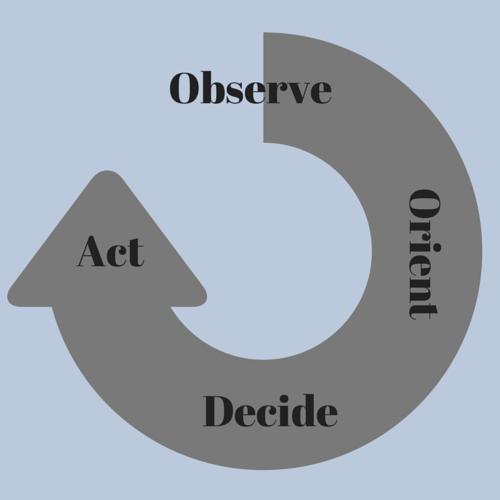
The OODA loop is one of my favourite strategic tools because it highlights the competitive advantage in speed and learning in a Responsive Organisation. I have also found OODA a useful mindset for my blogging and a way to ship posts consistently.

What is the OODA Loop?

Developed by a U.S. Airforce strategist Col. John Boyd the OODA Loop is the concept that strategic advantage goes to the party who can best navigate the decision loop through observing the situation, orienting themselves, deciding what to do next and translating that decision into action. Through transparency, autonomy and experimentation, a responsive organisation moves decisions to the edge of the organisation accelerating its OODA loop to deliver better business value.

How does OODA accelerate my blogging?

Observe: My blogging is built on a foundation of being constantly on the look out for insights. Every day as we work we are exposed to great ideas, wonderful learning and exciting conversations that challenge our thinking. The more I capture the more I learn and the more I have to share. Are you tuned to observe and capture these opportunities to share through a blog? Managing your attention to observe these moments and building a system to capture notes at the moment helps.

Orient: A blog is an expression of your cumulative knowledge and experience. Finding a way to orient a new observation against your current knowledge matters to building a consistent philosophy. You need to know how a new post fits into your blog. Once I have an insight I try to quickly connect it to other ideas on the blog and elsewhere that extend the thinking. Building this system of links helps reassure you of the value of a new post. Ultimately I would like these links to provide an ever evolving network structure to the ideas on my blog.

Decide: Struggled with a white screen? Found your 500 word post is 2000 words long? These are challenges of deciding what you are writing about. Decide to share one small simple idea. Keep it simple. Stop when it is done. If the idea gets complicated break it into a series. If you have oriented well then the decision on the role and scope of a post is a little easier.

Act: Write. Just start. The best way to solve a problem in a post is to write. You can always throw out and start again later. Only by writing and posting do you generate the interactions that create new insights. Embrace permanently beta. Ship the post and let others help you learn more. This focus on action in blogging is the power of working out loud.

Accelerating the OODA cycle on your blog reduces the risk of a writer’s block or a monster post that can be finished. Work out loud one idea at a time and invite others to share and accelerate your learning.

International Working Out Loud week is from 17-24 November 2014. For more on #wolweek check out wolweek.com. International Working Out Loud week is a great time to put OODA into action in your working out loud.

Standing In: The Future of Work

image

What are you doing to cut through the challenges of attention in the future of work?

Attention Discriminates

Yesterday a client found me in a busy activity-based workspace by my colourful socks. There were too many dark suited males sitting at desks but only one was wearing loud socks. A distinctive trademark cut through the challenges of attention.

Our attention discriminates. We deliberately focus to exclude distractions. When humans lived on the African savannah there was already too much information and attention was a way to economise.

When we enter the future of work that issue of attention explodes. Streams of updates, flat networks of relationships to follow and complex rapidly changing environments create a load on our attention. If you want to be recognised for your efforts in this environment you will need to stand out.

Wearing colourful socks won’t cut it. Socks don’t scale. The traditional response of the extroverts among us just adds to the noise. One pair of colourful socks is a discriminator. Many are noise. We see the same with the ‘look at me’ cries on social media.

The future of work might not be about standing out. Perhaps it is about standing in.

Standing in

The way to get noticed in a network is to be a valuable node. Your goal is not to push yourself to isolation at the edges, it is to contribute to value creation at the core. In short, you need to stand in (networks).

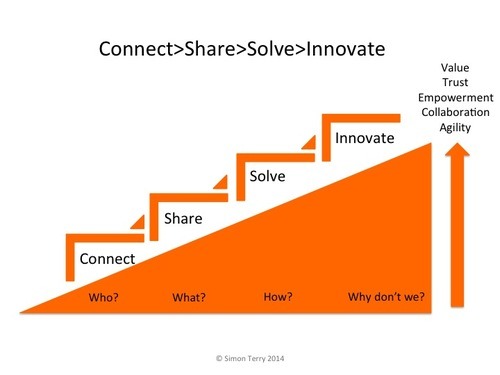
How can we stand in more effectively? The Value Maturity Model offers us a guide:

  • Work for a purpose and gather those around you who share that purpose
  • Make connections between people to improve the efficiency of the network
  • Share relevant information, add new information to your networks and don’t pass on the dross. Working out loud is a great practice that helps others and John Stepper has described how working out loud works for introverts.
  • Help solve problems of others in your network
  • When you see an ability to make a unique difference, take that chance. Innovative opportunities don’t happen often. Take a risk and leverage your network to make something unique happen.

To fight the discrimination of attention in the future of work, focus on standing in (networks).

image

Leaders Can Authorise Debate by Working Out Loud

A key role for leaders is to authorise discussion in organisations. Leaders need to foster frank and authentic discussions by all employees. The best way to signal willingness to discuss the real issues is to start that conversation yourself and to show you will take action on the outcomes.

How do you invite questions?

I was recently asked what was my favourite aspect of a YamJam was. A YamJam is a Q&A session in Yammer usually by a leader or other authority figure. My answer was that my favourite element is that a YamJam authorises employees to question leaders and role models. This starts to create the kind of leadership that employees want: open, authentic and responsive.

Working out loud by leaders has the same positive impact. By openly sharing the work in progress with all its doubts, flaws and uncertainties, leaders invite others to engage them on that work. They make transparent their personal work processes for the benefit of others. The sharing authorises others to engage and respond to the leader’s work. This is a powerful tool to cut through hierarchy and change leadership interactions in an organisation.  Change the interactions and you change the culture.

Authorise the debate

The greatest barriers to human potential are the things we think we cannot do. Too often we look for others to authorise us to act. For many people and organisations, questioning leaders falls into the category of some we can’t do without permission. The role of leaders in realising potential is to release this constraint and authorise the kinds of generative conversations that enable organisations to be responsive.