We don’t do crowds anymore. We are missing an opportunity for collective creation and collective wisdom in the face of adversity.
Live in even a moderately busy city and you become used to the opportunity to lose yourself in a crowd. In the throng of people, we can slip into the flow and become anonymous members of the hustle and bustle. Crowds are an opportunity to participate in a collective experience without necessarily participating in interactions. Many people never consider how lonely you can be in a crowd.
Crowds are lost to us as we isolate in this unique time, but our need for a collective experience and the value of collective action remains. We may not miss their madness and their folly, but we are less for the absence of crowds. Crowds are forces of creation and change. There are things we can do to mitigate this loss, but we need to see that the crowds we recover is as valuable as the one we lost.
We have not just lost the crowd, but we may have lost the wisdom of the crowd too. James Surowiecki described the characteristics of wise crowds in his book The Wisdom of Crowds and it is clear we have challenges:
Diversity of opinion: People don’t necessarily have their own private information or their own views. We can draw on our own knowledge but we are not necessarily out engaging with our surrounding world to bring in a diversity of information or encouraged to share our diverse and unique views.
Independence: Partisanship shapes all conversation and decision making into factions that are not independent in their views and actions. The power of thought leaders shapes tiers of influence and imitation. Loyalty and popularity overwhelm independence.
Decentralisation: We are decentralised physically, but not necessarily culturally. Power tends to run in hierarchies and we engage in anticipatory obedience even in crises. Repeating the same authorised messages shapes the influence of a few sources of opionins.
Aggregation: We may have different views, but we don’t have easy mechanisms to aggregate those views. Markets handle the shocks of crises poorly as our animal spirits are easily spooked into herd behaviour. Polls depend on the questions asked. The media in its scrabble to survive, relies on shock and emotions, tending to emphasize extreme and unique views over an aggregate of the crowd.
Trust: The crises of this year and the failings of leadership seem to be reinforcing the societal crisis of trust.
Collective challenges demand collective action. We can’t expect to solve the challenges of our times in digital cubicles. We can only restore the value of our crowds if we each consider how to take action to improve the discussion. As tempting as it is to focus on loyalty, alignment and power in a crisis, the collective debates of a self-managing crowd are more likely to offer value. They also offer the opportunity to improve the dialogue and address Surowiecki’s criteria for wisdom in the process.
Wise crowds are unruly. They are messy. Their views aren’t individually celebrated. They succeed as an aggregate. Nobody gets to claim victory. Nobody gets left out because they are inconvenient or invalid.
Like any process of inclusion, we cannot expect those excluded or ignored to do all the work of fixing our tainted dialogue. Change agents can come from either the excluded or the privileged. The change is not about fixing the excluded voices. The change we seek is about fixing the system to be able to realise the collective potential of all. We all have a stake in that outcome.
Until then we have just our memories of the hubbub of the crowd to console us as we work to bring them back.
It's not #digitaltransformation if you told everyone to go work from home for safety. It's not even strategy. It's a reaction. No surprise that the technology works. It's worked for years. Others already use it to do differently & different things. That's transformation
Right now around the world people are working from home in new digital cubicles. We may not be in the office, but we are in new boxes of isolation in our homes. The social separation is greater than in the office cubicle, because the distance between employees is measured in kilometres. The usual information methods of information sharing have been lost. Context, coaching and coordination are missing. The external pressures, of family, of financial stress and of survival, are greater. Back-to-back video conferencing meetings have taken over from back-to-back physical meetings. The myriad of interruptions, the searching to find information and the process glitches mean that any productivity gains from remote work and meeting efficiency are lost.
Digital transformation is the opportunity to do differently, not just digitally. Smashing the same process, organisational models and decision making through videoconferencing and collaboration platforms is not anything new. We need to start solving the problems of our people, our customers and our communities in new ways to create sustainable value from our current uncertainty and stress.
The opportunity to work digitally has existed for a long while. As we discover it in this forced change we need to consider not just how we work digitally, but how we work better. For me that challenge comes down to three key issues:
how to we become more responsive to our environments and learn faster?
how do we change our methods of working so as to benefit from digital work?
how to we use our potential to collaborate better to create new value for our people, our customers and our organisations?
We have been forced to react. We have done the tactical things to keep working. The strategic opportunity in front of us now is to do differently to create new value, new competitiveness and support our people to realise their potential in this a new normal.
How do we end the digital cubicles?
Here’s a series of starting points for pulling down the walls of the digital cubicles and rethinking the way we work,
Enable Greater Learning and Responsiveness
There’s a lot of change going on and a lot more needed. To be able to manage this in a distributed way, we need to increase learning, responsiveness and adaptation. This means our management mindsets, accountabilities, processes and our decision making need to change first. You can’t micromanage distributed learning and adaptation:
Start Changing Our Practices and Processes
Aligned to this we need to rethink our personal work practices and our organisational structures, processes and systems to work at scale in a distributed organisation. We will need to reflect on the foundations of our work and how best to use new ways of work to realise strategy and achieve our shared purpose.
Increase Collaboration for Strategic Value
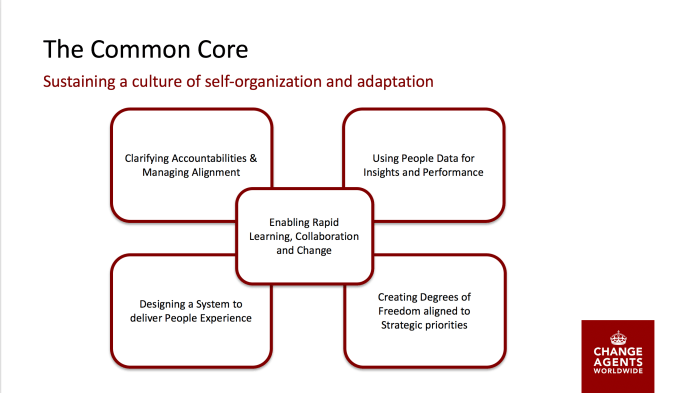
Knowledge work is networked work. The more digital we are the more knowledge work we will have in our organisations. We need to think about how our people collaborate to create value, especially remotely and using their new digital tools. We need to find, foster and develop the distributed leadership that will scale agency and change in our organisations and support a culture of continuous innovation:
None of this digital transformation has anything to do with how many video images your videoconferencing platform shows on screen in meetings. What matter is how organisations and individuals work, learn and adapt. The real value is not to work on digital tools. The value creation occurs when we work, learn and adapt in new ways.
We are sense-making our way through a global crisis unlike any in recent memory. We need to lay down markers to guide us in the fog of uncertainty. Without public markers, we will not sense our progress and could end up looping back again.
If only we had this view of the way
Word of the Day: "cairn" — stone-stack that stands as path-marker, guide-giver; there to show a way ahead when the weather is bad, the going hard, the route uncertain (from Gaelic, càrn). pic.twitter.com/cKMjwOgJ3v
We are in an unusual and uncertain experience for our times. We are challenged to make sense of new restrictions on our lives for our safety and the safety of others. We don’t know what effect we are having for good or for bad. We struggle to make what we can of our life work in this new and difficult world.
Like the man spreading, elephant powder in the old joke, we measure our success by an absence. Even then we face the uncertainty that what appears an abscence may be too much, may be not enough or may be the darker longer threat of asymptomatic spread. We struggle to understand the exponential and to appreciate how a little can quickly become overwhelming.
In the fog, it is easy to get lost, to get confused, or to follow false leads. A lot of the usual markers for our decision making aren’t their usual sure and certain guides to balancing the complex trade-offs we face as societies, as organisations and as individuals: prosperity, rights, entitlements, privilege, equity, normal practice, custom, habit, power, security, health or life. Now is a time to step back from shorthand and ask ourselves what values should guide our way and make decisions consistent with their application at this time.
We don’t get to live life in a double blind trial, so we will never know the differing outcomes of other paths. What we can know is our path. We walk one foggy and uncertain way. We can lay down markers of the way we have taken and set guides for our future course. If nothing else markers, create a path for action where otherwise there is only confusion. Bending the curve, herd immunity, supression and elmination have acted as markers in a frenetic public debate.
We can define what getting there looks like and refine that in continuous conversation as we learn, as we experience and as we adapt. Knowing and agreeing our collective course will help us to know when we change and to make that choice clear to others and to ourselves. Markers will help us refind the way if our choices to change don’t work. Markers will help others to learn and adapt from our experience.
If our path was obvious, then there would be no challenge. Now is a time for the robust discussions of civil society, not pat answers. You don’t build a cairn alone. It is a collective task with stones added and maintained by others over time. If nothing else, laying down some cairns in the fog will tell us where we went should we come this way again.
A reliable way to make people believe in falsehoods is frequent repetition, because familiarity is not easily distinguished from truth. Authoritarian institutions and marketers have always known this fact
Danile Kahneman, Thinking Fast and Slow
Intelligence is not only the ability to reason; it is also the ability to find relevant material in memory and to deploy attention when needed
Danile Kahneman, Thinking Fast and Slow
This post is the second part of two posts on a challenge posed by Steve Nguyen on Linkedin. The first post covered the implications of our preferences for push messages over employees pulling the information that they need as and when required. This post will look at fast vs slow styles of communication and its implications for our work.
The Different Ways we Talk
We have different styles of conversatiosn to suit fast vs slow thinking:
Chats: support shared information and can be incredibly rapid. Much of the highest velocity conversations in the Swoop Analytic Microsoft Teams benchmarking report would have been simple exchanges of factual information and status with little need for reflection or understanding
Conversations: support shared understanding. We need to slow down to ensure we understand each other’s thinking. We need to step outside of assumptions and shorthand and explore topics more deeply. Much of leadership and coaching occurs in the conversation.
Collaboration: supports shared work. We can work fast individually sharing status and information through chats. However, when we want to draw deeply on others talents and experience, it is a slower process of exchange and work. We know this work.
Fast vs Slow Conversation
These different modes of conversation support and are supported by different modes of thinking. Daniel Kahneman’s Thinking Fast and Slow explores two key modes of human thinking from his behavioural economics research and they map well to this discussion.
Fast thinking is tuned for the quick response. It leverages patterns, automatic processes and emotions to be able to make rapid judgements. Chat is ideally placed to suit the needs of fast thinking and fast thinking supports the rapid fire cognitive demands of a fast flowing stream of information.
However, fast thinking and fast chat have their limitations. They are prone to bias due to the heavy reliance on heuristics, patterns of thinking with which we can associate new information received without time for processing. We aren’t looking to create new patterns here so we will gather information to confirm our biases, reinforce our stereotypes and reinforce our existing narratives. The error rate of these mental models is likely low if we are working on common problems synchronously with our usual team, but these become real issues when we are doing something new at pace aynchronously with a new team.
I had a simple example over Easter. I was advising a friend making hot cross buns via chat. I had flicked a simple recipe to them and simply told them to follow. The friend was busy doing many things while they made the dough. I was not following along as I had gone about my day confident that the recipe was no fail. They came back to say there was a problem with the recipe. The bun dough looked like a wet batter rather than a dough. I asked if they had followed the recipe and they answered yes. After many back and forths trying to diagnose the issue, we realised that they had added 250ml of flour rather than 250g. Executing a new task in a low information fast-paced environment, my friend had assumed that the flour measures in the recipe were the same as the milk and warm water. It was written as grams on the page but their brain had formed a pattern and ignored information that didn’t fit the pattern.
Wet hot cross bun dough is easily fixed, but in our work environment errors like this from rapid communication of new tasks in low context can have major implications. We are currently grappling with a new environment where context is reduced, work is more asynchronous and our natural high bandwidth of communication is strained. We are more dependent than ever on tools like Microsoft Teams and Yammer to support our work. In this environment, we don’t want to be thinking and communicating faster than the judgement that says, ‘that doesn’t look right’. For example, there is already evidence that hackers are trying to use techniques to gain access that leverage the current environment.
Kahneman’s slow thinking is that process of considered reflection using effort and our rational logical thought processes. Our conversation to diagnose the issue with the dough needed to move slowly and methodically with effort through the potential causes and effects. We needed to confirm and check our understanding, unravelling the confusion and assumptions as we went. Much of our leadership and coaching is this work of building shared understanding and moving towards new ways of working through innovation. It can’t be done at the pace of chat. Just as we have Inner and Outer Loops of work we need to think through the slow and fast cycles of communication around our work and use tools suited to the different speeds of thinking.
Align the Speed to the Problem You are Solving
Leaders need to pick the communication style and thinking style that supports the goal that they are trying to achieve in each interaction and each team. The work to make people aware differs, from the work to align goals and from the work to motivate action and manage performance. I have previously explored how the different leadership challenges of Awareness, Alignment and Action map to different styles of conversation and the value maturity model.
The role of leaders is to leverage these tools and to manage the balance of push/pull, synchronous/asynchronous, fast and slow conversations to suit the delivery of the strategy of the organisation. There is no one size fits all, but alert leaders will manage these challenges adaptively and empower their teams to get the best from the platforms in each circumstance.
Don’t grieve. Anything you lose comes around in another form
Rumi
Slow down and remember this: Most things make no difference
Tim Ferris
We are obsessed about push messages and overvalue the interruption. We undervalue the ability to pull messages and worry too much about what is lost in communication. We love fast chatter as activity. We undervalue the slow discussions and even slower discovery that create meaning.
Don’t Kill the Golden Goose: You can love Microsoft Teams to death. The high end numbers of Microsoft Teams use in the report are actually more than a little frightening. Instant messaging and flying threads is not always the best way to think and to work. You can have too much engagement for reflection and work.
Steve Nguyen, Principal Program Manager for Yammer at Microsoft, asked one of his great questions on Linkedin – ‘Sort of related to the “Don’t kill the golden goose” section, would love your thoughts on fast vs. slow conversations sometime’. I will respond to Steve’s request with a two part post that explores the implications and issues with fast and slow conversations across both Microsoft Teams and Yammer:
Part I (this post): Will look at push vs pull communication in the light of Daniel Kahneman’s ideas on loss aversion
Part II (the next post): Will examine the impact of our speed of conversation on our interactions and our thinking.
Push v Pull – Power vs Productivity?
We moan about the volume of emails. We tire of waiting to push the skip ad button. We complain about marketing messages and calls interrupting our lives. We laugh at carefully and expensively prepared corporate videos that don’t reflect reality. A fast moving chat message stream has a real psychological and productivity load as we struggle to multi-task and change context. However, when it comes to employee communication and work communication we overvalue the push message to everyone.
Our willingness to push past relevance in pursuit of 100% communication is strange (and this applies equally to its related goal of 100% adoption) . We don’t need everyone to know and we don’t need to collaborate with everyone. As noted above, these messages are even a drain on productivity and engagement as they take us away from managing our own information and our own work.
Pulling the information we need when required is far more productive. Employees skilled in personal knowledge management and working out loud can productively rely on a network like Yammer to support and sustain there work with relevant information when and where they need. Creating this productive work network that enables employees to leverage an organisations talents to support their work and learning is the goal of the Collaboration Maturity Model approach, with its focus on connection, sharing, shared problem solving and innovation.
In the past, I have been focused on explaining away the bias to push communications as a feature of power dynamics in organisations. Leaders want to know that they have been heard. Employees want to ensure that they have evidence of sharing information with everyone for safety’s sake. Knowledge is power and this obsession with sharing knowledge universally, even at a real cost to productivity, is partly related to power dynamics.
Many high velocity push message enviroments have this dynamic where a leader with power is micro-managing by chat and the employees are demonstrating their compliance with an equally high volume of messages on status to facilitate the micro-management. This pattern was seen in the Swoop Teams research as one of its Teams structures. Even in flatter organisation structures, uncertainty and competition for power can lead to an unnecessary velocity of messages as members of the network compete to update, one-up and claim status.
Loss of Information?
Reflecting on Steve’s question opened up another factor in play. Daniel Kahneman who wrote Thinking Fast and Slow, won a Nobel Prize in Economics for his work on prospect theory, a challenge to the rational utilitarian view of human behaviour in economics. Utilitarian logic would question why . Part of prospect theory was demonstrating people’s aversion to losses. We don’t value gains and losses with equal equanimity as traditional utilitarian theory demands. Kahneman and his research collaborators showed that we value losses much more highly and are much more averse to losses than rational theory expects.
Even though we know most push communication is ineffective we still use it (Email open rates will tell us that). Why? Perhaps we are overly worried about the losses if we don’t try to communicate with everyone all the time. We worry that some disaster will befall us in the last 20% of employees to adopt or in the 10% of employees who don’t know. Many compliance regimes focus on 100% messaging for this exact reason even though we know that being communicated at is no guarantee of being understood. The number of people who know something in an organisation is always large than those who have been told it because communication happens most effectively through conversation – the development of shared understanding – questioning, debate and discussion.
We worry excessively about this potential loss and we respond with ineffective & increasingly uneconomic strategies to manage it. We worry about this loss exactly because it is undefined and uncertain. We assume that 100% push communication will elminate it but that is just an assumption and not supported by our own experience of understanding and push communication. A major barrier to the adoption of pull strategies is people’s fear of losing the outcomes of their ineffective push communication. They don’t know how well it works, they wish it worked better, but surely it is better than letting employees discover what they need to know.
Beyond Loss Thinking
The flip side of Kahneman’s theory is that we also undervalue our gains, as we overvalue our losses. Much of management has our focus squarely in the realm of linear thinking. We assume that the move up delivers a linear improvement in communication and collaboration.
However communication and collaboration in a network is en environment of exponential returns. We don’t need 100% of anything to happen because a small well connected group of individuals can deliver massive step changes in performance. They can break out of our persistent focus on 5-10% better and truly transform their work and the value to the organisation. More importantly, they can continue to collaborate and improve their work ongoing without the push of leadership or direction. Instead of worrying about everyone, we should put our resources into supporting the small teams that deliver exponential changes.
As we adjust to new ways of working, perhaps it is time for leaders and their communication professionals to consider how much we should invest in supporting this kind of pull communication in our organisations. This is where the role of the Inner and Outer circle working together matters most. The Swoop Analytic report highlights that those organisations using both Microsoft Teams and Yammer had the highest levels of communication and collaboration across both platforms. There is a role for the pull communications of conversation and collaboration to support the pace and execution of chat. More effective use of tools like Yammer can even reduce the need to pound Microsoft Teams chats with information, just so everyone knows.
With his eloquent brevity, Ernest Hemingway gave us the phrase “grace under pressure”. Now is a time of pressures. Lives, livelihoods, relationships, health and more are under strain. Grappling with this mess, unshaven in our leisure wear, it can feel hard to connect our current experience to the concept of grace.
The ancient greek concept of the Three Graces have had shifting origin stories, purposes and composition over history to suit the adorning virtues of each era but they revolve around our common meanings of grace, such as beauty, elegance, courtesy and joie de vivre. In Christian theology, grace is a bestowal of undeserved blessings and the three graces are faith, hope and charity, supporting an optimistic and outward engagement with others. Each of these sentiments are much needed as relief in this time.
We don’t need elegance in our current crisis. Like the ancient Greeks, we should treat the graces as a flexible to the needs of our time and our narrative now. We need to be able to respond to the pressures with grace, but we each get to choose our own three. There is a long list of much needed virtues in this time. To be able to practice our choices from these, under everyday pressures, is to shift our virtues and our values from hobbies to habits.
Here is my list of three graces for our time of pressure:
Compassion: There is real suffering now. We can look beyond ourselves and our losses to acknowledge the sufferings of others and work to alleviate them. Compassion will strengthen our hearts and our communities.
Joy: We lack many of our every day joys. We can find happiness and uplift in the smallest of our gifts. Joy will strengthen our lives & relationships.
Generosity: Today is not a time for how much we take or make. Today is a time for how much we can give to others to help them through. Generosity will strengthen our (common)wealth and societies.
The final word on grace is to remember that grace can be an undeserved blessing. You may not feel worthy of blessing today or any particular day in the future. Worthiness is not the test for grace. Practice self-care and self-compassion. Give yourself the good grace of your company. Forgive yourself and look for the little moments of beauty in each day.
I woke early this morning around 5am. I couldn’t fall asleep again. Sadly I missed the much vaunted early productivity because I was distracted by life these days.
That’s my mistake. Unfortunately I left my #hustle lying between the existential doubt, the mounting work and the devastating news. Spent the last few hours finding it so I could start. Will have to try a clean mind policy instead now. 🤷🏻♂️
Most organisations have a clean desk policy. For productivity and for security of information, desks should be cleared regularly. As someone who likes to work in the inspiration of piles, books and mess, clean desk policies haven’t always been comfortable. However, I recognise the value of a mindful approach.
Now that we are forced to work from home, we need to take the same care with our mindfulness. A clean mind policy can contribute to our health, happiness and productivity. We can’t empty our minds (not least in these circumstances), but we can acknowledge thoughts and put them in their place.
My tweet above was tongue-in-cheek, but there is value in a clean mind policy:
End days by spending 5 to 10 minutes planning to clear the anxiety and set up the start of the next day
Start days with some priority-setting to know what must come first and sift the important from the urgent
Take breaks to reset your energy and be ready to work again.
If other challenges need your time, stop work.
Don’t multi-task (if you can avoid it). Disruptions ruin productivity. It’s better to stop completely than shift back and forth.
Breathe. Meditate if you can. If you don’t meditate to improve mindfulness, at least take some deep breaths to reset your focus.
Postpone worry. Focus on what you can do now. There will be time for consequences later. It’s never too late to worry. Worry is never about now. Don’t mix crisis and work if you can.
Celebrate the end of tasks. Give your mind the reward of progress.
Laugh. The responses to the tweet thread above completely reset my mood and enabled me to enter the day more productively.
Lastly, and most importantly, forgive yourself some anxieties, some lack of focus and some challenges in these times. The power of a clean mind is seeing life as it is, not as it should be. We can only work with what we have. Anything else is just a messy thought looking for a bin.
Normally our lives progress according to all kinds of barely considered programming. Days have their routines, our work has its habits and our evenings and weekends are filled with patterns that we follow. This current crisis has interrupted our programming.
Instead of the steady stream of multi-channel entertainment that is usually scheduled for us, we are looking a test pattern. We have been challenged to make up an entirely new program for our lives. We need to do this under tight constraints: We need to wash our hands; We need to stay home; we need to maintain physical separation when we do venture out for only essential activities like shopping and exercise. In many cases, we need to do it urgently and without preparation.
Recreating Programming
Our first instinct is to recreate the programs that provide the comfort of the commonplace.
We start working in videoconference meetings that reflect the meetings of our work days and now stretch well beyond consuming meals, commutes and evenings as well. We create dinner parties and drinks in videoconferencing tools to experience the conviviality of our usual weeks. We exercise to online videos. We make our own espresso and our own bread to fill in for our deprivation. Teachers struggle to teach children online in schedules, class formats and worksheets designed for face to face.
We turn to instant messaging, chat and social media for social chatter and conversation. We order online the food and drink that we once ate out. People have been amazingly creative in recreating lost holidays and other experiences in the seclusion of their homes.
Recreating routine will only take us so far. We are denying the interruption. Denying that harsh reality leads to burnout, disappointment and frustration. Denial is one part of the stages of grief. Acceptance comes later.
A Chance to Choose Anew
Usual programming has been interrupted. It may well be off the air for some time. We can’t just go on as unusual. We need to choose our new routines.
Some have found solace in new or old pursuits revisited. I know I have rediscovered and re-engaged with poetry. It is an old passion of mine and it has been a great consolation to seek meaning for these strange days in poetry. Others have found new pleasure exercise routines, or baking, or craft or the simple art of reading deeply.
The television set hung in it’s wire-net cage protected from the flung bottle of casual rage, is fetish and icon providing all that we want of magic and redemption, routine and sentiment.
We also have the chance to choose anew how we live our lives and do our work. We can change the programming and find new routines. We get to ask “what can I do now?’ and our routines don’t need to provide the answer. We can be guided by what seems brightest in the dark moments. These new priorities will help us set the new routines and new priorities.
A simple step is to begin with Steven Covey’s Urgent and Important grid. We spend a lot of our routine time in the Urgent but Unimportant or worse the Non-urgent and Unimportant quadrants. Now is the time to plan. Now is the time to spend more of our time in the Important quadrants.
We also need to give ourselves the time to devote to things that are important but are rarely considered in the rush of our routines:
– Self-care: ‘Put on your own oxygen mask first’ is important advice in any crisis. We don’t have to transform. We just need to survive and forgive ourselves our foibles.
– Care for others: This is not a time for the selfish. We need time for those for whom we care most.
– Support for our communities: We will come through this together, not alone. Even our isolation is an act of community care.
Even our brief interruptions to date have revealed that there is value, productivity and personal rewards in working, interacting and living in new ways. Remote work has enabled some to explore greater productivity and flexibility from new, different and more agile ways of working. For some there is a new balance in households of work shared in families and for others a deeper connection with their families while working. The office has lost some of its magic of routine. The wider losses are many, but there are consolations that are guide to new ways of working and living when the isolation ends.
Some days I wonder how our open plan offices are going. Are they still creating employee engagement, collaboration and innovation without us? #futureofwork
Some of our current priorities and changes are still unclear to us. They might be only a yearning , a discomfort or a hint now. These changes to our programming will become clearer for us later as we have more time and less distractions. We can experiment, but we can also choose to defer these until we learn more. What we are not required to do is maintain the program as it was.
The programming has been disrupted. Pouring our efforts into recreating that programming misses the opportunity to find new value in what comes next. Now is the time to invest in a different future. This time is a time to choose new patterns of life and of work to start now or later.
We see the light because of the darkness. It is only in shadow, that we can find a path to the light. When we get there, let’s remember what led us forward.
A couple of weeks of global pandemic has made ordinary every day actions seem like unattainable joys – wantonly touching our face, engaging with the world, sitting in cafes, travel, visiting others and hugging family, friends and even strangers. We did these things routinely without thought, without concern and without enjoying them because in the light of endless sun everything was bleached and unremarkable. Now we sit in shadows we can see these joys clearly again.
The same holds true of our work. The human, the social and the collaborative we crave as we work away in the shadows within our homes. We did not appreciate these things in the bright sunshine. We were too busy on the dull mechanical parts of work, the process, and the dreary annoyances. Most of these continue to annoy us, but we now see that they can be removed, adjusted or even ignored.
I have spent the second part of my life
breaking the stones, drilling the walls, smashing the doors,
removing the obstacles I placed between the light and myself
in the first part of my life
Octavio Paz, from ‘Eagle or Sun?‘
Teams are working with new freedoms, autonomy and new levels of support in our new distributed life. Meetings go faster and there is less wasted time in our conversations and days. We aren’t mucking around when lives are on the line. From our shadows, we crave the light.
The bright sun will come again. This dark isolation is already bringing it forth slowly like an inevitable dawn. The shadows will be darker, sharper and longer before they are gone.
Like chiaroscuro, we can use the shadows to illuminate us, to help us better see the form and perspective of our lives and work. In the darkest hours, what remains bright should guide us forward.
The challenge is to remember the brightness we craved in the dark when the light returns. Sooner than we think our lives will be awash in sunlight and the pressures and challenges of distinction will return. The work we need to do is to ensure that we spend more time on these bright spots and allow the shadows and mundane distractions to whither from lack of attention and effort.