The Outrage Economy

In the 1990s, in the media industry there was a great deal of discussion on how the rise of the internet had given rise to an attention economy. Traditional media were going to need to focus on engagement and quality of content to win attention in a newly competitive landscape. What we forgot in our naivete is that outrage and conflict is an ancient human path to attention too.

What has transpired instead is an Outrage Economy, where the leverage of outrage plays in two directions regardless of your politics, beliefs or viewpoints. Outrage is everywhere, but it plays constructive or destructive roles depending on whether it is used to seek change in the world or simply to seek more attention as an end in itself.

Outrage

But if it had to perish twice,
I think I know enough of hate
To know that for destruction ice
Is also great
And would suffice.

Robert Frost, Fire and Ice

Outrage is everywhere. On every side of every issue, we have outrage. The internet has enabled communities of outrage to form and to grow around every position and every issue. It can feel like our polarisation is greater than ever. We talk far more about our divisions than our commonalities.

Outrage is a moral human emotion. In the ancient world, outrage and the social stigmas, taboos and morals on which it rests were dividers of cultures. We signified in and out of our groups with outrage at the practices and cultures of others. We vilified and excluded others, at times at the cost of their lives. Violence in this context was seen as the defence of a group culture, ethic, identity and morality.

When outraged we face a choice, to focus on its moral implications for our own actions or to focus on our rage against others. These two paths lead in different directions.

The Two Paths of Outrage

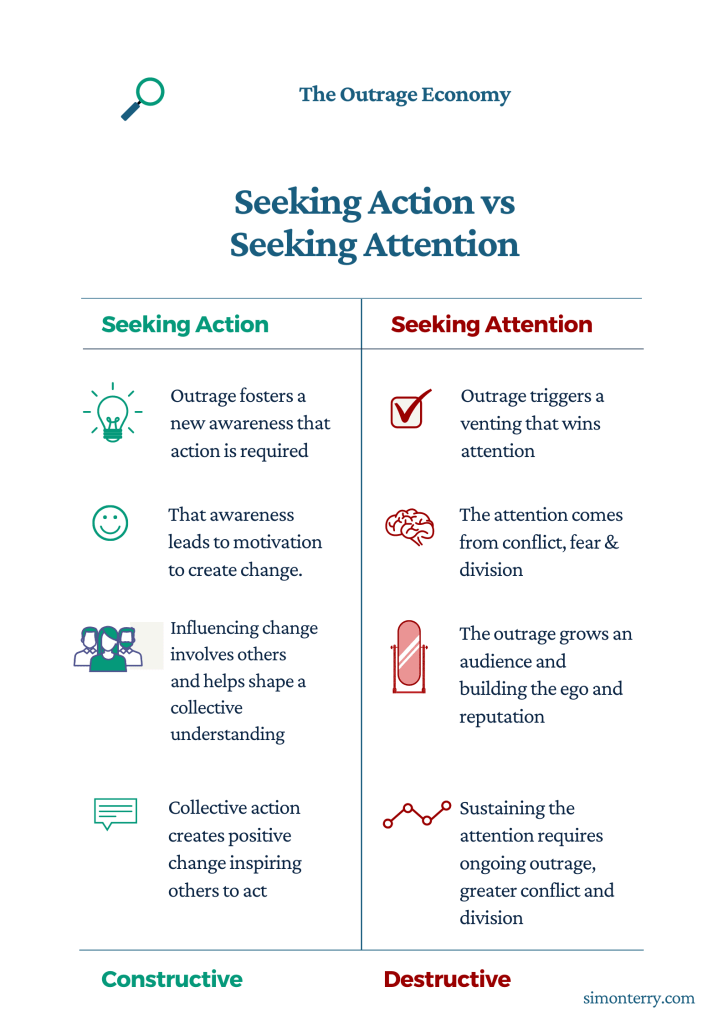
Not all outrage is equal. When we seek to understand the impact of outrage in our society and our economy, we need to realise that outrage comes in two forms:

  • Outrage seeking Action: a constructive cycle of leveraging outrage externally to seek collective change
  • Outrage seekinG Attention: a destructive cycle of leveraging outrage to seek an audience
Seeking Attention in the Outrage Economy

Much of the discussion of outrage in our media is part of the Outrage seeking Attention path. Whether from trolls, protesters, media, corporate or major political figures, outrage can be leveraged to win and retain attention and to build audiences. Like Mercutio’s dying words in Shakespeare’s Romeo and Juliet, attention seeking outrage is the ‘ plague o’ both our houses’. The path of Outrage seeking Attention works equally for any side of politics, any ideology, any cause and any belief system. Outrage seeking Attention is an equal morality employer.

This path is ultimately a destructive spiral as these outraged audience requires ever greater outrage to remain engaged and there is always the danger of losing ones audience to a practitioner of greater outrage. Tabloid media, demagogues and totalitarians have been masters of the cascade of outrage seeking attention, particularly in the form of outrage at all forms of the Other. In a world where many depend on the monetisation of eyeballs, outrage seeking attention is a well worn path.

The Seeking Attention Path is ultimately an inward one. Whether in the promoter or the audience the focus is on ego and a sense of inner superiority. We are outraged at Them. We are better and share our differences to Them. Attention demands no check with an external reality and there is little need for consequences. We don’t ever need to engage Them in real life and if we do our outrage prevents effective engagement.

Attention itself is validation of the outrage and our quest. The outrage exists within a bubble of believers. The outrage can and will endure. Outrage must remain to bind the group and even grow to sustain attention and its salve for the ego. Outrage without seeking collective action in a diverse community is never tested and can never be satisfied.

Seeking Collective Action in Community

The Outrage seeking Action Path may seem similar. However, the focus of this path is to create change in the world. Creating that change will require practitioners to go beyond the bubble, outward into the world.

Individual action can be performative and part of attention seeking. However achieving sustainable and scaled change requires actions that engage a wide community of stakeholders. Achieving enduring change requires collective action and engagement from those stakeholders to help advance the plan.

Shouting a plan in outrage is very different to putting a plan into action. All kinds of forces, including the outrage and resistance of others must be navigated in getting others to change. As frustrating as those community interactions may be, as impure the resulting changes and compromises may seem, they move the discussion from a moral feeling to a practical reality in a diverse community. Practical change seeks to engage others to reflect on their reaction to circumstances and then to act. The original motivating outrage may well remain a motivation for some but be a barrier to successful action in a wider community.

Action means we have to engage with the diverse views and capabilities of the world. Fostering this engagement and collective action to improve our world builds civil society. If we alienate and exclude others, we risk our collective action failing to deliver a sustainable change. If we engage others in our outrage, we do so to prompt them to act and to change and they too must carry that into the world. Transforming outrage into collective action may adapt our plans and the actions to addressing a moral concern but community engagement, not alienation, is the constructive path forward.

Defenceless under the night
Our world in stupor lies;
Yet, dotted everywhere,
Ironic points of light
Flash out wherever the Just
Exchange their messages:
May I, composed like them
Of Eros and of dust,
Beleaguered by the same
Negation and despair,
Show an affirming flame.


WH Auden, September 1, 1939

Relationships

How good was hanging around over coffee?

Let’s not forget the value of human relationships and all that they bring. As strong as the pull of the transactional, addressing the real opportunities in our lives, work and society will depend on relationships founded in generosity, trust and empathy.

Teams of One

It can be easy to see the world in transactional terms. We are isolated in our algorithmic bubbles, purchasing online, running from online meeting to online meeting and powering through daily to do lists. Isolation has stripped the casual conversation, the social interaction and the human relationships from our days. We even debate the value of and need for the wave at the end of an online meeting – part symbolic closure but also an important relationship gesture of recognition and acknowledgement.

One of the challenges of chat platforms like Slack and Microsoft Teams is that, when poorly used, they can reinforce transactional relationships in smaller and smaller silos all the way down to an atomised organisation of one. At the other end of the spectrum a life of all Zoom or Teams calls can be lacking in context and overly formulaic as people need to get through agendas. Without investment in rapport, team understanding and rich human interaction they can be highly transactional. If people aren’t supporting a balanced relationship with chat with open discussions and agendaless video discussion, a lot of opportunity to build teams, to share concerns, to resolve issues and to create is lost.

Better Change Needs Better Relationships

An overlooked part of my Value Maturity Model of Collaboration is that effective collaboration is underpinned by growing human relationships, trust and understanding over time. You don’t create an agile, innovative and responsive organisation without changing relationships and particularly relationships of trust. Here’s a test: Can you move resources or functions and their associated accountabilities around your organisation without a fight? In high enough trust environments, people know the job will get done equally well by others. They don’t need to do everything themselves.

Why does this trust matter? You can’t create scalable change or innovation with everything staying the same as it is now. All that negotiation of resource reallocation and accountability change is a massive tax on your organisation’s ability to change and to innovate. Many people will decide it is not worth the effort if they know there is a fight, that power will decide or if they don’t trust others. Just as a lack of psychological safety stops ideas being shared and problems being discussed, lack of trust stops the change and adaptation required.

We need scalable change and innovation more than ever. Whether it is tackling the major issues of our times, delivering better for customers or adapting to changing markets or work, scalable change and innovation is essential. If we lose the relationships that underpin this change we have created new and hidden risks across our organisations and for our people. Importantly our focus on relationships will strengthen our efforts on the generosity, love and respect that will enable us to leverage people’s potential.

In our personal lives, social lives and communities, we need to keep our focus on relationships. We need to invest against the transactional forces in our lives at this time. The change we want depends more than ever on the quality of our relationships.

Unconditional

The sun shines without conditions

Turning and turning in the widening gyre   
The falcon cannot hear the falconer;
Things fall apart; the centre cannot hold;
Mere anarchy is loosed upon the world,
The blood-dimmed tide is loosed, and everywhere   
The ceremony of innocence is drowned;
The best lack all conviction, while the worst   
Are full of passionate intensity.

William Butler Yeats, from The Second Coming

We live ‘if then’ lives in our market economy. There is power in the unconditional. In a time of crisis when conditions can no longer hold, we need to let a few conditions go. It is a time to get back to our human values.

We didn’t plan for 2020 to go this way. Our grand 2020 strategies didn’t allow for this year. 2020 has broken so many of our preconditions. For many ‘the centre cannot hold’. This isn’t the deal we signed up for.

It has been commonplace for us to view unconditional action as unwise. The smart game, as the common discussion goes, involves a ‘quid pro quo’, conditions being met or some other a transactional exchange. Generosity is suspect. Self-interest rules.

Not all of life is a market exchange. Crises have a way of disrupting markets. Community, relationships and love matter. The best of these are unconditional. The best of these are even unlikely and irrational. Instead of market transactions, they are human relationships between people who engage unconditionally.

One of the reasons art has appealed strongly to me during this crisis is it is often unconditional. A poem is. Artworks are. They don’t demand conditions be met first to add value. Art may be part of our marketplace but transcends it.

For many, conditions and quid pro quos are not part of the equation. Emergency workers and frontline workers are continuing to do their roles often without necessary safety equipment or even a full understanding of the risks. Protesters are pushing for important social and climate change and for a more just society at risk to their own lives and livelihoods. Parents are grappling with work and education and life all on top of each other when the usual supports are removed. Many are worrying about the care of older parents and relatives or dealing without critical networks of support and care. Neighbours are looking out for each other and their communities. Few of these people get to impose conditions. Few wait until the circumstances are perfect to make their contributions. They do the needful.

If you don’t stick to your values when they are tested, they are hobbies, not values

Jon Stewart

To paraphrase Jon Stewart, conditional values are hobbies, not values. Organisations that fail the test to look after their people, their customers and their community in this time don’t get to rely on a crisis exception. Values are as unconditional like the relationships that they found. Let people down now and they are let down for ever.

Now more than ever, we need to look for those who we can build relationships on that are not based in transactional values and fragile conditions. Many of the things we need to do deliver cost in the short term for longer gain. It is a time for empathy, respect and love. A time for us to be generous in our regard for others and their potential. The path forward from this mess is founded in collaboration, community and a new respect for human, not conditional, relationships.

We don’t fall in love: it rises through us
the way that certain music does –
whether a symphony or ballad –
and it is sepia-coloured,
like spilt tea that inches up
the tiny tube-like gaps inside
a cube of sugar lying by a cup.

Julia Copus, from In Defence of Adultery

Stretch

If you don’t stretch, how do you know where the edge is?

My world is pretty small at the moment. I’m inside my house 95% of the time. I can walk to a supermarket so I don’t even drive for shopping. Travel and movement is one thing that used to bring stretch, challenges and new perspectives into my life. Work will continue to do that but in its own limited domain. The smaller my physical & work worlds the more I must bring the stretch.

Travel stretches us because it takes us into the beginner’s mind. It takes us to places where we don’t know the way, the rules or the language. We become alert and stretch ourselves to try new things, to experiment and to adapt. We grow because we stretch. We gain new experiences, new capabilities and new confidence because we stretch.

We don’t inherently know the limits of our capabilities. Many of us underestimate what we can achieve. A few overestimate. Either way, it is through a process of reaching out for the edge that we discover what is possible and what next we need to learn. When our stretching fingers hang out into open air we have a new boundary and a new place to hang on.

Physical stretches help our muscles to recover and to lengthen improving our movement and our agility. Mental stretch can play the same role. If you have recently tackled a difficult new idea or new practice, you will remember how exhausting it can be as your brain or your body grapples with skills that are unfamiliar and starts to build new strengths.

If we constrain ourselves, we know what we get. If we stretch, we can surprise ourselves and others with what is possible.

Fatigue

Looks fine until it is not

In 1954, a series of BOAC DeHavilland Comet aircraft crashes were attributed by a public inquiry to metal fatigue. The stresses of repeated pressures and landings in the aircraft caused a failure in a window in the plane. The planes broke up in flight when experiencing additional stress such as sudden air turbulence. The discovery of this metal fatigue in planes led to a general improvement in aircraft safety and new testing and maintenance routines to catch fatigue before it became disastrous.

Fatigue is more than tiredness. We all get tired when the effort or the duration is large. Fatigue is an extreme response as a consequence of extended stress. Just as metals fatigue and fail, so can individuals and organisations. Running an always on digital and global organisation in a global pandemic is a test of any individual and any organisations ability to avoid fatigue.

There were multiple BOAC plane crashes because it took time to identify metal fatigue as the cause of why the planes broke up in flight. The fatigue was invisible, hidden in the metal. It took engineers to take the planes apart and test the metal to discover the stresses and the dangerous flaws that were developing. People died in at least 3 more crashes after the first because of the inability to anticipate the cause of crashes and the delay taking preventative action.

Tacoma Narrows Bridge when a design is extended without mitigation for the stress of high wind

Henry Petroski’s book “To Forgive Design: Understanding Failure’ is an examination of bridge failures. Petroski highlights that bridges tend to fail when new designs become standards and slowly are extended beyond their initial design. For example, the famous Tacoma Galloping Bridge collapse occurred when the known risk that a suspension bridge to act as a wing in fast air met unusually high speed winds and a lighter than usual bridge. The new bridge was a longer and therefore less stable than usual. The result was a costly and embarrassing disaster.

This desire to do more, to reach further, to last longer and to push harder, creates new stresses and risks that were beyond the focus of the initial designer. Like the Comet crashes, hidden risks and stresses can lead to new forms of fatigue and failure. Petroski discusses the need to understand competing objectives in designs, bound designs to a lifecycle, to engage in testing and prevention to find hidden flaws and to learn from past failures.

We are asking people to work beyond the bounds of our designs for remote work and working from home. This is no longer an emergency response. We are shifting to a point where our patterns of work are enduring and changing for the longer term as organisations make real estate, technology, organisation and other decisions to lock in to new patterns of work.

As we start to redesign the systems of our work, we need to consider again the new stresses caused and the old stresses that are magnified and exacerbated in these changes. We will need new testing and new preventative measures to ensure that individuals and our organisations don’t move from tired and stressed to catastrophic collapse. This time calls for more than just an employee engagement survey. Organisations, managers and colleagues need to be actively involved in considering what their design choices mean for the future of work in their organisation, when those designs might break, what risks are created and what mitigation is required.

Remote work can mean that stresses and failures are hidden until it is too late for individuals and for organisations. Anticipating these issues, factoring them into the design of work and acting on mitigation is critical to prevent catastrophic disasters. Most important of all given we are dealing with humans and not metal, is that we need to have the forums in which to have safe conversations about the risks, mitigation and signs of fatigue. Unlike silent metal, people can help us spot and address these issues early, if we let them and support them to do so.

Conforming to the Algorithm

Our Robot Overlords

Confirming to an algorithm removes our human individuality and uniqueness. It also makes us more easily replaced by an extension of the algorithm.

‘How would you feel being managed by an algorithm?’

I was asked this question few years back on a panel for the University of Sydney’s Digital Disruption Research Group. I responded that I hadn’t experienced that with an algorithm run on a machine. However, I’ve had human managers who mechanically applied their management algorithm. In fact, management practice is full of them.

Like the algorithms of the digital world, these management practices tend to standardise, commoditise and simplify the complexity of human behaviour, creativity and performance. How many organisations lost the leverage of unique talents because stack ranking of employee performance made the middle of the bell curve the safest performance zone?

Not SEO

Earlier this year there was much debate on twitter why recipes online are so terrible. They all begin with really long mostly irrelevant narratives. The only defining feature of these narratives is that they mention the recipe name repeatedly. You are standing in your kitchen ready to get started and you have to work your way through long story about an Italian or French holiday to get to the recipe. The simple answer was search engine optimisation.

Recipe authors use those long inconvenient narratives to hack the algorithms that determine their traffic. We can appeal to the algorithm or we can appeal to our audience. I note to many people that this blog is hardly SEO. It would be more effective but less valuable to me (& many others), if it was tightly focus, stuck to mainstream topics and patterns and scripted to suit keywords. If this blog said what everyone else said, it might have more traffic, but it would be pointless. Nobody needs more mindless lists and repetition. Curiously the one post on this site that consistently wins a small amount of SEO traffic is an accident. As part of advocating for capabilities in strategy and learning, I explained the difference between competency and capability. That explanation seems to have found a gap its own somewhat unique place in the market.

No Luddites. Just Rebels

We aren’t going to smash the machines that enable algorithms. As I have noted, some of those machines are human heads. The power of analytics and the march of automation will continue. There are real benefits to be had from their application. However we need to be alive to the costs.

What we can do is make the choice between aiming for the safe standardised middle and exploring ways to emphasize our unique human value. We can also advocate for change for those who are experiencing bias, exclusion or other issues interacting with a world that is driven by algorithms.

Over the last decade, I have recruited a number of senior management positions. Often the losing candidates are disappointed. They know they are qualified and ready for the next step. Often, I must explain that this was obvious to everyone. The challenge at a senior level is that aiming for the algorithmic middle of the market is unsafe. Everyone who makes the short list is qualified. Everyone can do the role. The one person who wins the role is unique in their fit for the strategy, the needs or the problems that they can solve. Worse still, the everyday middle skills are those that can be learned on the job when the unique skills take experience elsewhere. Nobody became a senior manager because they are the best at running team meetings.

Finding our place in world of algorithms is a question of how we find and develop our unique talents and capabilities. Individual human experiences, creativity and potential will play a key role in this path. Differentiation may be the critical element to enable you to be recognised uniquely or at least in a differentiated cohort from the mass. There are risks in targeting and aligning ourselves to the mainstream algorithmic path. As managers of organisations, we also need to ensure that we allow people the latitude to show us this potential and curtail any algorithms, human or machine, that chop it off this rich and valuable data.

Beginner’s Mind

Image by Gerd Altmann

In the beginner’s mind there are many possibilities, in the expert’s mind there are few

DT Suzuki

We come into situations with stories, expectations and answers. The beginner’s mind challenges us to be open to learn, curious and adaptive. Our work has never demanded a beginner’s mind more.

Not to Specification

2020 isn’t performing up to specification. We had plans. We had goals. We knew what we could do and what it would take. All those expectations are being disrupted one by one – by bushfires, by pandemics, by changing economies, political turmoil and by climate change.

We can approach this mess through our hopes, our expectations and our standards. We will be disappointed. 2020 cannot live up to the narrative that we brought into this year. The pain and anguish that has been caused around the world is too obvious even for the most oblivious.

We can apply a different approach. We can grieve for what has been lost, but we also can start to work on our way forward. We can be open to search for learning and opportunity in all the turmoil. We can be present to what is and apply a beginner’s mind.

Beginner’s Mind

Once we delete the story we brought into the year and all that we tied to it, new paths open to us. The beginner’s mind is where we approach our circumstances with openness and a keen eye for learning.

The beginner’s mind makes us entrepreneurs of our lives, our circumstances and our work seeking to make value where we can. In place of our imaginings, we can focus on the present and the needful. With the naive open eyes of a beginner we will see opportunities that did not exist in our preconceived narrative. Lifting our eyes from a chosen path we see there are other ways through and around.

Working in new ways will challenge us to be more agile and adaptive, to create new value through new conversations, collaborations and approaches. If 2020 is a kick in this direction, it is also a reminder that the most important element we bring to our challenges is not some new piece of digital kit, it is the creative potential of human curiousity, openness, learning and creation. The beginner’s mind releases us from the bureaucratic constraints, accepted ways and deeply engrained stories to leverage that potential.

The Needful

Cut Wood. Carry Water

Zen Phrase
Cut Wood. Carry Water

The last two years have given me a deeper recognition of the value of doing the needful tasks. As much as we all desire to leap, hack and accelerate, there are parts of life and work that need sustaining with deep and consistent effort and attention. Focus as much on the presence of the needful as on the transformative opportunity. They come together.

A Dreamy Impatience

I see better futures, a big picture, think strategically and have an impatience for change. Add an entrepreneurial streak, a fair appetite for risk and you get someone who is always looking for a way to leap, hack and accelerate. In my default setting, there has to be a way to improve the process and get there faster. For much of my career, that has been productive and rewarded with success, especially where I was smart enough to reinforce my impatience with team members who could bring the discipline and relentless execution that I so often overlooked.

Exercising strengths should be encouraged. This dreamy impatience has worked well in my career and led to lots of opportunities that either didn’t appeal to others who couldn’t see the vision or lacked appeal to others because of the risks or the clear path. I have gravitated to communities where people share the same vision of potential and I have learned from their ability to execute and get the job done.

Stretching and creating new things also comes with the ‘slings and arrows of outrageous fortune’. When things are good, they are great. However, much more of the time, there is challenge, failure and difficulty. Change agents know that all of the time the system opposes their work. You get used to disappointment and set backs. You come to recognise that even innovation is a grind.

The Needful

Some time recently, I saw the phrase ‘the needful’ somewhere on twitter. Who shared it is now lost to me. However, the phrase resonated deeply and has become a useful reminder to me on how to complement my strengths. I am not likely to become the greatest completer finisher, but reminding myself of what is needful has become a key to improving my performance and reducing my frustration at the challenges we now face.

Dreams, wants and desires are great. They inspire and motivate us. However, we have work to do to be present for and satisfy our needs, the needs of others and the needs of our community. ‘The needful’ has become my refrain to reinforce this work and to find joy and presence of mind in it.

The needful is not self-abnegating. It is a reminder that both my needs and the needs of others must be fulfilled for happiness and success. Equally, the needful is a challenge to remove all that is unnecessary that usually fills our lives. For example:

  • My needs: Do I need to take a break? Do I need to do this now? Do I need time off? Am I giving this the effort, care and attention it needs? How can I make my performance more sustainable? I am really doing the necessary things and eliminating the unnecessary?
  • Needs of others: Do I need to do this? Am I best placed to do it or would another be better? How can I be sure that we are truly meeting the needs of others? What more need I do? Is this request truly necessary or do we need to discuss another way?
  • Needs of work: What is most needful to do now? Am I continuing to do what is needed for success? What else do I need to succeed in this task? What else can be stopped to improve focus and performance?

Focus on the needful also acts as a reminder to me that some drudgery is required and that I have made efforts to remove the drudgery. The needful is not an alternative to dreaming of a better future, but it is a complement to yearning for change.

Our present circumstances have changed the scale and shape of our world and our ambitions. We need to balance our ambitions with attention to the needful if we are to maximise our happiness and performance.

It’s a small world after all

A friend from interstate asked me yesterday how Melbourne was doing. I had to admit that I didn’t really know. With various forms of lockdown since March and our recent curfew and 5 km limit, my world has shrunk to my house and its immediate neighbourhood. Yesterday, I posted on managing anxiety and the post has received views and responses from around the world. Many of my Melbourne friends responded on Twitter expressing their recognition of my experience. We may be hyperlocal, but we are living in a connected world and coping with shared experiences.

Connected in Community

Community is now central in our lives. We are dependent on others to achieve control this virus. We ourselves are guardians of ourselves and others by practising social distance, washing our hands and following guidelines. As we have seen in Victoria, reckless actions by a few can generate widespread risk to health and life of others. We are dependant and at the same time a part of public health that involves the whole community.

For some this is a revelation and a threat to their independence. We have emphasized individualism in our work and our society so heavily that a requirement to wear a mask is seen as an infringement of liberty. Usually a mask signals the opposite, new freedoms and rebellion.

We are developing new rituals of community that signal our care and concern for others and help bind us together in this time from the wave at the end of our teleconference to new grocery shopping routines. These will continue to mature as our practice of this time develops.

Before the pandemic individuals and organisations could pretend they were an island focused purely on their own outcomes. That is no longer the case and most evidently demonstrated by businesses being shutdown to protect the wider community. As employees, customers and business owners, the challenge we have going forward is how we now think of community as running within and through our organisations. Our employees are community members & customers as well as participants within the internal community of the organisation.

Understanding these connections and their flows out to the whole world offers us new ways to understand purpose, the impact of our actions and how we might execute strategy. Strategy is no longer the heroic realm of smart senior executives. The future of organisations depend on their frontline adapting and responding to community as much if not more as the decisions of the chief executives. The challenge of strategy has always been execution and aware of community that execution is much more dynamic and demanding.

As we start to see the communities around us and around the world, there is an opportunity to leverage this awareness and this connectedness for change to tackle big problems such as systemic racism, inclusion, equity and climate change. That won’t happen with black squares, black and white photos and filters. That change will require us to treat these issues with the seriousness and the widespread community engagement that we have given to public health. In each of these we are guardian, participant and beneficiary for the community and the consequences of our actions reach far around the world.