What Kind of Community Do You Have?

image

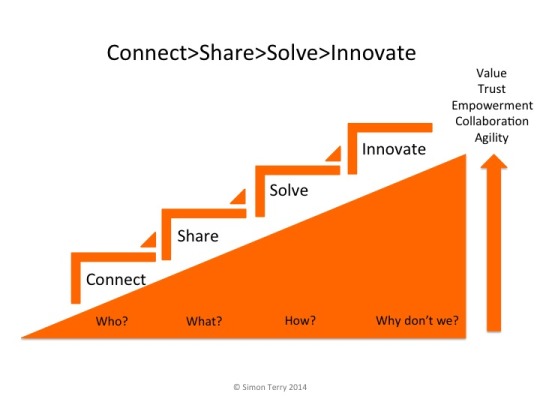
Enterprise Social Networks reflect the organisation’s culture and the maturity of collaboration in that organisation. As collaboration matures, different modes of engagement arise.  Higher levels of engagement aligned to the strategic objectives of the organisation are fundamental to the growing value of collaboration for any organisation.

Connect: The Directory

Many organisations don’t create much community in their networks. Networks or collaboration features imposed without thought or support will often languish. Without clear strategic rationale for collaboration in the organisation, their efforts create a new directory of employees (In many cases, a directory of only those who adopt). The collaboration features are used to create a social profile for individuals and to help people find others using the knowledge of those in the network.

Share: The Salon

When people are freely sharing ideas & their work, the level of engagement in the network rises. The community begins to resemble a salon. A salon can be an inspiring place filled with insightful knowledge and witty repartee. However, it can also be dominated by personalities, expertise and narrow schools of thought. Sharing knowledge is an important step on the journey of collaboration and a foundation for greater connection but posts with links is only an entry level for the human potential of social collaboration.

Solve: The Universal Genius Bar

When trust and engagement is high enough, people will see a community as a place to solve their work and personal challenges.  Like a Genius Bar, the community brings now just expertise and ideas, but solutions in the form of resources, processes and other ways to help drive change in the organisation. Well managed communities will be universal in their ability to reflecting the strategic intent of the organisation and the breadth of its people’s interests and purposes.

Innovate: The Platform

Successful cultures of innovation are those where people have a platform to which they can take ideas for development and trial. They also leverage the value of that platform as a way to track, understand and refine new ideas and those in development. When you have an innovation platform built on a rich level of engagement of all your employees, then the value and pace of change,  innovation and continuous improvement is accelerated.

Questions to consider:

  • Where does your organisation sit today in terms of the nature of the activity in your enterprise social network or other collaboration platforms?
  • What level of collaboration fits the culture of your organisation and its strategic goals?
  • What are the modes of collaboration that will help your organisation best achieve the value it seeks from bringing its employees together?
  • How have you authorised and enabled people to drive change and to collaborate in your community?
  • How can you move your organisations network from a Directory or a Salon into more valuable levels of engagement?
  • Do you have the leadership, community management and the change agents necessary to build trust, role model change and develop engagement?

The Value Maturity Model and its supporting tools are ways to help organisations plan and execute the development of strategic value in collaboration through enterprise social networks and other communities. For more information on the Value Maturity Model and how it can help you develop collaboration, please contact Simon Terry.
ICYMI: 2015 Top 10 Posts by Popularity

The over 10,000 people who have visited this blog in 2015 enables us to review 2015 by popularity of each post. This blog has covered a lot of ground in 2015 in 206 posts so it is interesting to see what rises to the top of the social sharing. The practice of learning, leadership and collaboration for the future of work top the lists as they are the focus of my work and my interests:

  • Competency or Capability Mindsets Matter: I am a little surprised to see this post do so well. When I wrote it I thought of it as more of a technical post dealing with a key HR and management issue. Clearly the need in the future of work to focus on capability and move from strict competency resonates deeply.
  • The Last Thing We Need is an Enterprise Social Network:  This rant of a post from 2014 continues to circulate, educate and amuse
  • Working Out Loud 3 Tiny Habits: The growth of Working Out Loud in 2015 with the release of John Stepper’s book and two Working Out Loud Weeks has made this post from 2014 (and its various forms of content: posters and videos) enduringly popular
  • Big Learning: I see this post as another pillar of this blog ongoing. The idea of organisations needing to arrange systems to accelerate learning and capability development remains as urgent as ever. Big Learning is the next big challenge. In 2016, I am looking to bring Big Learning further to light with clients.
  • Beyond Adoption to Value Creation: The foundational post of my work in collaboration and probably the most linked post within this blog. Also widely used by others to explain the development of collaboration in organisations.
  • Why Hierarchical Management Survives: Institutional Filter Failure Struck me in a flash. Still surprises. As long as our organisations are deliberately dumbed down we will miss out.
  • The Growth Mindsets of Collaboration: I love Carol Dweck’s work on Growth Mindsets. Let’s hope more managers are inspired to consider & encourage them.
  • Double Loop Learning of Working Out Loud: This world has got to complex for single loops. Let’s help people to reflect on whether they are doing things right and even in a triple loop whether they are doing the right things. Working out loud will continue to be a key focus of my work in 2016
  • The Lean Startup of Me: If the circulation that this post received on Linkedin was added to its stats, this likely would have been #1 post of the year. It is certainly the post I get most questions about. This is still the way I approach my practice and life.  It has been invaluable to me and to those I coach on following the independent path.
  • The Future of Work is the Future of Leadership: Another foundational post from 2014 that benefited from a lot of links in 2015. Leadership work will be a big part of 2016. We need change and we need leaders at every level to get us there.

If I take out the 2014 posts, the next most popular 2015 additions would be:

This list of posts is a wonderful encapsulation of the focus of my work in 2015 and the areas that I will be focusing on growing in 2016. There are a few much beloved posts that failed to make these lists.  There are also many posts on the blog that probably should never have been written. That’s the journey of blogging consistently and working out loud on your practice and learning.

Thanks for your support in 2015 and I look forward to sharing more posts in 2016 and being involved in the great conversations that they inspire.

The little gesture #wol #vmm

Your gifts don’t need to be big. They just need to be gifts. 

I saw a neighbour driving in the street this morning. Being Australian males, we both raised a hand of acknowledgement. Two little waves made a gesture of greeting and respect. In regional Australia, the gesture is refined down until only a finger is raised from the steering wheel, but it is usually raised to greet each vehicle. 

Little gestures matter precisely because they are small and easy to ignore. Taking the time to recognise others specifically, is part of building community. Anyone can drift anonymously through a large city or organisation. Recognition reminds you that you have peers. 

The genius of John Stepper’s Working Out Loud is his focus on making small contributions to one’s network. All networks are built on these little moments – gifts of recognition, support or respect. Working out loud refines the giving in your networks and build a generous atmosphere of community. 

When I work with clients on enterprise social collaboration, my focus is to bring the conversation down from big set piece projects to these little gestures of community. The first three verbs of the Value Maturity Model, Connect>Share>Solve>Innovate, are foundations created by these small gifts of time, attention or value. Multiply small gifts and you multiply the power of collaboration. Most importantly of all, like a hand wave between neighbours, these gifts can be given everyday. 

Build your community with little gifts. 

May you enjoy the season of giving. Merry Christmas and a happy new year all. I look forward to further conversations with you in 2016 about the role of learning, leadership & collaboration in the future of work.

The Four Capabilities of a Social leader

Senior executives need new mindsets and new capabilities to be effective in the networked work of the future. Four capabilities will help e executives make the most of their networks:

Personal Knowledge Management: Personal Knowledge Management gives executives the personal learning skills to manage the flow of information and to deepen their personal networks. As executives personally learn to Seek>Sense>Share they develop critical digital skills for network leadership.

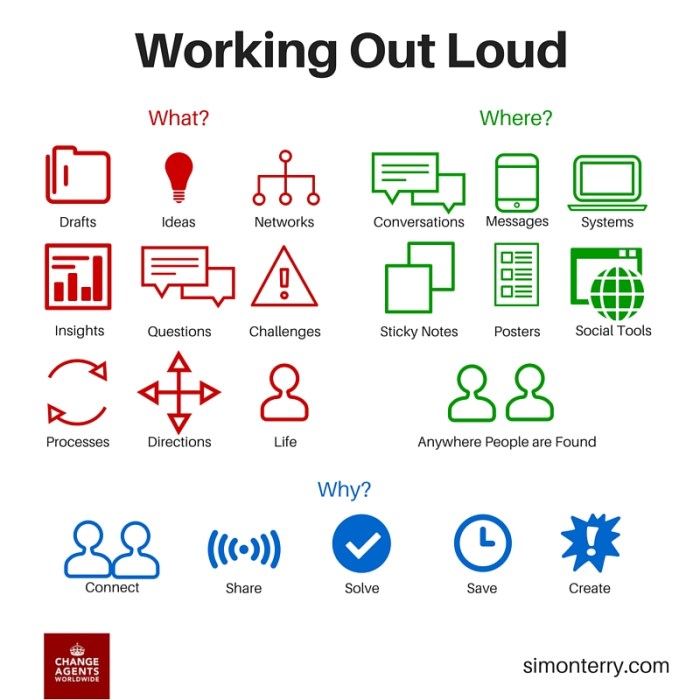
Working Out Loud: Working out loud is a practice that helps surface the value of work and learning in networks. Leaders are already the focus of attention. Making their work in progress visible to others is a highly valuable step because it accelerates trust and learning.

Leading in Networks: Network leadership requires leaders to surface shared purpose, build trust and influence and enable collaboration. Expertise, rank and orders are replaced with adaptive leadership techniques that manage learning, tension & alignment.

Creating Value in Networks: Leaders need to be able to set a strategy for their and their team’s engagement with networks. They need to be able to accelerate the maturity of value creation in those networks as they develop through Connect>Share>Solve>Innovate.

Developing leader’s practice of these key capabilities will enhance their effectiveness in enterprise social networks and the future of work.

Speaking to Senior Managers

Senior leadership engagement in change is a hot topic. Social collaboration makes the absence of leader engagement obvious. I’m often asked to speak on collaboration, learning and leadership to senior executives. As I used to be one, people want me to share a little of my passion for these topics. Here are some suggestions to guide you in your senior leadership engagement.

It’s not a priority

Collaboration, leadership and learning is unlikely to be a priority for your senior leaders. Sure they’ll discuss it but they don’t want to do it. They don’t know anyone who got made a CEO because his team was the most collaborative or the most agile. There is always a bigger business or customer problem that is on their mind.

Rather than engage in an argument as to why this mindset is wrong (it is – see Big Learning), I start with understanding the real business problems that they want to solve. Once we understand the business problems we can connect collaboration, learning and leadership as solutions to that problem.

Avoid Capitalised Nouns

Senior executives are busy and distracted. They don’t want jargon and hype. They are allergic to empty captalised nouns. The more you use words like Collaboration, Leadership, Engagement etc without making them tangible the less credible you are. The more it sounds like a futuristic vision or a quixotic quest the less relevant you are to their world.

Tell Stories

Stories make change tangible to busy & smart people. Ben Elias of ideocial.com remarked to me recently that it is hard for people to conceive of how their organisation could be highly collaborative. They have never seen it, so the ideas and practices don’t connect with their reality. Specific stories make that connection. Tell rich and engaging stories of how things can be and how to get there.

Ask for something specific

There’s nothing worse that taking the time of senior leaders, winning their support and not being able to define exactly what you want them to do. Always have a specific ask of them ready to go. Have two in case they say yes to the first. Better yet have a personal ask that is framed as something simple that they can agree to do to sustain change. The 3 simple habits of working out loud was designed as one such example.

When you are done, Stop. Leave.

Senior executive time is precious. Give it back to them. Tempting as it may be to bask in the glory of a good meeting and deepen rapport, you will win more credit by leaving when you have done your job. Remember when something is not a priority you are always on borrowed time.

Sharing is not Enough

All over social networks people share links and opinions. Meet ups are held to enable more sharing face to face. Networks share information every day.

Sharing is happening more than ever but it is not enough. Sharing information is a critical part of the value maturity model. Sharing builds trust, deepens understanding and fosters connection. Sharing should be a sign the network is taking off.

You only take off if you have somewhere new to go. A lot of the networks sharing information never mature beyond a flurry of content marketing. Their links and messages are the same as every other network.

Shared Purpose and Collaborative Work

Any reason will bring you together to share information. Before people can work collaboratively they need some overlap of their personal purposes. They need to have some commonality of the change they want to make. Shared purpose takes the conversation deeper and creates incentives for action.

As obvious as it sounds, people won’t do collaborative work unless there is work to be done. In dispersed networks, don’t assume everyone can see the work opportunities. Mostly people will see the barriers to work.

The role of Change Agents in a network is to connect people around shared purpose and to help everyone to see the work to be done. The generative leadership of change agents will help lead people to new ways of interacting by solving real problems. If you don’t yet have change agents, community managers and other leaders will need to show the way.

Links, pictures, jokes and opinions are a good start but not enough. The purpose is in the work.

The Hypotheses of #wol – #biglearning

Working out loud helps us to learn faster by making our hypotheses explicit.

Hypothesis is one of those words that makes something simple sound elegant & scientific. Many digital practices like experimentation and design thinking push people to work and test from explicit hypotheses. It sounds better than draft or work in progress. Using hypotheses and testing them quickly is a core practice of organisations that leverage big learning approaches.

Working out loud can help you to discover the speed, engagement and agility of explicitly testing ideas as hypotheses with your work colleagues. If you are reluctant to share a draft idea, ask for help to validate a hypothesis that shapes how your idea will advance.

Confirming the underpinnings of your work as you go both brings stakeholders on the journey and also enables you to get to the destination faster. Treat every share as an opportunity to confirm that you are on the right track. You will benefit by making small adaptations now rather than rework later. You will also be helping your organisation to practise big learning.