The Last Thing We Need is an Enterprise Social Network

Dear CEO

Re: The Last Thing We Need is an Enterprise Social Network

The purpose of this email is to explain why the last thing we need is an enterprise social network.

This email is in response to the conversation about enterprise social networking in the executive leadership meeting yesterday. We thought it best to summarise the position of the leadership team, because yesterday’s conversation got derailed by anecdotes about social media, technology terminology, fear of change and discussion of abstractions like collaboration, future of work and new organisational structures. Before you left the meeting, you remarked “Based on this discussion, I think an enterprise social network is the last thing we need”. We agree.

We don’t want faddish technology. We need execution of strategy.

As CEO, you’ve been rightly suspicious of all this discussion of social inside the organisation. It is bad enough that your teenage children never look up from using social media on their phones. Whatever that involves, it can’t be needed activity in our organisation. We are a place of work.

What made this country great was well-run organisations, hard work and increasing effectiveness in creating value for customers. That takes focused strategy, disciplined execution and a willingness to do the hard yards. Great organisations aren’t built by chasing technology whims. They come from executing strategy to create better value. When we need to create better execution on strategy, the latest fashionable technology is the last thing you need.

We need better strategic value creation

Times are tough. Industry is more competitive than ever and change keeps increasing. We know customer and shareholder value needs to go up and costs need to come down. We have a strategy that is about meeting these new customer & stakeholder expectations, improving the organisational efficiency and delivering the returns that shareholders demand. We all wonder from time to time whether everyone in the organisation gets the imperative of the new strategy and whether they are all working hard enough to find new ways to create value. We know that we perform better when we have better conversations to make sure that our employees are aligned to the strategy. What we don’t need are distractions when there’s doubt that people even understand the strategy.

When we need strategically aligned value creation, the last thing you need is an enterprise social network.

We need new more effective ways of working

To fulfil the strategy of the organisation, we know as a management team that we will have to start to work in new more effective ways. There has been too much wasteful duplication of work in the organisation. Too many of our processes & policies don’t line up across the silos, aren’t agile enough for the environment and don’t meet customer needs. Both our customers and our employees complain about how badly we do this. We need to start working in new and different ways to identify, solve and improve this on a continuing basis. We have to focus everyone on find and using better work approaches that help us to fulfil the strategy.

When we need working in new and more effective ways, the last thing we need is an enterprise social network.

We need to change management and leadership in every role

Working in more effective ways will likely require us to change the way management works. We are going to need to push decisions down to people closer to the customer and give our people the ability to fix problems. We will need our managers to move from command and control to a coaching and enabling role. We need to ensure that all our people are realising their potential and able to work to create new sources of value. Of course in this new role, middle management will need to be trimmed and the new flatter organisation will need to change more often as we respond to further changes driven by our customers. Employees will need to step up into a leadership role in these changes and with customers, the community and the organisation.

When we need to change the culture of management and asking every employee to play a bigger role in leadership, the last thing we need is an enterprise social network.

We need different conversations

Changing the culture of management is going to demand very different conversations in our organisation. We are going to have to find ways to make sure that conversations are efficient and effective. We need to leverage the contributions of more people from across the organisation. We won’t be able to rely on long meetings, workshops, speeches, video and emails. Did you see the budgets for communications, off sites & roadshows in the forecast for next year? We have to do something different. We will need to involve our people more in making decisions. If that’s going to happen our people will need to be better informed and better able to channel their contributions. Our people will need ways to inform themselves, learn by pulling what they need, share ideas of how to work better and collaborate to solve work problems. We are going to need to encourage our people to join conversations that use their capabilities to innovate, to create value for customers and create new forms of working.

When you need to change the conversations, collaboration and culture of an organisation, the last thing you need is an enterprise social network.

We need more from our people

We wrapped up the last executive leadership meeting reflecting on how big these demands will be on our people. We will be asking for a lot of change in them, their work and the way the organisation exists around them. We will be asking our people to play an increasing role in the success of the organisation. We will want them to lead new conversations to create the future for this organisation. We need our people to be more engaged because we will need much more from our people.

Conclusion: What we need

After you left the executive leadership meeting to catch up with the board, we realised that we are clear what we need as an organisation:

  1. we need to succeed by fulfilling our strategy to create greater value in a rapidly changing market; and to do that
  2. we need to be able to work in new & better ways that create a more effective, agile and responsive organisation; and to do that
  3. we need a new culture in management and more leadership from our people; and to do that
  4. we need new conversations that enable our people to discuss and act on creating better strategic value; and to do that 
  5. we need more engagement and a better ability to leverage the potential of our people to contribute to and lead this change; and to do that
  6. we need an enterprise social network to support the first 5 steps.

If you are surprised by point 6, think back through the needs again. After all you were the first to say that an enterprise social network is the last thing we need. We don’t want an enterprise social network because it is new technology or because it is good for some abstract goal. We need one to help our people to execute on the changes necessary to achieve the goals of our strategy. Enterprise technology only makes sense when it enables us to work in new ways that deliver strategic value. As your management team we can see that the value creation opportunity is compelling. We couldn’t see it when you made your remark, but we have come around to your perspective.

The paperwork required by our old process is already on your desk, but a number of our people have started experimenting with solutions to see what value we can create. (Interestingly, their first suggestion is a better procurement process.) When you get back from the board, your assistant will show you how to log-in and join us discussing how we implement in the new enterprise social network.

Thanks for challenging us to come up with a better way of working.

Please think of the environment and don’t print this email. We’d encourage you to discuss it on our new enterprise social network instead.

If this post sounds familiar or if you would like to create greater value in your enterprise social network or discuss how the Value Maturity Model applies to assist your organisation to create strategic value through enterprise social networking and collaboration, please get in contact. I am available through @simongterry or Linkedin or www.simonterry.com
Working Out Loud Creates Value

image

Working Out Loud is one of the most crucial practices for value creation in an enterprise social network. For many, it is also the least comfortable. We need to work at this new practice to deliver value.

Working out loud is the core new practice as sharing grows in an enterprise social network. When the conversation moves from sharing personal information to sharing work, value for the individual and organisation rises dramatically. That sharing is critical to the maturity of value creation in an enterprise social network. Without sharing of work, you hold back the benefits from other forms of work collaboration.

Working out loud creates great value in a network because:

  • working out loud gives a work purpose to the connection that has been formed in the network
  • working out loud invites community to form around people and their work enabling others to help, share knowledge and make work easier.
  • working out loud is not natural to many in the traditional workplace, but when people overcome hesitation and practice it they start to see the benefits of new forms of collaboration, that it makes work much easier & the culture much richer – a core driver of personal adoption
  • working out loud is the transition point to much wider collaboration across the organisation and particularly collaborative sharing and problem solving – work that is open is work that can be made better 
  • working out loud exposes the work which allows for better strategic alignment, reduced duplication and importantly recognition of the great work underway.
  • working out loud enables role modelling of transparency, vulnerability, learning, agility and experimentation.
  • working out loud by leaders can change the leadership dynamic from one based in control and expertise to one that leverages networks and collaboration.

Some great resources are available to help you with working out loud:

If you would like to create greater value in your enterprise social network or discuss how the Value Maturity Model applies to assist your organisation to create strategic value, please get in contact. I am available through @simongterry or Linkedin or www.simonterry.com

Beyond Adoption to Value Creation

Slide1

A great deal of attention in enterprise social networking has gone into ‘driving adoption’. A focus on adoption can distract organisations from the real challenge of any business activity, creating value in fulfilment of the organisation’s strategy.

Adoption is an intermediate goal

Adoption is a means to an end. Adoption is a tool of value creation. It is not the result. The desired outcome is the value created by an engaged community that allows for the fulfilment of a strategic goal through outcomes like better alignment, innovation, adaptation, better customer & community focus, greater agility or improved efficiency.

The desire to move beyond adoption is growing. Luis Suarez recently argued that the language of driving adoption is missing the mark. Joachim Stroh has also highlighted ways in which we need to move beyond traditional adoption.

The logical next step from adoption is the end goal of work. Business and people work to create value in line with a strategy. We need our use of enterprise social networking to create value for each users and for the business as a whole.

Adoption as a goal alone can lead us astray

Our focus on adoption is often reflected with concerns from our traditional hierarchical ways of working. For example I have been asked the following questions about adoption that indicate something is going astray:

  • If we don’t have universal adoption, how will people get our messages?: If you are focused on one-way communication, there’s a good chance they don’t listen to your messages already.
  • Can’t we just mandate adoption? You can, but it rarely works to create an engaged & valuable community. Incentives may be a transitional tool to help people engage with the solution but take care that they don’t make participation an end in itself.
  • Won’t our people resist adopting this new solution? If the solution offers no value or is seen as a distraction from real work, they should resist. If it creates value for users and they see its value to the organisational strategy then this is an issue that we will overcome.
  • What’s the right number of users to adopt a social network? There is no magic number. The right answer is enough of the organisation to create enough valuable conversations for users and the organisation. That can be a surprisingly small percentage of the organisation, provided they are well connected into the larger organisation.
  • We have lots of users. Nobody knows what to use it for. What do we do now? You have users but it is likely you don’t have a community that understands how to do things together to create value for your strategy.

Most importantly of all, enterprise social networks are infrastructure, not tools. Employees need to make sense of a new enterprise social network and integrate it into their work. There is no pre-ordained usage that people can adopt like many other technology systems. Adopting a network as another conversation tool may be interesting but rapidly loses relevance in a busy workplace with many high volume channels for communication. The best guide to employees is to direct their sense-making into how it will create value for their work and strategic value for the organisation.

Often adoption drives demand a lot of overhead and effort. They are pushing something into a community. Where this effort goes to creating niche use cases with easy adoption, selling a uniqueness event in an enterprise social network or investing all the time in unusual campaign activities it can backfire. Employees who come to think of the enterprise social network as being used only for a special activities may not consider the opportunities for every day value creation. In these networks, there is a dramatic difference in utilisation between when adoption is being driven and every day use limiting the potential of the platform. Use caution that your efforts to drive use reinforce the connection to value in daily work and strategy.

Importantly adoption is rarely a goal that makes sense to the managers and leaders whose support is needed to foster a collaborative culture and role model usage. Conversations advocating adoption of social collaboration and other future of work practices can seem abstract and a side issue to the work of the organisation to many managers. Managers are looking for how enterprise social networks contribute to value creation.

Personal and Strategic Value

Value is different for every organisation as organisation’s purpose, strategies and goals differ. Value need not be a hard dollar return on investment. ROI can rarely be calculated in the abstract for infrastructure. From an organisation’s perspective defining a contribution to a strategic goal is often more effective.

Value is different for each individual depending on their goals, their role, their work preferences and their needs. Individuals will need to change their work practices in ways that make sense to them. Role modelling and storytelling will assist this journey but they will make their own sense of value.

There are 5 key elements of the work to moving the focus of enterprise social networking to value creation:

  • Create Strategic Alignment: Make explicit the connection between social collaboration and the strategic goals of the organisation. At a minimum, these conversations will educate your employees on the purpose, strategy and goals.
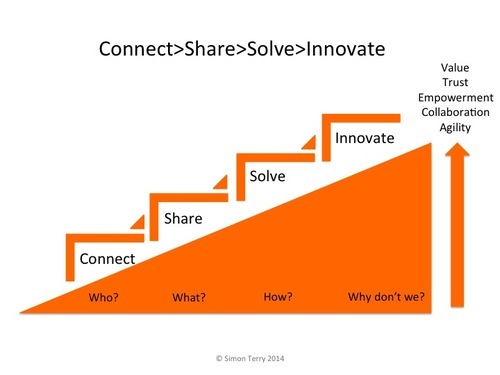
  • Guide Personal Value Creation: Guide employees to understand how the enterprise social network creates value in their work. In my work with organisations, I use a Value Maturity Methodology based on users maturity through 4 stages Connect>Share>Solve>Innovate.
  • Experiment & Learn: Create an environment for employees and the organisation where the enterprise social network fosters experimentation to create new forms of value in work. Encourage sharing and solving challenges.
  • Foster A Learning Community: An engaged and aligned community of employees working together for business goals is the greatest opportunity for value creation in organisations. Focus on how community accelerates value creation and the key roles required in any community. Understanding the roles of champions and leaders is critical.
  • Discuss Value Creation: Social networking accelerates double loop learning. Discuss value creation in the network as the work conversations occur. Celebrate lessons and successes. Back innovations with corporate muscle. Use these new learning conversation to foster alignment with strategic goals and encourage people to find new personal value.

If you would like to create greater value in your enterprise social network or discuss how the Value Maturity Model applies to assist your organisation to create strategic value, please get in contact. I am available through @simongterry or Linkedin or www.simonterry.com

Stop Magical Thinking

image

Magical thinking is any attempt to bend reality to the will or hopes of an individual. Whether by sleight of hand or genuine higher powers, magical thinking leads people into flights of fancy.

Many will remember the Magical Realist school of literature that delivered some extraordinarily captivating novels. Novels would move along telling an engaging story. Then suddenly they would swerve free of reality while magic transformed the world.

Sadly many business plans follow this swerving course at exactly the moment value needs to be created. Instead of exploring the human changes required they swerve into magical thinking. Magical thinking makes for engaging stories, but it makes for terrible plans for the future of work.

Stop Magical Thinking at Work

Let’s leave the magical thinking to creative arts and stop it in the future of work. Value in the future of work is hard work and we will need to create it together.

A really good indicator that magical thinking is creeping in to plans in business is the use of the passive voice. The human contribution to change slips away and magic takes over. Nobody need do anything because great stuff is about to happen suddenly entirely on its own.

The following things are all examples of magical thinking:

  • Adoption will be driven by the right launch, right features, etc.
  • Value will be created by adoption of the terminology, features, systems or processes.
  • Culture will be changed
  • Leaders will be changed 
  • Ideas, changes and new practices will be understood and adopted easily
  • Hierarchy, command and control, micromanagement, etc will be eliminated
  • The desired outcome will be delivered by new policies, processes, measures or systems.
  • More social/analytical/collaborative/cooperative/community-oriented/engaged/innovative work will occur and will be valued by management
  • New forms of value will be created
  • Great new jobs will be created
  • New efficiencies will happen
  • New performance metrics will be adopted

Change is not Magical. Change takes work

None of those things happen without the hard work of leading changes in the attitudes, behaviours and outcomes of the way people work. A real person needs to make that change happen. That special someone has to help others to:

  • Change attitudes about work so as to
  • Change behaviours at work so as to
  • Change the outcomes from work

Only those changes in outcomes create value. Value creation is critical because value creation determines what businesses do and keep doing. Sadly, value does not magically appear.

Before we see any value, at least one leader has to experience those changes in attitudes, behaviours and outcomes themselves. Then that special leader get to work hard to create the value for others through effort, influence and experimentation.

There is no passive voice in leadership. Let your actions speak louder than words.

So when do you start?

The Network Navigator

image

The power of a networked world is shifting the emphasis of work from expertise to navigation. Are you ready to move from expert to network navigator?

From Expert to Navigator – a financial services example

Research into perceptions of an advice relationships in financial services consistently often comes up with a common theme. Usually, the financial services organisation is keen to build a trusted relationship with the client as an advisor and to demonstrate its depth of expertise in the advice process. 

However, these goals are rarely what the client is looking to achieve. The client is often more interested in building a relationship with someone who is responsive to their needs and who can to help them navigate the complexity to find their own answers. The complexity the client needs to navigate is not just the financial decisions; it includes the organisations own advice and service processes. In times of complexity, uncertainty & change, clients are reluctant to be dependant on someone else’s expertise. They want control. They want to be guided across the map of choices and find an easier way through the process.

The Network Navigator

Networks and the increasing pace of change that they bring about are having a similar disruption for the traditional model of expertise-based advice.

Relying on a proprietary stock of knowledge is no longer enough to justify an advice proposition. Knowledge is increasingly a flow. Stocks of knowledge are out of date too quickly as the network learns more faster by sharing.  If clients want access to stocks of knowledge, they can find the information themselves (& access a greater diversity of insight and experience) if they are prepared to put in the time and effort.  Doing that work for them on an outsourcing basis is a low value task.

The challenge of a networked era is no longer gathering a stock of knowledge. The challenge is leverage rapid flights of knowledge and guiding others through networked knowledge creation. The skills that rise to the fore are no those of hoarding a stock of knowledge. The skills are those of being able to connect people, share capability and create new knowledge together.

The 8 Skills of a Network Navigator

A network navigator does not need to know the answer. They do not even need to know the whole way to the solution. They need to be able to lead others, to leverage the knowledge of the network and to find a way forward in collaboration to create new value: 

  • Setting a course: In a complex world often the purposes, goals and questions are as unclear as the answers. Helping people clarify their objectives and questions before and during their engagement with the network is a critical role that the network navigator can play.
  • Seeing the big picture map: Navigators are people who can hold the network system in view and manage the micro detail to guide people forward.  A navigator creates new value with an understanding the broader map and new & better paths that others may not have considered.
  • Make new connections: Increasing the density of networks can be critical to creating new knowledge and value from network interactions.  Bridging weakly connected groups is another role that navigators can play to realise new insights and value.
  • Recruiting a crew and local pilots:  Building community matters in new network ways of working.  Community takes connection to a deeper and more trusted level and begins to accelerate learning and change.  Network navigators know how to recruit crew to their travelling community and add local pilots as they need to learn faster in new parts of the network.
  • Translating strange cultures: Connecting diverse groups often means that there are differences of context, language and culture to be bridged before conversations can create new knowledge. Network navigators have the skills to understand and share diverse inputs.
  • Logging the journey: A network navigator works out loud to record their journey and let others contribute and benefit from the record.  A network navigator nows there are many others seeking the same answers or looking for better paths forward and makes that possible by sharing their work and inviting others to contribute.
  • Weathering storms & avoid shoals: Journeys through networks are not linear and often unpredictable.  The navigator has the experience and the confidence to see others through the storms and to sustain others in their journeys. Most importantly, when the storm is darkest, they have the passion to keep pushing and keep experimenting.
  • Navigating where there is no map: Network navigators need to be able to embrace uncertainty and ambiguity.  They need to be able to lead others forward to learning even if it is dark and there be monsters.

Acknowledgements:  This post is in large part inspired by conversations with a wide range of participants that occurred during John Hagel’s recent visit to Melbourne for the Doing Something Good dinner and Centre for the Edge workshops that I attended.  It is also informed by ongoing conversations about new networked ways of working among all members of Change Agents Worldwide.  

The New to Social Executive: Actions to Get Ready

As a senior executive starting to use social collaboration there will be a little nervousness when you engage at first, unless you are supremely confident or incredibly extroverted. You need opportunities to practice your new mindsets and learn new skills of social collaboration before you hit the main game. Even if you are confident and extroverted, you may need practice, because you may need to learn to adjust to the expectations of others.

Here are a few actions to help the new-to-social executive to get ready for the art of social collaboration: 

  1. Start by being social: The technology is just a facilitator of conversations. Do you go out of your way to have social conversations in your organisation now? Are you mentoring and helping others across the organisation now? When did you last have a coffee meeting with no agenda? It is no good running chats on twitter or posting think pieces on Linkedin, if you don’t talk to your own employees or customers in the foyer. Start using your new social mindsets and engaging a wider audience in other ways first.
  2. Choose a purpose: When starting out in social collaboration, focus helps build reasons for connection.  Choose the one topic on which you want to start to engage purposefully with others. If you can’t think of anything else, choose one of your corporate strategy, meeting talented people or better understanding customers. Add these topics to your everyday conversations and your team. Refine your purpose as you go. Eventually this purpose will flower into a personal manifesto.
  3. Reflect & Start to share your learnings: New-to-social executives often say “But what do I have to say?”. The things that you share are going to come from the interactions in your day and responses to the activity of others. Reflect on what you experience and read each day. Start to take some notes about what these experiences mean for you and what you learn (Tools like Evernote are handy for this). Those insights are ideas that you can share. Explain to others how these ideas came about. They might seem minor to you but to others without your experience your thought process can be incredibly valuable. Over time this will become a form of Personal Knowledge Management where you constantly refine what you read, capture insights, and also learn how you share your insights with others.
  4. Test the influence of your insights: Most senior executives are used to their teams listening to their words. Social audiences are busy with many competing voices. You may need to test how influential your ideas are before you debut them to a wider and more discerning audience. You may need to adjust your style of communication. Social favours the short, sharp and punchy. Run some tests sharing your thoughts in a variety of different means through email, internal social posts, voluntary talks or blogging internally. Measure the response and seek feedback. Use that feedback to refine your style and your messaging. 
  5. Start Working Out Loud in your Enterprise Social Network:  There is no better place to practice social collaboration than in your organisation’s Enterprise Social Network.  You will be practising in front of an audience that is well aware of your fame, power and influence. They will be forgiving. Use your enterprise social network to start to practice Working Out Loud. Develop new habits that you can carry over to external social media. Make sure you get the network’s mobile applications so that you can easily access, share and respond to others as you go about your busy life. Most important of all, learn the lessen that the value of social collaboration grows with your consistency and your effort.

From that point on there are plenty of experts that tell you how to use Linkedin, Facebook, Twitter, Instagram, Pinterest and other social tools for business.

Search, experiment and keep the practices that work for you 

This is the second of two short posts on tips for the senior executive looking to move into using social collaboration tools inside and outside the enterprise. This post deals with actions to get you started. The previous post dealt with mindsets.

The New-to-Social Executive: 5 Mindsets

Your mindset matters to how you are perceived and connect in social media. Whether internal or external to your organisations, the way you think and the way you lead play a critical role in your ability to influence others.  As a senior leader atop the hierarchy, you have power and influence in your organisation (Admittedly that’s rarely quite as much as you would like). When you take your leadership position into the realm of social collaboration whether internal to your organisation or externally, there are a few key shifts in mindset from traditional models of leadership.

Keep these in mind these five key phrases:

  1. Be the real human (& sometimes flawed) you”: Nobody is looking to get to know your communication manager’s idea of you. People don’t need you to be the perfect model executive. You can’t have a conversation with a corporate cardboard facade or get help from a PR bot. This is an opportunity to be more human and to use deeper connection and communication. It will demand that you share more of you. If there is more than one of you, one for work and others, then social collaboration will test your ability to maintain the curtain of separation. Using social media works best when you bring your whole self to the activity. You will learn new ways to demonstrate your strengths and authenticity in the process.
  2. Think networks”: Social media flattens out the playing ground. Your current fame, power and fortune won’t deliver worthwhile connections or influence immediately. In this environment, your voice competes with many others and those that are better connected and more trusted will have greater influence than you regardless of their status. Your voice & authority is much more easily challenged and even mocked. Influence works along networks of trust and connections. Valuable business traction comes from deepening connections to stakeholders and influencers in your own world. Start there and build your influence over time as new connections join in to the valuable interactions that you help create.
  3. ListenEngage others”: Listen first. The network doesn’t need to hear you. Mostly it won’t. The network doesn’t need another opinion; it needs your response to and your engagement in the conversations already going on. If you want to deliver on your strategy, the path is through helping others to better align, understand and deliver that strategy with you. How you engage with others is more important in building influence in your network than who you are or what you have to say.
  4. Be helpful”: Make connections & help others find those who can help them. Set context. Guide others. Enable others. Share stuff to help others solve problems for themselves. Ask great, thoughtful & challenging questions. Work aloud and let others prove their value by helping you. Connect with people to deliver them value. People are looking to learn more and help themselves. As a senior leader you can play a critical role
  5. Experiment, learn & change stuff”: The value of human networking is to learn, connect with others and change things. Embrace difference & the chaos that many opinions and desire for change creates. After a while you will recognise the appeal of ‘being permanently beta’, always evolving to better value as you experiment test and learn. If you want to hear your own views, build your personal brand, increase your control or resist change, don’t start in any form of social collaboration. That attitude doesn’t show much respect for the efforts of the others in the network. 

This is the first of two short posts on tips for the senior executive looking to move into using social collaboration tools inside and outside the enterprise. This post deals with mindsets. The next post will deal with how to start engaging.

What Interests My Community Fascinates Me

Living and working in a hierarchy can shape your attention to the world. We all need to be fascinated less by power inside our organisations. We need to be fascinated more by customers and the community outside the organisation.

A common piece of advice in large organisations is expressed this way:

‘What interests my boss, fascinates me.’

The advice highlights that your boss often has a major role in perceptions of your performance and career opportunities. The suggestion is that the path of success is to be ever more conscientious on what matters to your boss. Managing their interests will deliver rewards from their greater hierarchical power.

Except that is terrible advice in almost all circumstances:

  • your boss does not determine real value: value is determined by the network of customers and the community
  • your boss does not determine change: change is driven by collaboration across silos internally and decisions of customers and community externally
  • unless you are great at working aloud, your boss rarely has your better context of what is going on in your role and lacks your networks 
  • many bosses are reactive worrying about the last big issue or the last thing their boss mentioned
  • many bosses are fickle changing their mind on what matters -some even in your performance appraisal
  • the most enduring factor in your performance and careers is the outcomes you deliver not to what or to whom you paid attention. 
  • ‘But you told us to…’ never saves anyone

Being fascinated by every whim of your boss might build a great relationship between you two. (Warning: It might be counterproductive too) However, it will not drive real business performance.

So next time someone asks you to worry about what your boss thinks, don’t. Look outside the organisation in your networks to find what matters. Make your mantra:

‘What interests my customers and community, fascinates me’

Your boss is just one voice in your network and probably the least valuable one.

What are you working to achieve?

‘What are you working to achieve?’

Working out loud is not a common enough experience yet.  Many people are still reticent to share their goals, their challenges and their work.  

That makes a question about what people are working to achieve a very powerful one, because it:

  • helps people clarify their purpose and goals
  • separates wishes from tangible action
  • moves beyond appearances, titles and surface issues to form the basis for a deeper context, connection and conversation
  • enables you to identify how you or others can contribute to help

I ask this kind of question a lot.  I find it is incredibly valuable for simply building rapport.  You have a lot more to discuss when you know where someone is devoting their efforts.  

However, it also enables further action to help.  Just this morning I asked the question of somebody that I did not know well.  Turns out I have networks that will assist them to achieve their goals more quickly. That makes the question a powerful engine of collaboration. You can’t help if you don’t know.

If others are not sharing their work, ask them what it is that they are working to achieve.

We need shared context

If you are struggling to get your message across it might not be the message, it might be the context.

You are an expert.  You might be an universally recognised expert, have some special qualifications or you just might be the person who best understands your job, your customers or a problem.  That better understanding of some context, however narrow, makes you an expert.

Any form of work or collaboration will require you to use your expertise. That expertise can also be a barrier to communication and collaboration.  Your challenge is that others don’t share your unique context.  

Unless you share a context, others won’t be able to understand what you are doing or what you want to share.  If we don’t share enough context, we can’t see things, trust or understand what experts tell us.

Here’s a simple example.  Start working with a new group of people and you will find people are speaking incomprehensible new acronyms or using buzz phrases you don’t know. The group knows their history and you don’t. That group has a context and you are not part of it. Until you learn enough of their context and share enough of your own, you won’t be able to follow conversations or contribute.  The friction and surprises will undermine your confidence and potentially your trust in the group.

So how do you make sure others share your context & your expertise?

  • Work aloud: Sharing what you are seeing and doing with your connections enables them to pick up your context.  You don’t need to push it on them, but they can pull what you share when needed
  • Ask questions: The questions that you ask will be some new ones and obvious ones.  The fact that you are asking will enable you to explain a little of your context in response.
  • Be curious and generous: There is no right or wrong context.  Explore the context others have. Ask them to tell your their stories and share your own in reply.  Learn more in the process about what you may not have seen and also how your expertise can help others