Frustrated

Everyone is frustrated. We need to adjust for a while to a world where frustration, anger and resentment are seething. We also need to focus on helping people adapt and address root causes of frustration

And used it to write a word in the snow.
I wrote the word snow.

I can’t stand myself.

Brenda Shaughnessy, A Poet’s Poem

The Anger Around Us

Whatever your view of the public health response to the pandemic, it is fading away as restrictions are slowly being lifted. People have sacrificed a lot, waited a lot and put up with much inconvenience to benefit the community as a whole. Overall, the broad support for these measures was a demonstration of community spirit in adversity. However, in my daily experience as these measure are removed, people are not relieved, they are increasingly frustrated. These frustrations show up in small ways and large:

  • People are impatient pushing into traffic with their cars, honking horns more and crossing recklessly as pedestrians, as if they have waited enough.
  • In service environments, I find so much more sharpness, rudeness and conflict than I would expect.
  • So many friends, contacts and colleagues are expressing their frustrations from lack of energy, to a desire for major changes and even to throw everything in and start again
  • There is a volatility in discussion of political conflicts and perceptions that goes well beyond agreeing to disagree and now can be quite spiteful: and
  • People are still expressing their fatigue at the disruptions to normal patterns and their struggles in establishing new ‘normal’ routines.

These are markers but they reflect ongoing impacts of this long pandemic experience. We are still deep in all the feels.

How could anyone learn
their way out of such blunder,

how could any song be gathered
from those shards grating

like something lodged in a shoe.

Corey Marks, Broken Music

Adjusting for Frustrations

We can’t change the past. We can’t unwind or stop the losses. Grief will continue. Some of these frustrations are part of our experience of adjustment to the world after. However, we need to recognise that public expression of frustrations is likely to increase the frustrations of others. A problem shared may be a problem halved but shared frustrations multiply.

Around the world we see people seeking to mitigate and manage the frustrations they are experiencing. Signs announce that businesses are short of staff due to covid cases in their employees. Suppliers and logistics businesses are constantly apologetic about the delays and disruptions that they are experiencing. We need to recognise and plan for a world that is on edge. Getting in first and explaining a situation, helping others to understand and emphasise is a first step to better interactions for all. It also means time can be focused on what matters and what can be done, not listening to pointless outrage.

We can recognise our own frustrations too. We can pause and be present and let them slip away before we impose them on others. Problems that need solutions are rarely better managed in an environment of tension and anger. People experiencing frustrated outbursts rarely respond well. Making the effort to be constructive is a small contribution but it matters and it scales.

Having found it, you must trust it.
This is how you put aside anger:
pulling yourself up, hand over hand.

Stephen Dobyns, Song for putting aside Anger

Frustrations Pass

Most frustration is ephemeral. The anger and the pain passes and we wonder why we let it dominate our attention so strongly. Some frustrations are actually us expressing our disappointment in ourselves. We might even be embarrassed for our actions if we noted the influence of frustration on others.

The frustrations that remain are signals of the real changes we need to make. We have had a lot of time inside our own heads through this pandemic. There are real changes to be made to meet those insights and to address the wider community issues that have bubbled up into our attention in parallel. We don’t want to waste our influence and our agency on gut reactions and making the experience worse for others.

We must not waste this crisis in frustrations, in anger and in our own self-centredness. As a community we have real work to be done togeher. Lets focus on those shared frustrations and begin the process of making real change. That is a process that begins with each of us exercising our agency to make the world better, safer and a lot more human.

Thinking in this way, the old writer concludes that art must be a thing of vanity if fashions can change so quickly. Indeed, the work of these young people will be as ephemeral as his own—though this does not comfort him.

C P Cavafy, Reflections of an Old Man on Writing

Serendipity

Photo by Ramaz Bluashvili on Pexels.com

at times the best kept universe   
was my own, no interceding docents   
or guided tours, but a riverine serendipitous   
wandering—waif, naïf.

Leslie Williams, In Me as the Swans

Remote work is wonderful for its flexibility but without a change in work patterns it will crush us with lost opportunities. If people feel the need to book meetings all day, even when working wherever they please, then the opportunities for moments of serendipitous discovery decline. If you have to book a meeting to make a call, then casual and incidental conversation will be lost.

Technology might mitigate this for some, but the losses for many will be deeper. Not all of the context we need to work is available from chat and community, unless we foster the tangential conversations to bring depth of context. Without deep shared context, we can’t understand each other. If parties aren’t working out loud with full transparency, serendipitous conversation is essential to reveal that context.

Over the last few weeks I have struggled with issues in progress on key projects. In each case, the problem was a lack of depth of context exacerbated by distance, In each case, it took serendipitous and tangential conversations to reveal that someone was changing roles, that a key stakeholder was not aligned or that two parties shared a different meaning of a key term.

Naïve wonder is important. Flowing around the problems is important to find new paths, new ideas and new capabilities. Step changes in efficiency can come from inefficient and aimable discovery.

& what if hope crashes through the door what if
that lasts a somersault?
hope for serendipity

Mong-Lan, Elegy

To leverage serendipity we need an intent that guides our attention. We will miss the brief moment if we aren’t paying attention. This intent may be a purpose, a problem or an ambition. That intent need not be at the forefront of our efforts but it needs to be present enough in mind to be able to guide us to what the universe and our connections offer up.

Serendipity demands space and time. Because it cannot be programmed or scheduled, it must come from exploration. Tangents, doubling back, going deeper, taking the time to appreciate something, or more often someone, open up the many winding paths to nothing at all or perhaps a surprising discovery. Serendipity is an outcome of a deep connection in the moment to surface hidden information, capabilities or intentions. We all know love at first sight is rare, most love is developed over long interactions. It flowers from depth of connection, not immediate recognition. Serendipity, too, can be a flash of inspired connection or the outcome of a long slow development of shared context, trust and exchange of information.

Serendipity can take its sweet time to unfold. It may require us to unlearn, to let go or to surrender to a better approach than the one to which we have been clinging so tightly. We may need to admit we are wrong or that a major change is required before we can accept its gift. At other times, we might need to embrace the scary dark of uncertainty, failure and despair before we can see the hand out that we are being offered.

We need to be present to capture the moment that arises when we explore the landscape. Most serendipity does not occur head on. The connection can be upside down, backwards or in passing. Grabbing that moment and not letting it pass is essential to realising the opportunity.

This Valentine’s Day may life bring you a little serendipity and may you be brave enough to grasp it.

At the edge of the forest the thistles
were attaching themselves to the fur of animals.  
What serendipity to hitch a ride to your future.

Stuart Kestenbaum, How to Start Over
Photo by Jasmine Carter on Pexels.com

PS: one for the serendipity of Big Game fans

Unfolding

At the start of 2022, I committed to letting this year flow. But flow is too smooth a concept for a year of pandemic and transitions. My flow for now has become much more planned, more mechanical and laden with effort. I am now convinced it is better described as unfolding slowly.

Opening Up

Always I wanted to give and in wanting was
the poet. A man now, aging, I know the best
of love is not to bestow, but to recognize.

Hayden Carruth, Sonnet #10

My goal in embracing flow was to not feel like life was forced into boxes, against goals and through patterns. I was hoping for our ‘new freedoms’ to allow for more spontaneity and dynamic movement. I have been sorely disappointed. The year has been one already of some great outcomes but freedoms are scarce and spontaneity needs planning.

Most of all the sense of a dynamic movement has not yet returned or been created. Hiatus still holds its grip. Life refuses to flow smoothly. The constraints aren’t rapids to be navigated they are hinges and hard boundaries. I have recognised that more mechanical effort is involved. The courses into which my life will develop is shaped by the boundaries of the landscape from which it has been made up to today.

The Map and The Territory

… and the Cartographers Guilds struck a Map of the Empire whose size was that of the Empire, and which coincided point for point with it.

Jorge Luis Borges, On Exactitude in Science
Photo by Andrew Neel on Pexels.com

We create mental models of our world to expedite our journey through the world, simplifying and streamlining the flow of our days. However, when these models no longer fit or worse become barriers to our progress they like the maps of Borges’ story must be abandoned to the wilderness with ‘some Pitilessness’.

Finding a new map that scales to the efforts of our new work and life and unfolding and refolding that map with care to make it a useful guide to the ever changing demands is endless work. We have to chart and amend the boundaries we need to navigate as we go in a world with so much dynamic complexity. We cannot rely on simplicity and passivity. There is no guarantee that our old 1-1 maps describe the world well enough for us to move through it with purpose. The ongoing adjustments of this global pandemic, changing work and a changing world mean that we must continuously fold and refold our maps, discard some and a times advance well beyond the beaten path mapping our own journey as we go.

Leaving, though, always a kind
of unfolding of the act of staying.

Katie Peterson, The Truth is Concrete

The Origami of Effort

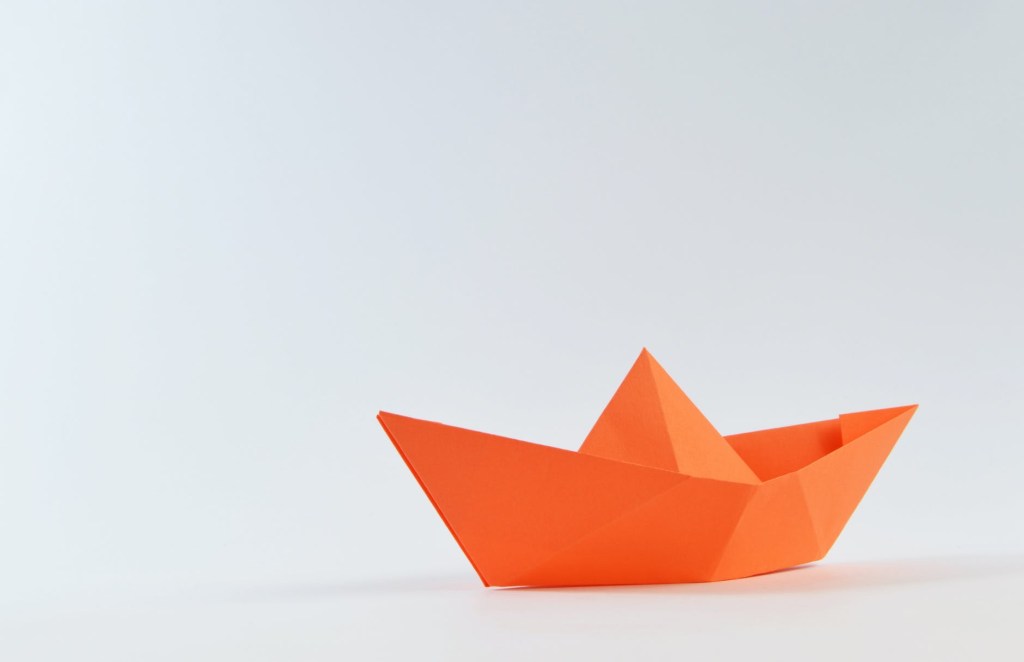
Often the moment before it is finalised a piece of carefully folded origami looks like a great deal of complicated and wasted effort. That last fold or unfold enables the work to flower into its final shape. As we struggle through this time and as the journey feels mechanical and forced it is important to remember that effort leads to a goal that can be right around the next bend. I am not yet sure that the effort that has been put into 2022 has mapped a path to that final shape, too much is still up in the air, too much is changing, and there is too much still to unfold.

I had hoped that 2022 as a year of flow would enable a much greater openness, connection and exploration. Thus far in 2022 it feels like conservation of effort for the challenges ahead will demand time folded up small to rest and recover. The open and exploratory unfolding will come later when the next phase of adventure is to come.

Whatever this year brings, I am ready for the leap.

I could see what it cost her
to make that leap. What heat it takes
for the body to blossom into speech.

Dorianne Laux, The Student
Combining folding and flow

The Cacophany

Photo by Marcin Dampc on Pexels.com

Our world has many voices. In the quest for comfort, some argue for simpler more consistent conversations. Only if we embrace the cacophany of conflict and strange uncomfortable conversations will we realise our human potential.

Anne Applebaum’s Twilight of Democracy explores a theme that authoritarian disposition is in part a desire for simplicity in a complex and connected world. Whether harking back to great days of the past or promising a new future, the promise of authoritarian and populist movements is to simplify, make things easy again.

Liberal democracies always demanded thing from citizens: participation, argument, effort and struggle. They always required some tolerance for cacophany and chaos, as well as some willingness to push back on cacophany and chaos.

Anne Applebaum

Our Organisational Cacophany

Last week, I saw two closely related stories. One was how Victoria Police were using Yammer to successfully identify criminals from photographs. Another was how Victoria Police were dealing with a backlash from disciplining an officer for comments on Yammer. If you invite contributions from everyone, you get everyone’s contributions, even those you would rather not have. Balancing engagement and tolerance as Applebaum notes above is the work.

Some will argue that this messy cacophany is the weakness of tools like Yammer. Messages should be clear, simple and agreed by those in power before they can be shared. However, removing the cacophany from official channels merely encourages it to spread in unofficial channels via text, Facebook, or Whatsapp. As disappointing and hurtful as public intolerance and conflict may be, intolerance is a lot more dangerous in the dark. The loss of engagement and understanding from purely controlled top down conversation leaves so much organisational knowledge and potential untapped.

From Cacophany to Shared Narrative

Applebaum’s book hints that shared narratives and shared principles have been ways to sustain democratic engagement when the systems of a state have not always lived up to the promise. People will stay engaged in the belief that they will become better together.

Modern organisations working in highly distributed ways in a faced paced economy have real challenges of adaptation and alignment if they do not learn how to manage the cacophany. Command, control and simplicity are not the answers. Instead people need to use community tools like Yammer to build the elements of engagement to a common end:

  • Alignment: Enabling people to understand in two-way conversations what an organisation wants to achieve and what is expected of them. People who don’t align to those goals then have the option to make their own choices as to where they contribute their efforts.
  • Shared Context: We struggle to collaborate when we don’t share context. It is easy for the Other to arise when we don’t share a context with those with different ideas or experiences to ours. Uniting an organisation in a shared context of information and discussion is a critical role of open community platforms.
  • Shared Values in Action: Values don’t live on posters and lanyards. An open community platform is a place where employees can see the organisation values in action or complain if they are being failed. That some of those complaints may reveal conflicts between values or misunderstandings of what the words mean is the point. Values are lived and acted out not discussed.
  • Shared Better Narrative: Incredibly diverse groups of people can come together to contribute their many different capabilities to a goal if they share in the story of that goal. Visions and Missions aren’t speeches they need to be evidenced by tangible actions that employees can understand each day. Sourcing and sharing those proof points through tools like Yammer is the work.

Simplicity of message is a tempting answer to a cacophany of voices in the modern world, but simple messages can be lost or miscontrued when so much is being said. There’s a much richer opportunity to engage everyone in expressing the potential together.

Vanity Projects

On change, beware a CEO looking to make their mark. That project will be likely undone by the next CEO. Look for change that is sustainable.

Si monumentum requiris circumspice

On Sir Christopher Wren’s tomb in St Paul’s Cathedral
St Paul’s Cathedral designed by Sir Christopher Wren

Every CEO wants to make a difference. Some want to make a big mark on their organisations during their tenure. That inevitably leads to consideration of some defining transformation, a culture change program, a new building, a technology change, a new product range, an acquisition or all of the above.

The Vanity Project

Nothing that is worth doing can be achieved in a lifetime; therefore we must be saved by hope.

Reinhold Niebuhr

CEO tenures are now short. Nobody has a lifetime at the top anymore. A competitive market for talent, the pressures of the role and changing business circumstances ensure that. As passionate as the CEO is about change doing something because one person wants or needs it to mark their tenure is an extraordinary act of egotism. Most people’s lives are not recorded in marble. That includes most CEOs.

When someone invites you to lead the change on a CEO’s vanity project it can be intoxicatingly attractive – status, profile, resources, a spot in history, and more. What is not advertised is the frustrations. There will be people who wait out the CEO. The people who missed the CEO role and the candidates for next CEO may well have other agendas. The success of the project will likely be driven by and shape the organisation’s opinion of the CEO.

This is dangerous territory. Remember, at some point, the CEO will tire of you asking for help to push the change through. Ego projects are meant to make the CEO feel good and you will be judged on that measure, whether explicitly or not.

Danger is fine. What frustrates most of all is seeing the work not achieve completion or be completely undone because a CEO’s enthusiasms mean that the change skipped through the need for wide buy-in. CEOs like to encourage these projects to go hard with their backing and breakthrough to make change. Sadly there is only so much you can break and still have a functional change. The more a project is identified with a CEO the more likely it ends with that CEO’s tenure.

My name is Ozymandias, King of Kings;

Look on my Works, ye Mighty, and despair!

Nothing beside remains. Round the decay

Of that colossal Wreck, boundless and bare

The lone and level sands stretch far away.

Percy Byssshe Shelley, Ozymandias

Sustainable Change

Great change projects are designed to be self-sustaining. They don’t need to be pushed by a CEO barking orders. They are designed with an eye to the medium term needs of the organisation. They engage people in a vision that is shared.

If you take on a vanity project, your challenge is to frustrate the vanity. You will need to work to make it sustainable by building the connection to organisational purpose, aligning with customers, managers and employees, seeking wider support and bottom up engagement, understanding the needs and eventually changing the project to suit the organisation’s needs and not a CEO’s ego.

Your challenge will be to deliver a change for a community and not a corner office. Change looks best in the hands of others, not in the pages of a memoir.

My heart must rally to my wit

And rout the specter of alarm

Theodore Roethke, Against Disaster

Cake Mix

As a kid I loved cake mix. You open the box and the little packets, you follow the instructions and you get a cake. Cake mix seemed like magic to me and those cakes tasted the best. I used to bake cakes when I should have been studying for exams. I’d make a special trip to the supermarket and bake a cake to eat as a study reward.

I didn’t come from a family that baked. I relied on cake mix magic because I didn’t know better. Only years later, when I took up baking as an adult, did I discover that my childhood cake mix was an illusion. Baking is far easier than you think. Cakes taste better when you mix each fresh ingredient in the right order rather than relying on a pre-mixed packet. Baking is precise, but not hard.

How many times do we fall for the cake mix option? The situation where a clever marketer makes the simple sound hard to sell a product at attractive margins. Pennies of inputs become dollars of profits because we believe the marketing and don’t do our own research and experimentation.

Whole industries of consulting, fitness, health, food, career advice, self-help, technology and more use the cake mix model over and over. Whenever someone is telling you to buy their solution because something is hard it is worth checking that it is not just slow, precise, complicated, or demands practice. Most cake mix solutions lead you to end up doing it yourself the ‘hard way’ in the end. There satisfaction to be had in the effort of getting there yourself.

Community Management As Facilitation

As organisations adjust to more flexible ways of working they are rediscovering the need to actively work on fostering a sense of community. Working from home can create new isolation and new silos without the connection that employees created in and around our workplaces. Tools exist to foster community but tools alone are not the answer. Organisations that want to develop the sense of community in their employees need to invest in community managers to facilitate interactions on the platforms that are available.

Photo by ThisIsEngineering on Pexels.com

A Group Is Not A Community

Before we go further, it is important to note that community is not a synonym for team or group or organisation. You can’t just anoint a gathering of humans a community. If you do so, you will still have a collection of humans. Communities need to share something – goals, resources, values, beliefs or a sense of belonging. That sharing is by necessity voluntary. You can’t make people share and people need the ability to opt out. The community needs the ability to ostracise too, whether to remove violators of rules or to set boundaries. You can’t make everyone a community and you needn’t try.

When you bring together groups of humans to bond in meetings, workshops and conferences, you will nominate a facilitator a productive connection and ensure the group works towards the goals of the session. When you bring together a group of employees on a technology platform like Yammer or another community platform, you can’t expect the platform to do the heavy lifting. Technology no more makes a community than pens, projectors, sticky notes, butcher’s paper and whiteboards make workshops.

Photo by Kelly L on Pexels.com

Facilitating the Human Bits

Facilitators play important roles in human interactions around our work because they play essential roles in helping humans to address the human questions of community:

  • Is this place for me and is it safe to be involved?
  • Who is here and what can I learn?
  • How can I help and how can others help me?
  • Where are we going together? What’s next?

We need community management to lead the work that enables humans to go beyond their fears and conservative habits:

  • Connect: Making the space, helping make sense of new work & making it safe
  • Share: Creating shared context. encouraging participation & sharing towards goals
  • Solve: Exploring options and fostering creative problem solving
  • Innovate: Pushing boundaries, taking the group further and translating discussion into action

Some groups are small enough to manage the process of managing this evolution themselves. Some groups have leaders who take on the role of facilitator naturally seeing the potential in the team and the technology and helping others to make sense of the opportunity to work together in a richer and more valuable way. Beyond these rare cases, the value of community, particularly in larger groups, needs to be facilitated by professionals dedicated to the task. We ask people to chair our meetings, why wouldn’t you expect a community of employees to be facilitated by community managers?

The context of our work is rapidly changing and we are expecting employees to do more in different ways every day. The human parts of the process around all this demanding change requires continuous sense-making, alignment, creativity and change. Investing in community management will help facilitate employees to find new and better value in their day-to-day work.

Boundary Questions

Yesterday for me was a day of announcements and negotiating the beginnings of a new transition. The day therefore became yet another day in my life of thinking closely about boundaries. This post is a meditation on some useful boundary questions to consider.

As humans, we love to put lines on our world and our lives. Some of those lines have meaning shared with others. Some are just our own imaginings. We need to separate out our views and those of others. We need to separate the experiences from the imagined or merely expected.

Boundaries tick off achievements, transitions, ambitions and no-go zones. Asking ourselves hard questions about these boundaries can help us ensure they are guiding, but not ruling us. These questions can also help our continued learning and progress.

Lines on the world

For those who like the answer upfront, here are my questions and I will explore the value of each in turn:

  • What is the boundary you will never cross?
  • What is the line that you want to cross but think you will never get there?
  • What do you carry with you wherever you go?
  • What were the last and the next boundaries?
  • What do you need to prosper the other side of that next line?

The Boundary You Never Cross

We all draw lines in the sand from time to time. Some are permanent. It is important to separate the ‘mostly won’t go there’ from the ‘truly won’t go there’ and understand the difference why.

The boundaries you will never cross is not a question of ability or background. Those things can change. The boundaries you will never cross are those that breach your values. Know what is unacceptable to you and don’t go there. Ever.

Desired but Feels Unattainable

as if the edge of
continent contented us with boundary.
Draw a line from A to B. Live there

Bin Ramke, Curve of Pursuit

You need to know this boundary well. Perhaps it is entering a new job, industry or career. Perhaps it is a state of happiness or a relationship. This is one you passionately desire, but feels out of reach.

Remember that passionate intensity and desire. Forget the unattainable bit. Things change. Keep pushing. Understanding why you want this crossing will help you achieve it. There’s always another path.

Carried with You

Borders are places we lose things. We have to set some things down and pick others up. This makes it more important than ever to know what we carry across that line and won’t let go.

These gifts, tools or burdens are our uniqueness. Choose carefully what you always carry. Is it really essential to you? Is it valuable to you and others? Is it even real? Some times in a new land we discover we have been carrying things that no longer exist.

Last and Next

Secretly, and with what feels like good reason,
we’re the pain the people we love
put the people they no longer love in.

Graham Foust, Star Turn

Placing yourself helps you see the paths. At some stages of our life and career, we slip over boundaries without noticing. Knowing the last line helps us see this better.

The next boundary is the one we are preparing to cross. The next boundary is the one we need to find and conquer. We must keep it in view.

The Other Side

Marshall Goldsmith famously wrote ‘What got you here won’t get you there’ about careers and leadership development. People are surprised to discover that their one key trick to success in life and work stops working when they cross a boundary. The rules are suddenly and inexplicably different.

Preparing to cross a boundary is one thing. The next challenge is preparing for success on the other side of the line where things work differently.

I track it, the old paths of a past life.
The martin’s pad foot prints the mud,
claws curled into slivers of an unspoken language.

Heather Derr-Smith, May we meet no line a boundary

HICAPS to Acquire LanternPay

Photo by Negative Space on Pexels.com

In exciting news, today NAB announced that it had reached agreement to acquire LanternPay. This transaction opens an exciting new phase in innovation in healthcare and disability claims and payments by bringing LanternPay together with HICAPS. Very proud to have been a part of the LanternPay journey of innovation to this point and excited about the opportunities ahead to benefit providers and schemes in the HICAPS business.

The AFR Story (paywall)

Adulting

Photo by Artem Podrez on Pexels.com

frightened, elated, sometimes trembling,
sure the weight of the word had come into my arms,
ready to learn what it was that I should do

Dick Allen, The Adult Section

Somebody should do something. Where are the people who will do something? Surely, there is a boss, a prime minister, a leader or a parent to solve this for us. They should have planned better. This shouldn’t be happening. Surely those responsible will step up. Can’t I just play? Can’t I skip the hard bits? Can I have an icecream now and do chores later? Why do others get to play?Why won’t someone step in take the responsibility from our hands and solve this.

I can almost guarantee that the readers of this blog are adults. Yet, we have all thought these thoughts. We have longed for a parent or parental figure to take away the troubles, to make us feel better and to help us find the happiness we lost. Our organisations love to create parent-child relationships that strip from us the difficulties of adult accountability and the conflicts of competing adult perspectives.

The hardest change to make as we evolve to new ways of working is to remove the parent-child relationships from our organisations, our work and our societies. To make our work truly human we need to stand on our own two feet, express our own views fearlessly and fill the adult shaped lacunae we ourselves have created.

Adulting is hard, relational work. Being an adult engaged with other adults demands new conversations, new acceptance of accountabilities, new drive and a clear sense of ourselves. Each of these things will make our work better, more rewarding and more productive for us and others. We need to start now. How can you take on the adult-size holes in the world around you?

 my hand trembled as I took it up
and moved slowly to lift it out of the window     into

the air     a kind of thinking     like everybody else
looking     for a continuing contravention of limits and
of substance

Robin Blaser, A Bird in the House